Assessing grocery store dependence

Once I learned I could grow vegetables, and they were so much better than the store, and then I had more sun and could have more beds, I became set to ease the grocery bill. The astronomical increase in food costs the last 5 years has accelerated that to an obsession. Unfortunately, with the processed foods we need costing 100% + more than they were a few years ago, our weekly grocery bill has not gone down. But, I was reviewing what has left the grocery list in the last few years, and it is impactful. Here is my assessment, and I would love to read about what other people have managed to cross off the list if you too are working to alleviate the dependence on the grocery store.

Never purchase anymore:

Tomatoes

Cucumbers

Peppers

Herbs

Summer squash

Peas

Winter squash

Eliminated from the spring to fall grocery list:

Dark leafy greens

Carrots

Beets

Strawberries

Purchase a little less:

Potatoes

Sweet potatoes (we consume a huge amount of these, and I would need a lot more land to meet our annual needs)

Watermelon

Things I can realistically eliminate in the next 1-2 years:

Lemons (use a lot)

Limes

We need a lot of rice, oats, nuts, seeds, beans, lentils, chocolate and processed flours (almond, cassava and a rice mixture) that I will never be able to change. We are vegan and thus heavy on those. Most of our fruit comes from the store, and organic produce in my area is very expensive. I was able to make a meaningful dent in the summer watermelon bills this year and last year. Having fruiting berries this year and last has made a difference. Avocados are a huge weekly cost that I’ll never be able to drop, along with avocado oil. I think that pretty much covers it. No, I haven’t recouped the cost of my vegetable gardens, but if you exclude my excavation project last fall to plant more fruit trees, I’m probably close. That excavation cost us the excavator, dumpster and a huge amount of soil, so I’m not paying for that in produce anytime soon.

What have you crossed off the list?
10 Likes

Try Sorghum. The plant has a lot of uses. Particularly White{low tanin} varieties. It’s grains can be eaten fresh and the stalks processed into juice or syrup too. Grains can be picked dry and popped. Ground into meal and flour. It has no gluten. We like it for flat breads with some leavening agents. It does well for cookies and crackers.

The juice can be frozen and used as a light sweetener and binding agent.{We lightly pasteurize it} Or of course syrup for concentrated sweetening. Some folks sprout it, dry it and get more flour/meal yield. This step also allows more usable protein.

7 Likes

I had surprisingly high yields onlentils and chickpeas tbh. Probably not enough to fully replace buying but im making it into tempeh after buying a book and some starter spores. They were both small plants and I planted 4 inches apart without issie. Chickpeas were less annoying to process than lentils

For me I have not needed to buy any fresh veggies in the summer. I will have to once my Brussels sprouts and frozen peas taper out… Maybe in January.

I should be done buying fruit besides citrus if I can get everything producing decent.

5 Likes

I’m very interested in sorghum and have been following what people say here. The issue for me is the height. There’s a field I bike past that had some under 4 feet, and I grabbed a few seeds. I just don’t know enough to know what type it is and what it might be good for.

@snarfing lentil tempeh sounds great! Let me know how it works out. It would be cool to grow lentils, but it would never be worth my time to process. That’s OK because along with beans and grains, these are relatively low cost items on our list not worth much of my garden real estate. That said, I’m trying a bunch of new beans next year, because I think they’re fun and can be added to every trellis without detracting from whats there.

3 Likes

A good short grade food grade sorghum variety is Korjaj. Under 6 foot is quite common. It also makes a nice tightly packed panicle that is easy to handle and process.

2 Likes

You might find discounts by going to wherever Mexicans shop. Walmart where I live purposely sells Mexican staples like limes, onions, roma tomatoes, and avocados for a lot less than other stores. Avocados are almost always under $1 each. $0.74 is I think what we did today.

It’s pretty common for us to be the only white people next to a lot of Mexicans filling bags of avocados.

4 Likes

I buy avocados from Aldi’s. Nice size and this summer they have been .79 each.

1 Like

I spend an absurd amount on fruit (just for me personally I eat over 14lbs of apples an average week, plus bananas, plus pineapples, plus watermelon) and more than anything it’s what I have been trying to grow in great abundance. I didn’t near to buy hardly any tomatoes or peppers this year (still working on getting a larger garden) but my major focus has been and continues to be max fruit yield. I am looking forward to my berries hitting full stride first and then my trees. Between the mulberries, raspberries, apples, pears, persimmons, pawpaws, cherries, plums, etc., I shouldn’t have to buy fruit at all after things start becoming bountiful. I’ll always have to buy things like oranges and things like that but I won’t mind it when I have a ton of stuff sitting here at all times in storage.

It is also a lot cheaper to be snacking on fruit than junk food for obvious reasons and for the savings of keeping a healthier diet.

4 Likes

Same here. I can often get decent guavas too for pretty cheap. We must be closer to the distributor because avocados are normally in the 60-80¢ range.

A few staple type veggies and fruits are also just so cheap it’s mind boggling. Carrots, cabbage, bananas, etc. even at retail places they’re reliability cheap.

A lot of veggies that are pricy in retail are surprisingly affordable at restaurant supply type outlets, maybe of which sell retail.

US Foods for example has their Chef Store locations. It’s where I buy a lot of our daily drivers. I get King Arthur’s highest grade of enriched, very high gluten flour there in a 40 lb bag for about $30. And things like carrots, peppers, spices, and meats are very reasonable. The storage conditions are better too so the quality is much higher on fresh produce.

https://www.chefstore.com/p/red-beets-25-lb_1998509/?srsltid=AYCX9vLm36cUgGI7kjuaKWUhKY0J5Fiic6MPapG43iTDmiKhFxFtljRx

25 lb bag of large, very nice looking beets for $20. It’s wild how high the markup is in nicer retail places.

I’m cautiously optimistic about my hazelnut and tiger nut experiments. I’ll have to report back once I actually dig the tiger nuts and actually get hazelnuts (probably next year) but so far it’s looking promising. Water chestnut I think I’ll try again next year in its own container because it didn’t compete well with the tiger nuts. I might also try American or Asian arrowroot, maybe.

I don’t know if you have space for a chestnut tree, if so that’s an option. There’s actually a dwarf native that’s blight resistant, I don’t know how productive it is but it does taste pretty good and it’s basically just a shrub, tiny nuts though. I’ve considered testing using it as a dwarfing rootstock.

I’ve seen people use vacuums to harvest otherwise difficult seeds, seems effective. Perilla produces a heavy crop of a tasty, oily seed that’s got very good omega-3 content, it does very well in the east coast climate. I grew it as a herb/green this year and was very impressed, I’ll probably try to grow it as a seed crop too next time.

2 Likes

Tree fruit takes us down too. I have a few years before I can impact that, and I’m not sure how successful I will be. Apples, stone and tropical fruit are a hefty portion of our weekly costs. I’m actually more hopeful I can impact the weekly winter citrus bill than the summer stone fruit one.

2 Likes

Do report back on your Tiger nuts. I bought some and some flour a while ago but haven’t gotten around to experimenting with it. I wish I had room for nut trees. High on my list if we manage to find a place with 1-2 acres to move to.

Perilla sounds fascinating. Which variety are you growing?

do you use arrowroot for baking? I use it in some recipes. But, not enough to make it worth the effort for me to grow and process.

1 Like

Berries are the most rewarding to grow ourselves in terms of work and cost. Very little work to grow most berries here and they are so expensive at the store. I have expanded our blackberry trellises and added more blueberries.

8 Likes

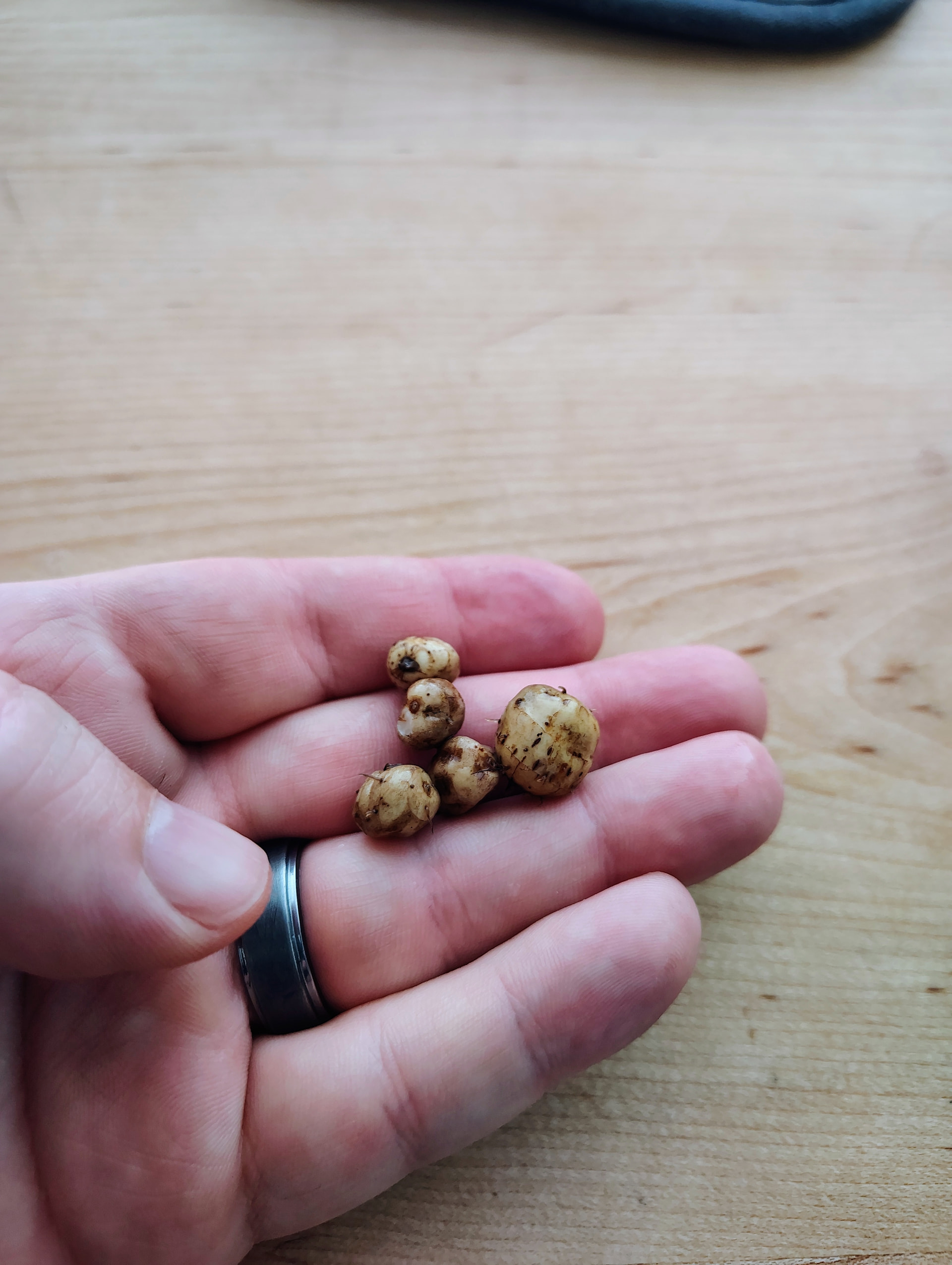
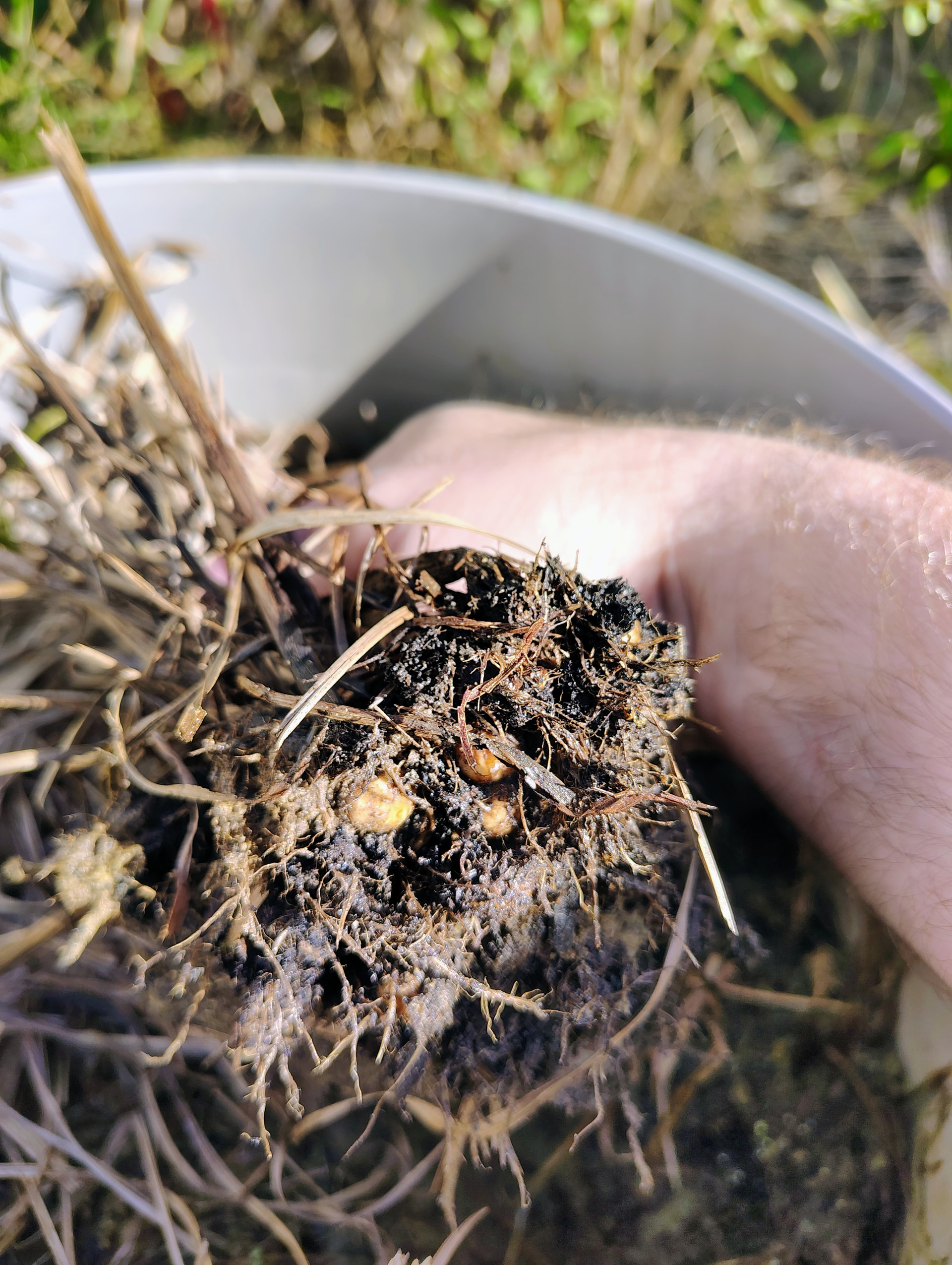
Decided to go pull up a few and check now that it’s a bit colder and they should be ready if not entirely sweet yet.


I grew then in a container to hold more water. Plant and forget basically and no weeds since it was very marshy in there.


Washing then was a pain. I think this would be best done in bulk using pea gravel or something as an abrasive then drying and floating to separate.


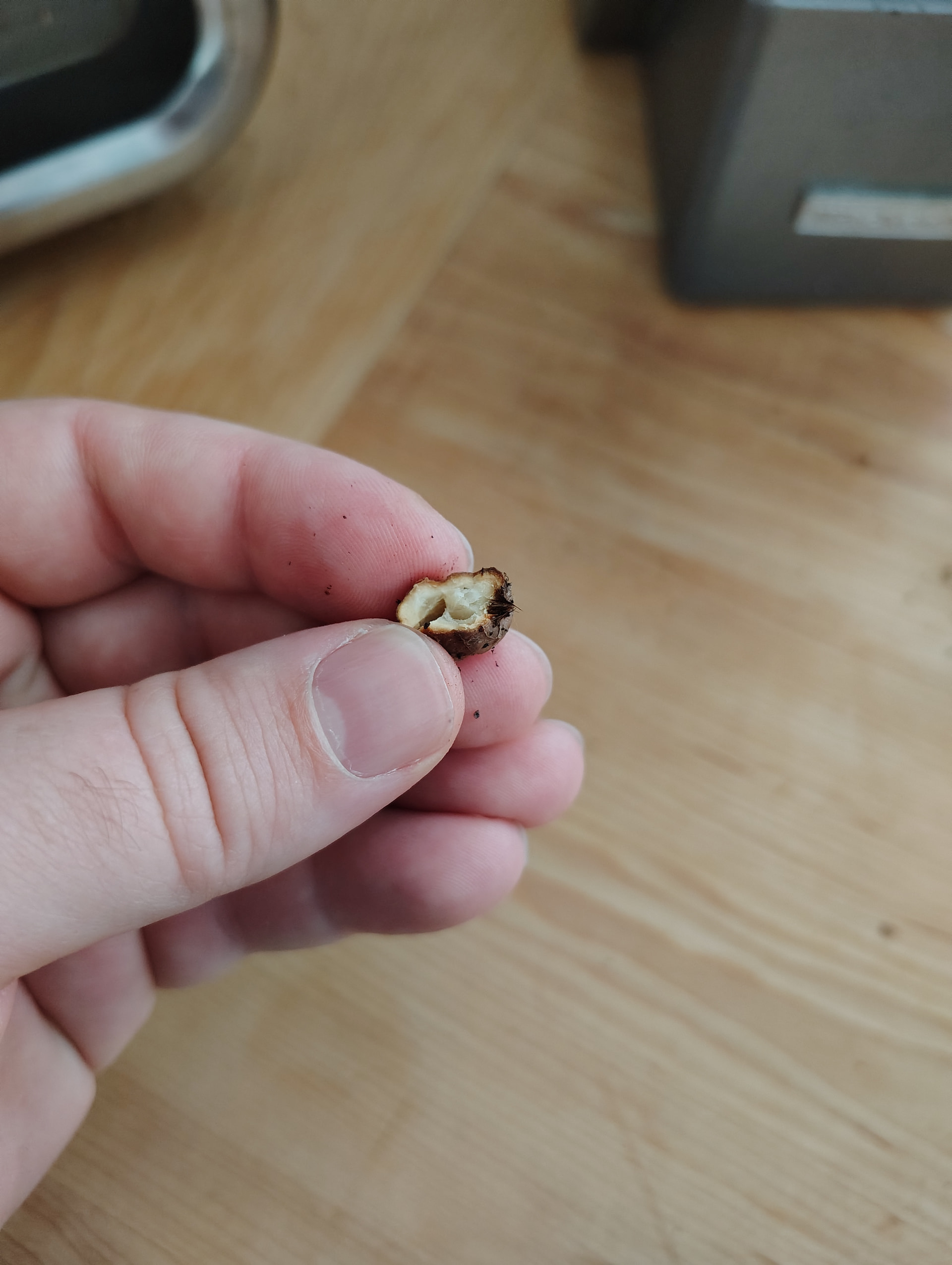
Raw there’s super crunchy and a bit fiberous. The flavor is nice, a little like mild peanut with some faint creamed corn and coconut things going on.

Partly roasted the corn flavor got stronger and the peanut flavor was more toasty like in stir fried peanut recipes. The texture want as good.


Roasted all the way it got nice and crunchy. The flavor was quite nice, toasted almond, popcorn, and some peanut stuff going on.

Overall the flavor is still mostly mild and the sweetness isn’t that strong, but it’s a little sweet, at least at this time of year. I’m quite happy with it, if I can clean them efficiently I’ll do a few containers next year.

6 Likes

The fruit trees have made the biggest dent for us honestly, once they’re producing you just stop buying that fruit entirely for a few months. Tomatoes and greens are satisfying to grow but you’re still buying them out of season.

3 Likes

So, it would be silly of me to list everything I’m growing in my yarden, and that doesn’t count my project area.

I refuse many grocery store produce options simply because of quality. I’d rather have no tomatoes than store tomatoes. They are just total shit.

Same thing with lots of fruit. I only buy a little at a time, and mostly just to grow seedlings.

However, I’ve only been in my current home since 2020 and, due first to work and then to a near-death health situation, I didn’t get rolling in any significant way until 2022.

I’ve currently got hundreds of edibles planted, and I’m adding around 80 more next year. My first trees are fruiting, a bunch more will next year, and in 5 years I’ll have tree fruit coming out my…ears.

My earliest bushes, brambles, and shrubs are producing nicely, and I’ve planted more every year. Again, within two more years I won’t be able to fresh-eat all my berries, not even with the four other berry hounds in my home.

I’m in Utah, and descended from pioneers, so it’s already in my blood, but this is why I’ve been focusing on improving my preservation skills over the last couple of years. I’ve been into fermentation for many years, but I got a nice dehydrator two years ago, I’m preparing to start canning again (back in the day with Grandma) next year, and freezing is always an option.

I also really enjoy sharing with my neighbors and church members.

In my last home, I provided all produce during the warm months.

It will take me 2-3 more years to replicate the same here (I’m installing raised beds next year to supplement my radical plant annual veggies everywhere approach and my profuse annual veggies in pots practice I’ve been using since I moved here, and now the pots will move to experimental/supplemental produce) as escalate the landrace/locally adapted projects for my main annual crops.

My goal is to replace 100% of my non-grain plant nutrition in 5 years. I don’t eat wheat, because I’m allergic to it (but not gluten, interestingly enough), but my family likes bread and pasta, and I like rice and quinoa. Potatoes are iffy, but we only eat around 2-3 lbs most weeks, so I think I can replace most of that.

1 Like

Sweet potatoes might not take as much land as you think, when well grown. They only require 8 inches inbetween slips, and a strong healthy plant can produce 3-4+ lbs of tubers. Plus you can harvest small amounts of the leaves for greens. A 20ft row can produce 90+ pounds in a good year, 30-40 lbs with low yields. It’s the most productive food crop I grow for calories, nutrition and weight of the yield, and they keep until the middle of the next summer. It’s hard to beat sweet potatoes for productivity and food value, plus shelf storage life. The white ones can easily be made savory and are a healthier and more nutritious alternative to regular potatoes. If I could only grow two veggie crops it’d be sweet potatoes and kale.

7 Likes

I’ve selected some long-lived perennial kale that has succulent leaves that stay tasty even through summer and get positively delicious after frost.

I’m now staking them, because they appear to be interested in assuming a tree form.

They also flower annually or biennially (depending on the specimen). My oldest specimens will be five years old next spring.

2 Likes

Reading this thread is really interesting!!!

My garden hasn’t helped my budget and I haven’t replaced anything I used to buy. It did add things to my diet that I’d completely stopped buying at the store. When I moved here, there were lots of things I stopped eating. They either weren’t available or the quality of what I could get was so poor (stone fruit, tomatoes) it wasn’t worth it. Grocery store berries where I am are terrible, half rotting usually and very expensive.

So the things that have returned to my diet: fresh tomatoes (from Late July till last week), berries, fancy baby lettuce and fresh herbs. Stone fruit- when I’m not frozen out.

I do have a huge number of farm stands and the local co-op, but what you can get is very very seasonal. So I guess there are some things I could get, but having my own means I can get them more than just the 2-3 weeks a year they’re at the farm stand.

Having my own strawberry plants meant that after June-bearing season was over, I still got strawberries this year. I’m hoping to have a longer asparagus season in the future. I’ve planted peaches that are supposed to ripen at all different times - hopefully some will come into bearing next year.

I am envious of those of you with grocery stores nearby that stock things like avocados more than just seasonally. I know it’s probably better for the environment that my local stores don’t have tropical fruit and don’t have most vegetables or fresh fruit out of season but sometimes it’d be nice.

Our tropical fruit is very limited (bananas- which we get year round). We usually have at least one or two types of orange or grapefruit and limes or lemons. Apples are year-round and pears are almost year round. You can get leafy green type things, carrots, celery, bell peppers and tomato year round, but everything else is seasonal.

The most expensive store in the area (Martin’s) does have a better selection but it’s still pretty limited. I had the most disappointing experience there this summer, paying a lot for a some “sweetest batch” berries I wanted to try that ended up being over half inedible. I’m not that far from major cities and I know people who drive an hour to Charlottesville weekly to grocery shop. That is just not going to be a priority for me.

I know where every ethnic market is nearby and while some have a few things occasionally, like papaya - they also have trouble getting those things regularly.

I think here’s the difference between us and the city dwellers! If I had limited space, I probably wouldn’t focus on any sort of potato because they’re so inexpensive at the store. Though they’re fun to grow.

I want to hear about the peas!!! I’d like to grow fresh peas…That’s something I’d like to have again.

@a_Vivaldi I’m definitely interested in growing some nuts. I’ve looked into pecans (which are marginal for me) and some thinner shelled walnuts- but I need to clear a bit of space and it hasn’t happened. I’d be interested in trying other nuts though!

5 Likes

We have great luck with runner beans. Plant; get started on the trellis. And beans come. Picked young for green beans or late as dry beans. Huge pollinator attraction.

3 Likes

I only grow sugar peas. Super easy, or at least it was until this year when the @$?:&27! Invasive house sparrows found them and relentlessly devoured a few hundred plants.

4 Likes