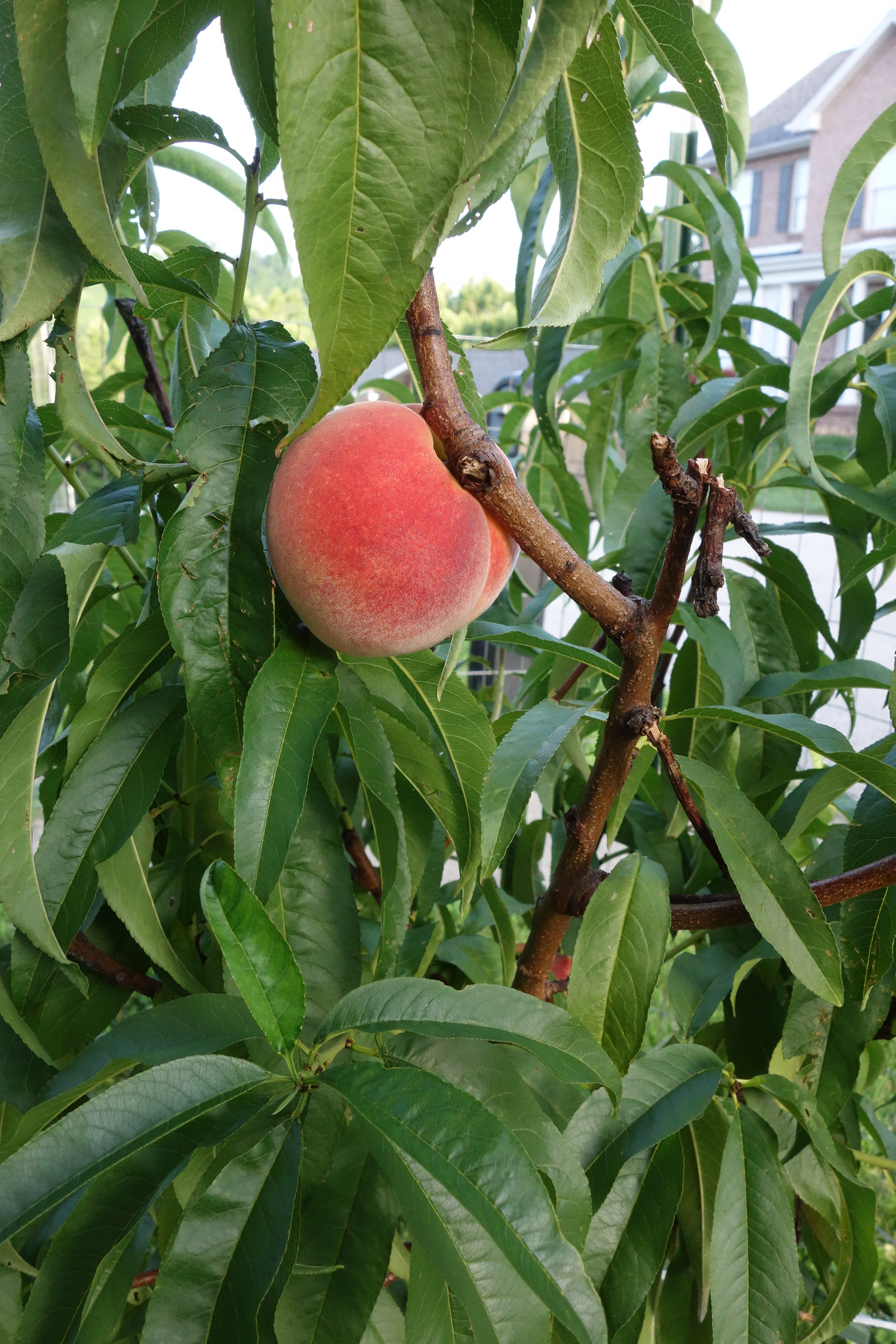
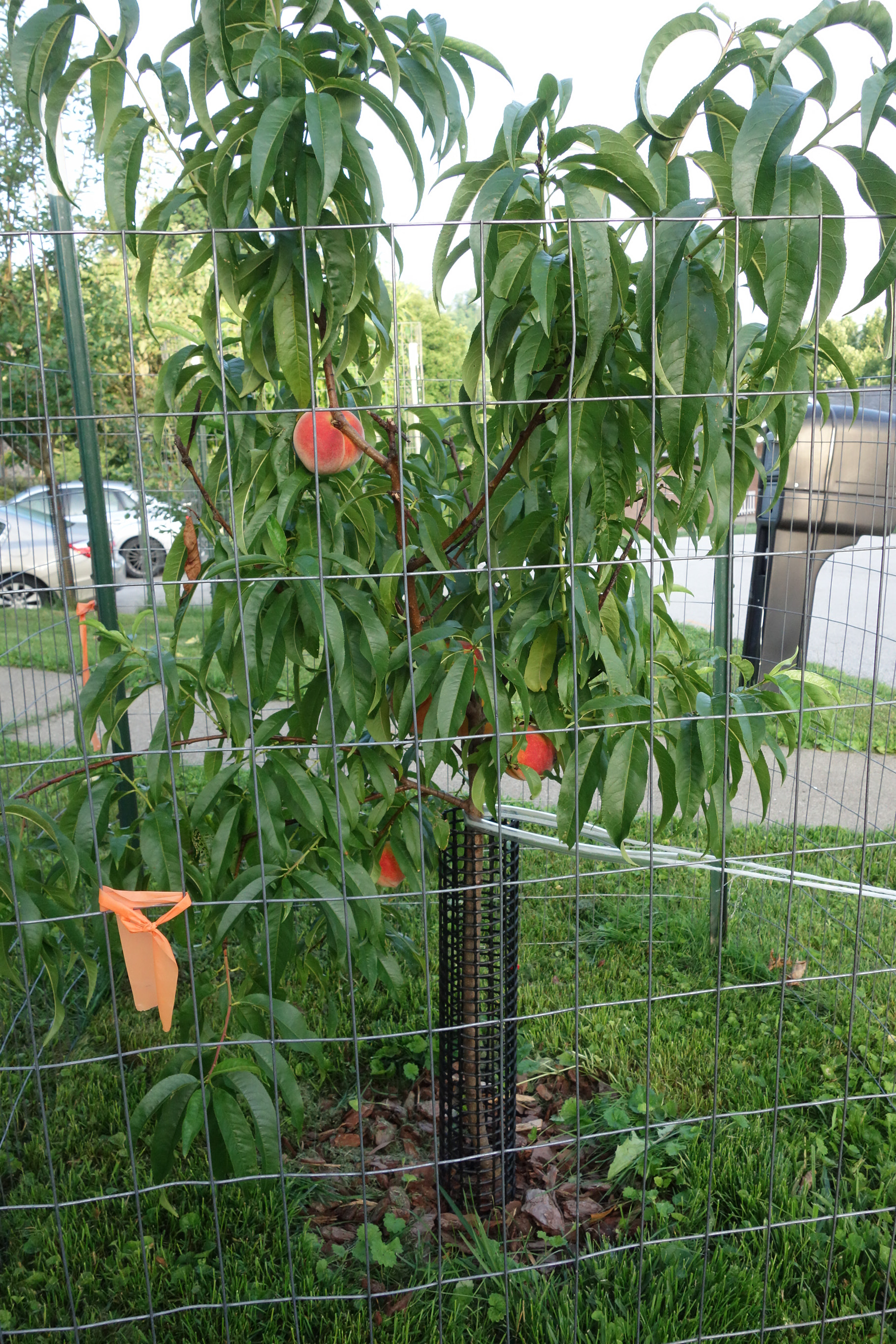
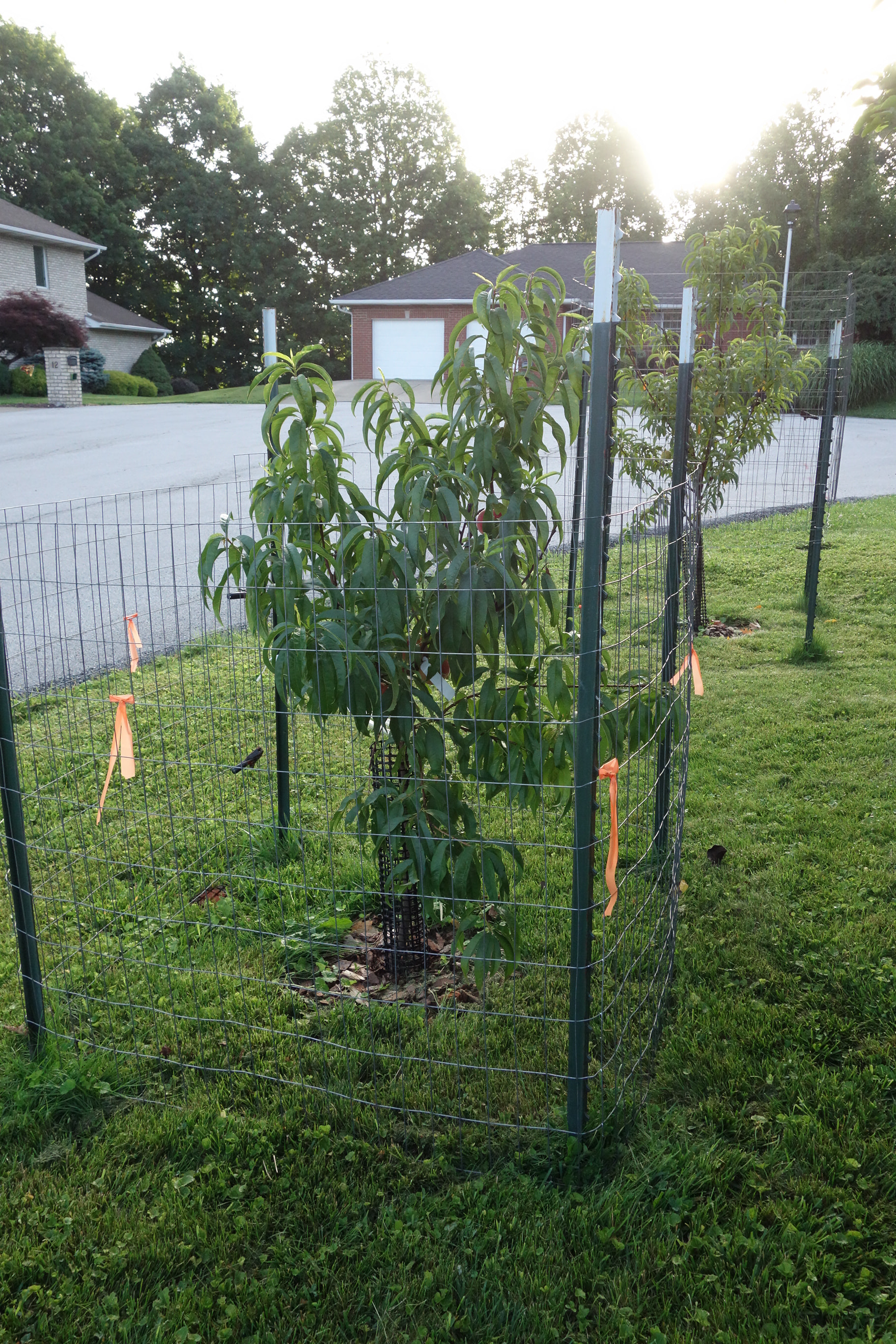
A Red Haven raised in the Carolinas. I planted it in April. I routinely get fruit from my trees I plant immediately. That is if I buy developed trees. This tree would have had more fruit on it, but I lost some transporting in my car when I bought it. You can see some of the tree damage from car transport in the first photo. (I can only afford an unavailable $7,000 Kei truck and not a $30,000 USA truck.)
Some twig planters say to strip all the fruit off the tree to let it develop. In the Rustbelt I will never see peaches like this again, so I don’t strip a thing.
With a no spray program, the peaches I get are more along the lines of this…
You shouldn’t do that. They need to put their energy into establishing. I’d also note that’s not a particularly big tree; that’s a pretty standard 1-2 year transplant for apples or peaches, in desperate need of a thorough structural pruning. Slower growing trees, like persimmons and pawpaws, should be much smaller ideally.
Any larger than that, you’re choosing instant gratification at the expense of long-term success. Most young grafted seedlings will overtake and outgrow a larger tree that’s been disturbed and transplanted. The break even point is usually only a couple of years, and after that the larger tree will be left in the dust.
i think it doesn’t matter too much- if you want a taste right away get an bigger tree to start, if you want to shape it more get a smaller one.
unless you are going for the biggest possible tree in 20 years, they’ll both be caught up and similar a few years after they’re planted anyway. the little ones catch up. letting it have fruit when it’s small, it just reduces vigor, right? so if you want to have a smaller tree all along it won’t matter in the long run
That’s great that you can do that, congratulations! However, as someone who moved from eastern Virginia, zone 7, one hour from the coast where peanuts are grown, to Missouri Ozarks, zone 6, where rocks are grown, I can tell you that your experience isn’t accurate for everyone. For me, trees and shrubs survive and thrive far better if I get them in 1 gallon pots; I could never afford a mature tree (they’re $100+ on sale!), and it would take a LOT of work to get larger into the ground (I often need the help of a pickaxe to get 1g into the ground).
I try not to trim my plants their first year because when I do, they often get badly damaged in winter/early spring. I don’t know why this is the case, but it’s been true for me. Letting them fruit that first year, no matter how mature I buy them, would be a death sentence because they need that time and energy to establish enough to survive our crazy winters (and early springs with freeze/thaw cycles).
I’m really glad for you that you have the right money, soil, and climate to be able to get fruits the first year. I really mean it when I say congratulations! But please be cautious when suggesting this method to others.
Make sure you mix in lots of charcoal and lots of manure, I’d say 10% each provided the manure is well aged, and sometimes I put a lot more to fertilize, like roadkill at the bottom of the hole on one side with a thick layer of charcoal so that the trees roots can go the other way if it’s too rich.
I like to shape my trees so I prefer the smallest tree possible. Although the ones you have are fine too, still very young.
Also I find not always but sometime it takes a few years for the roots to establish once established the fruit is amazing. Not true with all trees. Some are great from the start. I don’t concentrate on fruit till the third year. As I’m looking for best tasting fruit possible. I find most trees need about three years to produce top rate fruit.
Try to get best possible rootstock for your area. Every little bit helps. Trees are a lot of fun to grow. I love it!
I tend to go small and shape them myself, but I completely get the appeal of planting something that fruits the same year. With my apples I started from maidens and it took three years before I saw anything, which felt like forever at the time. The trade-off is they established really well and I got exactly the structure I wanted. Honestly if I had the space I’d probably do both, a bigger tree for something to eat now and smaller ones for the long game.
Of course on some fruit types; there is far better tree size selection available grafting twigs. I do admire more nurseries offering exact rootstock custom grafts selection. Just not a very generic non-descriptive definition of “Semi-Dwarf”. Which spans a silly range of 30 to 85% of seedling size. Not very helpfulf.
Large potted trees can mean girdled roots. There may be short term gratification, but long term headaches. Peaches grow and fruit pretty quickly/young too.
That reminds me of an old saying. If you move a three year old tree it will take three years to recover if you move a one year old tree it takes one year. This is a very old rule. Might answer the question why do many prefer young trees.
Not trying to start an argument, but I have moved a dwarf pear tree that is going on 20 years old twice in the last 5 years. It was moved for the second time 2 years ago to its final location, and it is fruiting again already. I had to do a lot of butchering of its root system on the second move and yet the tree recovered quite quickly.
But bare root trees are much better! I bought bare root B grade trees on sale from @39thparallel one of them was a Wolf River on very large Budagovsky 9 rootstock, and it tried to make 3 apples the year that I planted it, I picked two of them off and an animal got the third unfortunately.
It’s not my thought, just what is taught. Not my opinion just stating some schools of thought. I don’t have enough experience. I only moved maybe six big trees. All lived. I have another I want to do next year.
I have actually moved a lot of trees over the last 6 years, as I have changed my planting locations for various reasons on my old family property several times. I can’t recall any of my re-transplants dying. They usually bounce back very quickly, (if transplanted at the right time of year). For me that is usually Jan - Feb, as our winter is usually very mild here. Last winter we barely saw any freezing, so basically you can plant any time from Oct - April with little risk of shocking the tree.