Is your goal heavy fruit yield in your bartlett peear
orchard ?
In my area the juice isnt worth the squeeze. I want standard pears
Here is a great argument against standards
"


- March 15th 2016 Issue
- Story by Bas van den Ende
110+ bins of Bartlet pears per acre
Results from Bartlett pears grown on Tatura trellis in Australia
[fusion_builder_container hundred_percent=”yes” overflow=”visible”][fusion_builder_row][fusion_builder_column type=”1_1″ background_position=”left top” background_color=”” border_size=”” border_color=”” border_style=”solid” spacing=”yes” background_image=”” background_repeat=”no-repeat” padding=”” margin_top=”0px” margin_bottom=”0px” class=”” id=”” animation_type=”” animation_speed=”0.3″ animation_direction=”left” hide_on_mobile=”no” center_content=”no” min_height=”none”]
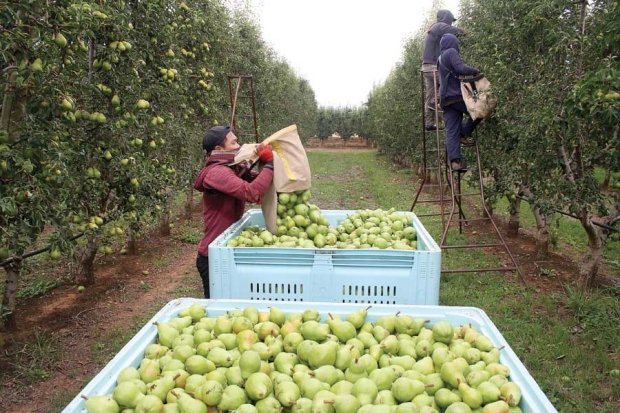
Experiments with Bartlett pear trees on Tatura Trellis began in 1975 at the Research Institute, Tatura, in the Goulburn Valley. The Bartlett trees are now producing commercial yields near Ardmona that we believe are at the biological limit of pear production. Yields of 114 to 123 tonnes per hectare/bins per acre is two to three times the average yield of commercial orchards with Bartlett trees in the Goulburn Valley, Australia. (Courtesy Bas van den Ende)
New results are in on an experiment in a commercial orchard near Ardmona, Australia, to test the biological limits of pear production by sustaining exceptionally high yields of good quality, canning-size pears (larger than 65 mm or 2.5 inches).
In an earlier Good Fruit Grower article (“Manage pears for higher yields,” September 2015), we reported how Bartlett trees on Tatura trellis produced 123 tonnes per hectare/bins per acre canning-grade pears in 2014-15 by changing tree management rather than the rootstock.
The following season (2015-2016), the trees produced 114 tonnes per hectare/bins per acre.
[/fusion_builder_column][fusion_builder_column type=”1_1″ background_position=”left top” background_color=”” border_size=”” border_color=”” border_style=”solid” spacing=”yes” background_image=”” background_repeat=”no-repeat” padding=”” margin_top=”0px” margin_bottom=”0px” class=”” id=”” animation_type=”” animation_speed=”0.3″ animation_direction=”left” hide_on_mobile=”no” center_content=”no” min_height=”none”]
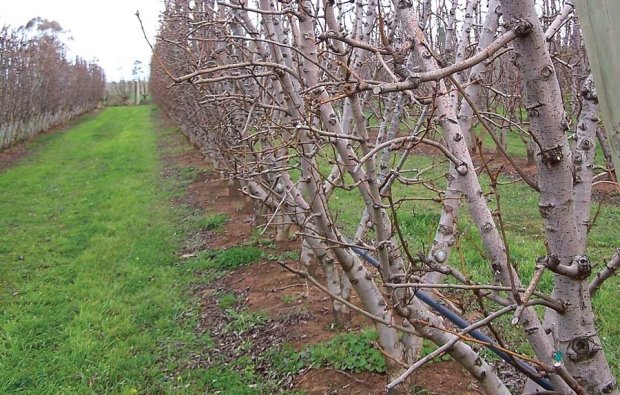
The canopies in the highly productive trees at Ardmona consist of horizontal fruiting units, which contain spurs and short laterals with terminal floral buds. Each tree has four leaders, two on each opposite side. There are no branches, only fruiting units that were created over three years. (Courtesy Bas van den Ende)
Tree management included winter pruning to develop short, horizontal fruiting wood containing spurs and short laterals with terminal fruit buds.
Trees were sprayed twice with the growth regulator paclobutrazol (PP333) in early spring to control tree vigor and improve fruit set and fruit growth.
Other management practices were repeated from the previous season.
Two foliar sprays of paclobutrazol reversed the effects of flower inhibition and increased the proportion of floral buds that set three or more fruit per bud.
Part of the flower promoting phenomena by this compound is attributed to alterations in vegetative shoot growth rates and improved light relations within the canopy, resulting in more competitive sinks for assimilates and nutrients. •
[/fusion_builder_column][fusion_builder_column type=”1_1″ background_position=”left top” background_color=”” border_size=”” border_color=”” border_style=”solid” spacing=”yes” background_image=”” background_repeat=”no-repeat” padding=”” margin_top=”0px” margin_bottom=”0px” class=”” id=”” animation_type=”” animation_speed=”0.3″ animation_direction=”left” hide_on_mobile=”no” center_content=”no” min_height=”none”]
[image]
The pattern of shade in the rows shows that the canopy is open, permitting good distribution of sunlight from top to bottom within the canopy. Maximizing the surface area of the effective thin canopy in the Tatura Trellis has significantly contributed to the high yields. (Courtesy Bas van den Ende)
– by Bas Van den Ende and Mick Conti. Van den Ende is a tree fruit consultant in Australia’s Goulburn Valley and Conti is an orchardist in Ardmona.[/fusion_builder_column][/fusion_builder_row][/fusion_builder_container]
Pears, Varieties, Research, Bas van den Ende
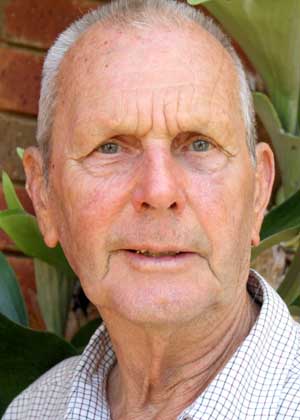
Bas van den Ende
Bas van den Ende was a research scientist with the Victorian Department of Agriculture, Australia, for 30 years, specializing in the management and production of fruit trees. He was responsible for the development and commercialization of the Tatura Trellis. In 1989 he moved to the USA where he worked as a technical consultant. He returned to Australia in 1995 to become a consultant.