I planted a Baby Shipova and a Dwarf Shipova ( Shipova grafted on Aronia to dwarf) from One Green World 2 or 3 years ago. I just realized that Baby Shipova is probably the same as the Bollwiller/Pollwiller pear, can anyone confirm? Latin names are pretty useless on these intergeneric hybrids.
1 Like
Not sure if anyone else is interested in this, but I came across this nifty slideshow from ARS: http://www.ars-grin.gov/cor/presentations/Intergeneric%20Pomes%20HTML/IntergenericPomes_frame.html
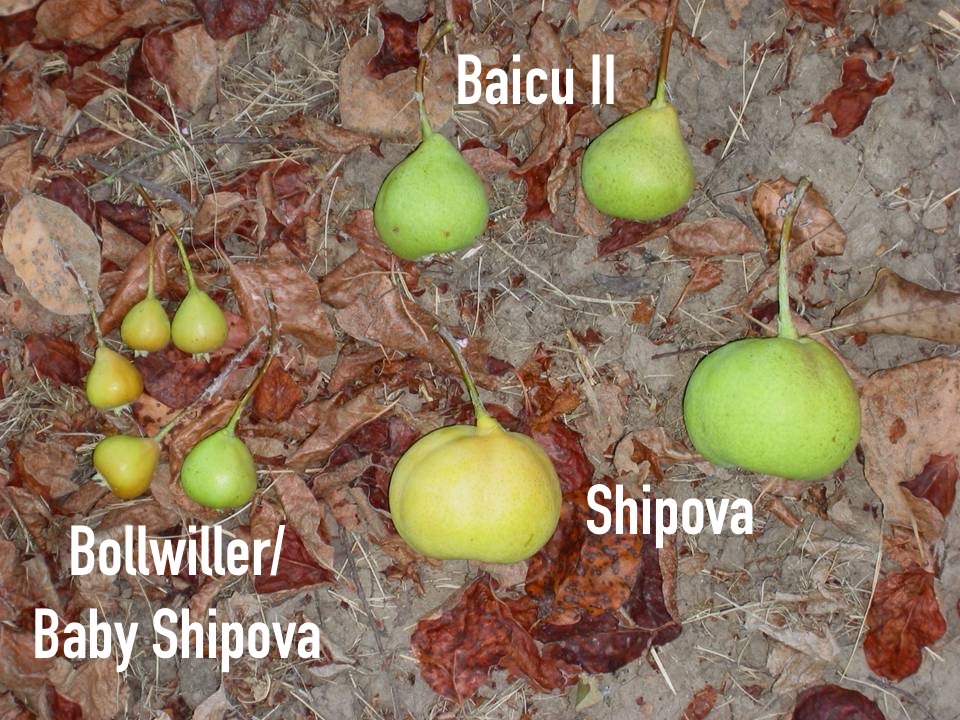
I may contact the slideshow author for some more info, but I think the Baby Shipova is the same as Sorbopyrus auricularis and would be the same as the Pollwiller pear of history. The regular Shipova is a triploid seedling of Sorbopyrus auricularis is known as Sorbopyrus auricularis var. bulbiformis.
5 Likes
Thanks for posting the slideshow. I learned a lot!
3 Likes
And to beat a dead horse, England’s lists Shipova and Pollwiller Pear seperately. Description of Pollwiller pear is similar to that of Baby Shipova.
2 Likes
@ampersand: I remembered an article that I read some time ago (unfortunately it’s not in English).
It’s from 1887 and in shortcut this is what it says: Shipova is a chance seedling discovered by botanist
Gaspard Bauhin in Alsace region of France close to Bollville (German Bollveiler) city (maybe today’s Belleville?). It was named by him Pyrus Bollvylleriana. Linne (Carl Linnaeus) changed the name to Pyrus Pollveria.
So Bolviller/Pollwiller pear=Shipova
Sorbopyrus auricularis var. bulbiformis is a chance seedling of Shipova. It was one of 8 seedlings and it was the only one that was kept because it showed similarity with the mother plant (1858). In 1877 it fruited for the first time. The fruits were 8-10 times bigger and not mushy when ripe (as Shipova). The shape was more rounded, like an apple or even onion like - hence the name “bulbiformis”.
These days it’s called Tatar’s pear".
The original article has lot more info since it was written by the breeder of Tatar’s pear so if you are interested let me know.
4 Likes
Interesting, thanks! I actually removed my baby Shipova since it wasn’t growing. I think the graft union wasn’t good (on Mt Ash).
Wow… that is a super-interesting slideshow.
The Malus “Red Delicious” x Pyrus is interesting! It is PI 589292 from Geneva. I wonder how compatible it is with apple rootstock and pear scions?
2 Likes
Anyone know if Shipova or baby Shipova flavor is ok ? Many posts suggest they don’t taste very good.
Lee Reich’s books speak highly of Shipova, which is why I got it. But yes, reviews here aren’t too favorable.
4 Likes
Hopefully the Red Delicious flavor doesn’t come through the interstem! 
I’m reviving this topic, because I’m curious if anyone here has gotten fruit from their so called “Baby Shipova.” To date I’ve only read descriptions, but never heard of anyone who has tried it first hand.
I actually bought one years ago and it grew very well the first two years I had it (It was beautiful too), but as I wanted it to be own root I ended up planting it deep to bury the graft. It didn’t like that and promptly died. Now, I’m wondering if I should try growing it again, but would like to know if anyone can actually vouch for the fruit quality.
1 Like
No one here has ever actually had the chance to taste the so called “Baby Shipova” yet right? It’s strange for something to have been commercially available so long, but yet so hard to find any first hand references as to eating qualities.
2 Likes
I’m also curious. Shipova and Baby Shipova are interesting due to their hybrid nature but with Shipova taking so long to fruit and not being super disease resistant, it doesn’t seem worth growing (for me given my limited space). The Wisconsin based Carandale farm notes weren’t that encouraging concerning disease resistance ( Shipova (Bollwiller Pear) – Uncommon Fruit. Baby Shipova, based on what I found online, seems to fruit faster than Shipova which would be a big advantage. I’m not sure about the disease resistance which makes me hesitant. The fruit also is likely pretty small based on pictures that I found on facebook. I found the following description on facebook: “The flavor is like a pear with a hint of quince and cinnamon. The texture is really interesting, a little bit pasty meets Asian pear. The flavor is really nice, but everyone who tried them though it would be a lot of work to do much with them given their small size. You can nibble them like a mini pear (the inside structure is like a tiny pear), but I wonder if you could cook them down for a pear sauce, straining or milling the skins and cores out.” This was in a post by “The Shark Garden”.
3 Likes
I can’t name a person I’m in regular communication with who’s tried Baby Shipova, I guess I tend to assume that follow-ons aren’t as good or better eating than the original unless they are touted as such.
From memory I think the advantage of Baby Shipova may be precocity and reduced vigor. Not flavor, aroma or texture.
I’d be curious to try the fruit if available, but Shipova, while tasting nice for the small window of optimal ripeness, doesn’t seem like a top candidate for scaling up in my orchard. The 10 - 100 fruit I’m likely to get in a season is probably about right for me.
5 Likes
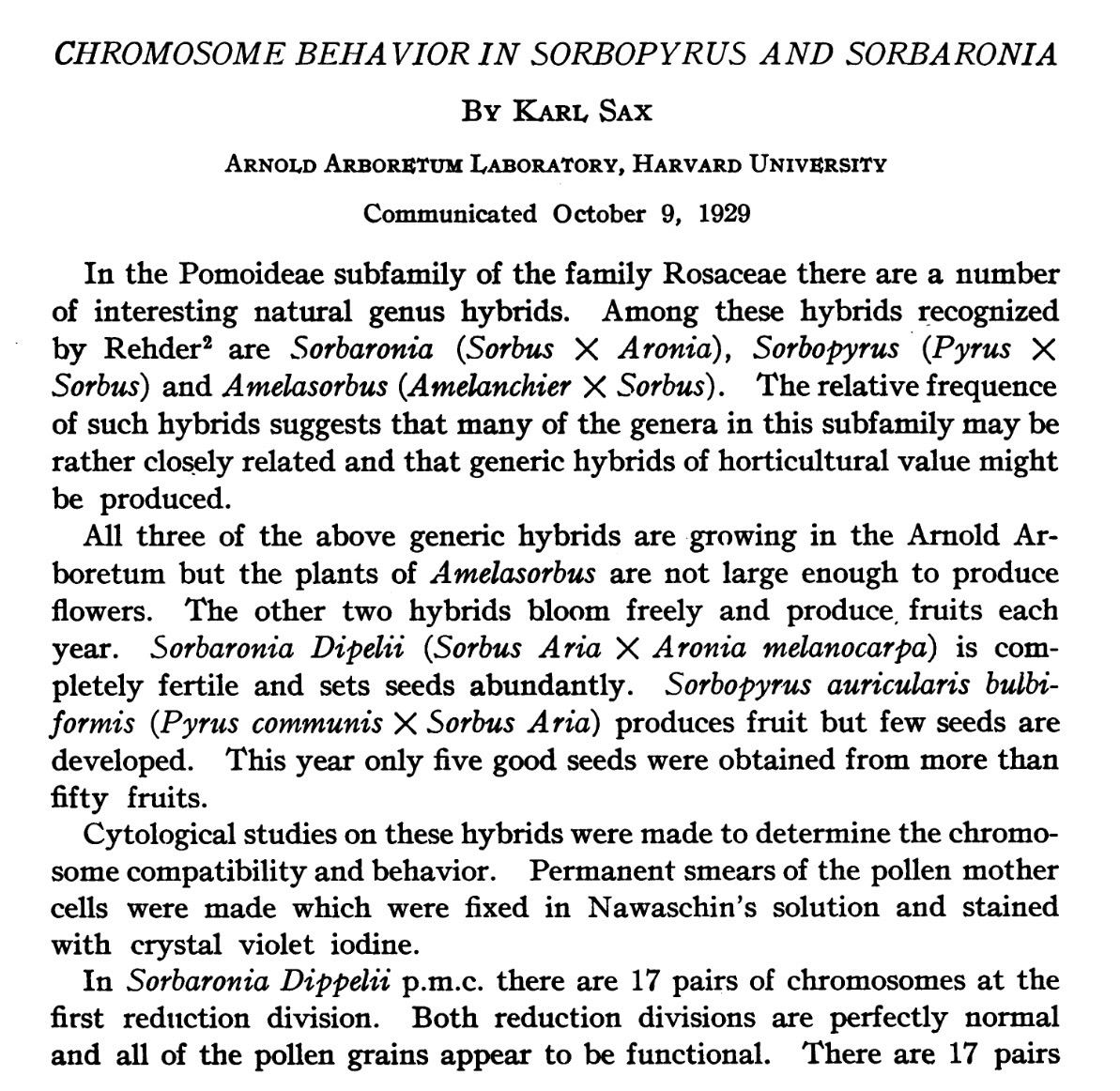
I emailed One Green World some time ago, and they confirmed that ‘Baby Shipova’ is the same as the Bollwiller/Pollwiller pear (Sorbopyrus auricularis ). It seems odd to name the parent of ‘Shipova’ as ‘Baby Shipova’; ‘Mama Shipova’ would feel more appropriate. Dr. Sax reportedly found five fertile seeds from 50 fruits, suggesting that the odds of breeding a superior ‘Shipova’ are fairly promising. Attempting a cross with Aronia (×Sorbopyaronia ?) might also be feasible.

PDF:

Not my picture- the link to the presentation where I found this is dead.
5 Likes
After looking back over it, it appears the seeds Dr. Sax found were from ‘Shipova.’ I’d imagine ‘Baby Shipova’ would have much higher fertility.
1 Like
How about we modify it to include both:
‘Baby Mama Shipova’
I actually got to try fruit from an Aria tree years ago. I thought it was pretty decent so I imagine the ‘Baby Shipova’ could still be pretty worthwhile even though iis fruit looks more similar to Aria than Pyrus.
3 Likes
lol, love the name. It’s odd that anyone would have changed it in the first place. An intergeneric hybrid pear cultivated continuously for over 400 years sounds like much better marketing than saying it’s related to another fruit that isn’t widely grown.
I’ve been curious how Aria tasted, so I’m glad it wasn’t bad. Rowans and whitebeams seem to have wide cross-compatibility. The other diploids in the group—Torminalis and Domestica—don’t seem to be as promiscuous.
1 Like
One Green World seems to like renaming plants. I believe it’s a way to temporarily control the market by appearing to be the only nursery selling certain named varieties. I wish they wouldn’t do that.
5 Likes
It’s been quite a few years, but I recall it was a mild, but balanced flavor. Not overly sweet, sour or astringent.
3 Likes