for those of you who don’t know the founder of this new fig forum, he’s a guy in australia (adelaide) who is a serious fig scholar and photographer. for a while now he’s been sharing his research and photos in his facebook group but the lack of categories has been a serious challenge. no surprise that his new forum has quite a few categories, but its easy enough to see all the new posts which is the link that i bookmarked.
it’s incredibly wonderful that there’s a category specifically for fig breeding! after years of advocating for this category to be created in other fig forums without luck, i started the ‘fig and ficus hybridization’ public facebook group. however, a forum category has always been my first choice. there’s no substitute for the way forums allow you to place images within your text…
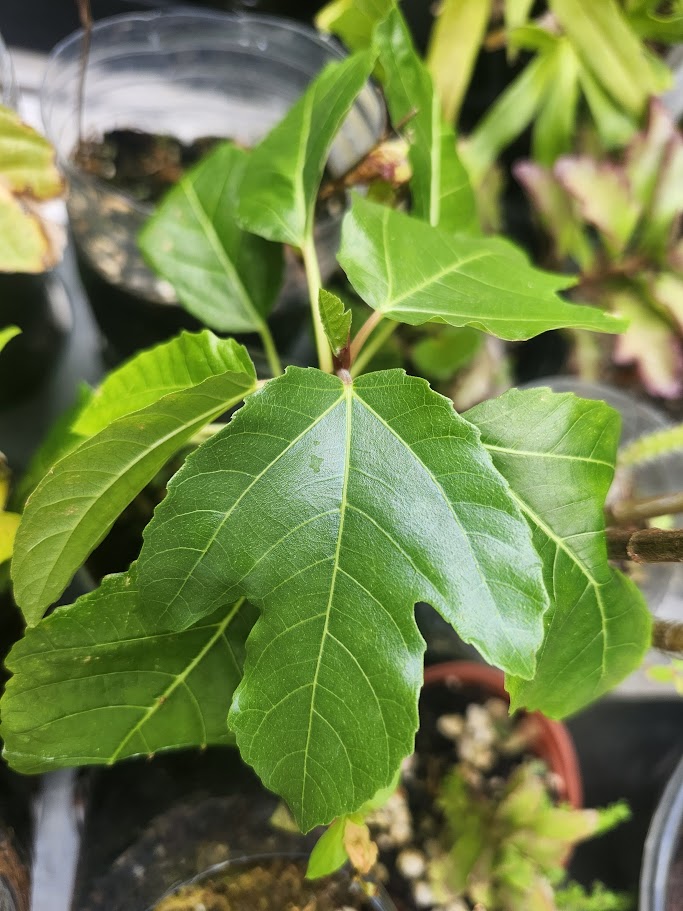
that’s a pic of one of my fig hybrid seedlings… ficus racecar (racemosa x carica).
a category for fig breeding helps to consolidate the relatively few relevant threads so that none of them are overlooked by the future luther burbank of figs.
but i still struggle to understand how i could possibly fail for so long at persuading a room full of hybrid people that hybridization deserves its own category. its seriously silly.
a minor drawback of the new fig forum is that its default style is a bit ‘vintage’ for me. i quickly changed it in my settings.
Warning: this individual in Australia is known for misrepresenting information (perhaps unintentionally) from otherwise reliable sources. Several of us have given up communicating with him.
Richard, I am certainly not going to get into a slinging match with you, but to think I misrepresent anything is one heck of a stretch. When you get called out over your thoughts that Blastophaga psenes never leave the fig they enter, pollen can only be on the Profichi crop etc, yet, studies, plus my investigations here tell me otherwise, that says it all for me!
ostioles aren’t binary (closed or open), they are a continuum. some are so tight that only the smallest wasps can enter. others are so loose that even fruit flies can easily enter, and exit. this diversity is what allows figs to continue to evolve.
Is that the famous fig wasp? I thought it was a big American wasp.
As far as Richard…
I like him, but good thing he is not a mod. Sometimes he is kinda quick to the draw. He thinks I spam the forum when I send in videos talking about how the grain crops are sprayed with glyphosate right before harvesting.
yes, that’s the famous ficus carica fig wasp… blastophaga psenes. its not native to california but was intentionally introduced over 100 years ago. there’s lots of material about this on the fighunter downunder forum.
richard is very generous, in my personal experience, but he’s a bit inflexible. nobody’s perfect though. i’m too open-minded. just kidding. is it even possible to be too open-minded?
i’m reminded of this quote from keynes, “When the facts change, I change my mind - what do you do, sir?”
Richard is very knowledgeable. His approach may be more direct than many people are used to. When he thinks something smells like BS, he calls it out. More time than not, he is correct.
Young female fig wasps like the one in your photo seek out immature syconium with undeveloped gall flowers to deposit their eggs. The fig pictured above is long past that stage, and developing Ficin which will dissolve any fig wasps that remain inside. The wasps will only be successful in immature syconia of next crop caprifigs, much smaller than the pictured fig. At that stage, the ostiole is very tight. The females must burrow their way through the panels of the ostiole, and in the process lose their wings. Their life cycle ends after ovipositing their eggs.
No, sorry. There are many species of fig wasps, each symbiotic with a specific group of fig species. They are all tiny. The fig wasp species symbiotic with Ficus carica (B. psenes) are native to northeast Africa, southernmost Europe, and southwestern Asia. They were first successfully established in California in 1900 by W. Swingle.
i’m not sure what you mean by “undeveloped gall flowers”. do you mean that the flowers haven’t opened yet? from my understanding, the female flowers in the male fig are open, and the wasp pollinates them as she inserts her eggs into their ovules. its the developing seeds that are exactly what the larva eat. no pollination, no seeds, no food for the larva.
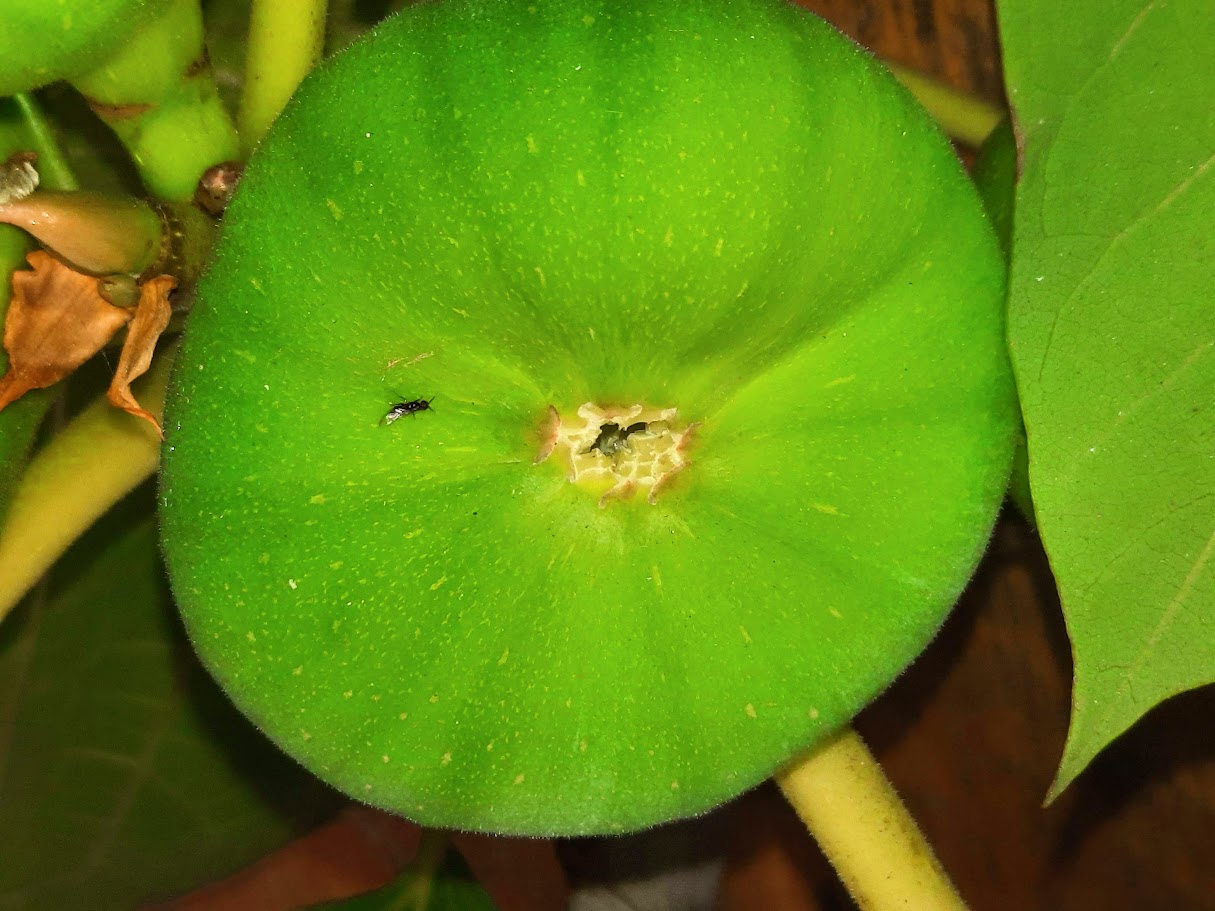
regardless if female flowers are in a male fig or a female fig, when they start to open, the fig emits a scent that signals this to wasps. typically this is why wasps land on a fig. the wasp in my pic didn’t accidentally land on the female fig, it was lured by its fragrance. when it entered the fig it tried to deposit its eggs but was unable to because its ovipositer couldn’t reach the ovules, but in the process it pollinated the flowers. in this case, it was easy enough for the pregnant wasp to exit this fig and try another fig.
Yet I proved you incorrect on both topics, even Finn Kjellberg’s words (one of the world ‘s most respected authorities on caprifigs) reinforced my words, and you reluctantly accepted it at the time, with no further reply, yet shortly after you saw fit to no longer take part in Ourfigs, but to migrate to F/F? You have a lot of work ahead of you Richard.
PS, if there is anything further that I can help you with richard, I am always available.
This was from Finn Kjellberg, as I have pointed out before on Ourfigs….
Hi Robin,
You are absolutely right that Blastophaga psenes often suffer limited damage when entering a fig. The females often reemerge from a fig they entered, and they can even enter a second fig.
There are a number of Ficus species whose pollinators suffer larger damage and whose pollinators never exit from entered figs.
But as you surly must know by now, not all wasps lose wings on their way into the ostiole of a caprifig, again my observations told me this, and Fin Kjellberg totally agreed. Oh, and I have pictures proving this, as they inside of a 25mm fig with full, and partial wings intact. When figs are in a receptive state, and begin emitting VOC’s, the bracts relax a little, some more than others, allowing easier entry.
Zone 6…..With the introduction of Blastophaga psenes into California, it was finally successful in 1899, and yes, Swingle sourced them, wrapped them in cigarette foil to keep them fresh, and these came from Algiers after many failed attempts from Italy etc. all in the same season.
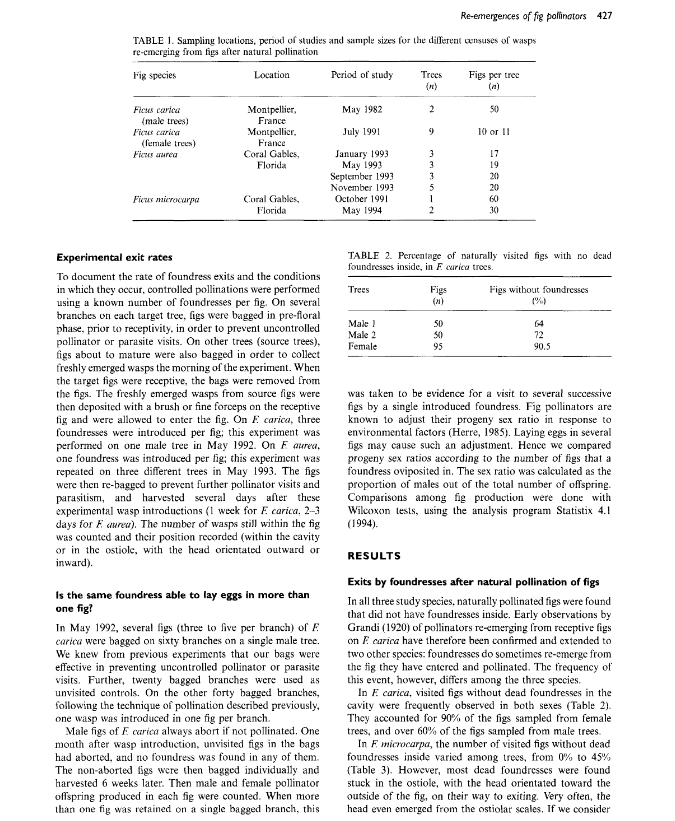
Well, this one is one of the best….and it goes into great detail. As a new user, I am not permitted to upload the full research paper, but it has the heading…Consequences of protecting flowers in a fig: a one-way trip for
pollinators?
M A R CGIBERNAU’‘3,MARTINEHOSSAERT-MCKEY"*, MARIE-CHARLOTTEANSTETT’ a n d FINNKJELLBERG’
‘Centre dEcologie Fonctionnelle et Evolutive, CNRS, BP 5051, 34033 Montpellier Cedex, France and 2Department of’
Biology, University of Miami, R 0. Box 249118, Coral Gables, Florida 33124, U.S.A
@FighunterDownunder
Oviposit is fatal to adult B. psenes females. They typically don’t completely enter a candidate syconium already occupied by another female, but instead journey to other candidate syconia. Their wings will only be partially damaged in this case because the first female already created a rough pathway. To the human eye, this pathway is best viewed with a magnifying lens. It will appear as a slight crack in the central portion of the ostiole.
I recommend these references:
Flaishman, Moshe A., and Uygun Aksoy, eds. Advances in fig research and sustainable production. CABI, 2022.
Sarkhosh, A., Yavari, A., and Ferguson, L. eds. The fig: Botany, production and uses. CABI, 2022.
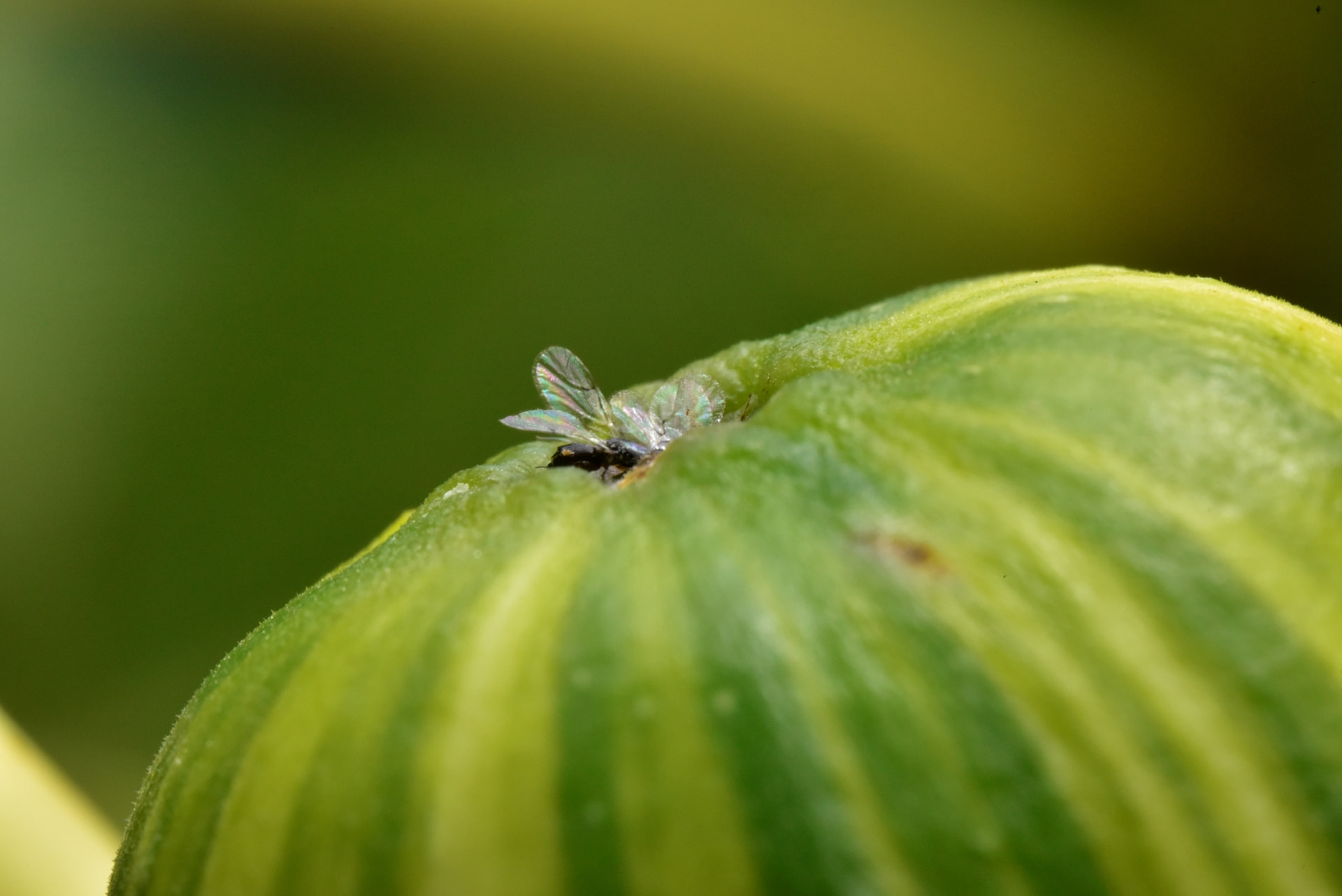
You just cannot accept that you are wrong, and I really have to question why? Did you even bother to read the post, and article above? They often enter a syconium, after after one or more wasps have entered it, even pushing dead wasps aside to gain entry, I have watched wasps push their way into my Panachee, as this picture shows! I also have photos that I have shared with you previously, showing 3 wasps inside of a small 20mm dia. female syconium, and I have video evidence of that!