I don’t know about this particular case, but generally speaking, chimeras are not helpful in breeding. Think of it this way. Is a grafted plant better for breeding than an ungrafted plant? Generally, no. A chimera is sort of like a graft, only instead of a well defined, visible graft line, different cell layers or regions of the the plant contain different genetics. It’s not like a true hybrid. Which ever genetic layer of the chimera is responsible for pollen and egg production contributes it’s genetics, and it’s genetics alone to the offspring. There aren’t second generation chimeras as far as I am aware. Another way of looking at it is like neopolitan ice cream. You have multiple ice cream flavors mixed in one package, yet they are still distinct within that package. That’s a chimera. A hybrid is more like melting the different flavors together in a bowl, so it contains a new mixture that’s not like any of the original types, but has similarities to all of them. That’s what helps cross species barriers in subsequent generations.
Okay, that makes sense. Too bad though. Still going to try some different things.
Actually, would hormonal stuff help any in a chimera vs just grafted in making hybrids?
A graft chimera could be useful as a rootstock or interstem.
You’re right about everything you said. I may have misunderstood what @KS_razerback meant, but I took his question to be asking whether hybridization involving a chimera is similar to the “vegetative approximation” developed by Ivan Michurin. In that method, making reciprocal grafts of the two species you’re trying to cross increases the likelihood of successful hybridization. I believe this is how the first hybrid persimmons were created.
With a chimera, even though only one layer passes on its genetic material, the chances of a successful cross may be increased because the other layers come from the plant you’re trying to hybridize with. If reciprocal grafting improves the likelihood of a successful cross, I think it’s entirely possible that hybridizing with a chimera could work in a similar way.
Yes, that is basically what I was thinking.
A lot of Ivan Michurin’s methods and reported results should be taken with a pinch of salt. Is there value in some of them? Perhaps. They are worth trying as part of the broader effort if you are targeting a difficult wide hybrid in the first or second generations. However, the results he reported are often inconsistent or not repeatable at all. That’s a good chunk of why his work was widely regarded as pseudo science in the west for so long. I know his work is getting more popularized now…but… I would just say don’t hang your hat on it or treat it as settled science with consistent results, because it really isn’t. It’s closer to the biodynamics end of the scale. Meaning some things may have value, but there’s more than a little bit of fantasy and wishful thinking mixed in IMHO.
I wasn’t thinking about a graft hybrid chimera being used for further breeding. I think it would be cool to see what sort of fruit resulted from such plants though. The fruit could very easily end up being entirely like one species or the other, but on the off chance the fruit was composed of both tissues who knows what it would be like? Large, but soft and juicy? Small and hard? Tasty, but woody? Unpalatable, but physically easy to eat? Though unlikely, a large, but still chewable and tasty fruit seems within the realm of possibility.
If it’s easy to produce a chimera then it seems worth finding out what the results could be. However, it would probably be a good idea to ensure that both the che AND the osage rootstock are both female. Would be sad if one made a chimera only for it to try and produce male flowers or confused part male/part female flower clusters.
This is true. His works reached the West primarily through the Moscow Foreign Languages Publishing House during the height of the Cold War, and they often read like Soviet propaganda.
In the West, Michurin’s work came to be widely regarded as pseudoscience—not because of his own work, but because, after his death, the Soviet Union used his name to promote “Michurinist biology.” This so-called biological theory was an all-encompassing pseudoscience deliberately positioned in opposition to Western genetics, including the work of Mendel, Morgan, and Weismann. Under Lysenko’s leadership, scientists who challenged these ideas, such as Vavilov, were persecuted and even murdered for dissenting.
It’s hard for anyone’s work to be taken seriously when their name becomes tied to pseudoscience, the deaths of prominent scientists, and open opposition to the leading scientific ideas of the time. In that sense, history has really screwed Michurin. He had nothing to do with any of it—he wasn’t a genetic theorist or ideologue, just a plant breeder whose name was later co-opted for purposes he never supported.
Transgrafting is Michurin’s mentor method and is widely used by leading seed companies worldwide. It is supported by extensive scientific research.
The only time I have heard about chimera’s contributing a beneficial property is Longanberry, where as it produces a thronless plant
There’s a madarin+trifoliate chimera which produces mandarin fruit on a tree with trifoliate hardiness.
Also, there’s an ornamental tree chimera which produces three types of flowers representing both donor phenotypes in addition to an intermediate type between both.
I haven’t heard of such a tree, but if it exists, why isn’t it widely grown? Seems like such a tree would lead to a citrus industry well north of the typical range where citrus is grown. Is there a “rest of the story” about why this isn’t commercially viable?
It’s called Prague.
The fruit ripens several months too late to avoid being froze off.
I’ve wondered about making my own chimera with one of the super early citrus eventually.
It’s not widely grown because it doesn’t crop heavily enough for commercial orchards.
As others mentioned, it’s called the Prague Chimera, it’s trifoliate and satsuma mandarin that likely originated in the Soviet Union but was found or rediscovered in Prague. The plant mostly looks like trifoliate, but the fruit are satsumas. The seeds when planted out grow into regular satsumas.
It’s an ugly, stunted, slow growing and gangly thing. It blooms heavily but sets very few fruit. Grafting onto vigorous rootstocks helps somewhat with the growth, but in general it’s hard to get much production from them. The fruit just like regular satsumas ripen early compared to most regular citrus but also don’t ripen early enough for most people in colder zones regardless.
Most citrus ripen in winter, something like December through March. Early varieties like satsumas ripen in late fall, October through December or exceptionally in September. But even then that’s in warm climates where they have months and months of hot weather.
All that being said, it’s still a really cool plant and a great novelty tree for people in zones 7-8 in warm summer areas.
The seeds of ‘Prague’, or of other chimeras, could be interesting. In some plants, chimerism has been shown to produce epigenetic effects that can be transmitted to the next generation. For ‘Prague’, the traits expressed by the offspring could potentially result in increased mandarin cold hardiness.
This could be true even if the offspring are apomictic clones. Clonal plants are known to exhibit epigenetic variation and can adapt epigenetically to different environments despite being genetically identical, or nearly so. One example is Aronia: studies suggest that nearly all commercially grown cultivars are clones derived from Michurin’s original cross, yet they still display measurable phenotypic differences and variable performance in field trials.
Here’s a video talking about the prague seedling.
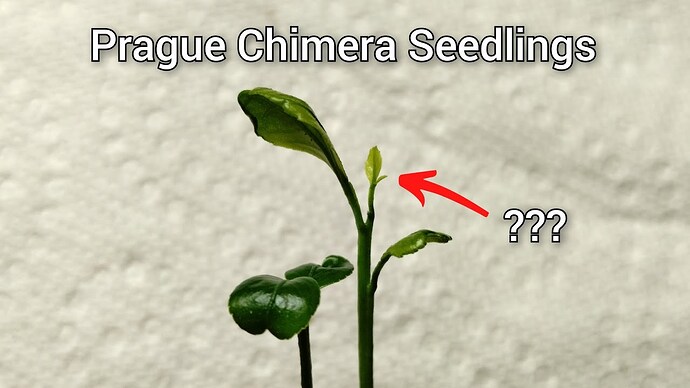
That’s true, but I think in this case what’s needed is a pretty significant genetic alteration, something on the level of multiple generations of sexual reproduction between carefully-chosen germplasm. There’s just such a massive gulf between what we have and what we’d need in a true cold hardy desert quality citrus for warm temperate climates like the Upper South and Atlantic states (to say nothing of cool temperate areas further north).
Traits that are pretty much required are no trifoliate resin, low or manageable acidity, low bitterness, sweet fruit, decent fruit size, acceptable texture, extremely early (for citrus) ripening, excellent dormancy, low seediness, attractive rind and flesh color, some juiciness, hardiness that at least equals most 50/50 trifoliate hybrids, and either deciduousness or very good wind/cold/sun burn resistance. That’s a very long list and currently even the best hybrids have like three or four out of those dozen traits.
It’s doable, I myself am doing my part to contribute, but it’s a really tough project. Some Prague seedlings could be helpful of course, not ruling that out, just saying useful epigenetic changes would still be just one in a great number of steps needed.
We’ll get there eventually.
Perhaps we’ll race the guys breeding edible Osage Oranges to see who gets a tasty, cold hardy “Orange” first, haha
In terms of cold hardy Citrus, anyone wishing for lemons in a cold climate could just plant Chaenomeles instead. Even though they’re an apple relative, the fruit taste like lemons. They’re rock hard fresh, but very quickly soften to apple sauce consistency when simmered in a little water. They can be used in any recipe needing some lemon flavor (making slight alterations to account for being a sauce instead of a juice).
Definitely an option, especially in drier climates where Rose-family diseases aren’t quite so bad (my ornamental flowering quince is just about the unhealthiest plant I own, I just need to put it out of its misery one day but at the moment it’s a useful catch crop for bagworms, among other things, so it’s staying).
There’s a sumac for pretty much every climate, they’ve also got a really nice tartness and a lemony flavor.
Lots of options for lemon flavor of course if the sourness isn’t a requisite. Lemon balm, lemon thyme, lemon basil, may chang, lemon verbena, etc.
Or a chimera of trifoliate (ideally poncirus plus) and Xie Shan
It would ripen before frost in most (virtually all?) Z7 climates, except really low heat unit maritime perhaps