To me the thing that makes it such a pain to breed citrus is so many of the good varieties mostly produce polyembryonic, nuclear seedlings and relatively few zygotic seedlings. From my point of view, that’s a big flaw/headache, and one of the biggest reasons I haven’t messed with citrus breeding. The other reason being all the quarantines that make it difficult to get or move interesting germplasm. I do find the cold hardy citrus efforts interesting though, and I wish those willing to work with the unique breeding headaches of citrus the best!
7 Likes
One of the crosses I want to do in breeding citrus is to cross a fast flowering trifoliate or poncirus plus with desert lime and then backcross that cross back to the trifoliate and select the ones that are fully cold hardy. The desert lime would have to be the pollen donor and thinning to the zygotic seedlings would be very easy, just by looking at the leaves. The beneficial traits the desert lime would contribute would be: reduce ripening time (they can supposedly ripen in less than 2 months after blooming), drought tolerance (it’s a xerophyte), reduce soil fertility requirements, possibly add even greater cold hardiness via its extreme resistance to desiccation, reduce acidity, reduce seediness (desert lime has almost no seeds), and increase zygotic seed percentage (it has 100% zygotic seeds). Nothing else it can be a great cold hardy rootstock for dry areas.
Oh, it could also possibly add the trait that makes the seeds be able to be dried without affecting germination rates.
3 Likes
If I’m not mistaken, zygotic seeds are common for non-hybrid Citrus. Since most of the clonal seed producing types are cultivated hybrids, it makes me think that it’s a trait which may be unlocked via hybridization even when the parents primarily produce zygotic seeds.
2 Likes
That’s not entirely true, some satsuma oranges are very high percent nucellar polyembryonic seeds.
Most domestic satsuma/mandarin/tangerine varieties are of hybrid origin even though they are still similar to the wild species. Like oranges and grapefruit, they have pomello ancestry. Just far less.
2 Likes
Do we really need to improve Osage Orange when Che already has fruits this large?
Che fruit - General Fruit Growing - Growing Fruit

9 Likes
I think it’s something that happens to coincide, not something causative.
Trifoliate is a wild species that’s highly nucellar. Wild mandarins like shekwasha and cleopatra mandarin are nucellar, Hong Kong kumquat is pretty much the most basal citrus and it’s nucellar, etc. Most wild citrus are zygotic sure, but plenty aren’t.
What does seem to be the case its that nucellar seed is a dominant trait. I think what happens in cultivation is that as hybrids are created the trait for nucellar seed rapidly increases in preponderance. Without natural selective pressures, it’s very easy for a population to get dominated by nucellar clones. A hypothetical region in China three thousand years ago might have been growing nine zygotic varieties and one nucellar variety. Fast forward a thousand years and a dozen OP generations later and odds are every citrus in that region will likely be nucellar.
4 Likes
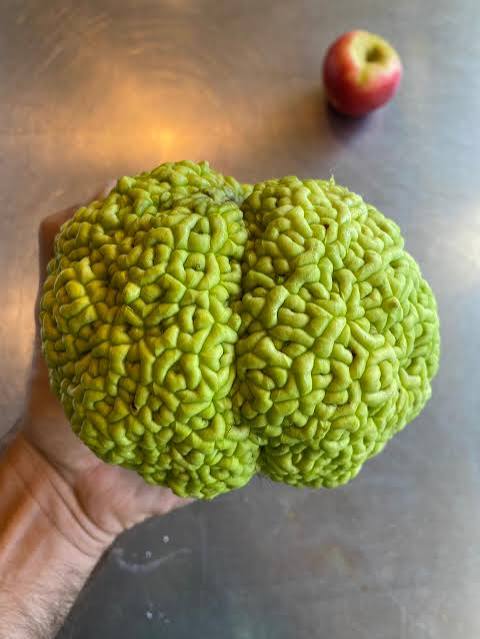
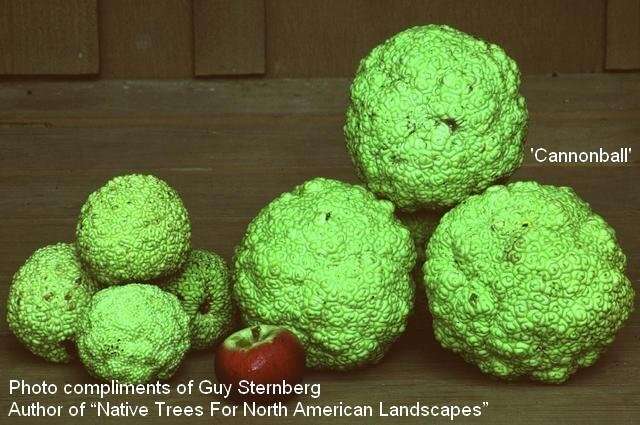
Well, the Oregon exotics che is a super late ripening variety that won’t ripen everywhere, and still falls very short of the volleyball size desired, also different flavors would be nice along with different colors.
3 Likes
3 Likes
As a soft fruit. a berry that huge would be highly impractical.
3 Likes
Oh, absolutely. It would be a novelty if it worked at all. Still, the idea of red, bowling-ball-sized fruit hanging from a tree is just awesome. At least my mastodon and woolly mammoth wouldn’t go hungry.
5 Likes
I’m curious how big the 'cannonball fruits get?
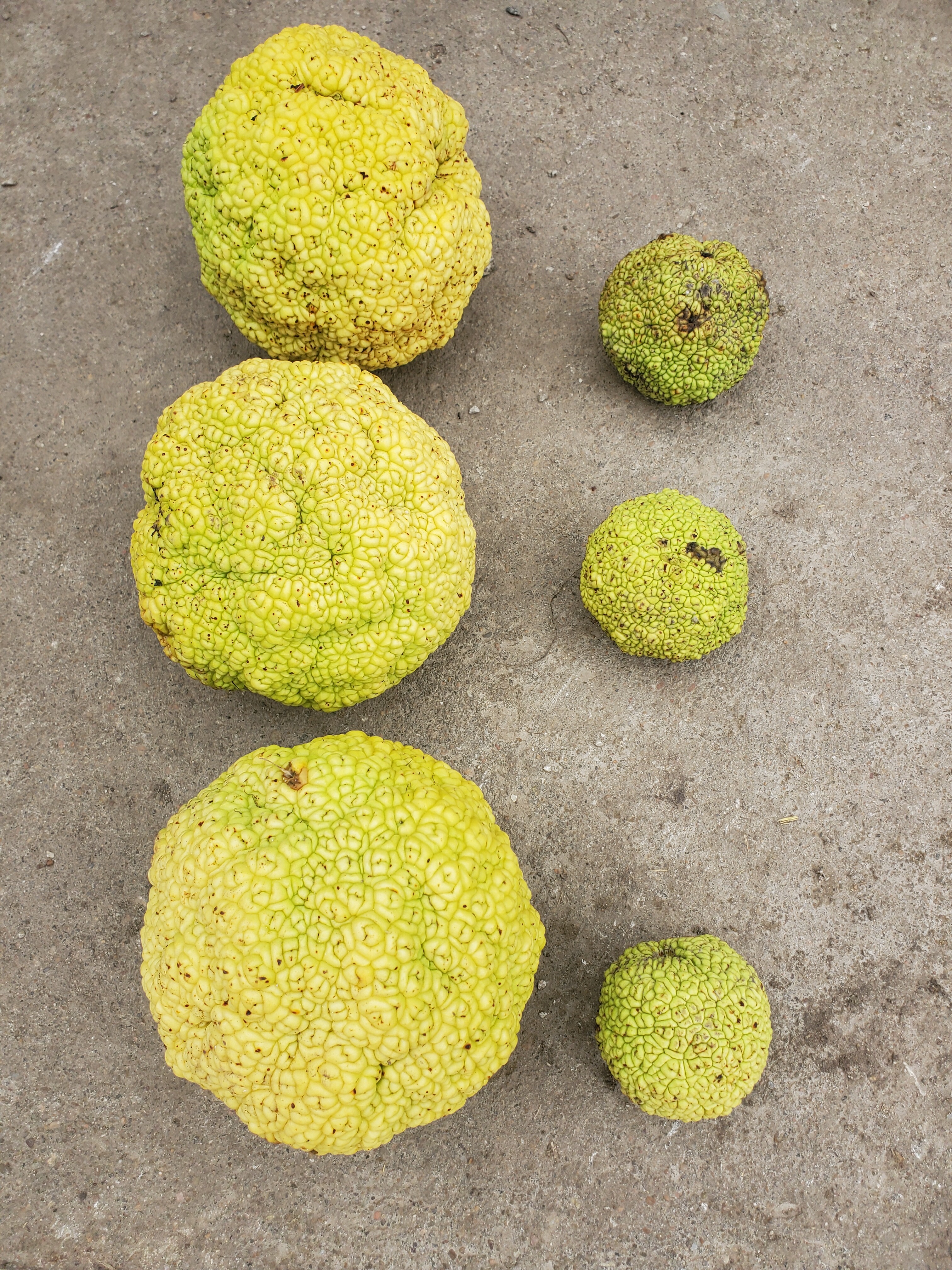
I have some of my own hedge trees that have huge fruit. Here’s one with 6.5" fruits.
6 Likes
It’d sure be easy to harvest .
.
Hedge fruit themselves already are a soft fruit that you can squash when they’re fully ripe.
1 Like
I think “Cannonball” is only found in arboretums. I’ve never seen the fruit, but various sources say they’re about two-thirds larger than average and can grow to the size of a small bowling ball. The ones from your tree look every bit as large—if not larger—than the photos I’ve seen. Those things are massive.
2 Likes
They are some of biggest one I’ve seen here, even with all the extensive cow plantings.
3 Likes
lordkiwi, they are really hard/firm right up to the point of complete ripeness in my experience in eastern KS. So I’ve thought for decades a huge potential is in this area of hybrids to be produced. I read a wildcrafter’s blog with pics quite some time ago about cochinchinensis. He said it was troublefree in natural areas of Australia (ancient relict from Asia) called cockspur thorn. Tastes like a stonefruit blended in dairy. Almost nobody harvests it except the indigenous peoples.
5 Likes
idk this sounds fun. i watch closely to see your work lol. I mean its silly but it sounds like a totally fun tree
2 Likes
I was just chatting with another member about this one!
It’s available in the US, but the only source I know of, Woodlanders, isn’t sure if they have a male or female tree. I’ve never seen anyone else make it available for sale so getting another plant for pollination is a challenge.
4 Likes
I had one from Raintree about 1997, only year offered. They called it Himalayan Damarru. I planted it against my stone basement wall with south exposure. Growth looked like a hedge apple that had been cut to a stump. Long, limber, arching spiny sprouts out from the center, happy all summer. Came back next year in June with the heat-didn’t survive 2nd winter.
4 Likes
…
This forum brings out the worst in me
I have had this in my cart for 5 years but never pulled the trigger on buying them
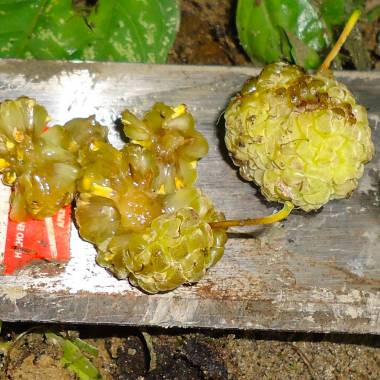
Maclura tinctoria
Maclura tinctoria – Dyer’s Mulberry, Fustic Tree – Buy seeds at rarepalmseeds.com
7 Likes