no worries, it probably should be moved into it’s own topic. Altho I’m curious to your responses cuz your different view point is a learning opportunity for me.
1 Like
Thank you! I can wait till yours set seeds. I have no land thus I can’t accept cuttings (Hence why I’m collecting seeds only).
FYI, while ‘Purple Robe’ is a Robinia, it is only about one quarter black locust (R. pseudoacacia). It’s actually a three way hybrid with Robinia hispida (1/2), R. pseudoacacia (~1/4) and R. viscosa (~1/4). Therefore it’s probably best not to think of it as a selection of “black locust” since you would likely be able to observe a lot of differences between ‘Purple Robe’ and black locust beyond just flower color. While ‘Purple Robe’ has a tree like growth habit, the majority of its dna comes from more shrubby type Robinia species, so that may show up in its seedlings (depending on what it’s pollinated by).
3 Likes
Nice! This is even better for capturing diversity! This explains why it’s more pink than white.
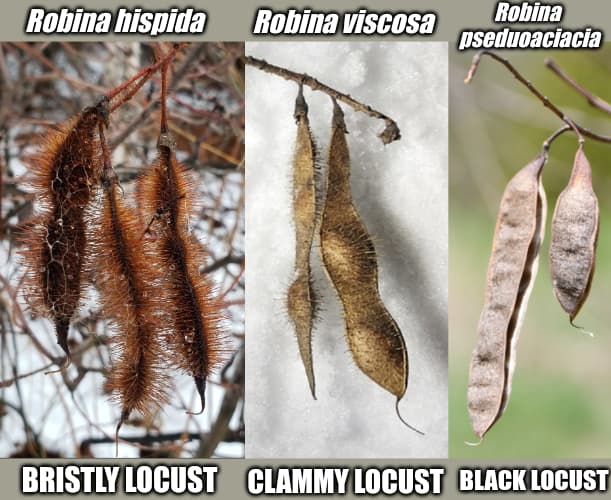
Indeed altho I think of the entire Robinia genus as a species complex of Robinia pseudoacacia, since they all easily & readily hybridize. I suspect many species are actual hybrids between White & Pink flowered Black Locusts, In particular Clammy Locust (Robinia viscoas) looks intermediate of R. pseudoacacia x R. hispida, almost as if a Naturally occurring Hybrid became a species. Indeed, the Pink Flowered Black Locusts have bristles but the traits are very fluid depending with lots of inbetweens. I mean just look, I’m not the only to notice right?
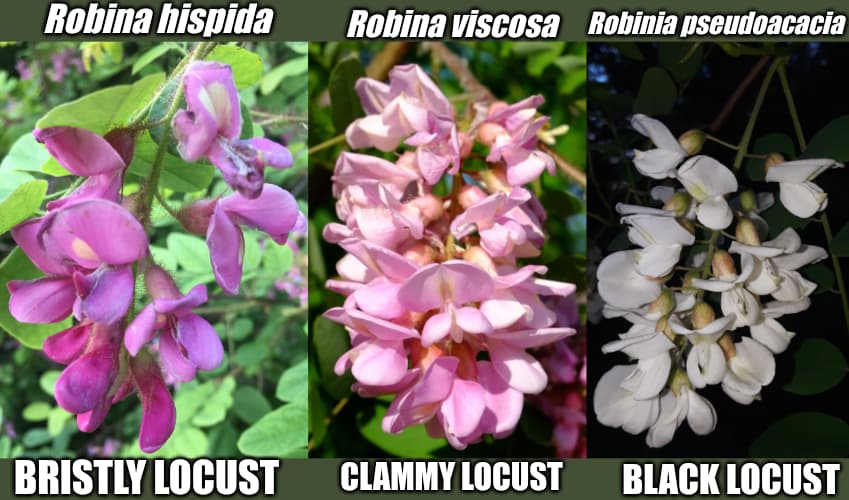
Awesome! I was gonna make this cross anyways so might as well get the completed product. Shrub Growth Habit is Ideal for me cuz it makes flower harvest easier, otherwise I have to summer prune the Tall Black Locusts so they don’t grow out of reach.
2 Likes
… and I can get annual sunflowers to cross-pollinate and produce hybrid offspring with jerusalem artichokes. That doesn’t mean that they don’t still warrant separate species status. Ability to interbreed when given the opportunity is a poor measure for whether a population is distinct enough from other populations to warrant separate species status.
5 Likes
Taxonomy with its wish to fit all the world into tidy little boxes is a human intellectual conceit. It’s a religious idea rather than a scientific one. Everything is a complex really, and all of life one big spectrum and tangled web. Gotta make species distinctions for practical reasons, like does a given variation have its own clearly identified population or not? Black locusts and bristly and clammy locusts are distinct enough that one immediately understands what’s being described. Genetically, they could also be a complex. Both are true at the same time.
2 Likes
Perhaps the real question why is it not 1 species yet  .
.
On a serious note it seems that there are only 2 species (R. pseudoacacia & R. hispida) & everything else is in between those 2.
That’s incredible! Asteraceae is that one crazy family known for spontaneous intergeneric hybrids . What did the hybrid look like? Did it form arial tubers & Sunflower seeds like the best of both worlds?
Perhaps, and there goes the age old debate of what is & isn’t a species . I’ve seen more variation in Cucumis melo & Cucurbita pepo than Robinia viscosa, Yet all of Cucumis melo is just 1 species but not all of Robinia, how come? How can 1 species taxon have more weight than another? Cucumis melo is actually a complex, consisting of many subspecies that were all introgressed during Melon Domestication (Only Cucumis picrocarpus was left out of Melon Domestication cuz it was in Australia). Why can’t the same happen with all the Robinia species? Maybe all the species haven’t been introgressed throughly enough to warrant single species status?
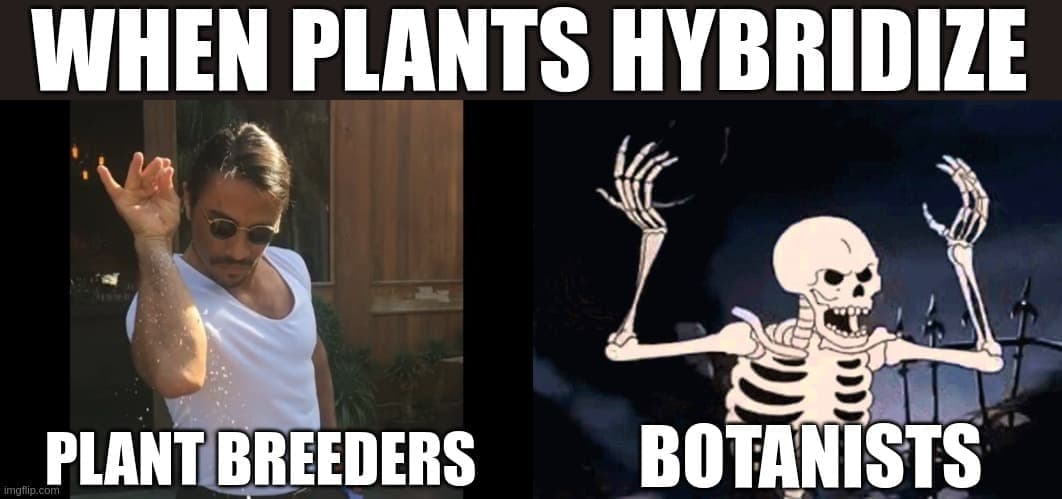
Interesting, perhaps the concept of species are simply a tool for us to understand? Makes me think wasn’t the whole purpose of a scientific name to have just 1 universally agreed apon name, we already have many confusing common names. I just can’t help but think of this meme.
All the 5 species of Squash (Cucurbita spp.) comes to mind. All Id traits are fluid because theoretically with mentor pollination & thorough introgression, all squash species can cross. The hybridization barriers exist only because squash had been domestication for so long they forgot how to hybridize readily with each other. I guess that’s why they’ve became separate species right? If so does that mean Cucurbita Symbiosis with humans caused lots of speciation events, creating the domesticated squash species we know & love today? Cucurbita moschata & Cucurbita angyrosperma aren’t quite separate species. Cucurbita texana & Cucurbita pepo have been introgressed so thoroughly while being domesticated twice that they’re now considered 1 species while C. texana became a subspecies.
I still think it makes sense for all 5 species of domesticated squash to be separate species, but Does that mean our ancestors evolved these species? If so can we evolve species thru landrace breeding?
I plan to cross & hybridize all the squash species, making a 5 species Squash Landrace. I’m TOO excited about the new traits that will show up.
I like this approach, that’s the way I would’ve split the species, with all the others being interspecifc hybrids. Hybridization can simplify or complicate taxonomy, often times both happens while blurring the lines between species, make it a fuzzy concept.
1 Like
Whenever you want to quickly see at a glance which species (of any plant) are currently accepted as valid, I recommend Plants of the World Online.
They are currently recognizing four species of Robinia as valid, plus named hybrid combinations.
https://powo.science.kew.org/results?f=accepted_names&q=Robinia
The hybrids I made have all formed normal tubers like jerusalem artichokes, but tend to have slightly larger flowers with only one flower per stem (because I used a single flower per stem form of the annual sunflower for the cross). Because of ploidy mismatches, this cross actually is effectively 3/4 jerusalem artichoke and 1/4 annual sunflower instead of 1/2 &1/2 like you would expect.
3 Likes
It’s a good resource! Thank you. I like how they also put in the hybrid taxa too. R. neomexicana looks a lot like the Ninia viscosaew Mexican version of Rob. Is it considered a seperate species because of where it’s found?
Very very interesting, is it possible to rehybridize with sunflower again & get closer to 50/50?
Also did your hybrids create seeds? I’d absolutely love to get some of those seeds if your willing to trade.
Back-crossing to either parent creates yet another chromosome mismatch (worse than the first) which would functionally make them sterile. It’s better to sibling cross to concentrate the desired traits. Other people who have made this cross have been able to get their hybrids of the basic cross to continue producing seed, but it’s kind of a numbers game. Jerusalem artichoke already has pretty poor fertility so getting seeds from the hybrid requires a lot of plants and sifting through many flower heads. So far I have not gotten an F2 generation (from that cross specifically), but I think I’m currently on the F4 generation from a cross between a different perennial sunflower which is related to jerusalem artichokes and annual sunflower.
3 Likes
oh my… What if you mix pollens while back crossing insureing both species pollens pollinate the same ovaries.
How does Asteraceae Family do such wide crossing but remain sterile? It’s a very weird family. I just look at this Brassica trianlgle with Raphanus and think how does the Brassicaceae deal with mis-matching chromasome numbers while Asteraceae doesn’t?
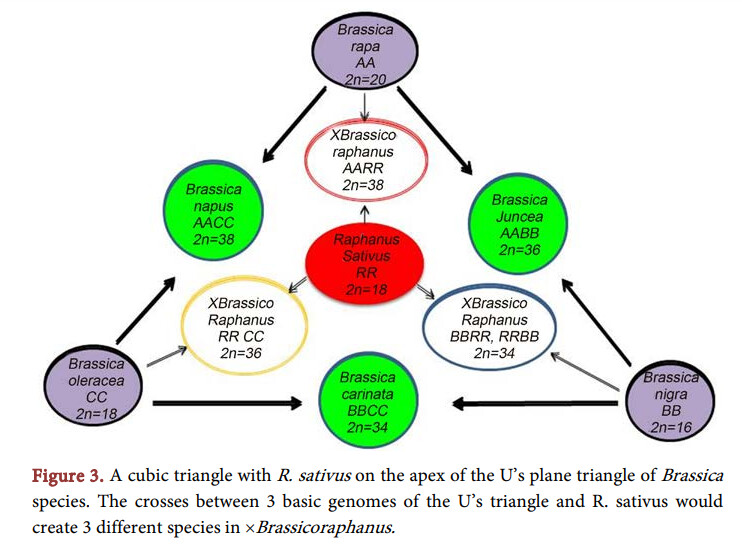
Thankfully no Robinia have mismatching Chromosome numbers right? Even with Olneye right?
a Number’s game? So just trying manny crossed until the Plants figure out how to deal with Mis-matching Chromosomes? I’m thinking there’s got to be some Horizontal Gene Flow techniques to solve this issue like Mentor Pollination & Mentor Grafting.
ooh! Nice, what species is the different perennial sunflower? And does it being perennial mean is has roots too?
I found this Helianthus Phylogenic Tree, does it make sense with what you understand about crossing Helianthus? I hope it helps

1 Like
That tree does not correlate to which crosses are possible and which aren’t. I know you have a lot of questions, but it’s getting a bit too in depth on Helianthus considering the topic is Robinia.
Speaking of Robinia, I recommend Googling the name of any plant you want to know the ploidy of along with “2n=”. Example: “Robinia pseudoacacia 2n=”. This will pull up search results which have some reference to ploidy. Not every species has been documented and some species contain individuals which differ in ploidy from the standard for the species, but it’s at least a starting point. Mismatches can happen whether the ploidy in hybrids lines up or not, but finding good matches does increase likelihood of offspring retaining some level of fertility.
3 Likes
So then what’s the point? I thought closely related species are usally more crossable than distantly related species? and most hybridization barriers are overcome with Mentor Pollination & Mentor Grafting (Sometimes other Horizontal Gene Flow Techniques), right?
I kind of Ignored Mis-Matching Polidty in breeding cuz the Brassicaceae, Poaceae & Rosaceae Family seemed to not care about which made me think why should I? It seems in some plant families it matter & in other not so much cuz they figured a way around it.
1 Like
In the vast majority of cases, only one pollen grain will pollinate a given ovule.
If you look at the chromosome numbers of the three green species in the diagram you posted, you’ll see that they are amphidiploids with a full set of chromosomes from each parent. Normally when you cross a species with 18 chromosomes with another that has 20, you’ll get progeny with 19 chromosomes that may have fertility issues. If the chromosomes are doubled, whether artificially with colchicine/oryzalin or spontaneously, you get 38 and theoretically no mismatches during meiosis.
1 Like
Yes (In what species is this not the case? I can’t think of any), but sometimes mixing the pollens tricks the ovary into accepting foreign species pollen so as to not reject pollen from it’s own species. It’s how you create interspecies squash hybrids.
Ah so, basically the goal is to get even chromosome numbers? Can mixing pollens or Mentor Grafting induce mutation for Chromosome doubling?
I know Mis-matching chromosomes is how we get seedless watermelons, but why do Seedless watermelons still occasionally contain fully formed seeds? Are those the mutations where the mis-matching chromosome numbers were fixed?
1 Like
I think the effect is more one of a species having a minimum threshold of fertilized seeds in order to not abort an ovary rather than any effect on the fertilization rate itself. I.e. if pollen A only successfully fertilizes ovule B 5% of the time, but variety B needs 30% of its ovules fertilized in order to mature a fruit, mixing in some pollen B would ensure you can get seed of BxA, provided you have some means of telling the desired hybrids apart from the others.
Mostly yes, but that is oversimplifying it a bit. If the species are too divergent and chromosomes are too different, they may not pair up correctly even if there is an even number.
Some plants, especially polyploids, are prone to producing the occasional unreduced gamete, so the offspring may not have the policy you expect.
No
They may be the result of an unreduced gamete.
3 Likes
The point of that tree is to show which members are more closely related. That’s not directly tied to which members can successfully hybridize. Even within a single species, there are sometimes members which can not easily cross with each other despite being the same species. There are endless variations in nature.
It seems you have an abundance of curiosity, but ultimately the only way to come close to satisfying it is to start experimenting. Discussions of what is theoretically possible will only take you so far.
4 Likes
Corn.
2 Likes
There was discussion of the timber variety Nyirségi further up this thread and availability of seed from Experimental Farm Network. At the time I looked I saw they actually get their seed from Sheffield who has now restocked their supply.
So anyone looking for quantity seed ($24 gets you over 1000 seeds) you can get it here:
4 Likes
Ha- permaculture is one of my trigger words, never been able to express quite why, so thanks for summing it up for me 