Heard of this one?
I asked this question on FB and they kind of side-stepped it.. Can anyone here elaborate moreso than they did?
Ignore my typo plz.. “..such that nothing..”
Heard of this one?
I asked this question on FB and they kind of side-stepped it.. Can anyone here elaborate moreso than they did?
Ignore my typo plz.. “..such that nothing..”
The most effective weed killer I have used recently is Walmarts 45% vinegar solution mixed with a 1/2 cup Epsom salt and a couple tablespoon of dishwasher soap for surfactant. Apply with garden sprayer and spray during het of the day when no rain is expected for a day or so. In 3 days weeds are brown. Safe for your soil as well
Dennis
Kent, Wa
Will that take care of the Himalayan blackberry we have?
BlackBerry is more difficult due to its underground established root network. I sprayed some native ones here this week and they started to yellow, so it may take more than one application. If by mid August they are still living, then dig them out by the roots with a garden fork.
That is what I did just a couple days ago! Luckily they are small but some root always gets left due to where it grows. I make sure to take out what I can though.
Could I use this brew around fruit trees as long as I don’t get any on the trunks? I know next to nothing about herbicides but I need to learn.
Thanks
It won’t kill the roots unless you kind of toxify the soil.. But it will stop the roots from growing further I think.
If you use just the agricultural vinegar (NOT household vinegar- it’s a lesser percent) and not the salt, the acidity may kill some roots and will probably dissapate with enough rain.
I would use it near FTs if it does not get on the soil much at all. Salt is hard to get rid of.
they dont call it salting the earth for nothing
So what herbicide do you use around fruit trees then?
I have not used it around fruit trees. I weed that area which is planted thick with clover which I want to keep living. I mulch out to the drip line all fruit trees with about 3-6” of leaves and wood chips, so weeds are not so bad there. I use this formula mostly in lawn and hard to weed places like sidewalks and drive ways or gravel walkways where weeds tend to invade. I would not recommend in gardens or fruit growing areas.
Dennis
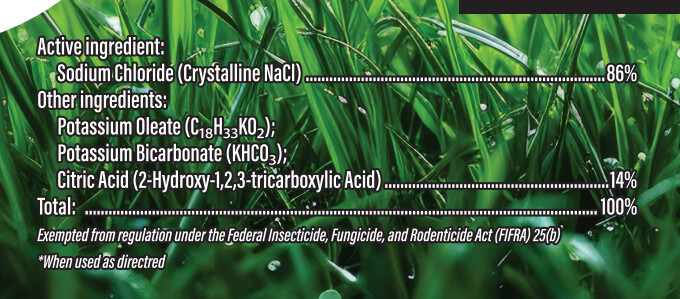
This “weed killer” is 86% Sodium Chloride.. Table salt is Sodium Chloride. I assume this kills by dehydration/desiccation of the plant, but why wouldn’t it kill the grass as well? Also why wouldn’t it make it difficult to grow anything where it was used, for a long time? Do the “Other Ingredients” in some way help to achieve the desired goal as well as mitigate unintended side effects?
Vinegar also kills (well harms) plants by desiccation.. Epsom Salt is Magnesium Sulfate, we put it around tomatoes and roses and various other plants. It’s a good fertilizer for things which need those minerals.
I’ve seen vinegar+salt+dish soap as well as vinegar+epsom salt+dish soap recipes on Facebook. I’ve always assumed the ones calling for Epsom Salt was someone who just misunderstood the purpose of each ingredient. Is there some science behind it’s use as opposed to table salt?
Anything with 86% sodium chloride is going to kill or damage nearly any plant at even modest rates of application. It can be fairly easily leached out of soils that drain well. But in some soils especially in dry climates it will be very difficult to remove. Salt buildup in soils in arid environments is a huge problem. It’s often caused by having salty irrigation water.
I once planted fruit trees in old horse pens in a dry climate. That soil drained well. I was advised to apply 12 inches of low salt water to alleviate the issue. Plants were showing salt burned leaves. Leaching solved the issue.
That’s a good example of why drainage makes such a difference. It’s amazing how much excess salt can be removed with enough good-quality water, but in poorly drained or arid soils it’s a completely different story.
