Heres a candy dish present i had made a few years back or so. Thought id share. As we head towards the year 1984, i can’t help but grab onto as much stuff from the old world as possible.



5 Likes
These concepts go back much further The Coinage Act of 1873 Explained | JM Bullion . Not everyone will understand you are referring to a book made into a famous movie “1984”. The confiscated gold in1933 is another reference most younger people were not taught. “Gold was confiscated in 1933 to stabilize the economy during the Great Depression, as many people were hoarding gold, which limited the money supply. President Franklin D. Roosevelt’s Executive Order 6102 required citizens to turn in their gold in exchange for paper currency, allowing the government to control the money supply more effectively.”
“ Gold: $4,553.99 $-104.00
Silver: $76.70 $-7.17
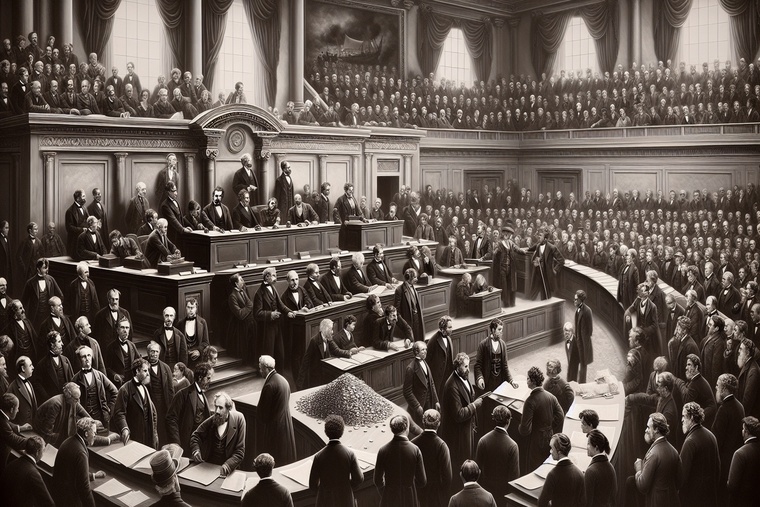
The Coinage Act of 1873: The “Crime of ’73”
Key Takeaways
-
The Coinage Act of 1873 was a major U.S. law that overhauled the nation’s coinage system.
-
Critics later called it the “Crime of ’73,” believing it hurt farmers and debtors who relied on silver.
-
The Act established the U.S. Mint as a bureau within the Treasury and updated coin denominations.
The Coinage Act of 1873 riled so many Americans that the law came to be known, both contemporaneously and in the time since, as the Crime of ’73.
The previous twenty-five years of America’s history had borne witness to some of the greatest amounts of change and turmoil in the history of the republic. In 1849, discovery of gold at Sutter’s Mill in California triggered the California Gold Rush and injected an incredible amount of gold into the Mint’s possession. A decade later, in 1859, the discovery of the Comstock Lode in Nevada did the same for silver—changing the trajectory of American coinage.
The ready supply of both metals did not create harmony over which should dominate U.S. coinage. Gold was largely reserved for the rich and upper class, while silver was more broadly used by lower and middle-class Americans.
The outbreak of the Civil War in April 1861 and the subsequent period of Reconstruction did nothing to tone down the disagreements between silver advocates and gold bugs. In fact, it was a major point of contention—making the environment for the Coinage Act of 1873 particularly heated.
With the stage set, let’s now discuss this law, its provisions, and the long-term effects it would have on American discourse and politics for the rest of the century and the early years of the 20th century.
Section 1: Background and Context
The U.S. monetary system was very much a work in progress from the time of its inception in 1792. Though the dollar was the currency of the land, foreign coins were permitted as legal tender in the new United States all the way until 1857.
With respect to gold and silver, American holders of bullion retained the right to have their holdings minted into coins by the U.S. Mint upon request, and both metals were considered viable for legal tender.
However, there was an increasing concern within the government about the interplay between the shifting prices of the two metals. The worry was that, all else equal, when two coins were of the same denomination but of different metals, the less valuable metal would push out the more valuable one as consumers preferred to trade the former and hoard the latter.
This principle is known as Gresham’s Law, which states that “bad money drives out good.” To allow it to play out unchecked would spell doom for the gold standard, which many policymakers fought passionately to install.
By 1873, the only silver coin that could still be freely minted from deposited bullion was the standard silver dollar. However, many Americans were relying on greenbacks—paper Treasury notes introduced during the Civil War—for everyday transactions, and silver dollar trade was uncommon.
Nevertheless, silver’s continued circulation remained important to those groups, as it allowed them to maintain liquidity and legitimacy for their transactions. So, the Coinage Act of 1873 portended some frightening consequences for many Americans.
Section 2: Provisions of the Act
The Coinage Act of 1873 bore several provisions that made significant changes—both large and small—to the American currency system.
The most notable and impactful of these provisions was the end of the free coinage of silver dollars, effectively removing silver from the standard coinage system and establishing a de facto gold standard. Needless to say, Americans who traded more often using silver—especially miners and farmers—now had few ways to convert their bullion into usable cash.
Silver prices crashed, and gold spiked in response. The U.S. had become a de facto gold standard state, but the decision bitterly divided the eastern and western portions of the country, as the latter was much more likely to use silver.
The Act did establish a new denomination that could be made with silver—the Trade dollar. However, it was an imperfect solution, as this $1 coin was intended primarily for overseas use in East Asian trade, not domestic circulation.
Other provisions of the Act were mostly administrative, codifying minting procedures, weight standards, and organizational rules. One other major change was that the U.S. Mint was formally placed under the Treasury Department, where it remains today.
Section 3: The End of the Silver Dollar
Despite its later prominence in political discussion, the passage of the Coinage Act of 1873 was largely ignored by the American public at the time. Since silver dollars were so uncommonly used, few noticed that bullion could no longer be traded in for them until miners in the West began attempting to do so.
Furthermore, their uncommon usage was one of the driving factors behind discontinuing them in the first place. Silver remained part of the composition of lower denomination coins until 1965, when it was removed from dimes and quarters and reduced to 40% in half dollars until 1970. Because purchasing power was so much greater at the time, these low-denomination coins were usually all a person needed at a store.
Policymakers also came to view the silver dollar as a vestige of the silver standard and an outdated piece of currency. By eliminating it from circulation and closing the exchange window at the U.S. Mint, they could push America toward gold, which was—and still is—considered a more stable backstop for currency.
Section 4: Controversy and the “Crime of ’73”
Once the miners found out, a large sector of Americans cried foul and dubbed the new law the “Crime of ’73.” That phrase became a rallying cry for pro-silver advocates, known as “silverites.”
One particularly disenchanted group was those who owed large debts, as they had often used silver to pay off obligations. The hardship created by the Coinage Act drove them to view the new law as unfairly prejudiced in favor of creditors and financial elites.
As mentioned, the law also created tension between the eastern and western portions of the United States, as the western states relied heavily on silver mining as an integral part of their economies. The decreased demand for silver meant lower prices and less money in the pockets of citizens in places like Nevada, California, and Arizona.
Section 5: Legacy and Impact
Congress attempted to placate the silverites with the passage of two major laws in the following decades. The first of these was the Bland-Allison Act of 1878, which directed the Treasury to purchase between $2 million and $4 million in silver bullion from miners each month. In essence, the Bland-Allison Act partially restored silver coinage but did not return the U.S. to full bimetallism.
Congress further bolstered the silver industry with the Sherman Silver Purchase Act of 1890. Like the Bland-Allison Act, it directed the Treasury to buy silver bullion—this time requiring purchases of 4.5 million ounces per month. The Treasury was authorized to pay with gold-backed notes, which ultimately depleted U.S. gold reserves and contributed to financial instability that culminated in the Panic of 1893.
After the Sherman Act, a populist movement known as Free Silver gained traction. Its advocates argued that gold was the metal of elites, while silver was the “working man’s” money. They called for the free coinage of silver at a 16:1 ratio with gold.
Critics again warned that Gresham’s Law would cause silver to drive gold out of circulation. Yet the silver movement gained enough public traction to become a defining political issue.
Everything culminated at the 1896 Democratic National Convention, where Nebraska congressman William Jennings Bryan gave his famous “Cross of Gold” speech in defense of bimetallism and silver. In part, he said:
“If they say bimetallism is good, but that we cannot have it until other nations help us, we reply that, instead of having a gold standard because England has, we will restore bimetallism, and then let England have bimetallism because the United States has it. … You shall not press down upon the brow of labor this crown of thorns; you shall not crucify mankind upon a cross of gold.”
The speech catapulted Bryan to the Democratic nomination for president and made him the leading champion of the silver cause.
Bryan’s candidacy ultimately failed, as he lost the 1896 presidential election to William McKinley, a staunch supporter of the gold standard. McKinley solidified the nation’s monetary direction by signing the Gold Standard Act of 1900, formally adopting gold as the sole basis for U.S. currency.
McKinley defeated Bryan again in 1900 but was tragically assassinated the following year. His vice president, Theodore Roosevelt, succeeded him and became a far more consequential president. For numismatists, Roosevelt’s presidency is notable for his drive to redesign U.S. coinage, leading to masterpieces such as the Saint-Gaudens Double Eagle and the redesigned Indian Head Half Eagle and Quarter Eagle.
The gold standard would remain law for 33 years. Ironically, Roosevelt’s fifth cousin, Franklin D. Roosevelt—who was married to Theodore’s niece, Eleanor—ended the gold standard with Executive Order 6102 in 1933.
Conclusion
The reverberations from the Coinage Act of 1873 could be felt for sixty years after its passage. In many ways, this Act laid the groundwork for later changes to the composition of American currency.
What its creators likely did not foresee was its unusual contentiousness among the populace. In other words, they underestimated how a move away from silver dollars would generate a political argument that would ultimately shape a presidential election.
If nothing else, the Act further tightened the definitions of what Americans could use as money. Given the free-for-all that characterized early American commerce, the Act marked a turning point in the nation’s monetary maturity.”
“ The Smithsonian Agreement
The Smithsonian Agreement
December 1971
In December 1971, monetary authorities from the world’s leading developed countries gathered in Washington, DC, in an ultimately unsuccessful attempt to rescue the Bretton Woods global monetary system.
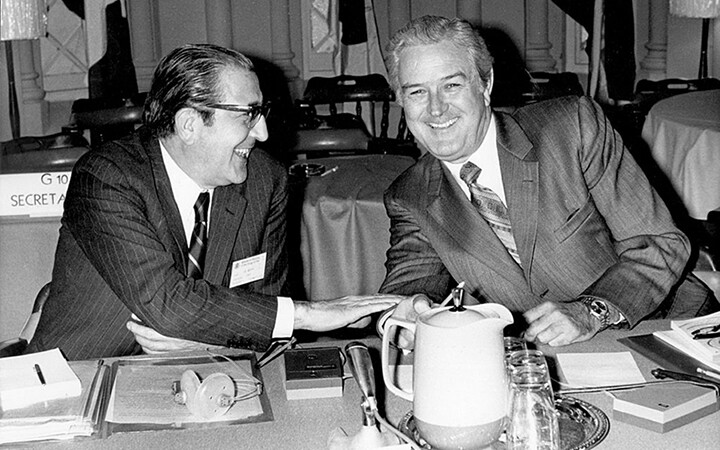
Rinaldo Ossola, deputy governor of the Bank of Italy (left) chats with John Connally (right), U.S. Treasury Secretary and chairman of the meeting of the Group of Ten at the December 1971 meeting at the Smithsonian (Consolidated News Pictures/Hulton Archive/Getty Images)
by Owen Humpage
In December 1971, monetary authorities from the world’s leading developed countries met at the Smithsonian Institution in Washington, DC. They hoped to rescue an international arrangement that was rapidly disintegrating, the Bretton Woods system of fixed exchange rates. The Smithsonian Agreement is what they came up with, but it proved too little, too late. Within fifteen months, the Bretton Woods system collapsed.
The basic structure of the Bretton Woods system contained a flaw that began to emerge in the early 1960s. Bretton Woods was based on gold, but the global gold stock could not meet the world’s demand for international reserves, without which pegged exchange rates were impossible. Consequently, the United States provided dollar reserves by running a persistent balance of payments deficit and promised to redeem those dollars for gold at $35 per ounce. By 1961, however, the amount of dollar claims outstanding began to exceed the U.S. government’s stock of gold. The deficit of gold implied that the United States might not be able to keep its pledge to convert dollars for gold at the official price. It might have to devalue the dollar.
The prospect of a dollar devaluation created strong incentives to exchange dollars for U.S. gold. The U.S. Treasury and the Federal Reserve tried to keep this from happening through stop-gap measures, but they could not solve the underlying paradox: Without additional dollar reserves, the system was unworkable; with additional dollar reserves, the system was unstable.
This difficult and uncertain situation became even worse after 1965. A rising U.S. inflation rate expanded the U.S. balance-of-payments deficit and pumped even more dollars abroad. Inflation in the United States rose from less than 2 percent in early 1965 to 6 percent by the end of 1969. The existing structure of fixed exchange rates seemed unsustainable in the face of such inflation. By the summer of 1971, speculators were moving funds out of dollars and into foreign currencies, and central banks were rapidly converting dollars into U.S. gold.
In August 1971, President Nixon “closed the gold window,” that is, he no longer allowed foreign central banks to exchange dollars for the U.S. Treasury’s gold. While the flaws of Bretton Woods and the Federal Reserve’s monetary policy had certainly played a role in the situation, Nixon also blamed the U.S. balance-of-payments deficits on unfair trading practices and other countries’ unwillingness to share the military burden of the Cold War. He wanted foreign currencies to appreciate against the dollar, but he did not want to devalue the dollar in terms of gold (Silber 2012, 93).
Nixon’s actions sent shockwaves through the international community. A crisis atmosphere prevailed. Many key foreign currencies began to appreciate against the dollar, despite heavy intervention. Restraints on cross-border financial flows began to emerge. Monetary officials around the globe feared international monetary relations would collapse amid the uncertainty about exchange rates, the imminent spread of protectionism, and the looming prospects of a serious recession. Officials at the International Monetary Fund immediately pressed for negotiations to revamp exchange-rate parities and address other complaints about the international financial system (de Vries 1976, 531-556).
At the Smithsonian meeting, the United States agreed to devalue the dollar against gold by approximately 8.5 percent to $38 per ounce. Other countries offered to revalue their currencies relative to the dollar. The net effect was roughly a 10.7 percent average devaluation of the dollar against the other key currencies (de Vries 1976, 555).
At the Smithsonian meeting, countries also agreed to future talks on broader reforms of the international monetary system. Issues that would be discussed included the central role of the dollar, shared responsibility for exchange-rate stability, the future role of gold, a means for easing exchange-rate adjustment, and measures to deal with volatile financial flows. Foreign nations also agreed to comply with Nixon’s request to lessen existing trade restrictions and to assume a greater share of the military burden.
The Smithsonian Agreement did little to restore confidence in the Bretton Woods system. During 1972, speculators pushed many European currencies toward the tops of their permissible—but now wider—exchange-rate bands. By intervening, their central banks accumulated large amounts of unwanted dollars, which stoked inflationary pressures. Germany and Japan expanded their restraints on financial flows, and other countries began to follow suit.
Gold prices, a barometer of uncertainty, rose to around $60 an ounce by mid-1972 and $90 an ounce by early 1973. Speculation was rife. On February 12, 1973, with exchange markets in Europe and Japan closed, the United States devalued the dollar by an additional 10 percent to $42 an ounce. When markets reopened, speculation against the dollar became rampant. Within a month nearly all major currencies were floating against the dollar. The Bretton Woods system was finished (IMF 1973, 2-8).
Bibliography
de Vries, M. G. The International Monetary Fund 1966 — 1971, The System Under Stress. Volume I, Narrative. Washington, DC: International Monetary Fund, 1976. Available online.
International Monetary Fund. Annual Report of the Executive Directors for the Fiscal Year Ended April 30, 1973. Washington, DC: International Monetary Fund, 1973. Available online.
Silber, W. L. Volcker, The Triumph of Persistence. New York: Bloomsbury Press, 2012.
Written as of November 22, 2013. See disclaimer and update policy.
Related Essays
Back to the reference by George Orwell for 1984 which is highly political and not allowed on the forum.

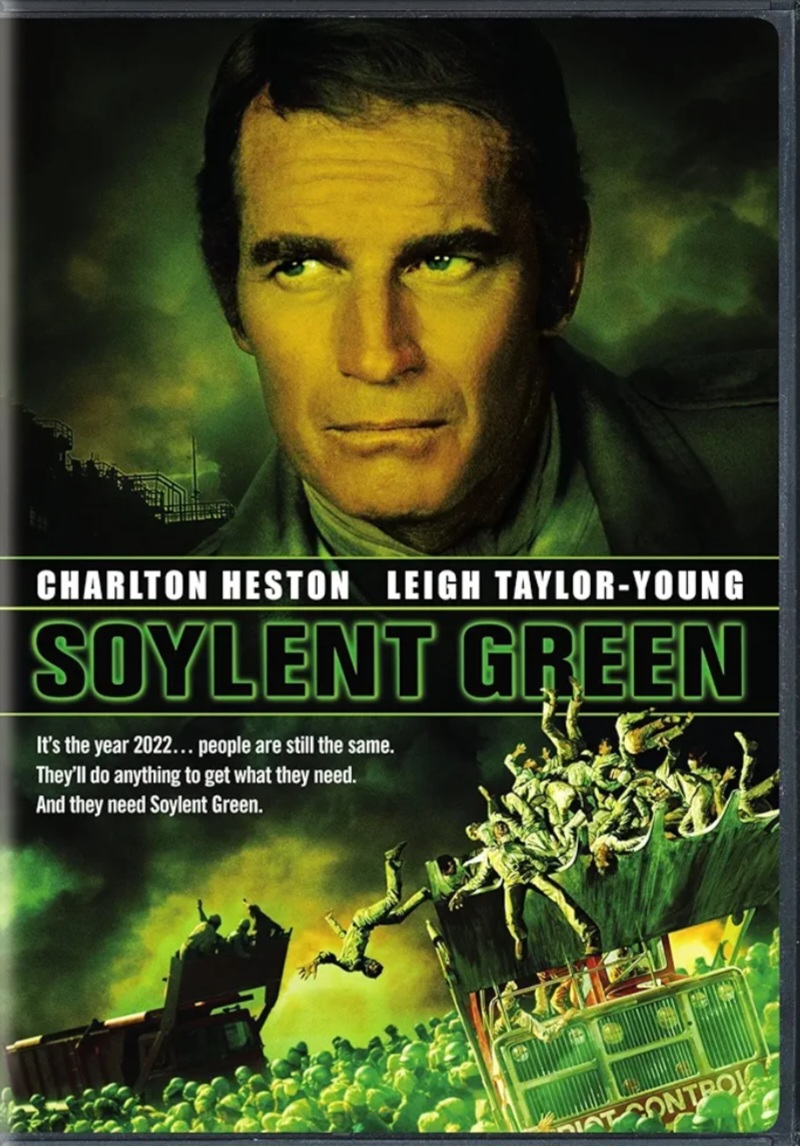
There was a trend for conspiracy political movies
Before someone outside the admin group recognizes this as highly political and it sets off a political rant on the forum I’m going to close the topic. Beautiful copper artifact you have there. There are places to discuss your topic just not on this forum. I did get the reference as copper becomes the new silver and jumps to follow silver and gold in price. Copper could indeed be confiscated some day and like 1984 maybe will be considered contraband like a book from the old world. @Bogovich I’m sure @scottfsmith mentioned the forum rules and 1984 definately will guarantee a political flag quickly. The admin group @mamuang @fruitnut @Olpea and myself are in 100% agreement historically political topics only cause conflict on an otherwise friendly fruit forum. Please refrain from posting such topics as those I mentioned above responding to your references. Thank you!
5 Likes