This is not fruit tree related, but I need help nevertheless.
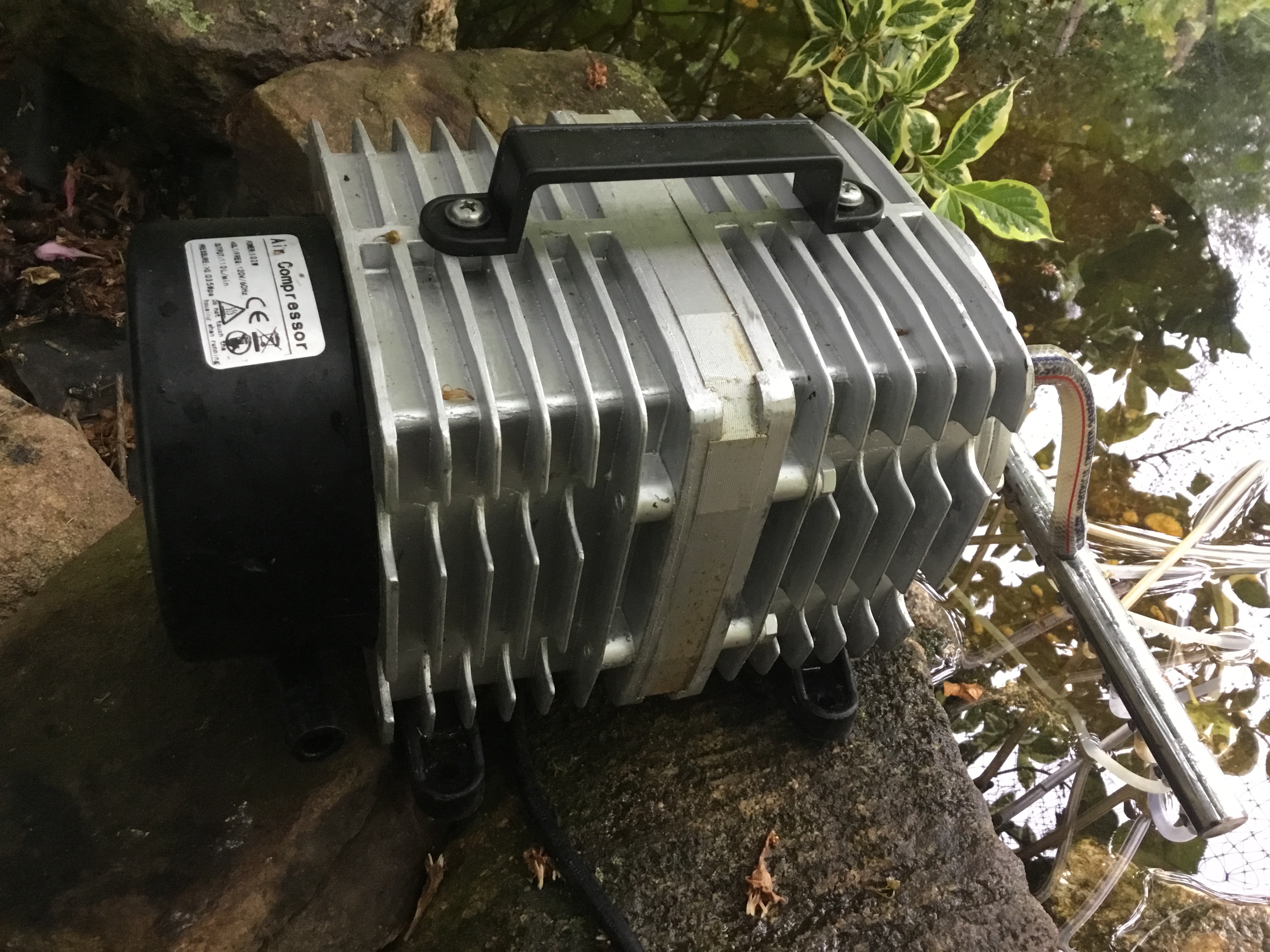
I have adopted 8 rather large koi, and a large air pump came with them to help aerate my pond when weather is hot.
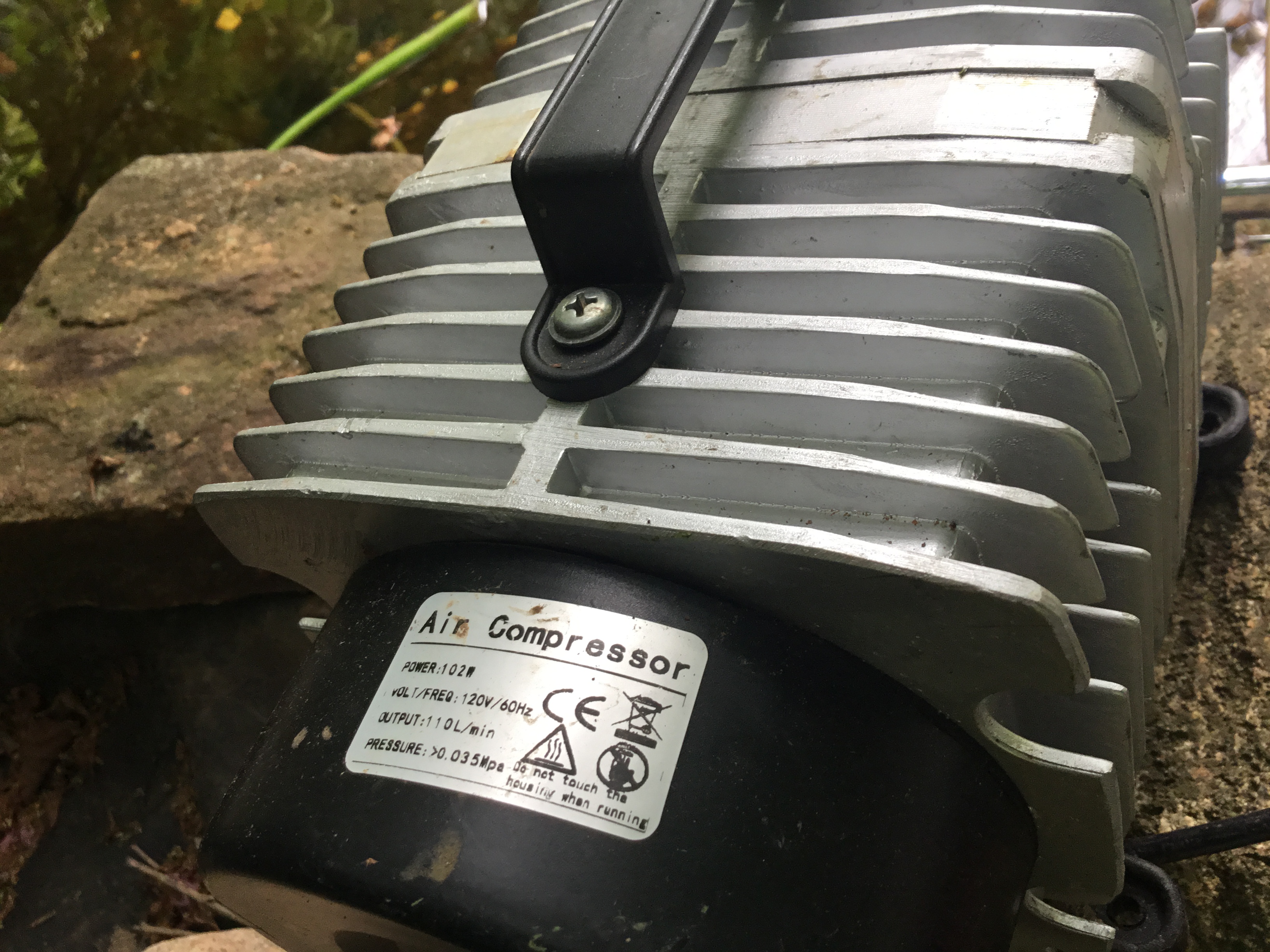
The air pump is very powerful and pumps a lot more air than I think the pond needed. It’s over 100w and it’s loud. I can hear the background humming noise at night if I my second floor window is open.
Of course, I can buy a less powerful air pump. But I like to see if I can still utilize the pump I have.
Is there a simple, inexpensive device I can get that can to reduce the the current (or maybe voltage?) to the pump, so the pump will work under “starved” condition and pump less air, therefore generate less noise?
does your pump plug directly into the mains (AC) or does it have an adapter? Is there a brand name or type number on it? without that information you can’t expect a reliable answer.
Air pumps are relatively cheap though. So in almost all cases it’s better to buy a new properly sized more silent one.
If you still want to underdrive it, you’d likely need a variac for an AC pump. Or a lower voltage or variable voltage power supply (properly sized preferable IP water proof rated). Both of those of good/decent quality cost 1/2 to roughly the same as an air pump.
Most pumps are designed for a certain load/use and artificially changing that usually makes them run less efficient.
This is also a case of, “if you lack the electronic knowledge to think of the solution, than you’ll also lack the knowledge to safely implement a solution.”
Insulating it is probably your better bet. The electrician in the house says you could get a rheostat, which is like the dimmer switch on your lights, but for motors. But, the you need an all weather cover and the rattled off some other things. Basically, he said he could do it, but he wouldn’t recommend it as a DIY project.
you would need to either use a non resistive based rheostat. And for that you’d need to know more about the motor driving the air pump.
Or you would need a massive one. Rheostats designed for light bulbs will overheat if used for a 100 watt pump. Also the rheostat will waste a lot of electrical energy as heat so will also drive your energy bill up. Not that bad if you use the pump 1-2 weeks a year. But if it’s continuously on, it might be cheaper to buy a smaller efficient pump that will pay for itself in lower electrical consumption quite fast.
the non resistive rheostats basically use PWM, and depending on your pump and the frequency, it can be okay with that. Or even make more noise.
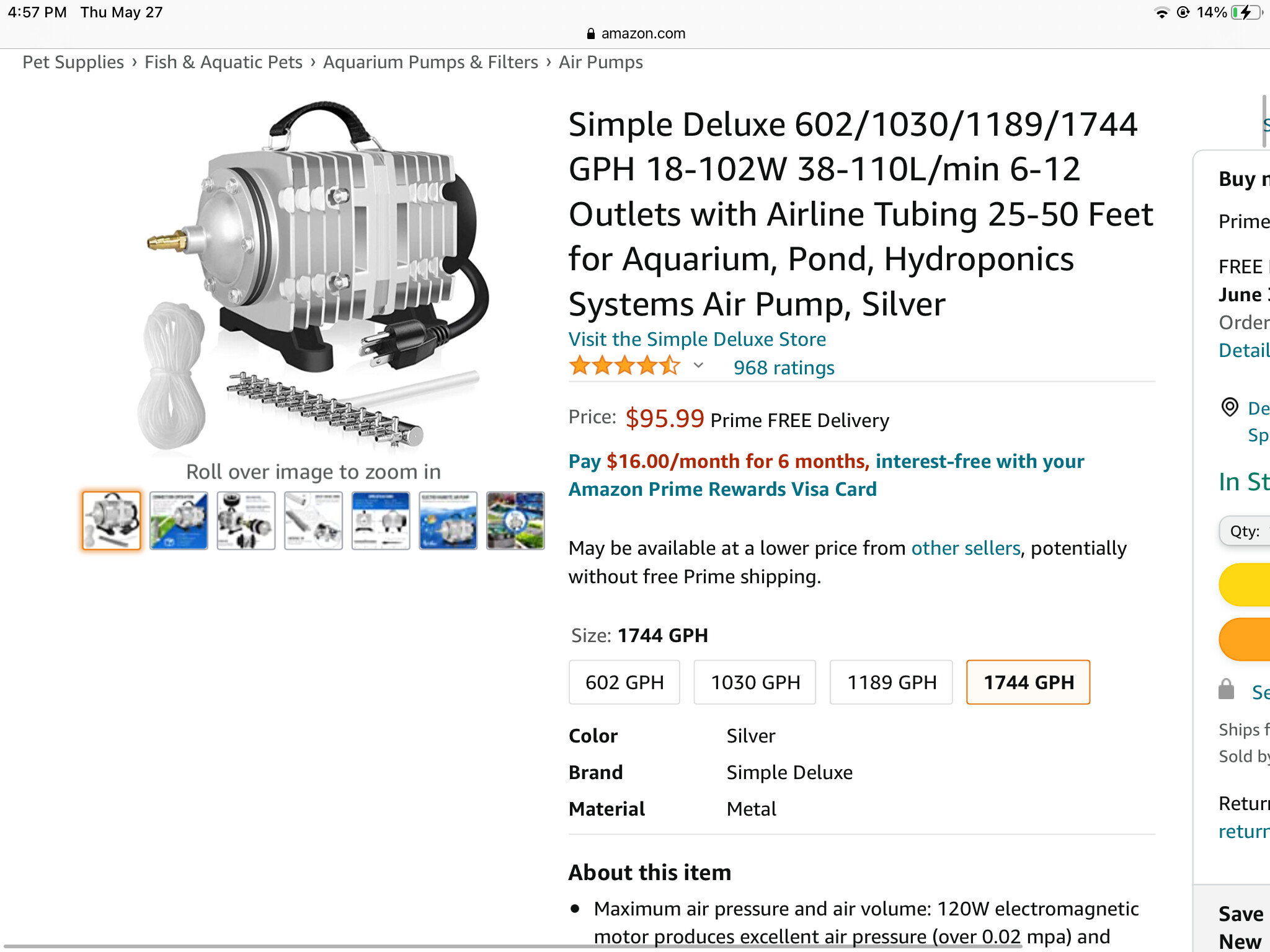
It looks just like the one on Amazon I posted before. I looked up that one, it says it’s electromagnetic motor. Can we assume mine is also electromagnetic motor?
@Robert@RubyTue thanks for the suggestions! A box with insulation was the first thing came to my mind, I tried to cover it with two nested boxes with old pillow stuffed in between just to experiment, and discovered that it get very hot quickly. This pump generate a lot of heat! Obviously I need put more thought into it if I want to go that route.
An air compressor seems like an odd way to aerate a koi pond, the noise being one reason. The usual setup is to have a submersible water pump which hooks to a fountain (also usually a filter and UV sterilizer). The action of the fountain is what aerates the water.
I have water pump and filter to aerate the pond already, this air pump is just a supplement for the summer when temperature is high and dissolved oxygen level in water is lower.
I have a large submersible water pumps that pump water to a higher place, through a large home made bio filter, then flow down through a man made creek back to the pond. The water quality is quite good and oxygenated enough, and my gold fish are quite happen all year round in this set up. A second water pump was added when the koi came, and they have lived in this set up for over a month without the air pump.
But, from what I learned It seems koi like higher oxygen level. I am just trying to get ready for the summer in case the oxygen level drops.
Air pump with some air stones can aerate the pond better.
It is an electromotor. And all commonly used electromotors are electromagnetic. (Did anyone ever use electrostatic motors for anything but experiments?)
The thing we wanted to know was, if it was a DC (Direct Current) or AC (Alternating Current) motor. It’s AC 120v 60hz
It could have an internal power supply and a DC motor. But i highly doubt it.
The proper way to adjust the output on such an AC compressor would be varying the frequency with a VFD. Those cost many times the cost of a new air pump though. An less efficient method is feeding it a lower voltage. So the motor slips. This can be done with a VARIAC. Those cost roughly the same as a new air pump.
The option of putting it in a sound insulated box will make the pump overheat. So you would need to construct a well ventilated sound insulated box. This will like cost a lot of time and effort and also cost roughly the same as a new air pump.
Conclusion. Get a new more silent air pump if this one is old and extremely loud.
Sound is hard to judge for us though. Air pumps off that size always make a certain amount of noise. I’m pretty sure a newer pump, that pumps less air at a slightly lower pressure can be a lot more silent. But there is no guarantee on that.
Aerating with a spraybar for surface agitation and a water pump might be more silent/efficient though
You could run the pump with a VFD (variable frequency drive). I use one on a 3 phase milling machine. They make them for single phase. You could probably get a decent one for less than $100.
VFD’s will underdrive the motor without hurting it, in the sense they won’t cause the induction motor to heat up, like a light dimmer switch would. But, the problem is that a lot of induction motors, the cooling fan is designed to turn a certain rpm. If you slow the motor, the fan won’t cool it properly, and the motor can heat up. This could be an issue since you’ve noticed the motor heating up (with the box over it).
Does the homemade filter use bio balls , charcoal etc. to clear up the water quality? Biological Filter Media | Bio Ball Filter | The Pond Guy . I understand now what you meant a compressor is very common in that type of application. At one time i raised tropical fish by the thousands for pet stores. The equipment you need can be found here Fish Pond Aerators | The Pond Guy . If i had to guess this guy was a koi pro. The filters are likely trash cans he modified into a filtration system. Sometimes they build them out of plexiglass and fill the box or can with biofilters. The person you got this from knew exactly what they were doing. You can buy the prebuilt plexiglass type filters which are called wet drys but i suspect you know this. This is what the best filters look like that improve water quality https://m.youtube.com/watch?v=54l6_-joh1A. I used them for many years in large tanks and ponds. It’s not about electricity its about filtration and aeriation. This is the premise of pond filtration which was borrowed from the ideas we used for tropical fish or in trout & catfish ponds and used a step farther in aquaponics now https://m.youtube.com/watch?v=icjLBECAtTE https://m.youtube.com/watch?v=p0B2l3DyRu4
Basically these artificial systems attempt to mimic a larger pond system. Make sure there are plenty of live plants in the water which greatly improve the water quality. Later in life i built my actual pond around the ideas i learned when i was still young and raising fish for other people to enjoy. https://growingfruit.org/t/ponds-are-a-great-investment/7033
As a fisheries biologist I’ll tell you that this is kind of a ridiculous motor for a few koi. This kind of pump is for people running crazy fish densities in large ponds. If I was you I’d probably use it too, but I’d put it far away from the pond, somewhere that noise won’t matter. Maybe in a garage or even up on a roof. Then run a very long air hose to the pond- just buried a few inches. The longer the hose the less air it will move. Hoses are cheap, and even with reduced air volumes it will be far more than enough.
I’d put it on a timer to only run at night. When the sun is up pretty much any pond will make it’s own oxygen.
Have VFD’s come that much down in price? or do you consider a non sine wave version “decent”?
A VFD is definitely more appropriate than lowering voltage and letting the motor slip. And judging by the heatsink on the air compressor i assume there is not an internal fan cooling.
Still the compressor feels a bit like overkill. So does a VFD to control it. It’s a bit like trying to modify your arc welder to make good toast. Probably easier to just get a toaster iron.
I like the idea of placing it somewhere where the noise bothers you less. And you got some pressure leeway to compensate for increase air tube length.
However switching inductive loads with cheap timers designed and rated for resistive loads is asking for a fire imo.
Maybe the pump has some internal protections. Or you could find a timer designed/rated for inductive loads. Or maybe the pump falls within the specifications of a cheap timer. But i would not want to bet burning down my house on a “maybe”