Citrus in Zone 5

@clarkinks the title and abstract of that paper are deeply misleading.

What the researchers did was analyze physiological markers on the leaves of this mandarin and trifoliate after exposing them to near freezing temperatures at 32 F. They found that the mandarin leaves were less damaged.

Which should have been glaringly obvious before the study was performed because trifoliate is deciduous. Of course its leaves took damaged from freezing, that’s what they’re supposed to do.

This sort of paper with amazing sounding results but genuinely asinine content is sadly very common these days, especially from certain fields and certain countries.

3 Likes

Thank you for explaining this to me. Now it makes sense why a lot more traits align with one of the plants that make up the hybrid when one selects for for certain aspects exclusive to it.

The first half of what you were saying until this made me think that you were saying there is no way of a highly edible fruit with trifoliate hardiness :sweat_smile:.
Well, I guess all this just means is we need to do a lot more generations of breeding and selection to get a lot more genes of the the genes we want together.

1 Like

This article states what i said about swingle. I take what was said above about me as very offensive.
Publication : USDA ARS

“Research Project: Genetic Improvement of Citrus for Enhanced Resistance to Huanglongbing Disease and Other Stresses

Location: Subtropical Insects and Horticulture Research

Title: Walter Tennyson Swingle, a relentless intellect that transformed American pomology

Author

item Stover, Eddie
item WRIGHT, GLENN - University Of Arizona

| Submitted to: Journal of the American Pomological Society
Publication Type: Peer Reviewed Journal
Publication Acceptance Date: 11/2/2018
Publication Date: 4/1/2019
Citation: Stover, E.W., Wright, G. 2019. Walter Tennyson Swingle, a relentless intellect that transformed American pomology. Journal of American Pomological Society. 73:129-138.
|
|----|

Interpretive Summary: In 1993 Walter Tennyson Swingle established a USDA laboratory and began a comprehensive program to breed disease- and frost-resistant citrus. He recognized the need for genetic diversity in crops and the risks of growing them in monocultures. He proposed testing all known wild relatives for disease-resistance and other advantageous traits that could be introduced to improve citrus. This led him into his comprehensive studies of the comparative anatomy and systematics of the orange subfamily. Through this effort he discovered some new species and several new genera: the genus Swinglea and several cultivars were named in his honor. In the citrus crosses he made or directed, he originated several new categories of citrus. He was an early advocate for permanent, living collections of economically important plants and their close relatives. In 1897-98, in collaboration with David Fairchild, he established the USDA’s Office of Foreign Seed and Plant Introduction, and new research facilities were set up in Miami. He conducted plant exploration, mainly in countries surrounding the Mediterranean, and among many other accessions introduced date palms, figs, table grapes, and ‘Clementine’ mandarins. In his duties in the USDA section of Seed and Plant Introduction, he received over 2000 plant introductions. After his retirement from the USDA, Swingle moved to Miami in 1943. It was here he completed his treatise on the taxonomy of the citrus subfamily. “Even in his retirement, Swingle inspired a generation of students with his knowledge, curiosity of nature, and insights into plants. His simple advice to students was ‘Look and look, again and again,’ words still relevant today”.

Technical Abstract: Walter Tennyson Swingle grew up outside of Manhattan, Kansas, attended a one-room schoolhouse and had mastered the entire curriculum at the age of nine. He was then exclusively self-taught or tutored by his mother. He was notorious in his passion for botany, and based on observations, made up his own names for plants that were demonstrably different. His formal engagement with science was ignited when he discovered that plant names and taxonomic distinctions could be found in books! He attended classes at Kansas Agricultural College (now KSU) at 15, and when he graduated at 20 he had already published 27 scientific papers in plant pathology, plant breeding and genetics. It was here that he developed his lifelong friendship with David Fairchild. Swingle joined the USDA in 1891, and in July was sent to Florida to investigate diseases in orange trees. He established a USDA laboratory and began a comprehensive program to breed disease- and frost-resistant citrus. He recognized the need for genetic diversity in crops and the risks of growing them in monocultures. He proposed testing all known wild relatives for disease-resistance and other advantageous traits that could be introduced to improve citrus. This led him into his comprehensive studies of the comparative anatomy and systematics of the orange subfamily. Through this effort he discovered some new species and several new genera: the genus Swinglea and several cultivars were named in his honor. In the citrus crosses he made or directed, he originated several new categories of citrus: the tangelos, citranges and citrumelos (now critical as rootstocks), and many other intergeneric hybrids. He was an early advocate for permanent, living collections of economically important plants and their close relatives. In 1897-98, in collaboration with David Fairchild, he established the USDA’s Office of Foreign Seed and Plant Introduction, and new research facilities were set up in Miami. He was a champion for ensuring that introduced plants were disease and pest free. He conducted plant exploration, mainly in countries surrounding the Mediterranean, and among many other accessions introduced date palms, figs, table grapes, and ‘Clementine’ mandarins. He also brought in the Blastophaga wasp to pollinate Smyrna-type figs. In his duties in the USDA section of Seed and Plant Introduction, he received over 2000 plant introductions (listed as “donor” in GRIN), but hundreds of accessions in GRIN list Swingle as the collector (among them numerous Citrus, Phoenix, Pistacia, Prunus, and Vitis accessions, but few including ‘Medjool’ date and ‘Clementine’ remain active). After his retirement from the USDA, Swingle moved to Miami in 1943. It was here he completed his treatise on the taxonomy of the citrus subfamily. “Even in his retirement, Swingle inspired a generation of students with his knowledge, curiosity of nature, and insights into plants. His simple advice to students was ‘Look and look, again and again,’ words still relevant today”.

1 Like

Just to be clear I quote articles because content and links change on articles. I did not quote articles in that way until I found out all my original 2015 research links were often broken making those threads worthless because the links were all down. If i say anything it’s with the best intentions it’s accurate but I and everyone else understand why some people insult others which violates this forums rules. Everyone should always do and say whatever they feel like is best. I will not waiver on my intentions in breeding desirable fruit. Some of that fruit I developed just about everyone somewhere is growing. The article above literally states “Remarkably, it is more cold-tolerant than Poncirus trifoliata, a widely used cold-hardy citrus rootstock.” I ask you how would you interpret that statement ? Citrus reticulata is a mandarin as I stated and is referenced in the article. If the article is stating something not true that fault is solely the authors of the articles fault.

1 Like

Well, not that there’s no way, just that good fruit quality while hitting that -20 F number mentioned earlier is going to be nearly impossible. Since could hardiness isn’t fully mapped and understood, it’s not clear how close to trifoliate hardiness you could get, but perhaps quite close.

And again, some generic recommendations happen, so you never know…

And there’s the point Avery made earlier about Citrus glauca, it might be the case that bringing in its desiccation resistance can actually result in superior hardiness.

There’s still a lot of options.

You could use the wayback machine, or just be sure to include the paper title and year of publication. I think I speak for most of us here that we’d much rather see an archive link or a citation than these huge copy paste text walls.

Yes.

I blame the authors on this one. I think they’re basically frauds.

They took an evergreen leaf and a deciduous leaf, popped them in a fridge to stimulate a light frost and then measured which leaf was damaged more, the one that stays evergreen during light frosts or the deciduous one that falls off after frost…

As you might expect they found the deciduous one was more damaged by a light frost. Then they wrote a paper saying the evergreen tree was more cold hardy because it’s evergreen leaves stayed evergreen after a light frost while the tree with deciduous leaves has leaves that behave like deciduous leaves and show damage after a light frost. It’s not that they lied, it’s just that they’re being incredibly dishonest.

That mandarin they found is native to a region that’s USDA zone 9. I’m deeply skeptical that it’s actually and more hardy than normal hardy mandarins.

3 Likes

Ironically, by the measurement these bozo scientists were using, trifoliate orange is one of the least hardy of all citrus.

2 Likes

@a_Vivaldi

Many times people have messaged me and said man i wish that original article was available. Sometimes the content of a website is just gone. Valuable research like themulberries or Stan Mckenzie does dissapears if something happens to them. If you dont believe me find me Jerry Lehman’s persimmons or his work. Short of this website most content is gone. Now i’m not saying my method of storage is great because its not its lousy. I wish search engines had longer cache of content like a library. Look up the Shannon pear or research harrow pear research station. Anyway I kind of agree with word walls are not ideal either but I read a lot and research a lot. My understanding of wild mandarins is they typically name them after the region where they are discovered. That means “ Chongyi wild mandarin (Citrus reticulata) was discovered in 1977 in the primeval forests of Niedu Township, Chongyi County, Ganzhou City, Jiangxi Province, China. Remarkably, it is more cold-tolerant than Poncirus trifoliata, a widely used cold-hardy citrus rootstock.” Means we know exactly where it comes from. There is a lot to know on mandarins. It is like ya means pear in Chinese they tend to follow logical paths which appears to be true of that mandarin also. If i understand that correctly based on this article https://www.sciencedirect.com/science/article/pii/S1674205218301874?__cf_chl_tk=5YmHB65JNd4M4SWSst.KLEhwqkGz7.y1kWTLnyJ_oDQ-1786659616-1.0.1.1-v0a7PsXAnKw.8E_KuiJkwb2QxBHvnRBM80gh4RyU5So there are a couple of major groups of mandarin and regions where they are growing. Since it readily hybridized with pummelo its variance is significant. Wild mandarin citric acid etc are much higher than domestic . I’m no longer as sure the cold hardy mandarin exists , but we can review the locations climate to get ideas. Here is what I mean by the 2 groups and variability in types “To understand genetic basis of mandarin domestication, we de novo assembled a draft genome of wild mandarin and analyzed a set of 104 citrus genomes. We found that the Mangshan mandarin is a primitive type and that two independent domestication events have occurred, resulting in two groups of cultivated mandarins (MD1 and MD2) in the North and South Nanling Mountains, respectively. Two bottlenecks and two expansions of effective population size were identified for the MD1 group of cultivated mandarins. However, in the MD2 group there was a long and continuous decrease in the population size. MD1 and MD2 mandarins showed different patterns of interspecific introgression from cultivated pummelo species. We identified a region of high divergence in an aconitate hydratase (ACO) gene involved in the regulation of citrate content, which was possibly under selection during the domestication of mandarin. This study provides concrete genetic evidence for the geographical origin of extant wild mandarin populations and sheds light on the domestication and evolutionary history of mandarin.” If my interpretation of the naming is accurate Japanese like Chinese follow location specific naming. That means owari would come from the owari province Owari Province - Wikipedia . That is helpful as we match location to fruits cold hardiness. As an example changsha is the capital of Hunan in South-central China. We can assume then this tree is from there Changsha Mandarin Tree - One Green World . You may already know this by what you said but I looked up the temperatures by location which rarely go below 36.Monthly Weather Forecast for Chongyi County, Jiangxi 341399, People's Republic of China - weather.com

1 Like

Wonder if we could have a thread for the content and have a link to the specific post in the thread, where if you’d normally just put a link to the website, but are concerned of the website being gone later, you would have link in your thread that you are discussing a topic that redirects you to a post in a thread that has has the link to the website and the contents of it?

2 Likes

I appreciate everyone’s contributions thus far, and I’m glad we can share such valuable information with each other as well as constructively criticize such information in a polite manner. It’s almost like a basic form of peer review.

I’m a big believer in hope, and without hopes and dreams, we would not have a lot of the little miracles we enjoy today. Some of our ideas may be too far fetched, but without our dreams, we would make little progress as we stick within the safe confines of what is “possible”.

Prior to its inception, did anyone realistically think a hardy citrus like the Carolina Lime (this variety always makes for a good example) was possible? Likely 5°F hardiness and highly useable lime-tasting fruit on a tree that is a Clementine backcross?! Pretty unbelievable to say the least.

I think it is much more satisfying to try and come close to our goals even if we never quite reach them. It’s a much better alternative than wondering after all those years…what if?

3 Likes

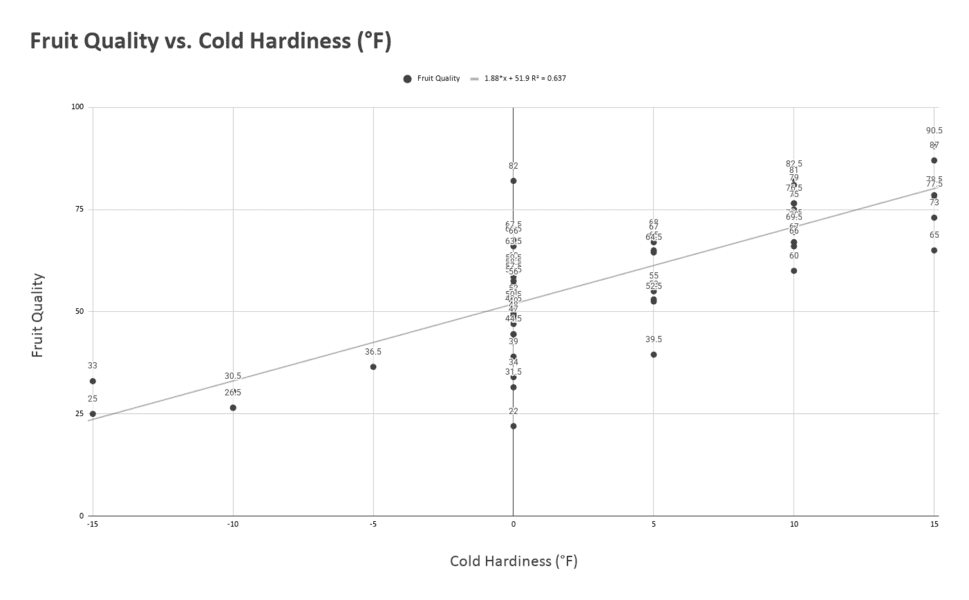
I’m sure some of you have seen this already but I enjoy graphs and visuals. Look at how wide that range at 0°F hardiness is. As low as 22/100 and as high as 67.5/100 if we discount the Prague as a ridiculous outlier. This graph is only based on ~60 varieties that I have been able to test and/or estimate fruit quality and hardiness (in the Southeastern US).

This means that while we have a strong trend, our dataset is very much incomplete, and I would not be surprised to discover we have not found the upper limits yet.

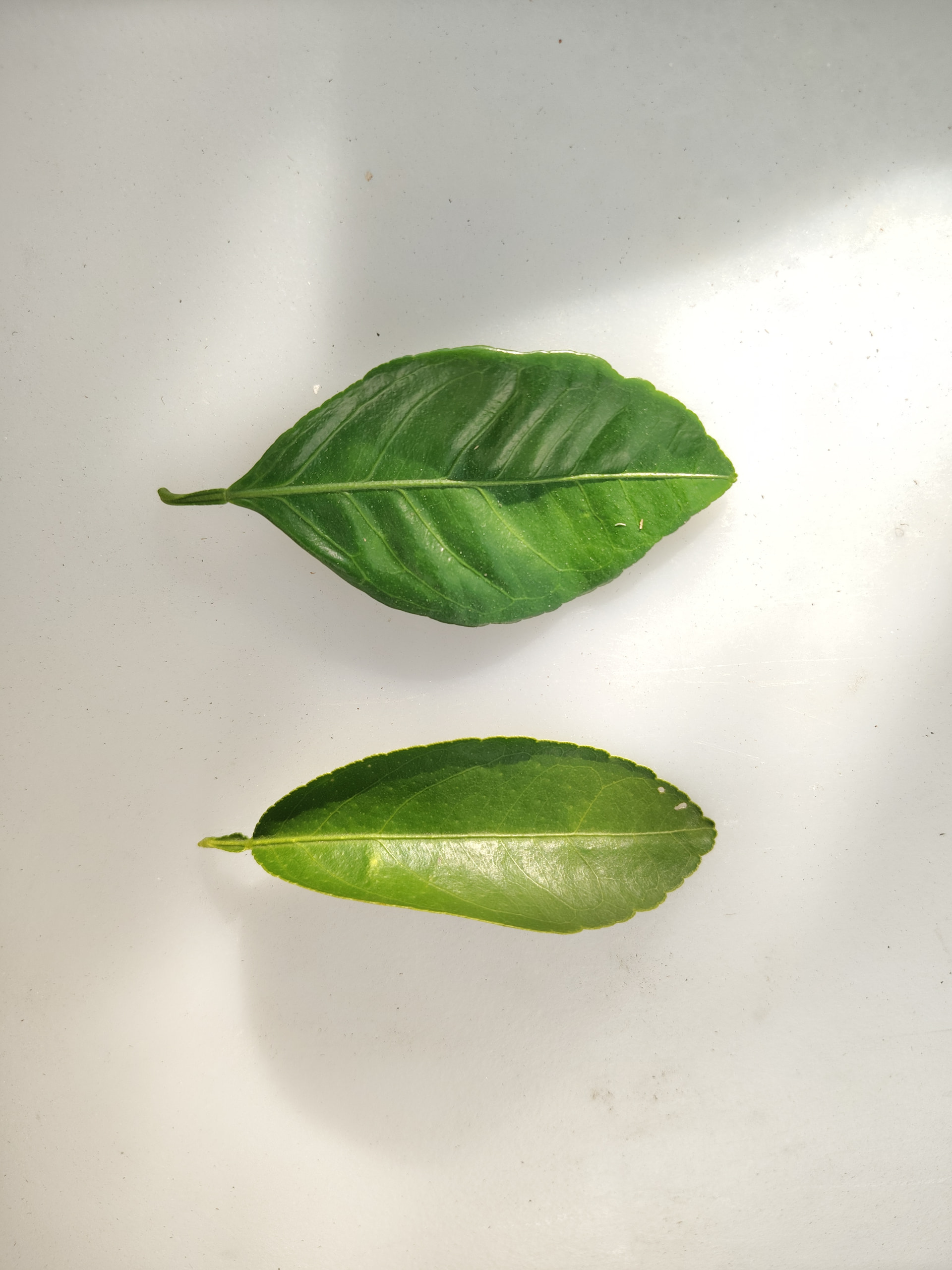
As an interesting side note, I wanted to share a photo I took of a Satsuma leaf (top) and a Prague hybrid seedling leaf (bottom) side-by-side. It produces mixed foliage types but I chose a monofoliate leaf for this comparison.

4 Likes

My thought is that areas with -20F winters have short growing seasons to mature citrus fruit. Much of the good citrus fruits take 12 plus months from set to ripe. How do you expect to get good fruit in 5-6 months at most?

2 Likes

@KS_razerback

That would be nice to have an archive somewhere and libraries do for scholarly articles but never websites or individuals research like Claypool, lehman, Donald Eugene Compton etc. and that’s just persimmons. It is how knowledge and fruit varieties become lost.

1 Like

@fruitnut

I think like pears or anything some we can grow and some we can’t. I plan to grow most underground under glass. I will always look for the Clark’s orange why not? Trifoliate ripen in zone 6 why not others. Some citrus i grew inside bloomed in February ripened in July or August. That was a huge pomelo grapefruit I grew for a number of years. It was delicious! You are being realistic ofcourse. My point is a high tunnel can work with Christmas lights and blankets on the trees if your close to the right temperatures. What is weird is when I went to Florida the grapefruit ripen in February like they are supposed to. Blueberries ripen in feb/march. I’m with you a greenhouse has some advantages. If we get one lemon tasting trifoliate hybrid to ripen and grow in zone 6 in the open we can raise it commercially for juice on major acres. We dont have California or Florida prices or pests yet. Juice is a place to start.

2 Likes

Desert lime would be a good source for the super early ripening genetics.
The earliest satsumas can supposedly ripen within few enough months to be doable here.

I wonder how early/fast it would be possible to breed a citrus to be able to ripen and accumulate sugars. Like would we be able to have a citrus tree that blooms in April and ripens the fruits from those flowers in june like the desert lime supposedly can, but with sweet fruit?

3 Likes

I can recommend Conestoga 026 as a starting point for the adventurous zone 6 citrus breeders pursuing an orange-like fruit for processing. It doesn’t seem much lower in resin than most Trifoliate Oranges but it does produce more juice with a more prominent orange-y flavor.

When diluted heavily with the right amount sugar and water, it actually makes a convincing orange drink. It reminded me and my family of Tropicana orange juice, which admittedly I’m not entirely fond of. But it’s great since you can ripen these in zone 6 where it was originally developed!

Ichangquat is an interesting and obscure hardy citrus that supposedly ripens extremely quickly, within just a few months!

3 Likes

Ooh, I’ve never heard of the Ichangquat before.

Another trait in the line I want to have is precociousness that is highly inheritable. Is there any f1 citraquats out there that are any good? If not I will hopefully try crossing changshou kumquat with poncirus plus and save only the most precocious ones.

1 Like

I think Ichang papeda helps lend some early ripening. I’ve seen photos of ripe ones in Raleigh that were taken in early October after blooming in late April.

Though the Australian citruses almost certainly will be even better for that.

I did have a note in my records of a non-satsuma sweet citrus that can ripen as early as September. I’ll have to go back and see which one that was.

2 Likes

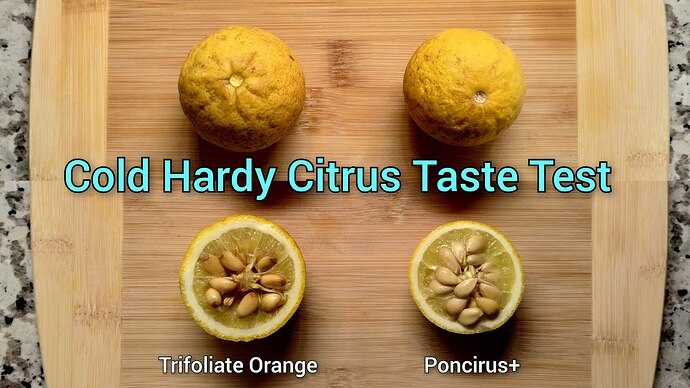
I think poncirus plus is a variety i need. I like the idea of less resin. I think it’s a great place to start with crosses.

1 Like

I have some poncirus plus and Conestoga 010 seedlings that I got as seeds from @themulberries, that I could probably give you 1-2 of each via 39thparallel if you want.

1 Like

Xie Shan is regarded as one of the absolute best mandarins and starts to ripen in early October in Z8 so it’s definitely possible for good quality fruit to be produced in less time

3 Likes