It’s mostly about the size of the example that determines which graft to use. Then like Clark said, there is a point in between that becomes choice. I think bark is better, but cleft is way easier.
I’m trying a few oddball graft ideas from youtube. The main one I’m interested in they just drill into the tree, then strip the bark from the scion to the matching depth. Looks easy. We will see how well it works.
Seriously, thanks very much for the link to the excellent tutorial. Do you use the staples? I see that in his photos, but for some reason I don’t like the idea - I guess I think it would just crack the bark. But it looks like it solves the problem for him.
I can see why you don’t like clefts. They can be a pain to heal cleanly. But for the first few years I grafted I didn’t even know there was any other kind -it’s what I was shown and it’s what I did. So it goes.
cleft is the only one forgiving enough for me to do. i shake alot. i just cant do whip n’ tongue. tried many times. never can get the angle right so i wind up chopping it off and doing a cleft instead. going to try some chip bud grafting this year.
I think chip and regular budding are both reasonably forgiving. A tremor is going to get in the way, no doubt, but if you can do clefts then you’ll manage chips and buds pretty well too. I think with those you could steady the knife edge on the wood before you start cutting, and I hope that helps.
I also like to do simple whips using Alan’s method of cutting stock and scion both with the nippers. If you can get a long enough cut on them and have the tape already stuck to the stock they go pretty well.
You don’t need staples. electrical tape is all I use.
chip budding is the grandest of all. It’s the fastest, easiest, the results are near 100%, and the vigor from the bud is at its max for the rootstock you got.
get a board @steveb4 , use your outdoor table to learn on a cutting board and then go do work in the yard doing chips. You do them once you feel summer is here. mid-June and then again in mid-August. You can start earlier too as long as you have true leaves but temperature helps around 70-75 F.
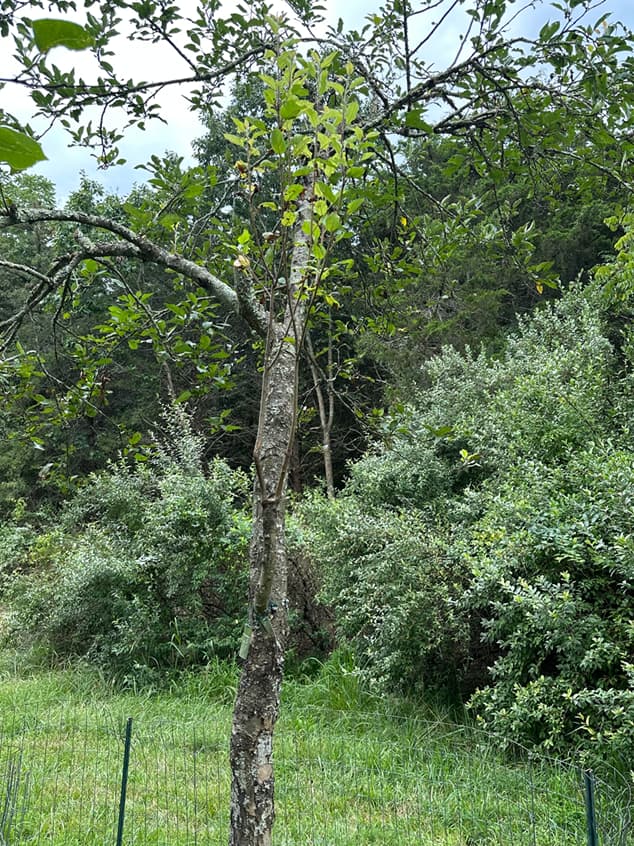
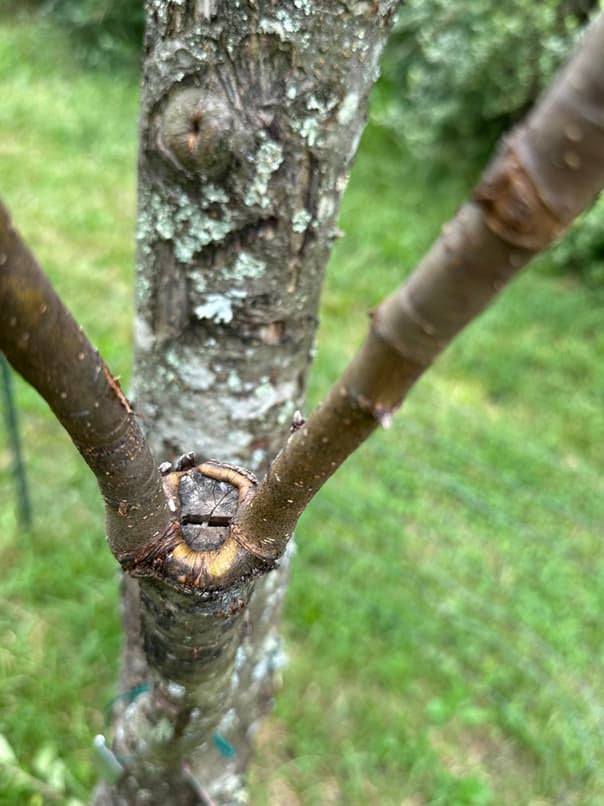
Hoping the cleft graft experts on this thread can give me some advice and postulate about why certain things happened with this graft.
This was the very first graft I ever did and I did it in sort of an urgent situation (preserving friend’s grandma’s apple tree). He had a pile of scions and I had some apple trees, so I took a couple scions and gave it a shot.
It is now 1.5 years later - this was grafted too early in spring 2024- and this is the only graft of my friend’s grandma’s apple tree that made it (several people tried).
Would like advice on:
What to do about the fact that there is still a hole in the branch? (the cleft is still there) It’s totally closed on the sides and just seems like a place for water to pool. However, I know if I cover it somehow stuff will get under that cover and the wood will rot…
Should I cut off one of the two scions soon? or should I leave both growing?
I am not attached to the rest of the tree at all but I’ve left it growing, should I cut the main trunk off and just leave the grafted part? If I should cut off the rest of the tree, when should it be done?
The rootstock tree is an unknown apple tree but likely of some eating variety one could get by mail order in the years between 2000-2005. It doesn’t seem to get fireblight but gets every other thing possible. It is a sluggish and wimpy grower.
Random questions that have occurred to me as I’ve been thinking about this graft:
Will the rootstock transmit characteristics to the scion? If I take scion wood from this tree will it be different from the original tree’s scion wood?
While it is possible that the reason for the cleft still being open is my poor skill, could it also just be the slow growing nature of this tree and maybe it will heal?
While all new growth at my house seems to be extra light green (and probably is deficient in nutrients) because of unusually heavy rain in the last few months, this grafted wood seems extra light. Is the graft somehow not happy/compatible and not getting nutrients? are these just a different color of leaf? something else?
In general how would one tell that a graft is not doing well/incompatible? (other than the graft dying)
Clefts sometimes are very slow to close up, as you see. But I don’t think you have to worry about it. Eventually the callous will reach it.
Do remove one of the scions. Any time is fine. I would nip the one of the right quite close to the callous. (If you remove it now you can use it as a budstick for summer budding.)
I would remove all the rest of the tree during late winter. In the spring your graft will take off.
The rootstock won’t transmit characteristics to the scion. The scion would from your grafted piece and everything that grows from it will be genetically identical to the tree you cut your scions from (barring mutations).
Your cleft will eventually heal; it looks to me like your skill is not at issue here.
I suspect your tree could use some fertilizer, but don’t know what.
Some times grafts survive but don’t thrive - they just kinda wimp out. That isn’t the issue here.
I don’t know if the discussion of the rescue scions goes further back in the thread, so forgive me for jumping in half informed.
If the variety is precious to you or others I’d hold off on nipping one of the two scions until the cut is healed over. In the meantime you can use much/most of one side to get more scions in the winter and share or make more grafts. I’m not sure how to interpret the purpose of saving the friend’s grandma’s tree. Is the idea to re-establish it for the Grandma or Friend at one of their places?
If its an experiment, and a chance to practice grafting to see what happens, then carry on.
At least there’s little risk that this is the last hope for a lost variety, if it was purchased in the last 30 years from a retail or commercial nursery. You could get it tested for variety and buy a new one if it is especially important to somebody.
I agree with Murky, I wouldn’t cut either of the grafts. That way if one goes down you still have the other. On those gaps I usually put tape or caulk over it to keep water out. It will eventually fill in, but like you I don’t like the idea of water collecting in it. Over the winter I would take a few scions from the grafts and cut the main section off. Then the next spring you can also graft it with your new variety. @benthegirl
@benthegirl, follow Murky’s advice! It’s pure risk management to get more scion wood next winter and graft, graft, graft! Remember, grafts can fail, break, or be destroyed by deer - so having backups is always a good idea.
You can do bud grafting even this summer.
The variety is unknown. My friend is trying to preserve it as he really liked the apples and the house has new owners. It is an older variety as the tree has been producing apples at least 40 years.
We will definitely be grafting again to create backup and the goal would be that my friend can have this variety at his house.
 going to try some chip bud grafting this year.