Haven’t thought of that yet lol. My last good seedling, I’ve just named it special strawberry 
2 Likes
Many times in my life people have told me what I can’t do , or shouldn’t do. I bring this up because every time i plant from seeds to accomplish new varities the people come out of the wood work to tell me I should not. That does not deter the dedicated mind from our cause. The most intelligent people sometimes are very negative. They at times accomplish nothing in their life for society because of their cautios, poisonous perspective, and ability to outsmart any good idea anyone ever came up with.
It’s the difference of knowing a lot of isolated, conventionally true facts ≠ understanding the basic principles of things.
It’s sort of like the parable of the fox and the hedgehog. The fox has a lot of ideas on how to catch the hedgehog, but the hedgehog has one really big idea (curl up into a spiky ball) that, when understood, just flips the fox’s understanding of catching hedgehogs on its head. The doubters who stick to the oft-repeated mantras are the foxes. Those who decide to start breeding plants anyway often become hedgehogs. Persistence in reality forces you to acknowledge it to have success.
every time i plant from seeds
My tomatoes started out as a few dozen seeds saved from an F1. Conventional advice would have you keep buying the F1 seed over and over again…but my tomatoes several generations removed are much different than that original F1: sweeter, not sour or sharp, larger (the average fruit size is going up with each generation), different colors and flavors.
2 Likes
I planted out seeds I saved froma four pack of large bell peppers from BJ’s. One hasn’t changed color yet. One is a smaller mostly three lobe orange, one is a larger four lobe orange, and the fourth is maroon and on the smaller size. Going to save seeds from the bigger orange one.
Edit: The original was a large orange pepper.
3 Likes
I’ve tried growing a few things from seed, but I’ve been most persistent and organized with jujubes. I casually grew seeds for a few years before I really started tracking it.
I did get one good seedling (so far designated BV1) from that approach. Tracking it back, I think it is a seedling of So. The father is more of a mystery, though I suspect Mi Mei.

Since then, I’ve been numbering my seedlings. Each pot gets a number. Since I generally plant multiple seeds from a given variety in a pot, when I later transplant them they get a dot number. For example, I planted 6 Bing Tang seeds in pot #10. 5 germinated, so later I planted 10.1, 10.2, 10.3, 10.4, and 10.5 in-ground. Which one gets which dot number is arbitrary, though I tend to give the largest seedling the .1 and move on from there.
I’m now up to pot #252, which includes 25 different varieties and 633 seeds. Quite a few don’t germinate, as I’d find 600+ seedlings quite a bit. As it is, I’ve got over 50 planted in-ground, plus another dozen from my casual initial phase.
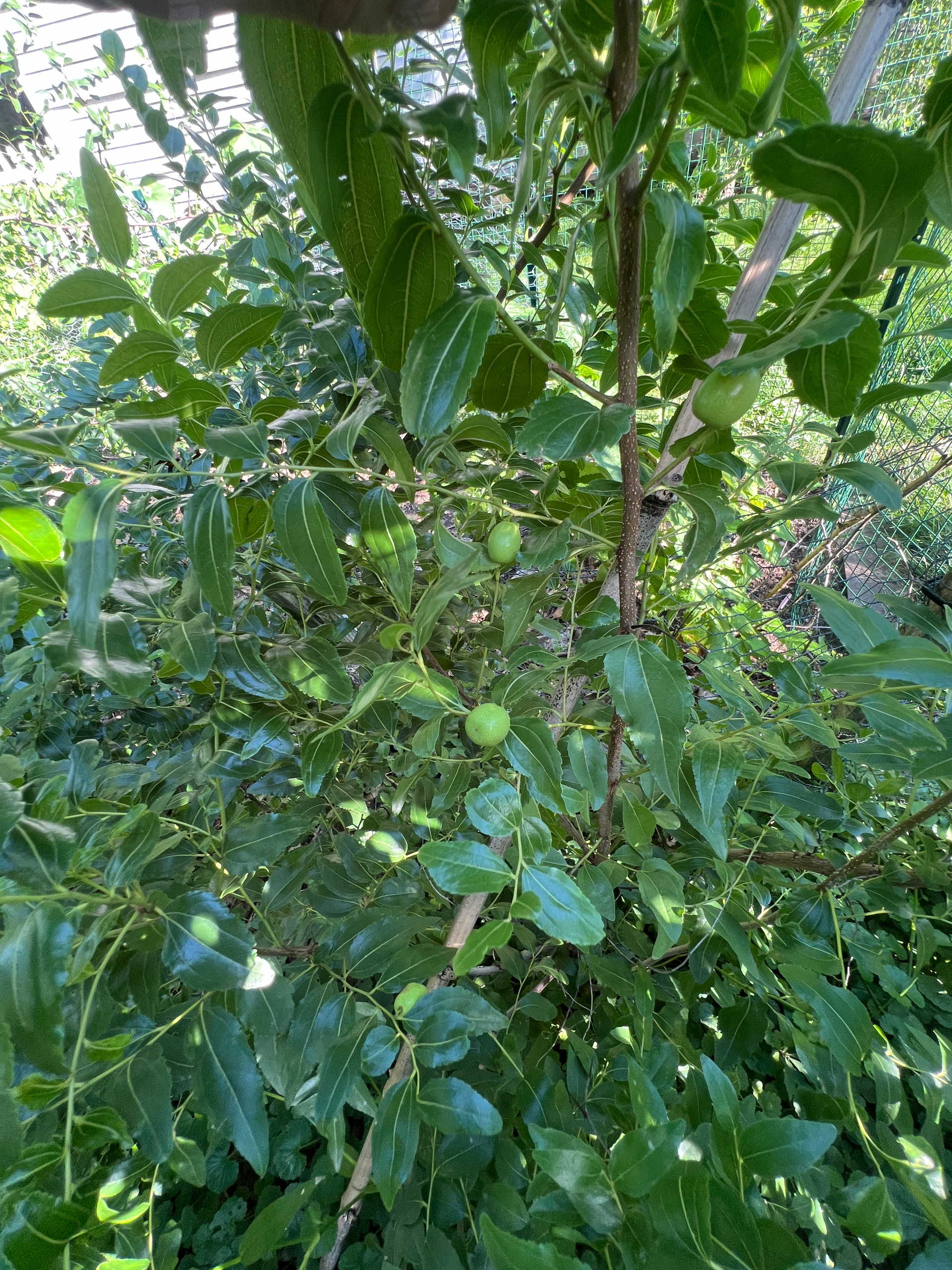
Some of the seedlings have reached 4-6’ tall and are starting to fruit.
I’ve also grafted some of the seedlings onto established trees. They definitely become productive quicker that way. Here are a couple of those grafts. The 8.2 might become BV2, based on the quality this year. The few I had last year were pretty good.
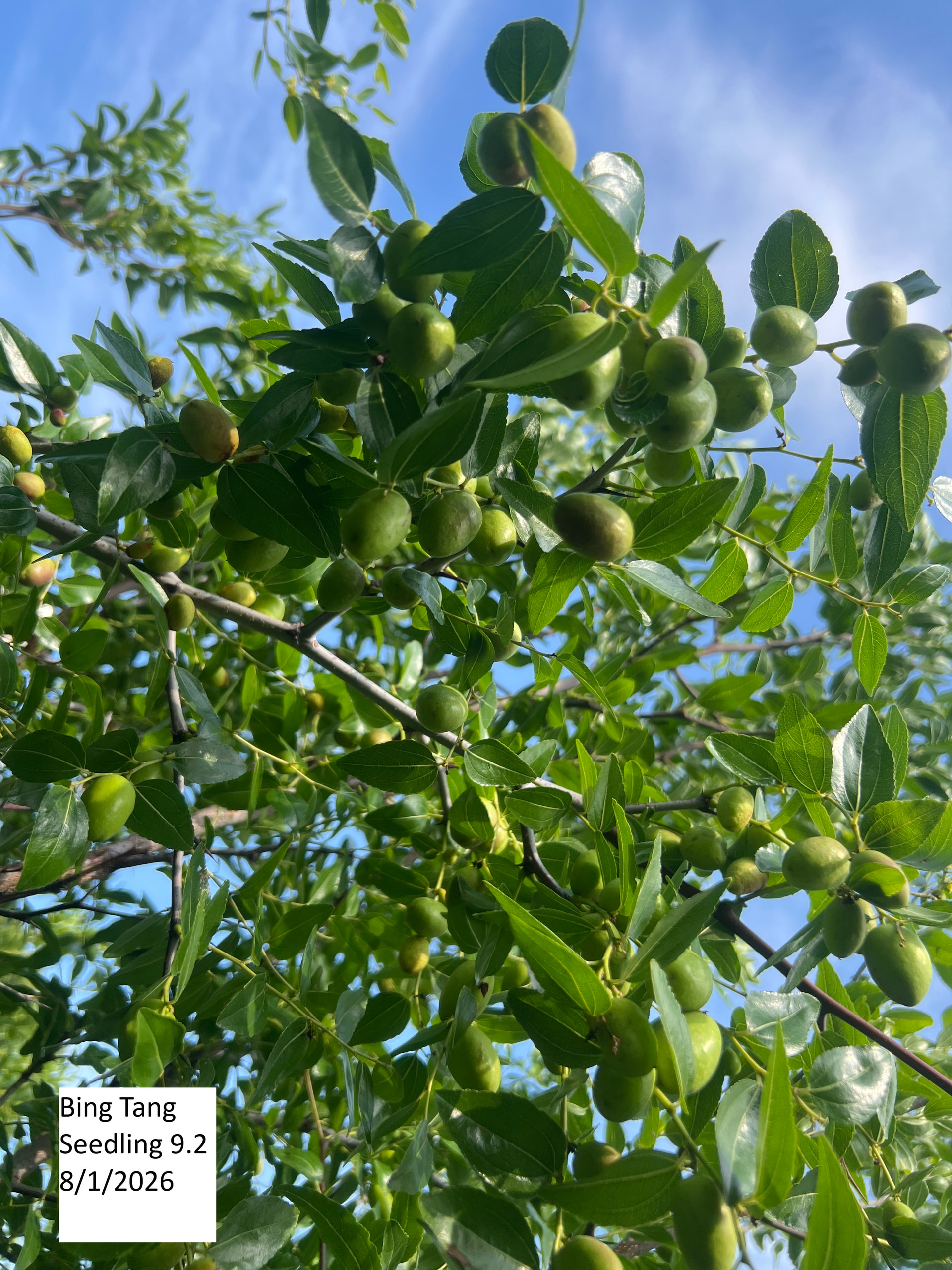
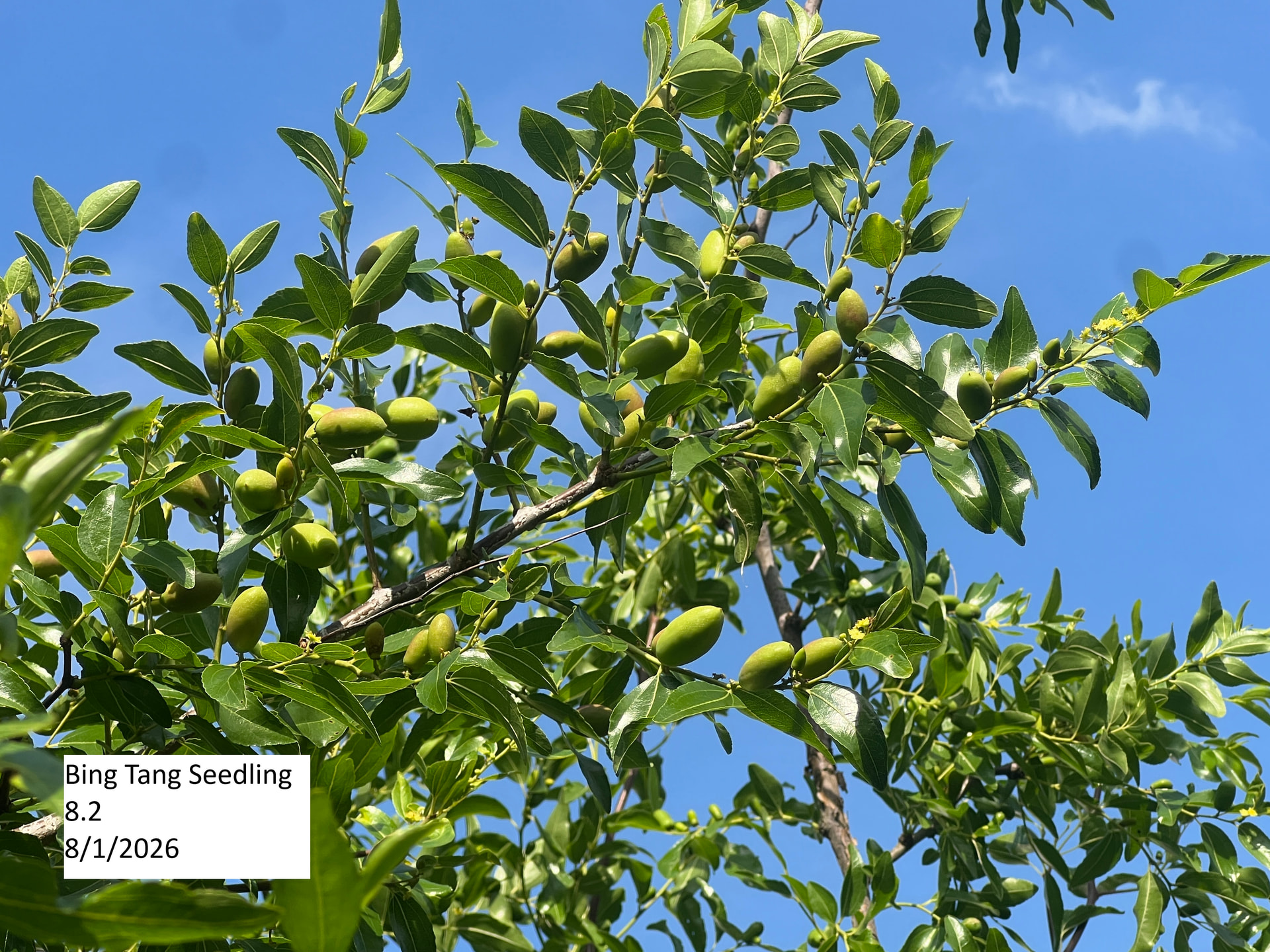
I’ll need to figure out what to do with the seedling which don’t produce great fruit. They are big enough that I wouldn’t want to ship them around. Maybe some local people will want some to use as rootstocks.
7 Likes
@BobVance I’m like this with my tomatoes where I number everything. For me, the first seeds I planted were numbered T1- T72. Then the next generation would get a second number and a label for whatever flavor it had.
Here’s an example of a tomato that tastes like cantaloupe
T1 → Cantaloupe T1 (1) → Cantaloupe T1 1 (7)
I’m at the point now where I just write the last few years’ numbers on the tag and the flavor type the mother is. Eg - Cantaloupe #7 8. I know where almost everything comes from so it’s not a big deal even if I forget to write the name down.
1 Like
I use a simpler system. It either has disease resistance or it does not. F1 gets a free pass because there is no segregation yet. F2 gets grown and subject to rigorous selection. For a typical F2 disease resistant tomato, about 1 in 60 passes. That means I can grow a lot of tomatoes and throw almost all of them away because they are not disease resistant. One result is Lorelei which is a very good flavored red cherry tomato with excellent foliage disease resistance. It took 14 years from beginning to fully stabilized variety. I have been growing it for 4 more years so I am now out to 18 years from beginning the project.
Here is another example. I am growing Buhl White corn this year. It is a result of selecting white seed out of the Buhl corn I grew last year. My selection last year was to pick out the best ears and save seed from them for this year with both yellow and white seed separated. Seed saved this year is from the best ears of white corn where best is defined as: 14 to 20 rows of kernels (mostly 16), no “floury” kernels (floury trait is mixed in Buhl), no short or undersized kernels, no short cobs, no cobs only partly filled. I saved seed to send to Glenn of the average ears but saved 3 packs of breeder seed for next year. I culled about 30 or 40 ears based on the listed traits. The result should be significant genetic gain with Buhl White corn improving significantly year by year as I grow and select.
I found one very very interesting stalk of corn in the Buhl White. It had 2 ears of corn and both were on long pedicels which hung downward when they dried. This is a valuable trait because it protects the ear from heavy rain which can ruin it for seed. It just so happened that this single stalk also carried very light yellow kernels in about 25% ratio. I have never seen kernels this pale yet still yellow. As the kernels on these two ears dried, they turned opaque and almost impossible to differentiate which are yellow and which are white. I want both yellow and white kernels as i am going to produce 2 lines with one white and one pale yellow. Hopefully a large percent of the ears will hang downward on long pedicels. This will be a breeding project for next year.
2 Likes
I don’t keep track of multiple generations. At least, not on a particular seedling. For example, here is part of a spreadsheet which tracks seeds planted. One of the mother cultivars listed is “JJS 8.2” (JJS = JuJu Seedling) for pot #237. But, I should be able to follow it backwards by then looking at pot #8 and finding Bing Tang as the (grand) mother variety. I only know half the genetics of my seedlings, as I don’t do controlled pollination.
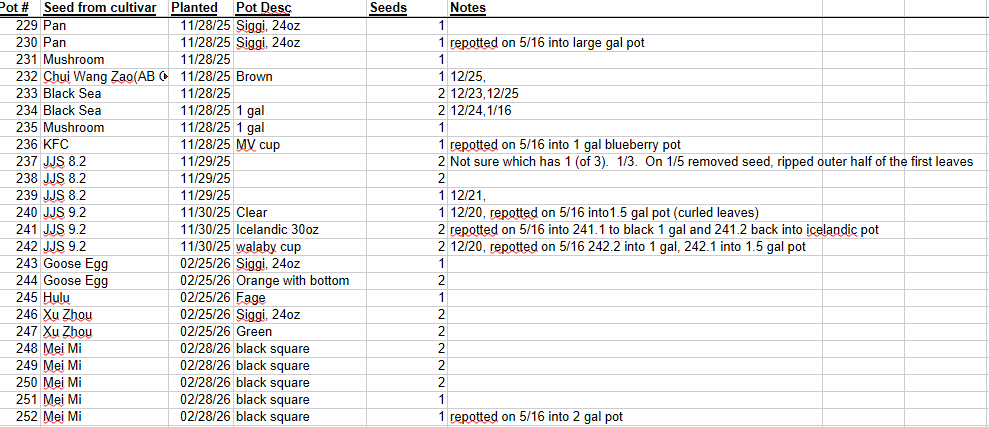
One other thing I keep track of is the kind of pot used for the seedling. This can be pretty useful in the event that the label becomes only partially legible. Knowing it was a Siggi’s yougert cup vs a square black pot can really help.
Under the notes I often list the germination date, as it let’s me see both how many germinated and how quickly so that I can get a feel for what to expect.
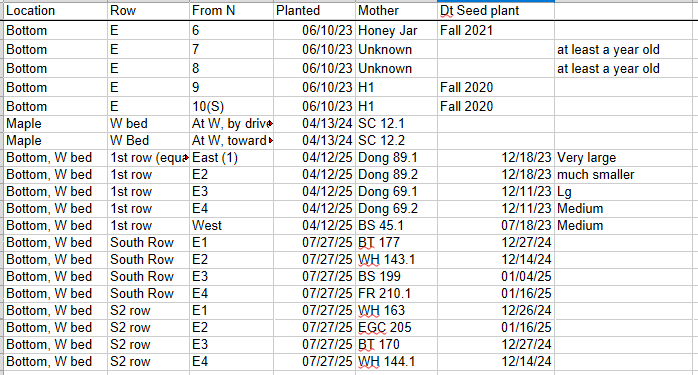
The other spreadsheet I have is one where I list what seedlings are planted where, in-ground.