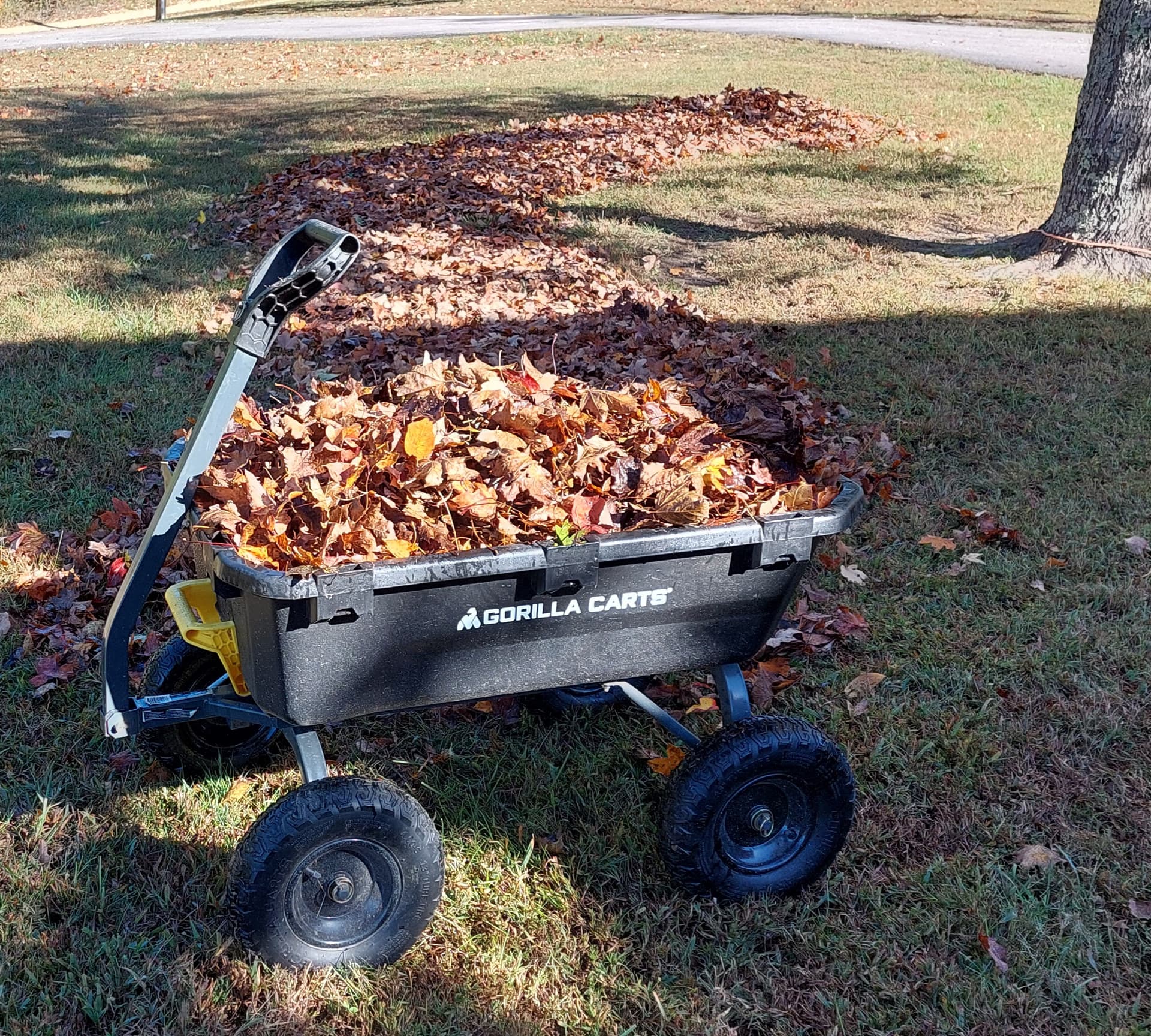
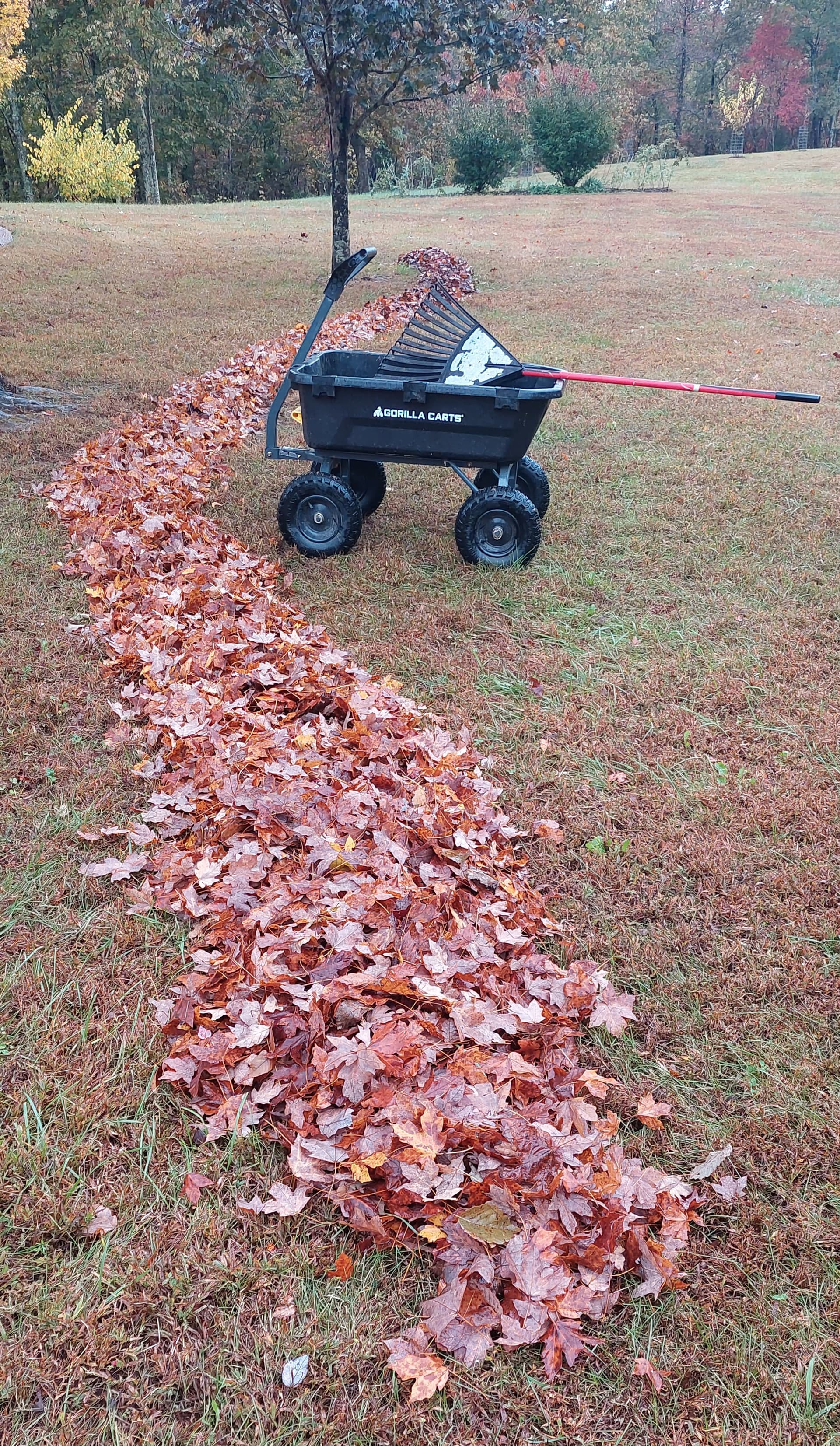
Since I practice “no mow May”… if the Maple leaves form a mat several leaves deep and sit that way well into June, then it kills the turf grass. This is consistent with my property edges which are neither raked nor mowed and do not have grass spreading into them.
As for mowing or just leaving the leaves where the leaf coverage is 50% or less… I don’t have enough experience to answer yet. I’ve read that it’s fine and beneficial, but they might have assumed you’d mow in spring.
As for the person letting their grass go to seed in fall… I can mostly do that; however, both the manure under my trees and the augmented topsoil contain weed seeds, sometimes of undesirable non-turf grasses. Broadleaf weed killers for lawns do not kill grasses that are undesirable. Hence I have to kill even grass-like things where I put compost or augment the soil because unwanted very large grasses pop up . I do not want the weed grasses to go to seed. There are weed grasses that I’ve had to manually hunt down and pull out with their roots where they appeared in the yard either in or expanding out from augmented soil. The last thing I want is a surprise of Switchgrass taking over – I’d have to glyphosate (herbicide) nuke whole areas of turf grass to bare soil to stop it.
If you stop mowing it at the time I do, it doesn’t grow up and puts its energy into making seed. It is better for the health of the grass to let it get a bit tall before winter to strengthen the roots, IMO. However, I’ve frequently seen mowing done where no grass is being thrown out of the machine, including this year because the drought caused grass to go virtually dormant in some soils.
No leaves at my place are removed that are hidden under bushes. Mostly it is leaves piled abainst walls or my house that we remove. .
I’ve got several young bushes I want protected through the winter so many of those will have leaves raked around them. The grass in the yard is quite long, it’ll be mulched soon, and any leftover leaves from the front yard (I keep that “pretty” so the neighbors don’t flip out at me) will go into the garden beds to decompose over the winter. I don’t see the point in removing free mulch/compost then buying something else in the spring.
I should add, that a key point of the article is that as species protecting habitat, shredding leaves is as destructive as removing them (unless they are moved to a place to improve habitat for the species that need it).
I’m particularly interested in how whole leaf litter might benefit syrphid flies, key pollinators in my orchard. I do have lots of them and tend to keep leaf litter on my property without any removal, besides immediately around my house.
shredding seems destructive if you dont collect right away. im currently shoveling piles of woodchips and leaves and moths are flying out of it constantly lol im sure their babies are in there.
I lived in a house that had big oak trees near. I always had to rake, of course to keep it away from the house. I moved out and decided to keep it as rental property for a while. The renter was supposed to take care of the yard, and I got the call the carpet was wet and mold was growing. He’ll let leaves pile up about 2 foot high on the wall .
I took care of it, I got rid of the renter got rid of the trees and then got rid of the house in that order. Never again.
Cultural practices are challenging to challenge. After working for a lawn care company for a season, I’ve learned more about grass than I ever thought I would (and there is always more to learn).
The best practice from a green lawn perspective is cutting and maintaining at 4", 3.5" minimum for adequate weed control and optimal grass health and resilience. As with everything there are exceptions based on grass type and other conditions.
From an environmental health and resilience perspective, leaf removal is not ideal for the ‘good bugs’ that naturally overwinter in leaf litter. Mulching those leaves is a step above complete removal from the landscape, but this still eliminates many of the good guys.
I would say that for those looking for a happy medium, blowing leaves into piles in wooded areas or as winter mulch in landscape beds is the ideal route. Some folks want that green November lawn, and that is ok.
All that said, my lawn is full of clover (fertilizer) and slowly being eliminated for more raised vegetable beds and fruit.
If you offer your lawn as a ‘dump spot’ for your lawn service, just let them know where you want them and you’ll end up with a lot of free fertilizer/mulch.
We have a massive dumpster that fills daily with shredded leaves during peak season. Having a place to dump is a win-win.
If you had directed that response to me, I would have answered you days ago… yes I did. I made the mistake because I thought it was a fresh article having found 2 days after you posted it. I never clicked your link, for some reason, and simply answered your query.
Sometimes conversations go on like that… no one else commented on my mistake and I bet a lot of the contributors to your topic didn’t read your article either. I got two hearts for posting it again.
This makes me remember that I am grateful for where I live despite my neighbors who have a junkyard instead of a yard. =)
I hear tractors, gunshots, chippers, chainsaws… but I am SO GLAD I no longer hear the leafblowers of suburbia.
It is not just super wealthy places. I lived in several suburban areas that were middle class where there were rules about lawn and lawn maintenance. I got a ticket (fixit ticket) once for my scraggly unmaintained plants that didn’t look good (in winter, when they didn’t have leaves, it wasn’t their fault. )
I’ve never bothered using a leaf blower or raking leaves on my property.
I live high on a hill and most of them tend to simply blow away downhill or off into the woods somewhere.
I did just get a leaf blower last year, so maybe this year I’ll try to get it out of some of the nooks and crannies in my fence line and a few other small places, but otherwise I’ll just let them decompose like I do every year.