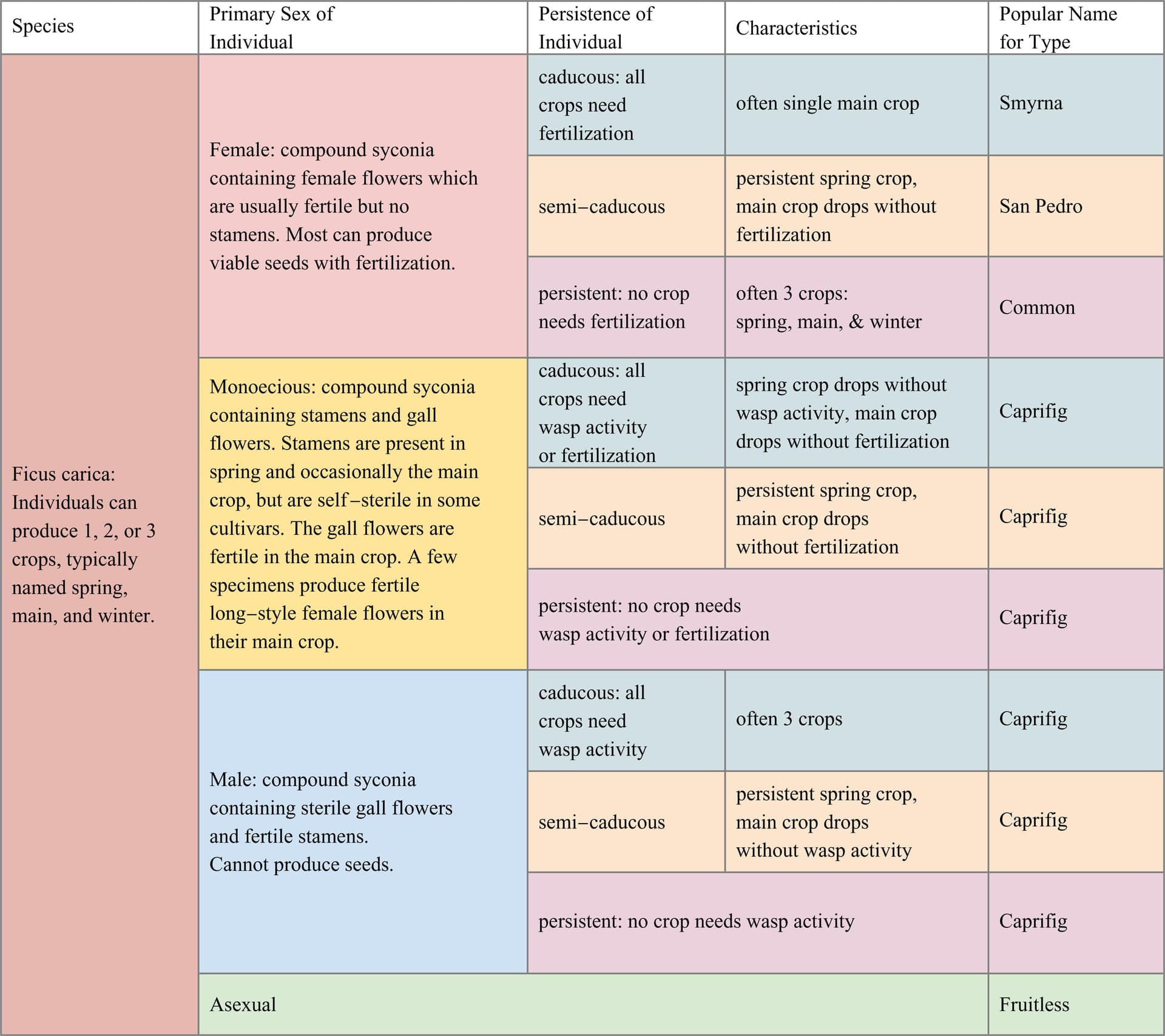
Here’s my latest attempt at aligning Ficus carica taxonomy with labels used by fig growers.
Primary update 12/10.
Here’s my latest attempt at aligning Ficus carica taxonomy with labels used by fig growers.
Primary update 12/10.
Figs are sure complicated! Thanks @Richard for shedding your light on them!! My take away question is that if I plant seeds from fruits produced in wasp territory, there is less than 1 in 10 chance to get a fruiting common fig seedling, am I correct?
It would probably depend on the parent. Not sure if they breed completely true, but a common fig would have at least a higher chance to have common offspring. You do still run into the 50/50 for male/female though. I don’t think being in wasp country would effect your odds, it just makes it possible for them to have viable seeds without hand pollinating.
@chriso , @sharq
It turns out that the persistence trait can only be passed by a persistent Caprifig. In California, many of the feral Caprifigs are not persistent. Thus seeds obtained from a fig that was pollinated in California by feral wasps from a feral Caprifig have a very low probability of being Common.
Interesting, so the male flower has to have persistent trait, either from a persistent monoecious variety or a persistent male. Does the females persistency matter at all? Like if both the male and female are both persistent, do the offspring have a higher chance to inherit it over a persistent male with a semi-caducous female?
Feral figs you wouldn’t necessarily be able to control that, but for hand-pollinated breeding projects that would be important to know.
No.
Saleeb WF. 1965. Genetics and cytology of syconium persistence in Ficus carica. University of California, Riverside. GENETICS AND CYTOLOGY OF SYCONIUM PERSISTENCE IN FICUS CARICA L - ProQuest