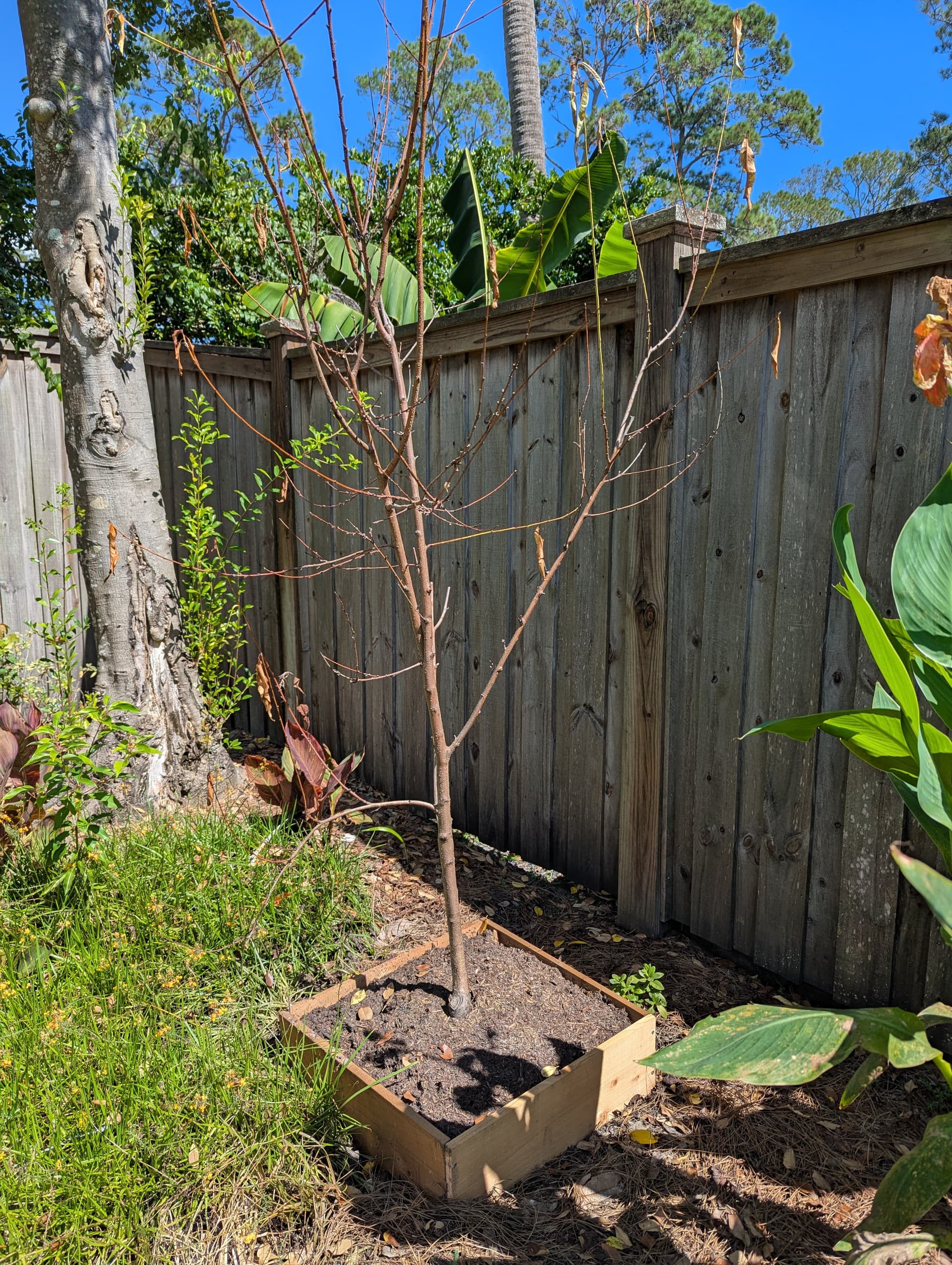
I have a question on how to address a plant with wet roots.
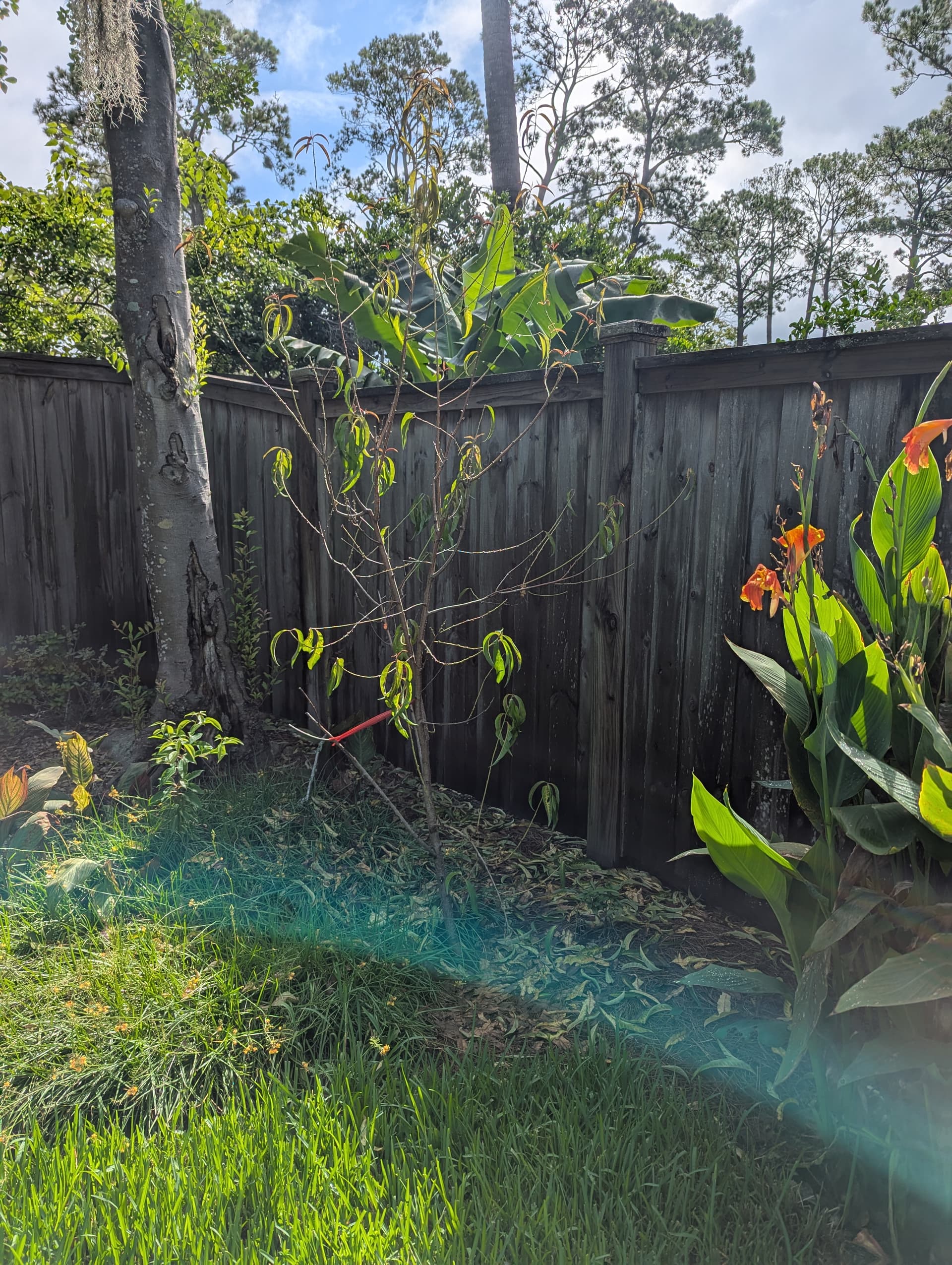
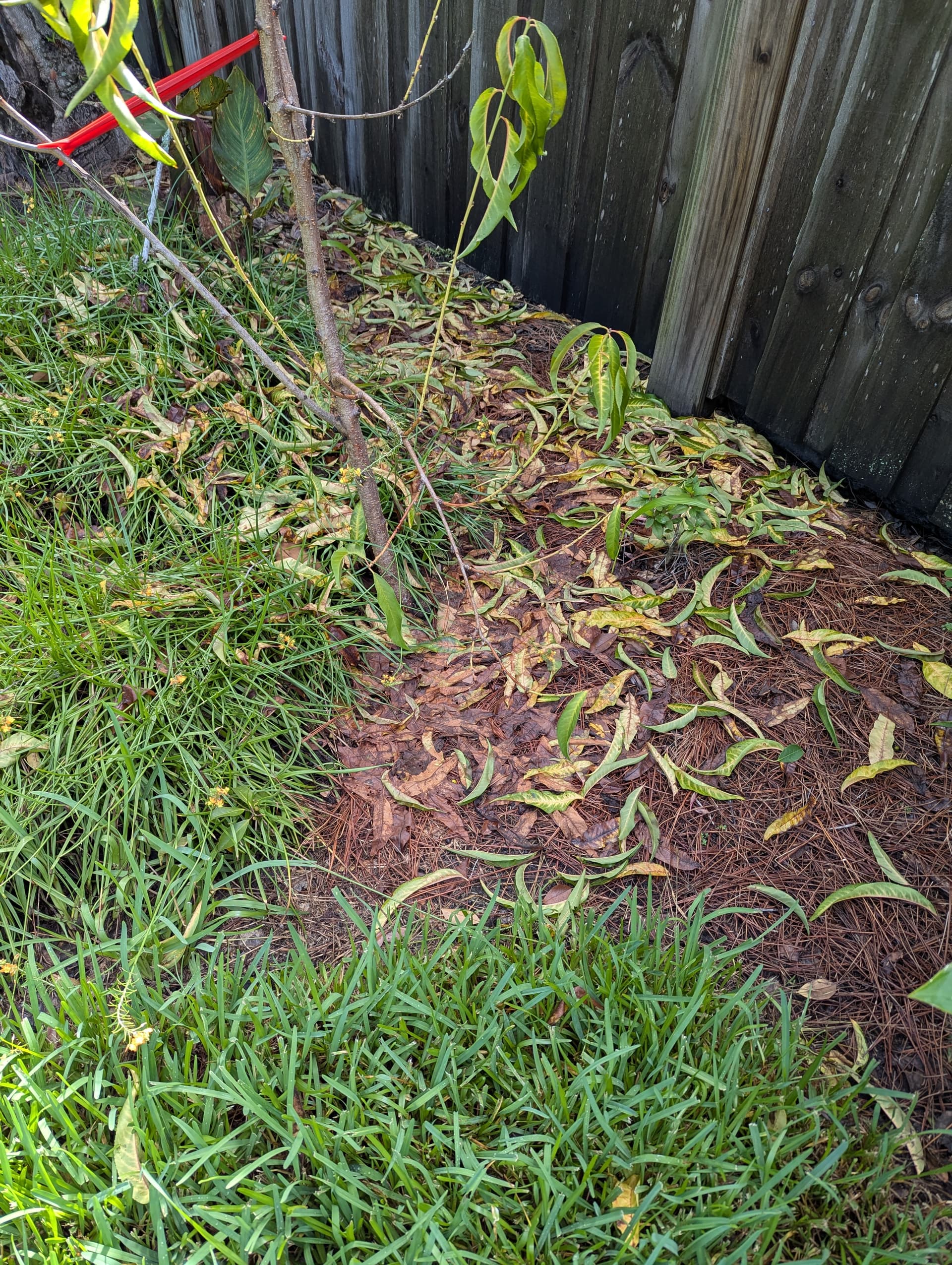
This particular area of the yard does get and stay wet and with recent rain has been an issue for two trees. We did get a lot of rain, but it was certainly not that out of the ordinary. I think it needs addressed and wasn’t sure what to do. Both trees saw the leaves turn yellow and fall off out of season.
The first tree is a nectaplum. It is just planted directly in the yard. I assume I can fix this by building a cedar box and planting it raised a few inches, but the plant has been in ground for a little less than a year. Should I just dig it up and replant it a bit higher into a raised bed? Is there anything particular to do when digging it up?
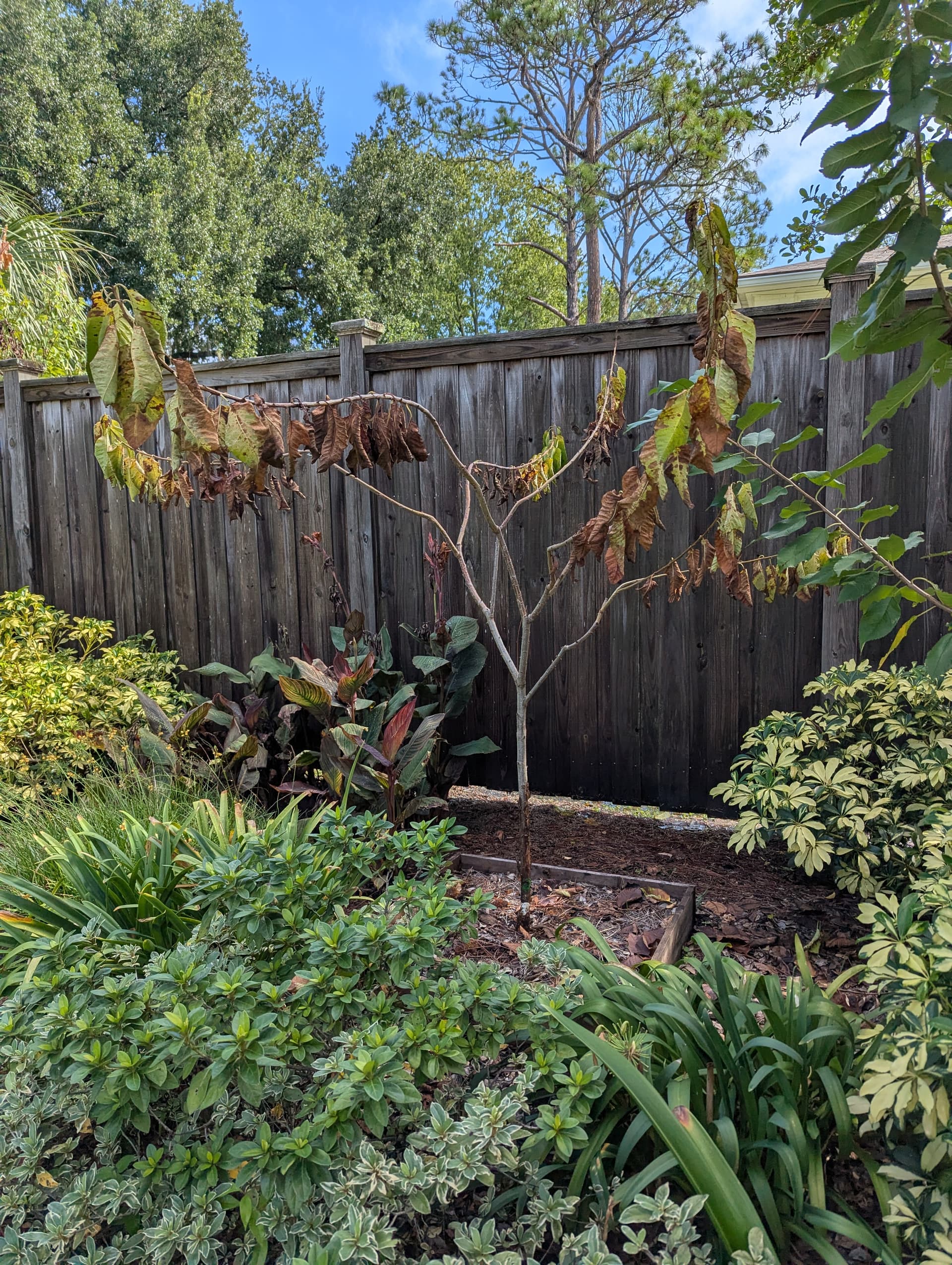
The second tree is a Lapins cherry on Maxma rootstock. This one I did plant in a raised bed. It’s next to two other cherries also on Maxma. They showed no symptoms. It is raised just as far so I’m not sure what to do. Also of note, perhaps related, is that there is this jelly stuff that was growing on the base of the tree. You should be able to see it in the second picture as I just scraped it off and left it there.
Is it oozing out of holes or damage to the trunk? like a canker? Look up gummosis of cherry tree.
And yes, you can just dig up the first tree and replant on raised bed or mound. There’s some advice on moving trees in some other threads. I think in general people have the most success waiting till winter.
I would say that you are heading in the right direction with raised bed thinking but it may be that you need to get more serious with the design.
Placing a fairly shallow raised bed on top.of an area that is regularly saturated may not be enough. During periods of rain the bottom layers of thr bed can still be saturated.
Im just guessing here because i dont know how you constructed your beds and what you used for soil.
Ideally in wet ground, if one thinks of building a raised bed big enough as to support the tree for most of its life that would be ideal. Especially with dwarfing rootstocks.
Using rock and perf pipe in the bottom to completely remove excess water is great if there is somewhere else you can dirrect that water.
The gumosis you have on that cherry is an indication of serious problems underground. On a tree that young its probably curtains…
Dont reuse that soil.
My thought is that a few inches won’t be enough. You need a real bed made of real soil not organic material. Real soil won’t decompose. And will sink less. You need enough soil in the bed to fully support the tree.
The cherry tree is unlikely to survive. The others on the same rootstock will likely follow suit unless they are also raised.
I have this problem with one of my peach trees. I unknowingly at the time, I did not know they need well drained soil and planted in a low spot that traps water. My plan is to wait until dormancy, dig it up and relocate it to better ground. I’ll fill and level the low spot and surrounding area with dirt. Then I’ll wait a season or two and plant another peach in the orginal area. Its directly in a row that I would like to maintain.
I also used the tractor and dug a trench for drainage to a hole they dug out when they needed dirt to build the barn. I used that dirt to fill in a few low spots also. I’m thinking I might plant some cold hardy figs on the left hand side trench, i’ve read figs dont mind wet feet all that much.
Installing a drain tile would fix the problem. I would suggest three feet deep if possible and run it to a low spot even if that means across your entire yard.
Wow, thank you all for the help. I guess there are multiple issues here?
I’ve briefly looked up gummosis. Is it more of a cause, or is it a symptom of something else? It was there before the heavy rains, so it would be unrelated. Sadly that cherry tree looks dead now, but the other two are fine.
I viewed the raised beds as a way to get some of the roots high enough for the plant to breathe. I didn’t think it would be the primary soil/support for the plant. That area of our yard is against a fence. The low spot pretty much encompasses our neighbors backyard. Draining it is not very feasible. I think water is just a fact that anything I grow would need to deal with pretty much. This year it was a few days of heavy rains, but we’ve had worse. It can also flood during hurricanes which would be much more water and nowhere for any of it to go. Any solution that removes water would eventually be overrun.
@fruitnut
I had used 4’x4’x4" cedar boards and a mix of soil and compost for the original beds. They did sink. I’ll use soil instead of compost this time and pack them better to keep the tree higher.
The Lapins cherry looks to have perished from this mistake. I did have a few rootstocks growing that I hoped to learn to graft on, so I’ll look to replace it with one of those. I’ll dig up what I can of that soil too.
@JesusisLordandChrist
I have a peach not far away that hasn’t had any issued. I knew cherries were sensitive. I can try and do the same with the peach I have. It seems to have really established well so far and I haven’t seen any water issues with it yet.
I’m not sure if Figs have similar issues? I have/had two paw-paw trees that never really took off, and a fig right by them. That area also gets wet and would flood when the tides get exceptionally high. I was thinking of putting other figs there in place of the paw-paws.
@Royal_Hautbois
I think draining the issue away is not a great solution here for two reasons. First I’d be draining my neighbor’s backyard to fix this (I’m sure they’d much appreciate that) and I believe the cost would be well more than it’s worth. Second even with putting in good drainage there are simply times that there is too much water. Our property is on water and when it rains too much or the tide gets too high there’s nowhere to go. If a simple raised bed isn’t good enough I’m more interested in just planting something that does work instead. The orange tree there has been doing great for years. I just wish HLB didn’t exist.
I know this thread is bit old, but I was thinking of it today because I was chatting about drainage and cherry trees. Then I looked back and saw you are in FL… which is a kind of interesting place for people interested in hydrology.
When people are planting on mounds- they are pretty big. And soil. Look at @Olpea’s peach trees. The mounds are FEET tall. I don’t exactly know where you are in FL but the drainage is a known problem. As a (former) civil engineer, drainage for citrus was a very cool/interesting problem for me and a very terrible scary problem for growers (and the mounds are FEET high).
Again, I don’t know how far from the coast you are - but part of my research area was brackish water intrusion. Certain plants are definitely more sensitive to that.
You can grow lots of fun things in FL - but if you can’t have a big mound to provide drainage (or an actual drain with a pipe that goes to some drain you’re allowed to drain to…) - you may want to try pots or cool espalier things against your house (which almost certainly- we hope- has a foundation drain if it’s that big a problem where you are).
I agree with all the comments, that in really wet areas, best to have enough dirt above grade for the tree to sustain itself.
Here’s an old thread where it shows new terraces, before settling. I think they were about 4’ tall in the middle and 11’ wide. I built them with the blade in the videos, but I’ve also built them with a skid steer. And, I’ve even built them by hand in my yard, by dumping a few 5 gallon buckets of dirt on the soil every day till the mound is big enough. You eat an elephant a bite at a time.
Agree with all the comments that the cherry tree looks to have canker. But I also might check the base for borers.
Hehe, it’s not that old! I actually just dug out and raised the plants this weekend.
Drainage is probably always a problem. We don’t live on the coast but live on the water, which is saltwater. Hurricane tides or even exceptionally large rains will cause flooding in the yard. The question is just how long does there need to be water before it’s an issue for the tree I guess?
The water does drain, but there are also times where if it’s a storm tide the water is coming from the drainage. The trees aren’t in standing water for long, but can be underwater for a few hours maybe.
My thought is that if I can keep some of the roots above the water level during those time periods it should be OK. If not I guess it’s not meant to be. But I would find it a bit odd to have this same area contain a really healthy citrus tree, some kind of holly tree (rough guess), and full landscaping with no flood issues. Water has reached the house as I understand once in the last 50 years, and it’s been in the yard twice in the last 5 years.
@Olpea that’s a pretty serious mound! More than I can get away with. I think that they’re pretty strict about things and I’d be violating some law by moving that much dirt and regrading. I don’t feel bad about making a little mound, but also if it’s just a few trees I think a little one might be all I need instead of a whole terrace. That was an awesome video.
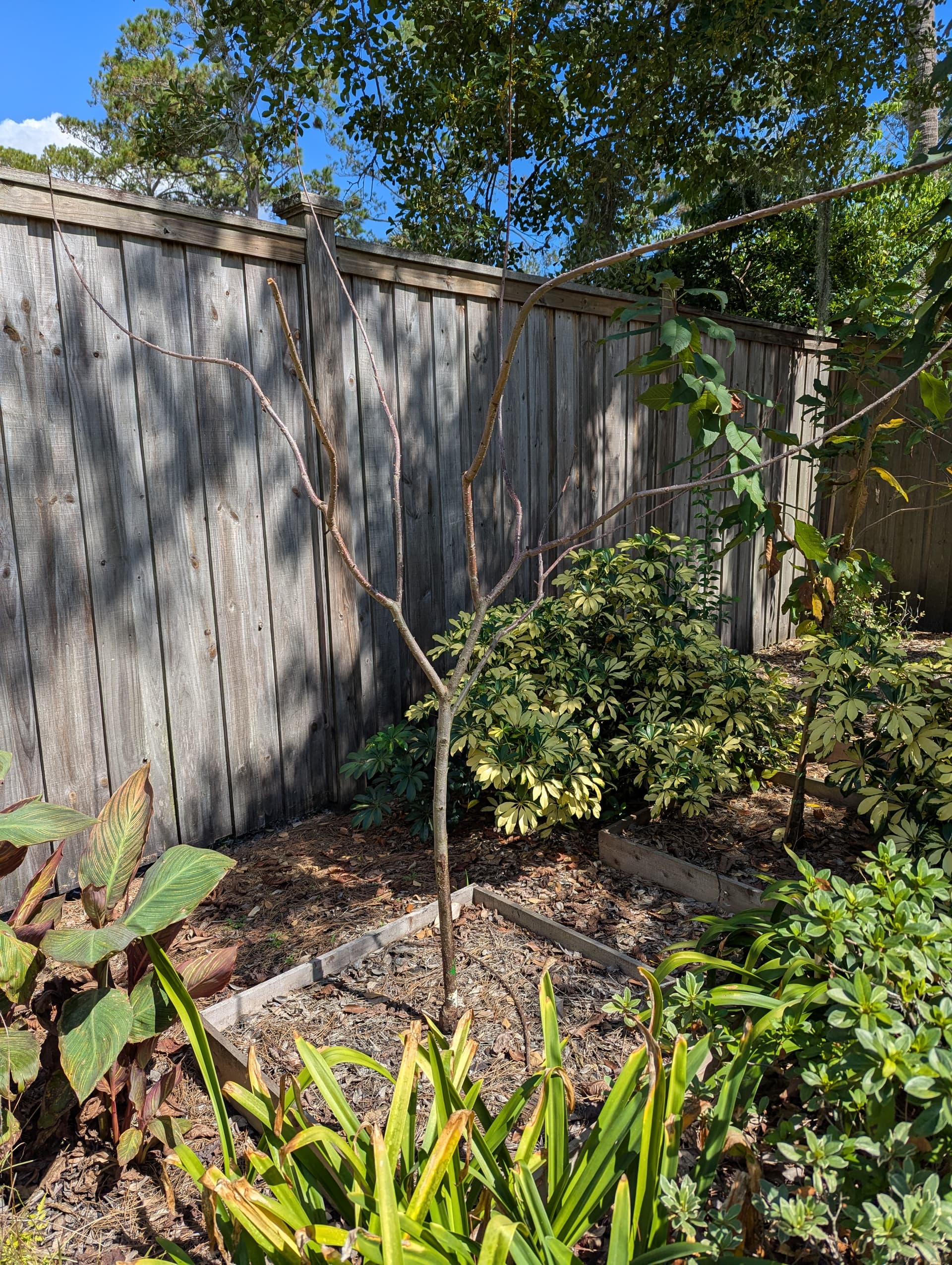
The cherry did die (or at least is dormant without leaves). The Nectaplum looks unhappy, and for good measure I dug up and raised a nearby necatarine. I’ll try and get pictures soon.
The Nectaplum which was losing its leaves and has now been raised. I put it in a 8" raised cedar bed. The cherries are on 6" and have sunk down a bit, so this is higher and should stay higher:
The Nectarine which I also relocated. Over the past month (it’s been very dry) it has started to look worse and worse. Preemptively I had thought I’d raise it, but maybe it wasn’t too soon:
As I read through some of the above, I had a thought. I think it was in one of the links, I had read about just keeping the plants in containers and letting roots grow into the ground. Once they’d grow into the ground it would eliminate the need for separate irrigation for them, and all fertilization and such could be applied to the pot. I’m not looking for any of the trees to be very large, so it would potentionally also help with limiting size while keeping roots dry?
Alternatively, if it doesn’t grow I’m completely fine with growing something else. I had great luck with citrus until HLB. I’m sure I can find something else that will do well. Based on one of those links Persimmons seem to be pretty wet tolerant.