I’ve done two interstems, so scion to scion to scion at same time on apple successfully. The scions were all apple.
3 Likes
So that’s what I do!
Graft to the interstem and then graft both to the rootstock,that way there’s no pressure on the graft, maybe a little jiggling, while making the second graft union.
I prefer doing whip and tongue or chip budding to the top of the interest, depending on how much material I have of my desired variety, and leave a long enough interstem to be able to hold it easily enough to perform the next graft without touching the top graft.
I also burried Bud9 graft and M111 interstems, I made a graft to wild apple rootstock that was damaged and broken with an M111 interstem to an Apricot Apple, and I also did a Bud9 graft on a Geneva rootstock log, not a root, just a log that I pruned from a friend’s trees in the summer, then after healing enough to remove the tape I planted the whole log below ground with the whole scion of Bud9 burried too, only the majority of the new shoot with leaves was above ground. It survived the next year, I think 2 actually, hopefully it’s still growing.
I wanted a Bud 9 tree because it’s red leafed and I hear makes good red cider, and I was thinking that I would “cheat” and use Bud 9 seedlings for semidwarf rootstock.
The idea was that the Geneva rootstock log would have enough energy to keep the Bud 9 scion alive until it rooted, and I think the log itself was starting to root after a few weeks in construction sand, and either way, one of them would root and the Bud 9 would survive and make a decorative Red Leafed tree that would produce rootstock seed for semidwarf trees, and cider or cooking apples too.
These Geneva rootstocks have such an obvious suckering problem that all of them are completely burried below ground, hopefully the interstem/burried stem of the desired variety takes over as the major root system too.
But I’m curious, why did you burry your interstems? Good rootstock but you had the cut off tops from M111 and Bud 9 just like me?
I washed this out of the sand with water soaking the whole bucket on it’s side in a Rubbermaid tub, trying to not hurt any roots, and it looks to me like all those soft white fluffy growths are the beginnings of roots, but the purpose of this is a Bud 9 tree, so I pinched off the lower shoot and planted it with the whole scion below ground and pinched off the lower leaves so that a third of the top shoot was below ground as well, and all of that was in a divot in the ground that will slowly fill itself in with leaves and errode back into itself burrying it another couple inches eventually.
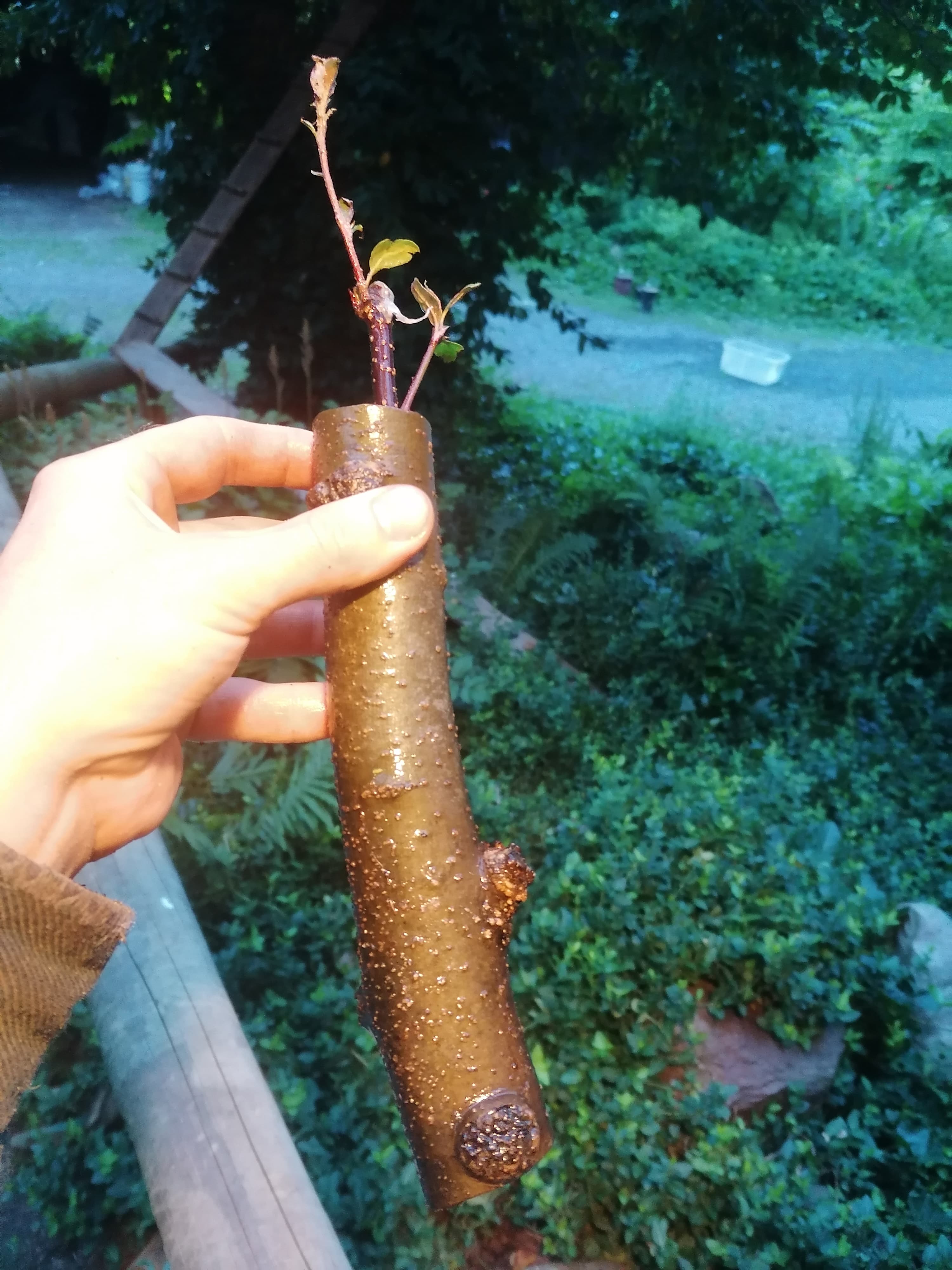
The burried long thin one log is an M111 with a graft on top again, but I can’t remember if it’s on a poor wild apple root or there’s a burried log section down there.
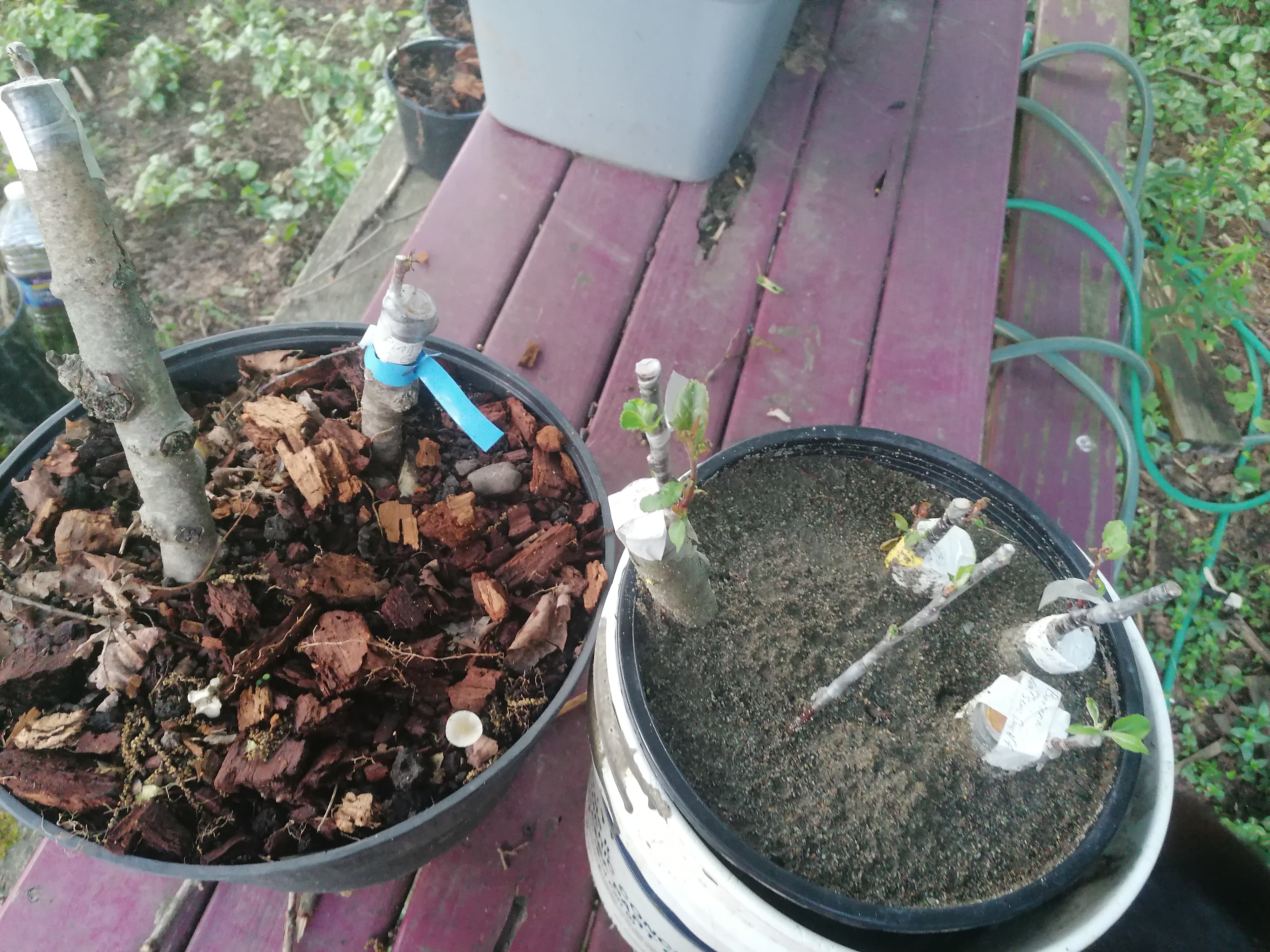
This is another log from that massive Geneva sucker with an M111 interstem and a Hall’s Pink chip bud on top. I think I planted this at my sister’s in her very wet soil, and I would imagine it survived, hopefully the Hall’s Pink didn’t get taken over by any suckers.
Of course I removed the M111 shoot, leaves, and swelling buds, and cut the stem off above the shoot forcing the Hall’s Pink chipbud to take over the growth.

My reason for burying around half of the B9 or G41 interstem piece was so that it would form feeder roots… In addition to the presumably larger and more anchoring roots the M111 portion put out. I’m hoping to have dwarf-sized trees, but which are free-standing. I have most of them at least somewhat supported still but at least a few have reached a point where that’s no longer needed. As they get more years on them hopefully all supports will be able to be removed.
That is very interesting on the grafting to a large block of wood and burying the entire thing. Presumably there is a lot of stored energy in the big piece of wood, which would keep the grafted piece alive long enough to form it’s own roots. Very interesting!
1 Like
Ahh, I see that’s why you had the M111/Bud9 written like that.
For anchoring, I think you might want to try a seedling rootstock like Antonovka, Northern Spy, or even Callery pear.
I hear only seedlings form a tap root and that’s the best anchor and also helps with draught resistance.
Burrying the interstem might work for you, but it might also lead to the rejection of the lower rootstock, wouldn’t it?
And the Bud 9 one survived 2 years, so something grew roots, hopefully I’ll get an update on it soon.
1 Like
For year 1 I grow the full tree in a pot with only the M111 portion in the soil. So they grow and are the only roots to feed the interstem piece and scion for that first year. Then any parafilm or anything else I may have wrapped them with I make sure is removed and plant it in the ground that fall. At that point I bury a portion of the interstem piece. I have 50+ trees like this with close to half having been in ground 5 years at this point. I feel confident the M111 part is still good to go, especially on the few which have no support and seem quite sturdy.
I have a number of seedlings I started this year with the intention of in the future using them as the “bottom” section instead of M111.
Since I tend to use more G41 then B9 for the interstem piece, I’ve stuck with W&T exclusively. Chip budding would probably work just fine but with the well known graft failure issues with some Geneva rootstock (particulary G41) I’ve not risked it. Hurricane Helene was somewhat intense here, not as much as folks in North Carolina or Georgia or a few other states saw… But it was still probably the most intense wind I’ve seen in 20 or more years. I had multiple trees blown over but not a single graft union failure. I upped my staking game after that…
2 Likes
Where do you get the B.9 interstem scion? Just buy a B.9 rootstock, as well as the MM111?
3 Likes
Yeah, just a length of B9 or G41 or whatever you want to use as the interstem piece. I have a few G41 trees growing in pots, that I snip ~1ft sections from the new growth.
This year I have a number of seedling + G41 + Cultivar interstem trees. Experimenting with seedlings to see if I like the results better than MM111.
Seedling plus length of new growth from an existing potted tree… Equals no rootstock purchase required…
If the AI I asked is correct, the G.41 patent expired first of 2025. Not that that likely matters for non-commercial home orchard propagation, but still…
3 Likes
By the law, no. Plant patents do not apply to personal propagation for personal use, but that doesn’t mean that a crazy company won’t try lawfare if you are too famous for propagating their plants.
And AWESOME! I really want to hear about the seedling results, I have an Antonovka Shafran and I’d like to use those seeds for seedling rootstock eventually. Antonovka is the longest living apple tree if I’m not mistaken.
1 Like
Yep. And I grafted it all at once. I did the scion to the B.9 then to the rootstock. So far, they are actually the happiest of all my grafted trees.
I’ve read a bunch of places it is suggested to bury the graft union because M111 suckers and burr knots so much. It sounds like that can be one of the drawbacks.
3 Likes
What is purpose of interstem grafting 2 rootstocks?
There are various reasons but for me it’s the hope of producing a fairly dwarf sized, and free-standing tree. The more dwarfing a rootstock is, typically means the less roots it will have. Thereby requiring staking or trellising to keep it from falling over.
So [Seedling|Antonovka|MM111|???] <-graft-> BUD9 or G11 or G41 or similar as the interstem <-graft-> desired cultivar.
The bottom part provides strong anchoring roots. I then bury the (~12" long) interstem piece by ~6 inches or so allowing it to form feeder roots, then the desired cultivar. Which will hopefully be free-standing, as well as short enough that I can avoid ladders… As well as hopefully avoiding lots of T-Posts or trellis wire, etc…
I have 50 or so trees like this, the oldest ones in their 6th year. Most of them still have a bit of staking but for me that means a half rotten piece of bamboo leaning against and tied to it. At this age most seem like they’d be OK standing on their own.
3 Likes
did you happen to plant any where the interstem isnt buried to compare if it made a positive or negative difference?
1 Like
No they’re all pretty much the same. I had planted a half dozen trees on MM111 and a few years later was thinking of their eventual size. Did some research (much of it this forum) and discovered interstem. While the first ones were growing in pots I read about burying the bottom graft union. So that’s how even the very first ones were planted.
In the spirit of this post subject, I’ve mostly grafted all 3 pieces at the same time. This year though I did graft some really small G41 pieces to some also really small seedlings. Perhaps by next year (or +1) I’ll be able to do a single graft of the cultivar onto that. Two grafts at the same time does increase the chance of failure.
2 Likes
Where about were you grafting on the m111 stock? I would imagine closer to its roots so you don’t have to bury so deep considering you’re adding 6" from the interstem as well but maybe not 
1 Like
Yeah, very low and close to the root “flare”. Which had another advantage, I’d scrape some bark and apply rooting hormone.. And root the remaining portion of the M111 and use it the next year. I had 7 I used for perhaps 4 years straight that way 
Apples in particular have the ability to produce adventitious roots. Bury them deep and the portion of the “trunk” that’s buried, will likely form roots. For some types of trees though, this would be a death sentence…
2 Likes
I love your description, this is the perfect explanation for someone who doesn’t know about interstems or dwarfing interstems, the only thing I’d add is that with 12” of interstem you’re only getting 3/4 of the maximum dwarfing effect which is effectively achieved at 16”. If that’s the size that’s good for you, great, but some people might want a little more, or less, dwarfing.
@kinghat the same guy who told us that dwarfing effect is proportionally to the length of the interstem with 16” having 95% of the effect of being planted on those roots also tested above and below ground with his interstems, if I find it, I’ll let you know.
1 Like
How low do you start your scaffolds and what tree/row spacing fo you use? Open vase, Central leader or modified central leader?
1 Like
@wdingus I’m just in the beginningprocess of doing the same thing for the same reason, but I’m using B-118 for the rootstock and a B-9 interstem.
I bought 10 B-9 this spring and have them potted up and have several B-118 stooling, should be set for next spring.
1 Like
When I was researching apple interstems in ~2019 I did not learn/find this detail. I found numerous references to using from perhaps 4" to 8" of a dwarfing interstem.. And chose 12" to hopefully guarantee a fairly high percentage of dwarfing effect.
The tallest interstem tree I have is probably White Limbertwig (G41). I’ll have to try to measure it but suspect 9’+. I knew I could heavily prune M111 trees to keep them small, but with a lot of trees that would be quite the chore. I don’t mind a bit of pruning for size control and hopefully most will stay in the sweet spot.
Wherever the deer allow them Or perhaps  as seriously they’ve been trying to kill many of the trees. I now have an 8’ fence about 2/3rds of the way around my home orchard space, hopefully complete soon. Modified central leader is what I’ve mostly been going for.. Jury’s out as to how anyone else would rate my efforts though
I have 9 trees with BUD9 as the interstem. Since I don’t have a lot of duplicates it’s difficult to compare to G41. Wooly apple aphids are severe here and they seem to love BUD9, is at least partially why I tended to lean more towards using G41. As far as the anchor roots, B-118 should do well. I’m experimenting with seedlings just to see how they compare to clonally propagated trees/roots.
2 Likes
i was wondering the same thing. if using the interstem would it matter if using m111 or would any wild/local apple seedlings do?
1 Like