" Nature, not laboratory, produced this unique pear
- By Peter Tonge
Oct. 16, 1981, 12:10 p.m. ETWeymouth, Mass.
If it hadn’t been for Lois Turnbull’s concern for her horses, it’s quite possible that one of the world’s most outstanding new pear varieties wouldn’t now be available to the public.
The pear – Turnbull Giant, as it is appropriately termed – has it over existing varieties in so many ways that it has been awarded US patent No. 4616. The pear has exceptional vigor, early maturity, disease resistance, and a 2-in-1 crop.
Midway through the season pears can be harvested when they are just as sweet, juicy, and crisp as any apple; at season’s end they are very sweet and soft in the conventional pear manner. In addition, the tree has a rather unique way of getting around the problem of late-season frosts.
It almost sounds too good to be true, but I am assured it is not.
Moreover, I can testify from firsthand experience that the distinct apple and pear stages of the fruit do exist and that the delicious flavor is in no way exaggerated. I enjoyed eating the fruit so much that I plan on growing my own in the future.
A fruit tree with so many advantages over its competition suggests that it is the product of decades of patient research by geneticists. Well, it was nothing of the sort. It was, in fact, a sport thrown up by nature right alongside the paddock where Mrs. Turnbull threw kitchen scraps over the fence as a treat for the family’s horses. It is presumed that she had been working with pears on one occasion and that a single seed, with all the right genetic programming, was trodden into the soil by a hoof.
There is precedent in fruit-growing history for this sort of thing. The Granny Smith apple, the premier apple of Southern Hemisphere countries and now being offered in the US as well, originated as a sport growing alongside a compost heap in an Australian backyard many years ago.
Ken and Lois Turnbull farm 160 acres near Depew, Okla., and grow all types of fruit and nut trees. They quickly recognized the considerable vigor of the young seedling but were not sure whether it was an apple or a pear.
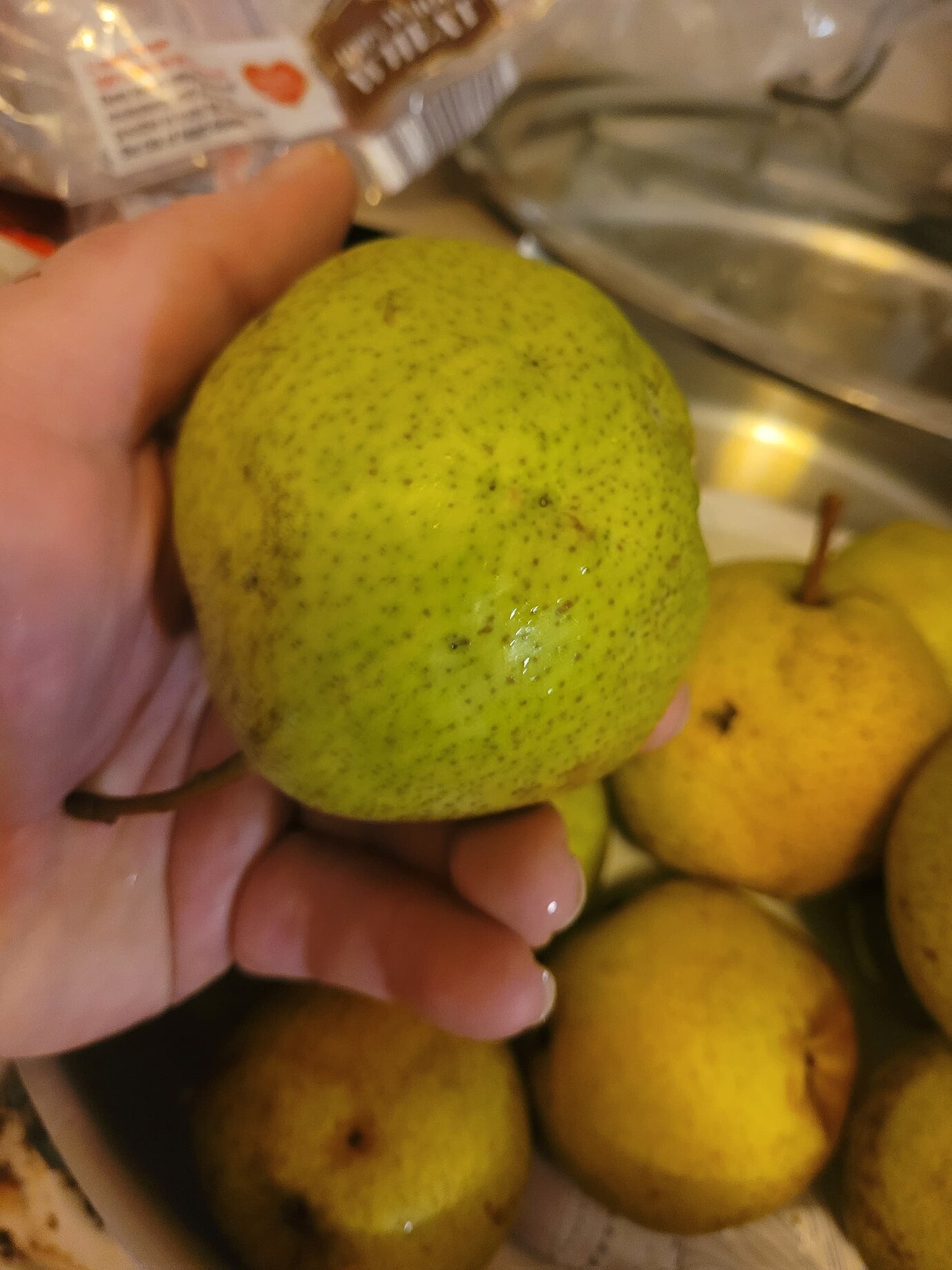
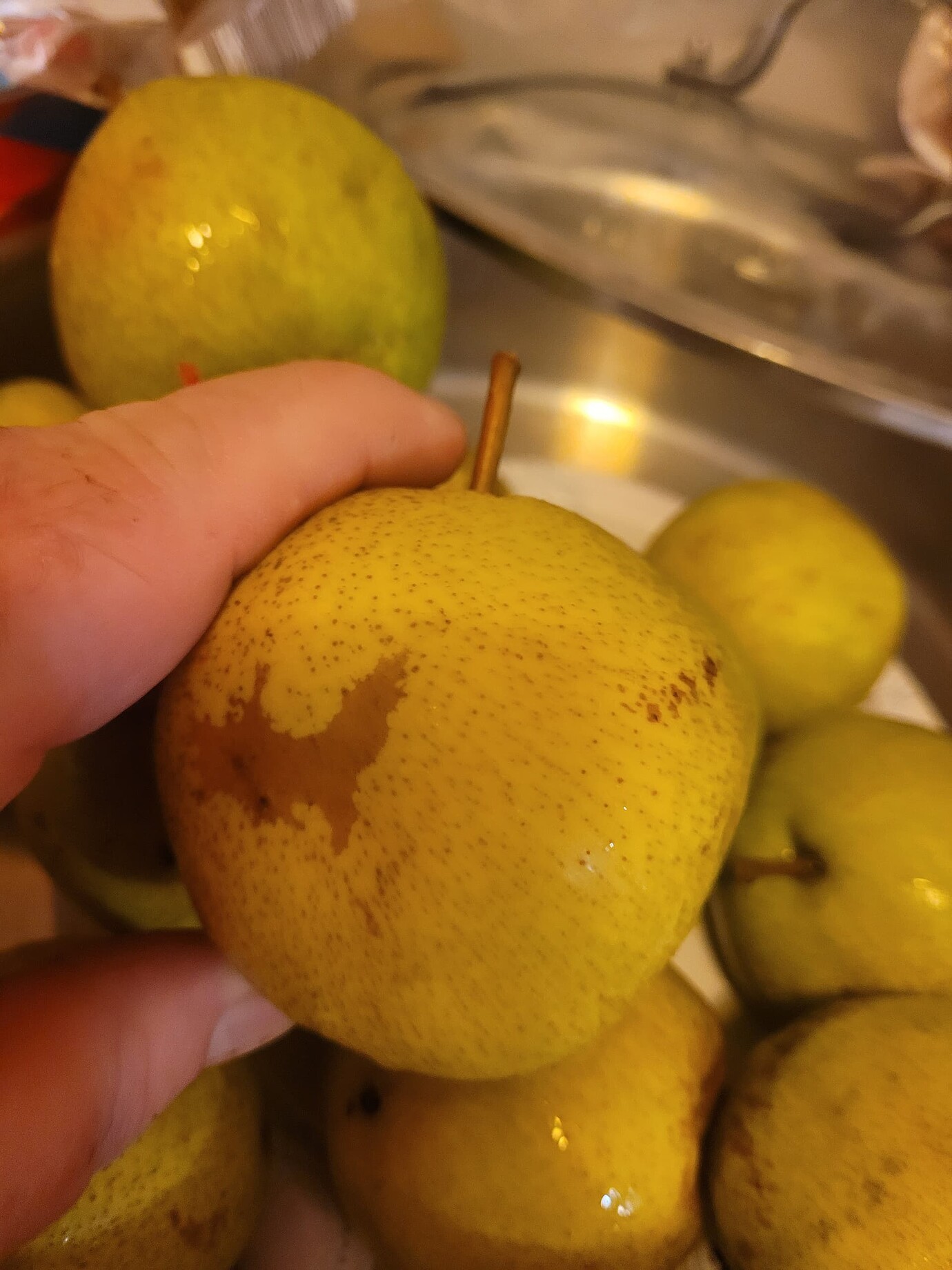
When it began fruiting it still fooled them for a while. The fruit looked more like an apple than a pear, but it tasted all pear once it was fully ripe. They were also impressed by the size of the fruit. Individual specimens would weigh as much as 3 pounds while one-pounders were common.
Once it began producing, the Turnbulls paid scant attention to their Bartlett pear. They didn’t need to. The seedling, now a large tree, was supplying all their pear needs and more. Friends and neighbors were so impressed with the fruit that eventually the Turnbulls wrote to Dan Hybskman, manager of Henry Field’s nursery in Shenandoah, Iowa.
“We’ve got a pear like no other growing here,” they said in effect. Mr. Hybskman was intrigued and went to look. It was indeed a pear (leaf and bark specimens told him that), but the fruit was almost as round as an apple although much larger. The creamy-white flesh of the tree was often almost seedless as well, a factor which might account for the fruit size (all the energy is going into the fruit and very little into making seeds).
Cuttings were taken and young trees started in the Henry Field test orchards.
Long after the growers at Field’s were convinced of the pear’s superiority based on size, taste, and vigor, a nurseryman cut into a still-green fruit to evaluate the flesh. When he chewed on it he was surprised to find the flesh juicy and with the taste and texture of an apple.
Repeated tests showed that all the large, but still-hard pears tasted just as good. The 2-in-1 characteristics of the pear had been discovered.
The tree also is disease-resistant and tolerant of heat, drought, and cold. Test trees have grown well as far north as the middle of Minnesota. There is yet another advantage that Mr. Turnbull quickly noticed. When a late frost kills off the first blossoms, “the tree just seems to bloom again until it sets fruit,” he says.
According to Mrs. Turnbull, the ripe pears can be canned, eaten fresh, made into sauces, and the like, while the green pears can be used “just like apples” in pies, cobblers, Waldorf salad, and other apple recipes."
Here are some photos from my tree this year


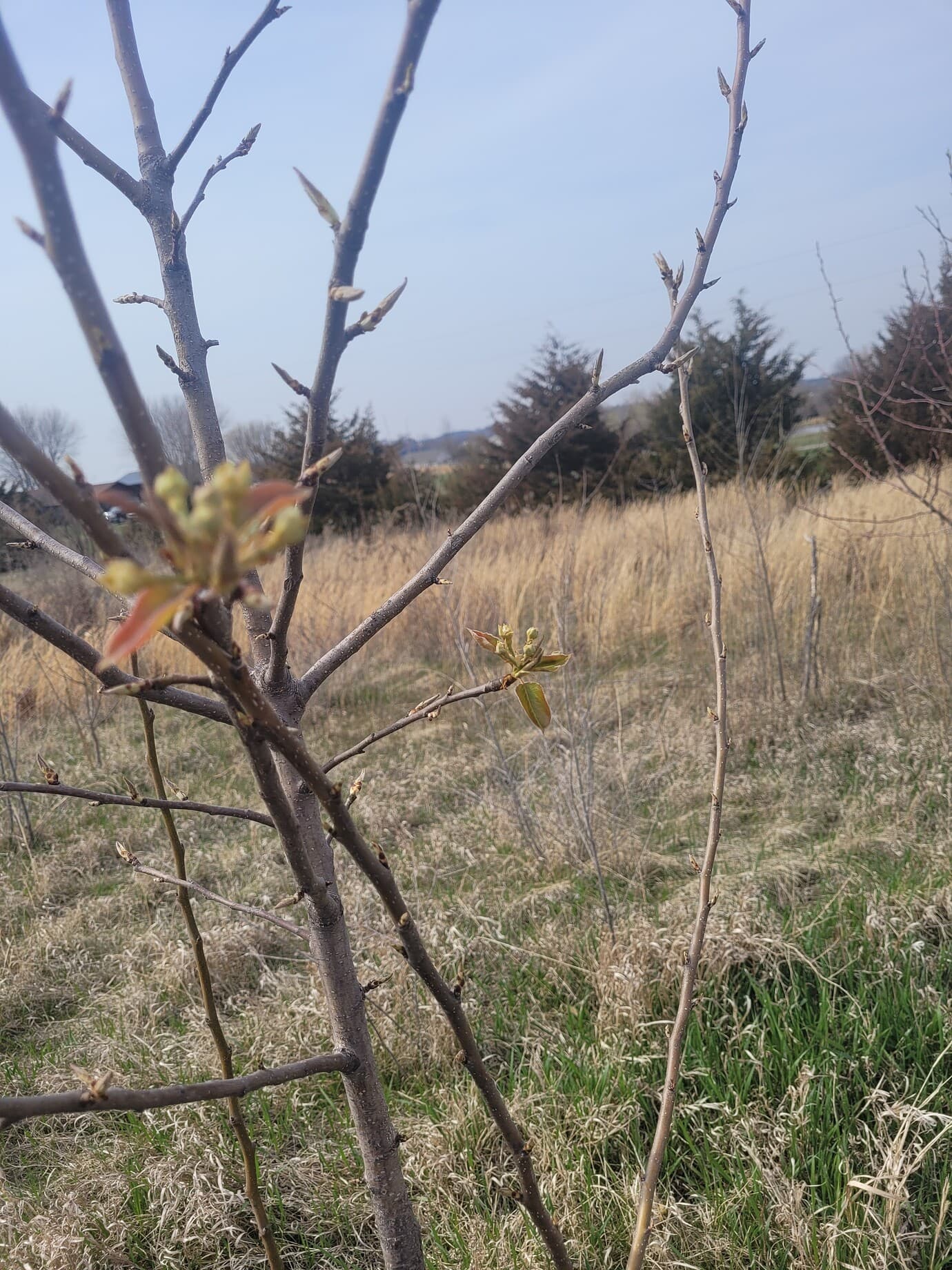
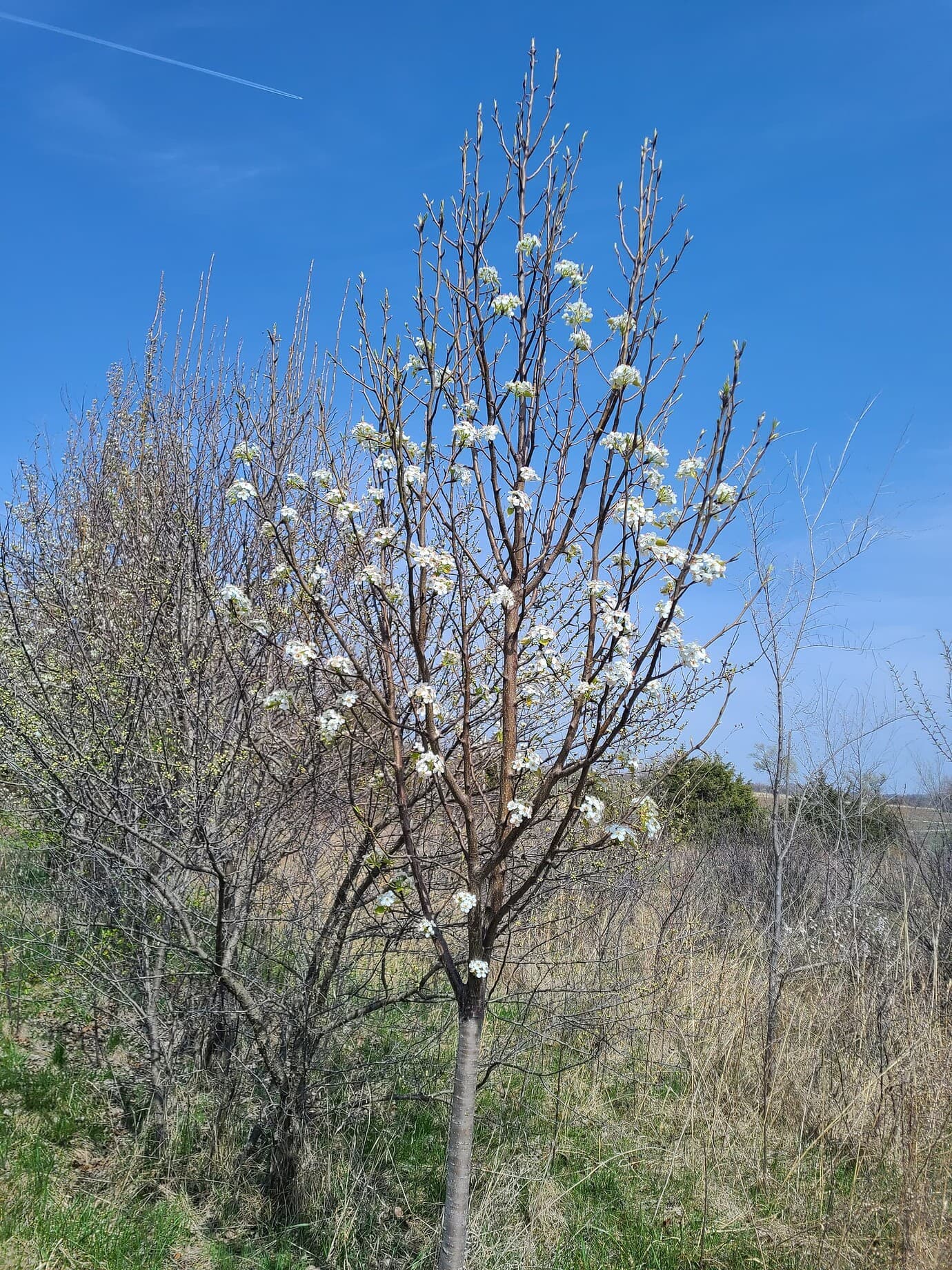
Here are some of my photos of the tree itself
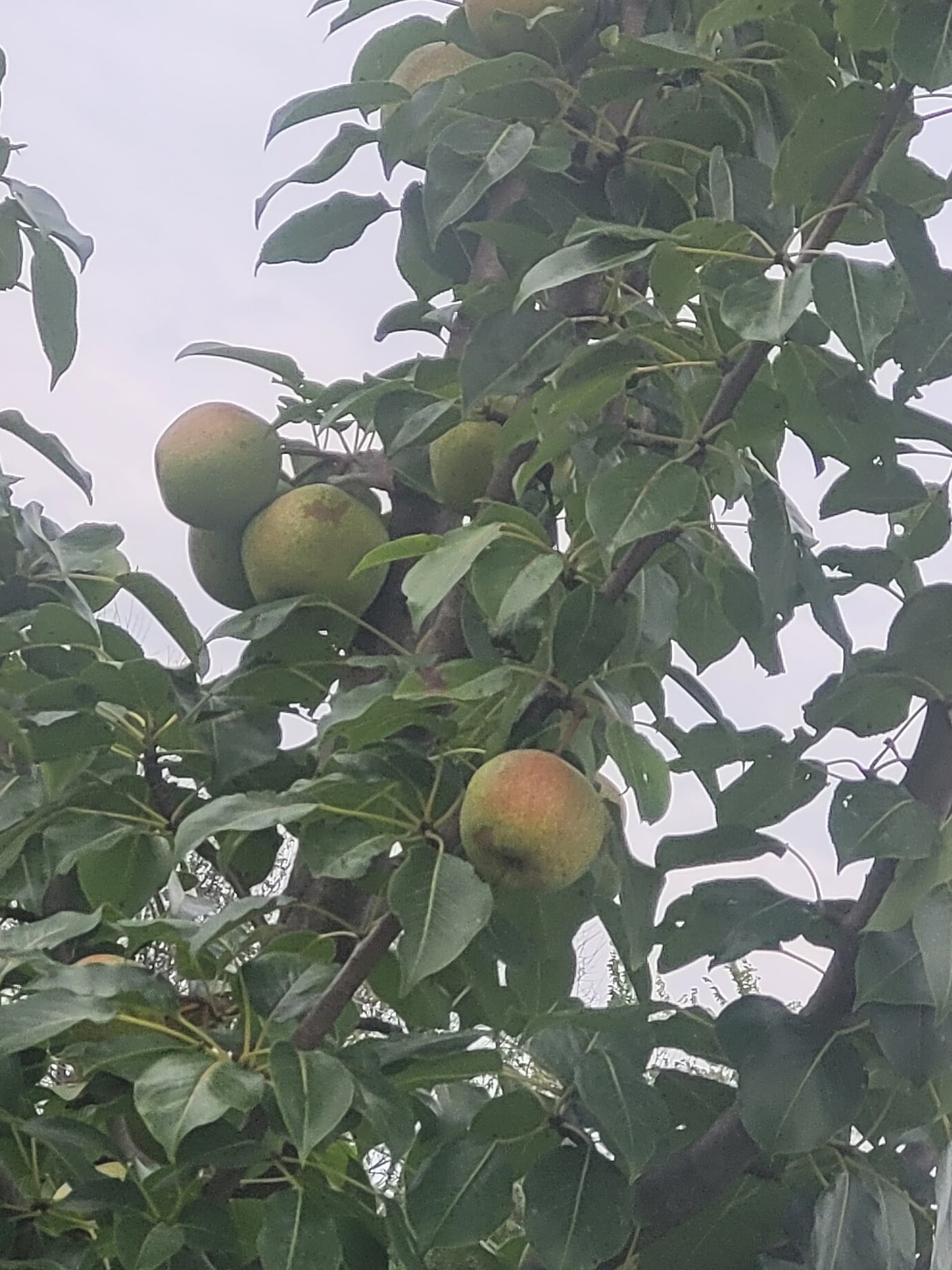
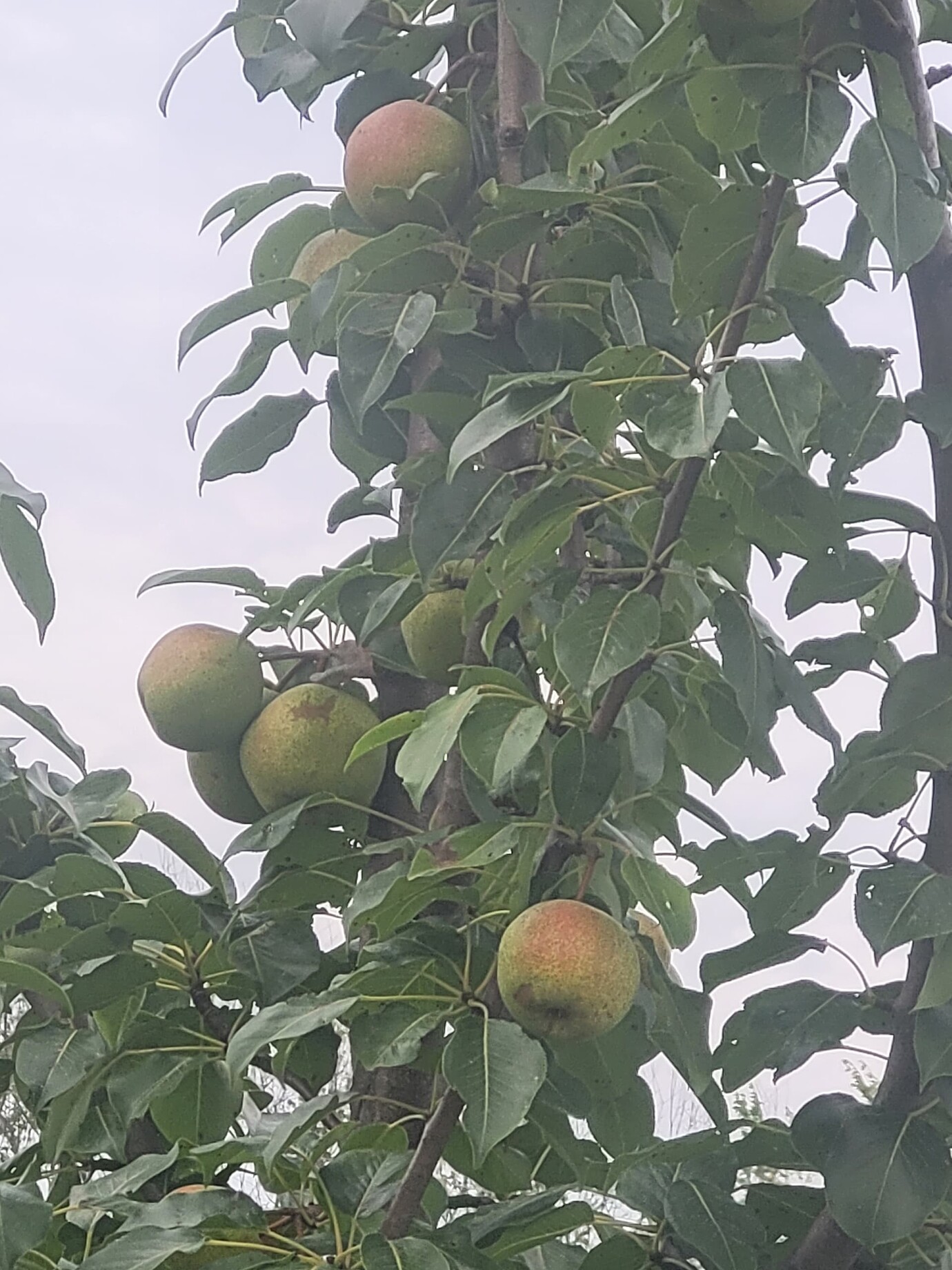
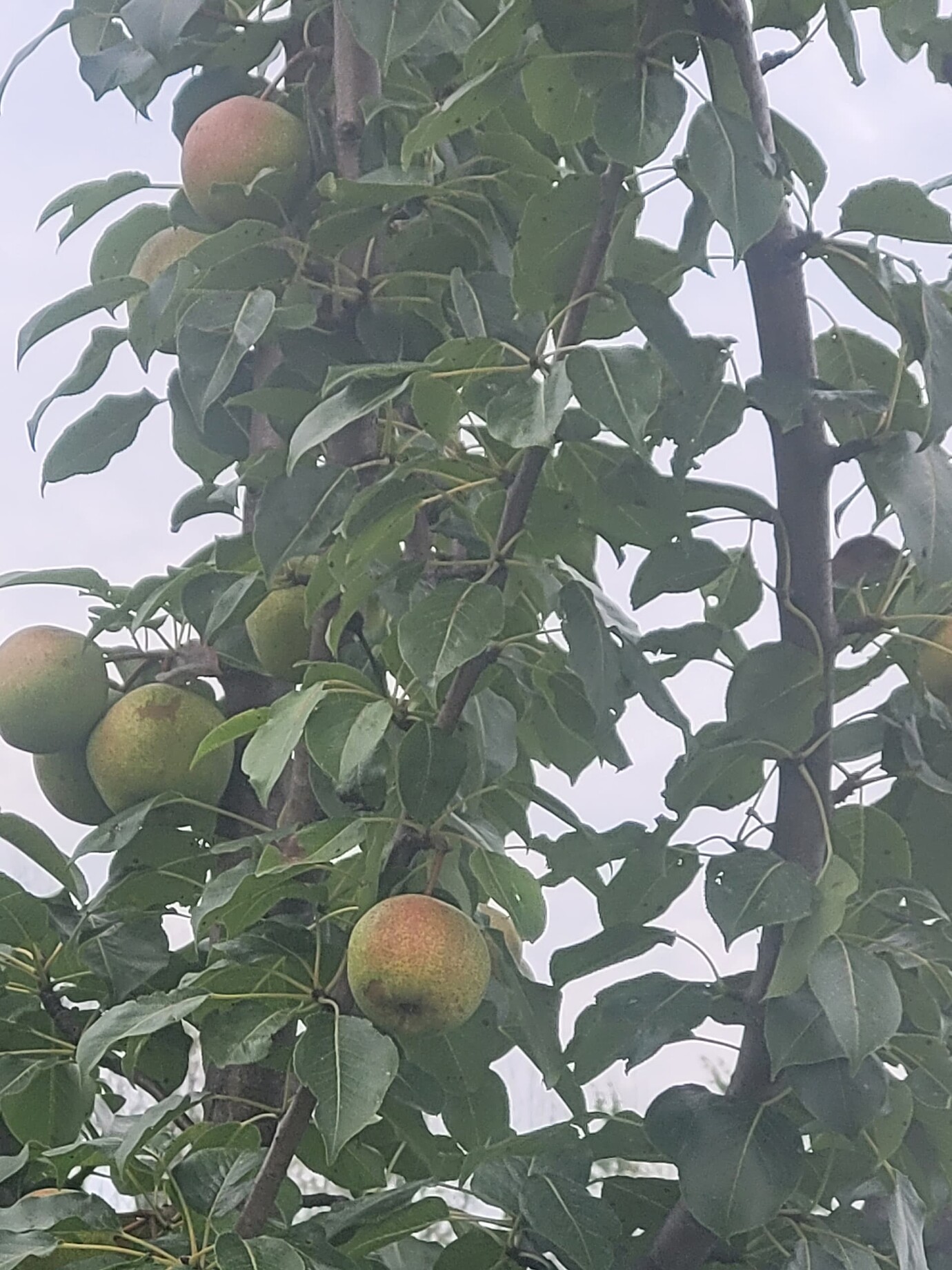
I enjoy this pear when its dead ripe. It tastes nothing like a pear. I think there is little doubt there is asianpear in the genetics. Charles Harris asian pears has some similarities but turnbull is unique.
The original patent information
"U.S. Patent for Pear tree Patent (Patent # PP 4,616)
Pear tree
Apr 20, 1979
A new variety of pear tree primarily distinguished by bearing extremely large fruit of globular-to-ovate form, weighing over two pounds in normal years and having a distinctive taste.
Skip to: Description · Claims · References Cited · Patent History · Patent History
Description
This discovery relates to a new and distinctive variety of pear tree.
The pear tree, a chance seedling of unknown parentage, was discovered in a cultivated area at a farm orchard in the county of Creek, Okla. in the vicinity of Depew, Okla.
The pear tree was asexually reproduced by T-budding on providence quince, cotonester acutifolia and pear seedling understocks, all with good success .
The accompanying color photographs illustrate this new variety of pear tree.
FIG. 1 is a view of a portion of the tree bearing fruit.
FIG. 2 is a close-up view of a portion of the tree bearing fruit.
FIG. 3 is a close-up view of a characteristic pear from the tree.
FIG. 4 is a view of two pears in section, the right pear being in longitudinal section and the left pear being in lateral section.
This new and distinct variety of pear tree is chiefly characterized by its extremely large fruit. The shape is generally globular to ovate. In normal years, the typical fruit averages approximately 41/2 inches long and 5 inches wide and weighs over 2 pounds. When present, the seeds are medium in size, but many of the fruits are seedless. The flesh is creamy white to ivory with a rather smooth consistency. Each fruit displays an interesting wavy basin similar to that of Delicious Apples. The taste of the fruit is distinctive and sprightly. At maturity, the fruit’s flavor is somewhat reminiscent of a Yellow Delicious Apple.
The tree itself exhibits a strong, vigorous, upright spreading branching habit. Blooming extends over a long period of approximately one month and often, when the first blooms are damaged by freezing, the later flowers set fruits. Fire blight was observed on a Bartlett pear tree a few hundred feet from this new and distinct variety of pear tree but the disease has not been observed on this variety which indicates fire blight resistance.
The botanical details of this new and distinct variety of pear tree are as follows. Color definitions are referenced to Maerz and Paul Dictionary of Color (1950).
Tree:
Size.–Large.
Height.–24’ tall at approx. 15 yrs. age.
Vigor.–Very vigorous.
Growth.–Upright, rapid, tall, spreading.
Production.–Very productive.
Bearing.–Early, regular bearer.
Form.–Upright, spreading, vase formed.
Hardiness.–Hardy.
Trunk:
Size.–Medium large.
Diameter.–12".
Texture.–Medium, shaggy.
Color.–Medium gray (8-C-7).
Branches:
Old growth.–Size – Large. Texture – Lightly shaggy. Color – Dark brown with gray overcast (7-C-7). Lenticels – Number – medium. Size – medium. Color – Medium gray (6-A-7).
New growth.–Size – Medium. Texture – Smooth. Color – Medium green with brown overcast (23-J-7). Lenticels – Number – Scattered. Size – Small. Color – Tan (6-A-8).
Roots: Pear seedling.
Leaves:
Size.–Leaves from current shoots – medium. Length – 21/2-3". Width – 11/2-13/4". Leaves from spurs – Large. Length – 31/4-33/4". Width – 13/4-21/8".
Form.–Ovate, acuminate, upward fold from midrib.
Thickness.–Thick.
Texture.–Smooth, leathery.
Margin.–Serrulate.
Petiole.–Medium long. Length – 13/4". Thickness – 1/16" medium.
Petiole color.–Top side on new growth is dark pink (4-I-3).
Color.–Top side-dark semi-glossy green (23-J-11) underside-gray green (23-H-6).
Venation.–Pinnate.
Buds:
Size.–Small.
Texture.–Smooth, rather glossy.
Color.–Reddish brown (8-L-9).
Flowers:
Blooming period.–April 1-May 1, continues after Bartlett.
Size.–Medium.
Color.–White (17-B-1).
Fertility.–Self-fertile.
Fruit:
Maturity when described.–Soft ripe.
Ripening period.–Sept. 18-Oct. 18, 10 days later than Bartlett.
Length of season.–Long.
Retention.–Hangs well.
Size.–Very large, non-uniform – 41/2" length, 5" width.
Form.–Globular to ovate.
Stem.–Short length – 13/8", thickness–2/16"-3/16".
Cavity.–Shallow, acute, narrow, rough, russeted.
Calyx.–Large, open. Lobes – recurved, separated at base, calyx tube funnel shaped, stamens marginal.
Basin.–Deep, broad, abrupt, wavy.
Skin:
Thickness.–Medium.
Texture.–Brittle, rough, russeted, waxy.
Color.–Light yellow undercolor (19-L-2) with golden yellow overcolor (9-L-2) with slight pink blush (3-I-9) and reddish brown russet (6-A-12).
Dots.–Numerous, very small, rough, round, brownish tan (12-B-4).
Flesh:
Color.–Creamy white (10-B-1).
Texture.–Fine, crisp, melting, juicy.
Flavor.–Subacid, sprightly, cooling.
Eating quality.–Very good.
Core.–Median and small.
Core lines.–Meeting.
Calyx tube.–Length – long. Width – narrow. Form – funnel shaped.
Seed.–Sometimes seedless. Size – medium 4/16" wide, 5/16" long. Form – acute, plump. Color – brown (8-L-9).
Use: Market, dessert, culinary.
Keeping quality: Good.
Shipping quality: Good.
Resistance to:
Disease.–Shows resistance to fire blight.
Cold.–Good, blooms over long period.
Wind.–Heavy branches resist wind breakage but heavy fruiting can cause some breakage.
Soil conditions.–Sandy and clay soil plantings do well.
Heat.–Good.
Drought.–Very good.
Canning quality: Very good.
Ease of asexual reproduction: Easily reproduced by budding.
Claims
- A new and distinct variety of pear tree, substantially as shown and described herein, distinguished by the physical characteristics of the fruit including its size, shape and taste.
Referenced Cited
U.S. Patent Documents
| PP309 | January 1939 | Ruedlinger |
|---|---|---|
| PP380 | April 1940 | Silvera |
| PP585 | May 1943 | Shannon |
| PP728 | March 1947 | Greiner |
| PP741 | July 1947 | Moritz |
| PP757 | September 1947 | Bowman |
| PP1044 | October 1951 | Cook |
| PP1095 | May 1952 | Kalle |
| PP1153 | December 1952 | Vistica |
| PP1184 | May 1953 | Eller |
| PP1401 | June 1955 | Dreyer |
| PP1806 | February 1959 | Dymond |
| PP1992 | December 1960 | Gebhard et al. |
| PP2975 | June 1970 | Anderson |
| PP3193 | May 1972 | Straw |
| PP3291 | January 1973 | Lowry |
| PP3599 | August 1974 | Griggs et al. |
| PP3622 | September 1974 | Anderson |
| PP3705 | April 1975 | Palacky |
| PP3928 | June 1976 | Johnson et al. |
| PP4148 | November 15, 1977 | Cordy |
Patent History
Patent number: PP4616
Type: Grant
Filed: Apr 20, 1979
Date of Patent: Jan 6, 1981
Assignee: Henry Field Seed and Nursery Company (Shenandoah, IA)
Inventors: Kenneth L. Turnbull (Depew, OK), Daniel K. Hybskmann (Shenandoah, IA)
Primary Examiner: Robert E. Bagwill
Assistant Examiner: James R. Feyrer
Law Firm: Lowe, Kokjer, Kircher, Wharton & Bowman
Application Number: 6/31,985
Classifications
Current U.S. Class: Plt/36
International Classification: A01H 500;"
USPP4616.pdf (254.7 KB)


