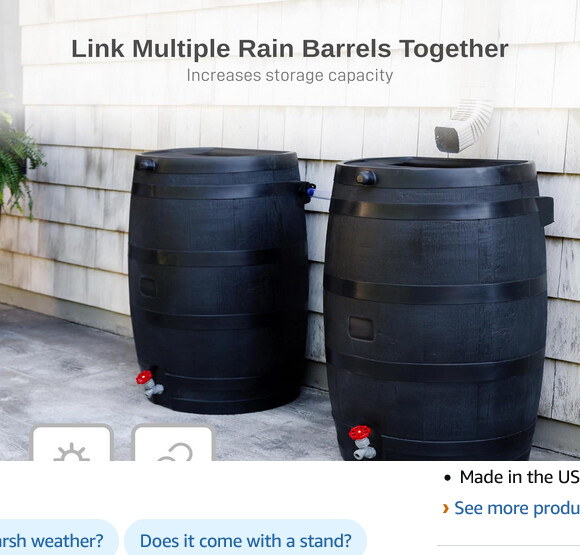
I did a bit of reading and it seems in some cases quite a lot as there were posts about people intentionally filling recently emptied barrels with water and letting the alcohol soak out and I think I read they got something like a gallon out, depending on how soon it was done.
Would it just evaporate after some time? They also sell wine barrels so maybe they would be better due to lower alcohol content?
I know most people would see this as a positive (free alcohol!) but I can’t stand the stuff and so would not want any appreciable amounts contaminating drinking water.
I think these have a much nicer look than the tacky looking blue HDPE barrels which are ubiquitous and you don’t seem to have any option there - blue or blue.
Wanting to use for holding raw captured water either from rainwater harvesting or the spring before being filtered to make drinkable.
Practically zero. The stuff is highly volatile and would disappear as soon as the wood was dry. Or you could simply ask CHAT these types of questions for a more complete answer. In this case, a slightly more accurate one, although you can’t count on that.
I think the greater concern is how it would affect the water’s taste, which is unpredictable and the reason whiskey barrels are often used for craft beer. You might enjoy the taste or not, but it would take a very long time for it to subside. .
Once a whiskey barrel has dried (or even been rinsed and aired for a modest period), the trace alcohol remaining in the wood is far below any physiologically significant level. Here’s why:
Ethanol evaporation: Ethanol has a very high vapor pressure relative to water, so it evaporates quickly from porous wood. After a few days to weeks of exposure to air, the amount left is measured in milligrams per kilogram of wood, at most.
Leaching into water: If you filled such a barrel with water, only minute amounts would dissolve — typically well under 0.001% ethanol by volume, far below what’s naturally present in many foods (ripe fruit, fermented bread, soy sauce, etc.).
Toxicology: The human body easily metabolizes trace ethanol; even fruit juices can contain 0.1–0.2% alcohol naturally. You would have to drink many hundreds of gallons of water stored in a dried whiskey barrel to ingest the alcohol equivalent of a sip of beer.
I would use a leaf blower to ram air in and let the spirits be forced out. Like Alan said, they turn to fumes quickly. Fill the barrel a few times after wwith water, and it would be fine. There likely are times where a half gallon of whiskey is left in there. Just remember why it is left over. We call it bottom of the barrel for a reason. Every liquor i ever made wine etc. That is where all the garbage is located like old yeast etc. In the case of wine. In the case of beer we call that bach beer. They tell me In this case of whiskey it is full of charcoil and other impurities.The old timers often used that phrase for those doing really badly in life “poor miss smith is really hitting the bottom of the barrel over there since Ralph died. Next she will have to start selling off land and cattle”
Leaving them outside to capture rainwater begins the rotting process if not already started on the wood.
Some barrels may leak and need tending.
Rainwater going in from a roof or gutter would have many chemicals let alone bacteria, then the larvaes of things that enter the vessel.
So that water would have to be filtered, then boiled… then sediment would have to be avoided.
That would net probably 40 gallons or so of ‘drinkable’ water per barrel.
In 40 days i think you can be much safer and smarter taking a gallon jug to work or a family member or friends house and using that for drinking water if you do not have indoor plumbing.
There are much better ways to collect rainwater nowadays than old used whisky barrels.
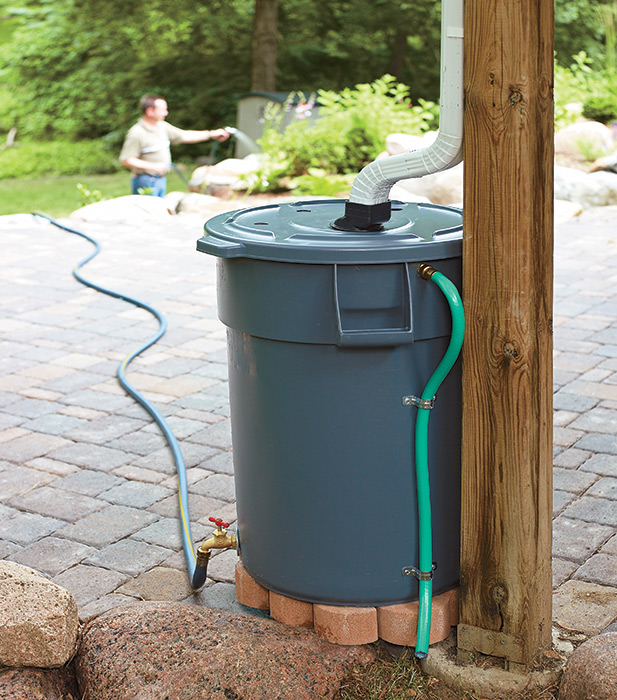
That’s exactly the trash “can” I use to collect it. It’s cheap and convenient, but the sun gradually destroys it so it will eventually end up in a landfill perhaps poisoning the earth for several centuries.
Better for me, but maybe not for my grandkids. I guess I’m selfish and stainless steel is not cheap. Clay might be the best answer, especially if you have the cistern in the ground… but I’m no engineer. I do have a cistern my house came with that was constructed with cement and holds about 500 gallons. Built over 50 years ago and never a problem except that the hand-pump that used to bring the water up stopped working and they don’t make parts for it anymore. My property is steep and my veg garden downhill so I can siphon the water to use for that. The siphon pull never leaves as long as I keep water in the hose that has an end stuck to the bottom of the tank.
There is not a significant amount of alcohol left in those barrels, no. Trace amounts will still be present in the wood and some of that may reenter solution when the barrel is filled, but at that point we’re talking fractions of a percent at the absolute maximum, even with a so-fresh-it’s-still-wet barrel.
At that point, sourdough bread is more alcoholic.
As others pointed out, rainwater off a roof is going to be questionable for other reasons, if nothing else it could give you salmonella from the bird poop it probably contains.
No, £50 each. I am off the idea now anyway and think I will get the HDPE ones instead. Marginally cheaper but more sanitary as replies have also confirmed. I will get over the ‘uncool’ look in favour of better utility.
Leaving them outside to capture rainwater begins the rotting process if not already started on the wood.
Some barrels may leak and need tending.
Good points.
Rainwater going in from a roof or gutter would have many chemicals let alone bacteria, then the larvaes of things that enter the vessel.
So that water would have to be filtered, then boiled… then sediment would have to be avoided.
I said in the OP I will be filtering. I already collect all my water from a stream and filter so I know the process. I just want something to collect more to have a buffer. Though I want to try more rainwater collection as well.
In 40 days i think you can be much safer and smarter taking a gallon jug to work or a family member or friends house and using that for drinking water if you do not have indoor plumbing.
That totally undermines the point of being off-grid. It is like saying ‘it is far easier to just go to your supermarket and buy your food instead of slumming it making your own crops that are half the size and take so much more time and effort’.
Once dry there would be no alcohol left. I would never use a wood barrel for this purpose especially outside. I would use food grade 55 gallon drums.
There is a guy near me that sells them for $20. The only problem with used ones is they are often used for things like artificial flavoring, sesame oil etc making it difficult to get the smell or taste out.
Around here the most common use is pickles. Those wash out pretty well, though in fairness we only ever used them for animal feed, garden water, etc. so maybe they still had a hint of dill.
If you keep them from sun exposure, unlike the “can” in the photo, plastic lasts a very long time… that’s part of their environmental hazard. However, until recently, I used plastic garbage cans for my slow action compost containers. Even though they were in the shade, the plastic only lasted for 20 years before it started cracking. I ended up switching to metal trash cans because some Norway rats showed up on my property that gnaw right through the plastic to get to the garbage. I throw everything in there, including meat scraps.
The galvanized metal cans cost more than plastic and don’t last as long but my grandkids don’t have to worry about them and rats have yet to gnaw through them.
Empty pickle barrels. There’s a large pickling company not too far from here.
Recently though I’ve actually been getting used barrels from a pharmaceuticals company. Some of their reagents and precursors come in barrels believe it or not. Those I will definitely never put food in though haha
I see a tiny amount of leached alcohol as a good thing because it’ll help preserve the drinking water from microbes. It’s why medieval people drank a lot of weak beer.
It’s basically impossible for enough alcohol to leech out of the barrel though. To kill things like cholera and norovirus, you need something like 50 proof, and that’s simply not going to happen if you put 50 gallons of water into a barrel.
Beer is safe because it’s boiled, and then the boiled water is cultured, reducing the chances of bad microbes taking hold and making it obvious if they do. The alcohol is not the main safeguard, it’s the boiling, the yeast, and the distinct flavor that’s easily messed up by contamination, and then the alcohol, that make beer safe.
But if you put contaminated water into a barrel, it’s going to take several gallons of pure everclear to maybe make that water safe, at which point it’ll be too boozy to drink as water anyway.
Dilute alcoholic drinks are not anti/septic. Beer and wine go bad fairly easily if not stored properly. It’s the boiling process that makes beer free from other microbes.
Regardless there won’t be any appreciable amount of alcohol as alcohol vaporizes quite readily compared to water
Lol, that is more like a lambourghini body on a prius.
I am not really bothered about the aesthetics. Functionality is more important. I am over that flight of fancy. If all other things were equal I would have chosen the wooden ones, but as has been clearly evidenced above, they aren’t; so I shan’t.
Another idea I have had and tried, which hasn’t worked, is digging to make a pond.
I have already dug about 10ft wide and 1.5ft down. I thought since it is heavy clay it would be an ‘easy win’ and the water would just collect and stay there but it is not the case.
Have had plenty of rain but it will pool to a couple of inches then just seep away and/or evapourate.
How does one get the water to stay?
I looked it up and ponds/reservoirs are made by puddling clay but I have not been able to make them water tight. Even the dam I made at my natural spring is constantly leaking.
I could use a plastic pond liner or tarp but since they are not made for food grade I would be concerned about them leeching microplastics. Not such an issue if using a tarp for rain water capture I thought since the water will pass over within seconds, although maybe still an issue if UV rays would degrade the tarp and cause the plastics to cleave and wash down with the rainwater to the container.
My filter does say it is good for microplastics too so not sure if I should worry about it or not?