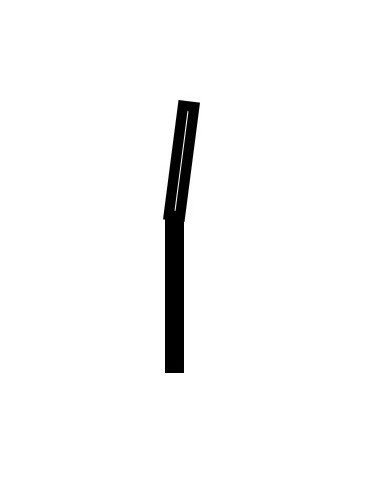
It is a bare root apricot. The scion was grafted a little crooked on the rootstock. I planted the rootstock straight up perpendicular. The scion is a little crooked. I figured after it establishes some, I can make the top straighter. (See illustration as to how I planted it.)
Should I have planted the rootstock crooked to make the scion straight?
Plant the rootstock straight, use a stake next to the rootstock, secure it, the rootstock tight to the stake and then tie the top to the stake straightening the whole thing up.
You may have a little bend at the union.
I think it will grow either way, but I think it will look better and straighter with the rootstock upright.
Tilting the tree towards the prominent wind is a time tested method, although I don’t know if it’s a researched one. Aesthetics are subjective, mine align with JoGar. However, in my nursery I use the JAF suggested staking method as customers tend to want a straight tree. I secure the tree to the stake with electric tape, but the stake sometimes causes some injury to the trunk if the tree rubs against it… nothing that doesn’t heal fairly quickly once the stake is removed. It requires a single spring to achieve the straightening.
My orchard never had straight trees. I never found myself concerned about it. My primary goal is to get large amounts of fruit. My trees tend to produce very heavy.
From talking to customers, my impression is that the main reason they want trees with straight trunks is because they think that straight = healthy and angled = some sort of issue. It seems to be less about aesthetic preferences and more about ignorance as to what does or does not = a healthy tree. In fruit trees people tend not to want to encourage them to grow overly large and straight trunks often are counter productive since they lend themselves to taller ultimate size compared to angled trunks.
Interesting but I question it. Trees will tend to straighten themselves out (if they aren’t angling for light) and I don’t see how a littler curvature in a trunk would ultimately slow growth. However, if trees are encouraged to grow too much sideways they often eventually topple- at least peach trees do for me when I plant 2 in a hole and have each grow away from the other. If I ever do that again, I will just have 4 scaffolds placed in a way both trees are balanced.
It has to do with apical dominance hormones. An upright leader will suppress other growth, but angling the leader reduces this suppression and spreads more of the vigor through the branch canopy.
If I stop to think about it, I plant tilting trees with the tilt to the North, under the hypothesis that the sun being most often in the South will tend to correct it. Though I guess it could just add another curve with the tree looking like a C
I observe the growth of hundreds of whips, and some are always going to be crooked, my living partially revolves around my nursery. What you suggest would immediately be prevented by selecting a leader and pinching back competing ones.
Crooked trees do not appear to have less vigor than straight ones in my experience, but I’m not evaluating growth with the measured calculations of a researcher. Still, I did decide to run it by CHAT GPT. I realize that some people do not trust this source but if you disagree with it on the basis of its bias towards the user, you can always ask it a question and maybe come up with a counter argument. It is no different that two experts debating different opinions, but I believe the overall process is constructive.
A young tree with a crooked trunk will almost always re-establish vertical orientation through gravitropism (statolith-driven auxin redistribution). The shoot apex reorients toward vertical, and subsequent growth forms a straight leader above the bend.
Key points (well supported in tree physiology):
The apical meristem reorients quickly toward vertical via auxin redistribution.
The bend becomes a localized structural feature, not a systemic growth limiter.
Hydraulic conductivity is not meaningfully impaired unless the bend is extreme (kinked, damaged, or constricted cambium).
I think we tend to correct more vigor towards the south through pruning. When I’m transplanting a branched tree. I try to remember to direct the side with less developed branching towards the south.
Johann’s suggesting that the public prefers a straight tree on the belief it is more healthy has some basis in research in the field of evolutionary psychology. Human beauty, as we perceive it, seems to be universally tied to facial symmetry with the more symmetric facial features being more attractive because it subconsciously suggests better health. Aesthetic judgements may be based on such basic survival instincts- that is the survival of our progeny (or our trees).
What I want to know is whether my trees prefer trees with a straight trunk
That is correct some trees like Bramley apple have a natural tendency to grow at an angle. They are very heavy producers. Trees like Korean Giant grow straight as an arrow.
Bramley’s is a crazy grower indeed. Not the easiest to train. Here it is prone to rots as are many over-sized apples. It has fallen out of favor with me.
To further prove the point for the purposes of other readers I’m going to reference a video demonstrating the point @JohannsGarden is making and corroborated by @alan and myself about Bramley specifically. @39thparallel bramley have the exact same problem. Stephen Hayes in legendary across the pond. Here Stephen confirms it is the same there
The reason I’m making this distinction is because there are trees naturally inclined to grow at an angle. Since there are several issues that cause the problem it’s important to recognize all of them. There are also those planted at an angle. Those angled due to sunlight. In my area they will be angled by wind also. Our wind blows strongly from the north most of the time and that makes most trees lean to the south that have willowly growth. There are other factors also. That is why leaning trunks are somewhat normal. Hopefully not every tree is leaning in any orchard but some will and we need to accept that if we want to grow them.
I recall ‘Bramley Pippin’ is a triploid right? Triploid apples are known for their high vigor. If one were to train them to be more upright they could likely get truly massive.
I trained ‘Centennial’ to have a straight central leader since I wanted it to be narrow where it was planted. Everyone says ‘Centennial’ is naturally semi-dwarf, but when forced to be very straight upright, I found it to be quite vigorous and I eventually had to cut the top off. Another crab I grow (an ornamental one) called ‘Snowdrift’ has grown truly massive after encouraging a straight up leader. It is much taller than any references say it should be and much more upright than any pictures I can find of that variety for comparison.
It doesn’t matter what the tree prefers. It’s the bee that chooses the tree’s partner(s)!
I’m glad the bend doesn’t matter so much. As much as I intend to orient the tree optimally, when it actually comes to planting it, I often orient it to best fit the roots in the hole I have dug. The top just goes along for the ride. For instance, if there is one particularly long root, then whatever direction looks easiest to dig (least obstructions/rocks/roots/etc) gets that root. Sometimes I barely notice the top, until after I’m already filling in the dirt…