That’s because there has never been a plant manual written for Georgia. The light green areas in Florida cover the counties researched for the Flora of the Carolinas. One of the two light green counties in Georgia contains George L. Smith State Park where I catalogued all the vascular plant species for my masters thesis. The light green areas of the Carolinas is the result of the research done for the Flora of the Carolinas by Radford. And there have been floras done for Alabama, Mississippi and Louisiana. My guess is that all but the Blue Ridge parts of Georgia have it. Georgia is one of if not the least botanically researched southern state.
3 Likes
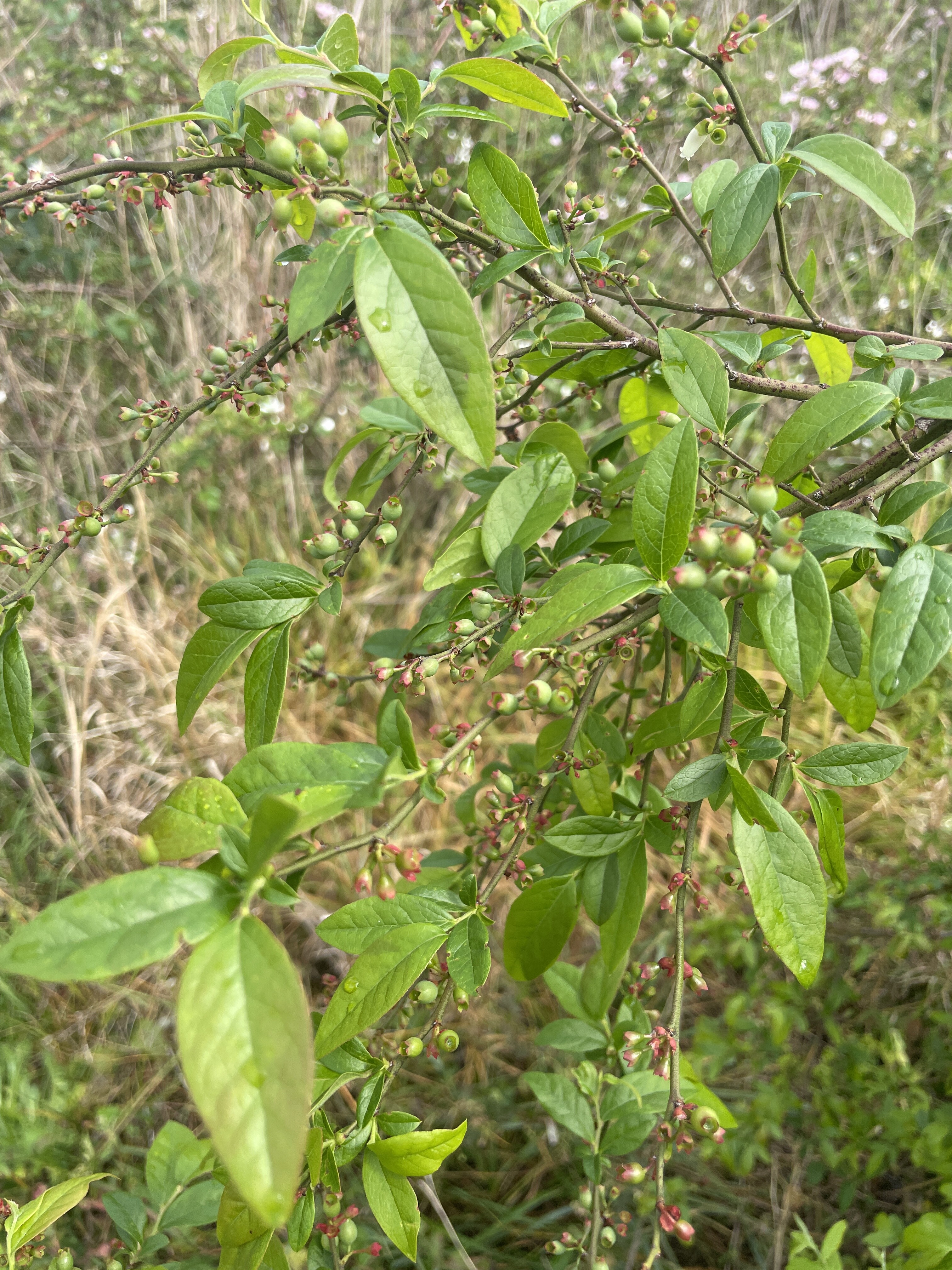
Are you up to ID’ing these plants?
This is a large bush growing in my back yard. I cleared brush out from around it and have had a crop of decently edible berries every year since.
This one originated near Hamilton Alabama and appears to be the same species as the above plant.
2 Likes
This is shocking to me. Georgia is one of the most biodiverse states east of Rockies, probably only second to Texas and Florida.
That’s very cool!
iNaturalist shows V. elliottii having exactly the distribution you mentioned–everywhere except the foothills in the far north of the state.
1 Like
This looks like highbush blueberry to me. The leaves appear to be too big for V. elliottii which is described as having leaves that are typically between 5/8" and 1 1/8" in length.
1 Like
The taxonomy of the Vaccinium genus is very complex and controversial. I would need dried specimens at various stages of flower and fruit and a dissecting microscope and more information about the general environment to ID it with any certainty. That said, if the plant gets taller than about a meter (yard) and has leaves that are over an ich long, which it appears to have, and the flowers are kind of fat, then it is likely one of the many, many different variants that have been lumped into Vaccinium corymbosum (High Bush Blueberry). That is made much more probable by how far North you are in the state. Basically, at one time there were about 15 different species that plant taxonomists eventually just lumped into one. It’s probably a cop out, but it is probably the best that they can do. I very much doubt that wild V. corymbosum around Statesboro are the same thing as the ones in Main. But the morphology overlap between neighboring strains and, obvious hybridization made tweezing the species out with any uniformity ridiculous. With the last paper I read, the highbush sub-genus is now considered to have just three species, and it comes down to the arrangement of chromosomes during cell division that distinguishes them. The three species are Vaccinium elliottii which is diploid. That means that chromosomes are arranged in sets of two during sell division like humans and most animals. Vaccinium comrymbosum (highbush blueberries) are tetraploid meaning that their chromosomes arrange themselves in groups of four during cell division. And Vaccinium ashei (Rabbit Eye Blueberry) are hexaploid meaning that their chromosomes arrange themselves in groups of six during cell division. But then there are a bunch of species outside the highbush sub-genus. You might be at a high enough elevation to have lowbush blueberry, but I doubt it. And you may have other species that I don’t even know about or forgot existed because my plant id skills are rusty. But more likely than not you have a highbush blueberry. But different plants in different locations are about as diverse as dog breeds. So, there’s that.
3 Likes
I see these bushes all over this region. They produce small but tart and flavorful berries every year. Birds eat most of them.
Both plants are about 6 feet tall with a distinctive clumping form with the top spreading out like an umbrella. I had ID’d them as corymbosum based on plant morphology, but it must be a southern ecotype. Highbush varieties from areas further north do not thrive here. These plants are drought tolerant, winter hardy, highly productive, and generally easy keepers. I have to net them to keep birds out. Otherwise they are trouble free.
I can eliminate at least a dozen species based on visual traits and flavor of the berries. I’ve seen plenty of highbush blueberries in the course of traveling for many years for my job. These don’t match my expectation for highbush blueberries.
1 Like
Exactly. We have something in the Statesboro area that keys out highbush in the key that came out in 1992 or 93. To my knowledge it’s hasn’t been superseded yet. I absolutely do not think what we have is the same species as a true highbush cultivar. And of course, I imagine you know that the so called southern highbush cultivars are multi-species hybrids with rabbit eye and V. elliottii genetics somehow incorporated in them. I know that we have a lot of V. tennellum around, and I run into them all the time. But I’m not convinced that these larger plants aren’t hybrids or variants of V. tennellum. And for all I know we may have something distinct since no one has ever done a flora of Georgia. I ran into at least four different morphs of blueberries at George L. Smith State Park in Emanuel County that sure seem distinct from each other to me. But with that key from the early 90s, they all come out V. corymbosom. As I said, I think that the current taxanomic scheem is a bit of a cop-out. But it may be the best we can do.
1 Like
IIRC, there is a range of ploidy levels in Vaccinium. It would be interesting to map the ploidy of some southern members of the group. I can point out 3 distinct blueberry species which grow around Rainsville Alabama where I grew up. If there are that many species playing hanky panky with each other, there are bound to be a ton of hybrids.
Anyway, I consider the bush here at my house to be an interesting plant because it is so well adapted to the region. I would rate it equal to rabbiteye for drought tolerance. It also grows in soil that a rabbiteye can’t.
1 Like
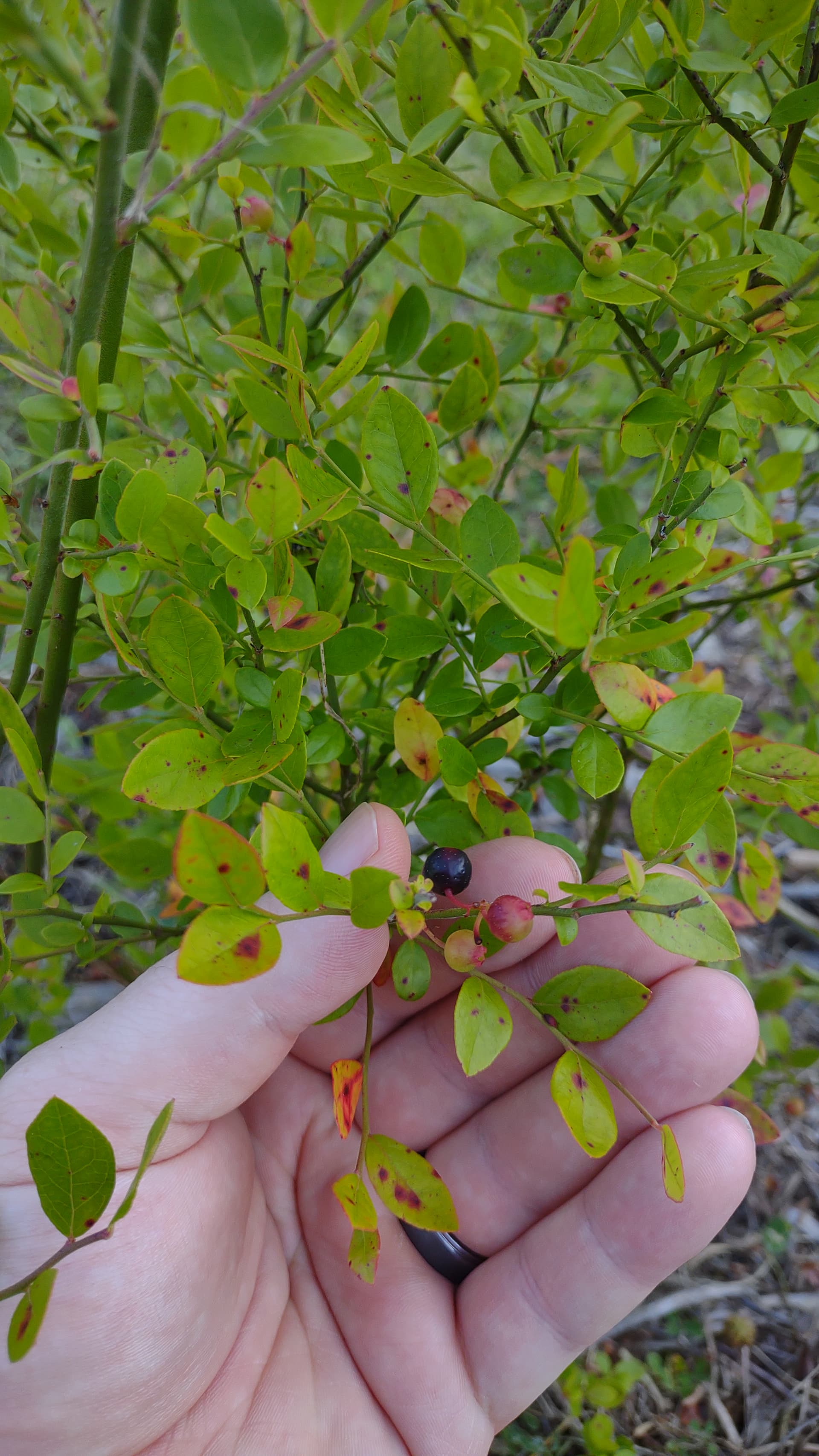
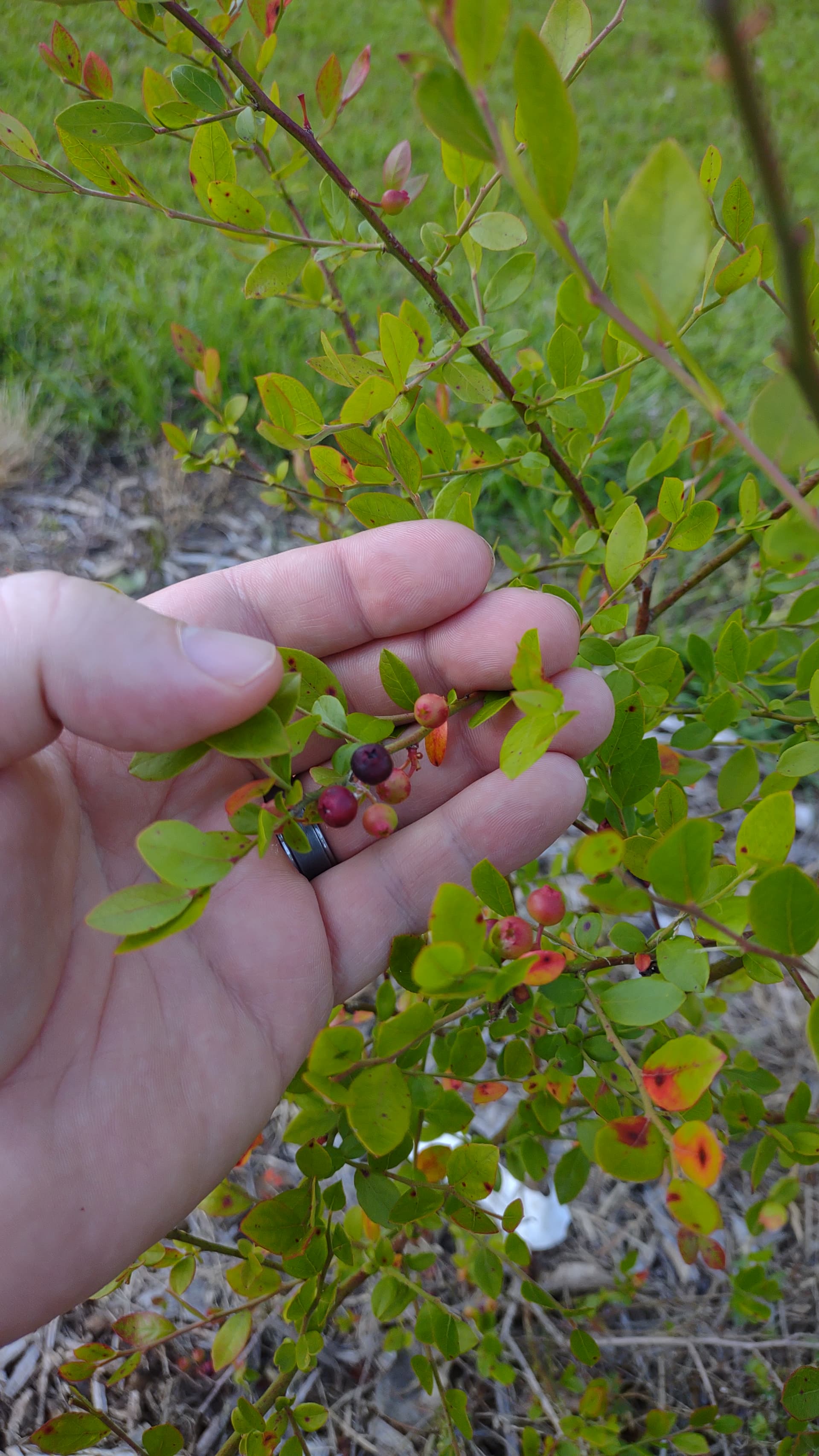
Last week I came across a wild Vaccinium elliottii and the difference couldn’t be more stark.
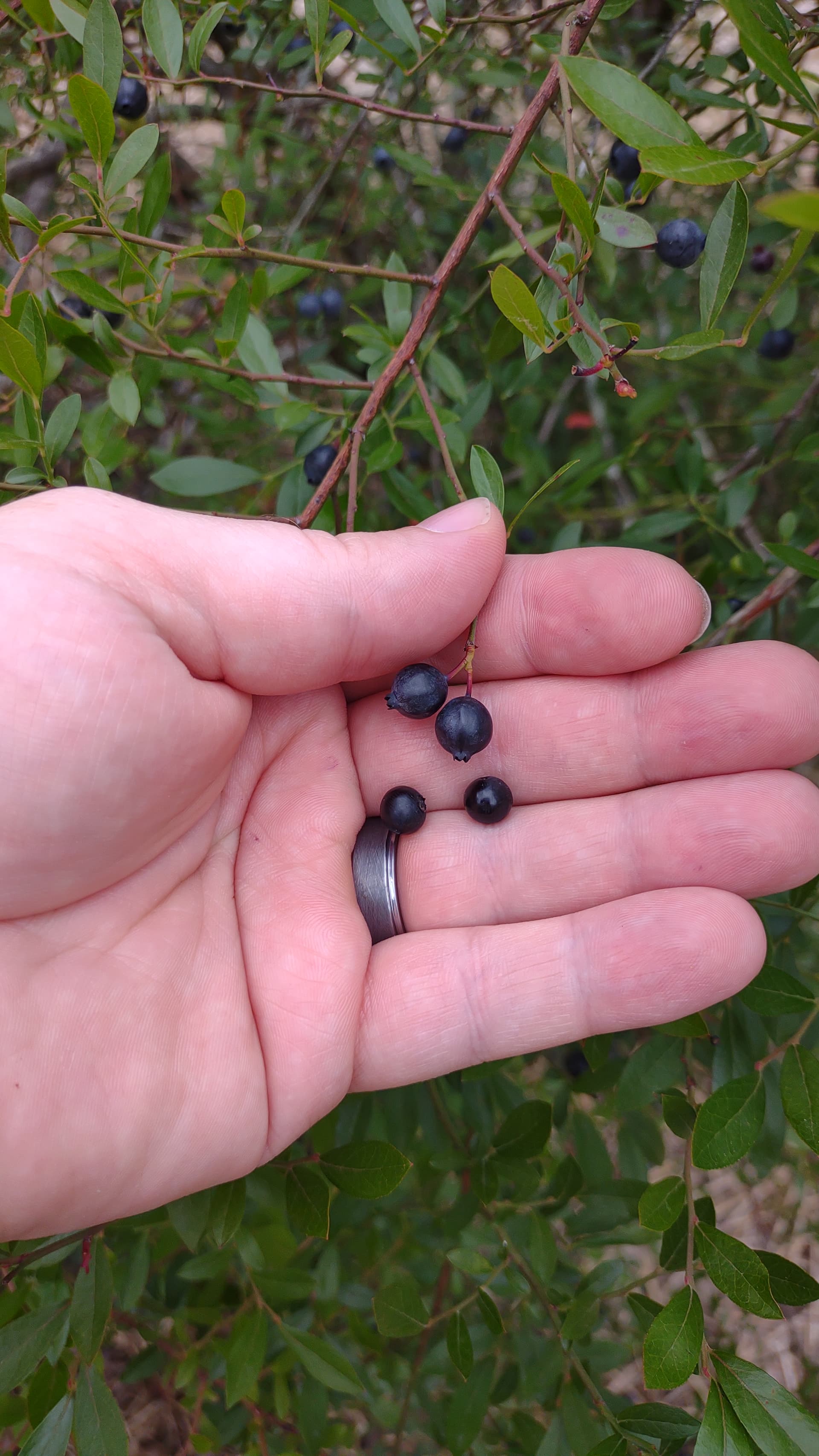
The wild plant has much larger and much bluer berries and they were exceptionally good. Sweet and with a strong wild blueberry flavor. Due to some development most of the trees around the bush had been removed and I think because of the reduced competition the plant was doing very well. It was heavily loaded with berries. The bush itself was about six feet tall and roughly ten feet wide.
There were some other bushes nearby, both of Vaccinium elliottii and of some kind of later ripening “highbush” like variety. The other V. elliottii had the same small almost black berries that I’m more used to. I may attempt to graft some material from the big bush to the plants I have at home to see if the fruit quality is just from it bring a big, established plant or if it has good genetics.
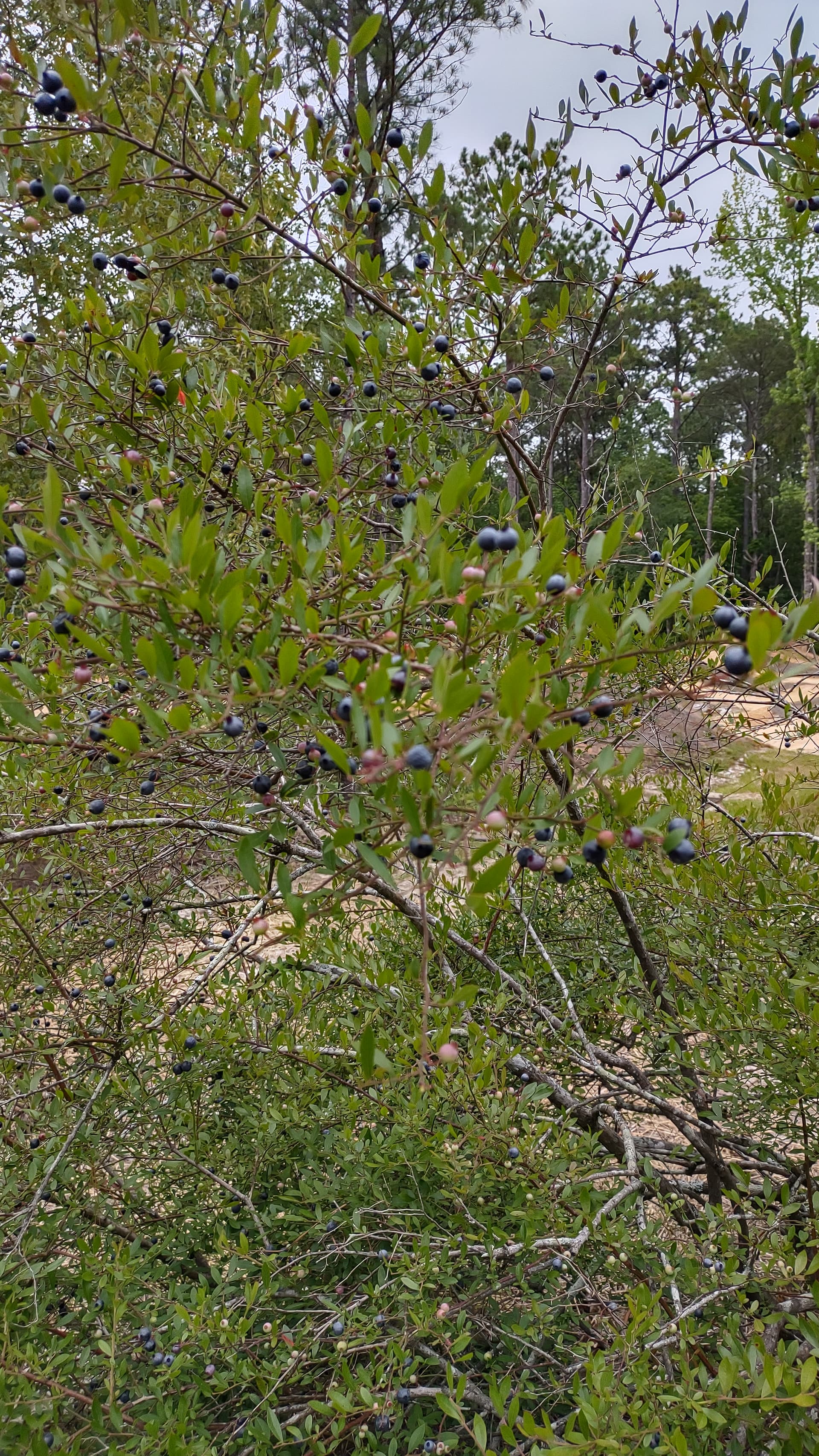
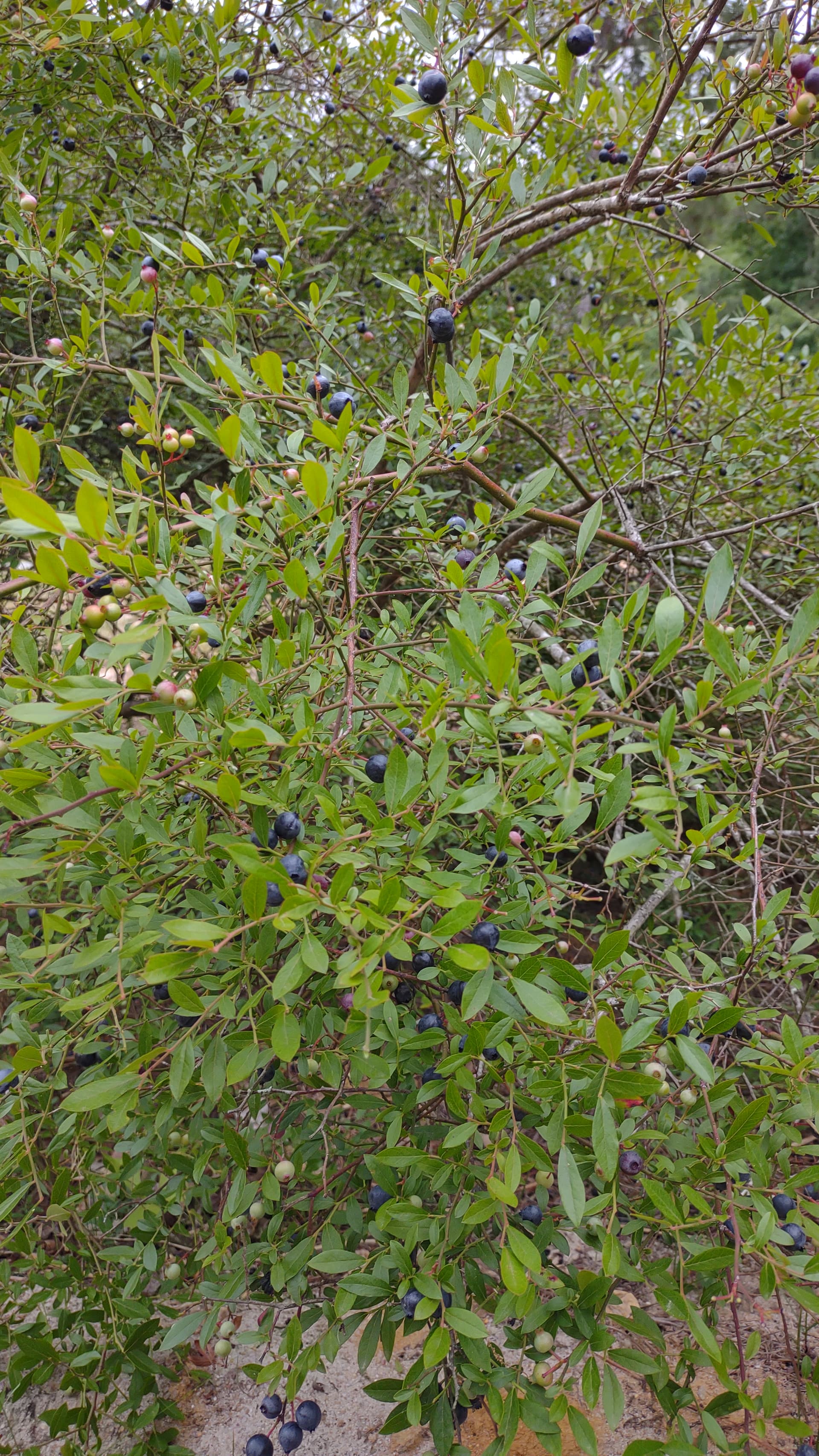
Large bush top, normal looking berries from a bush nearby below.
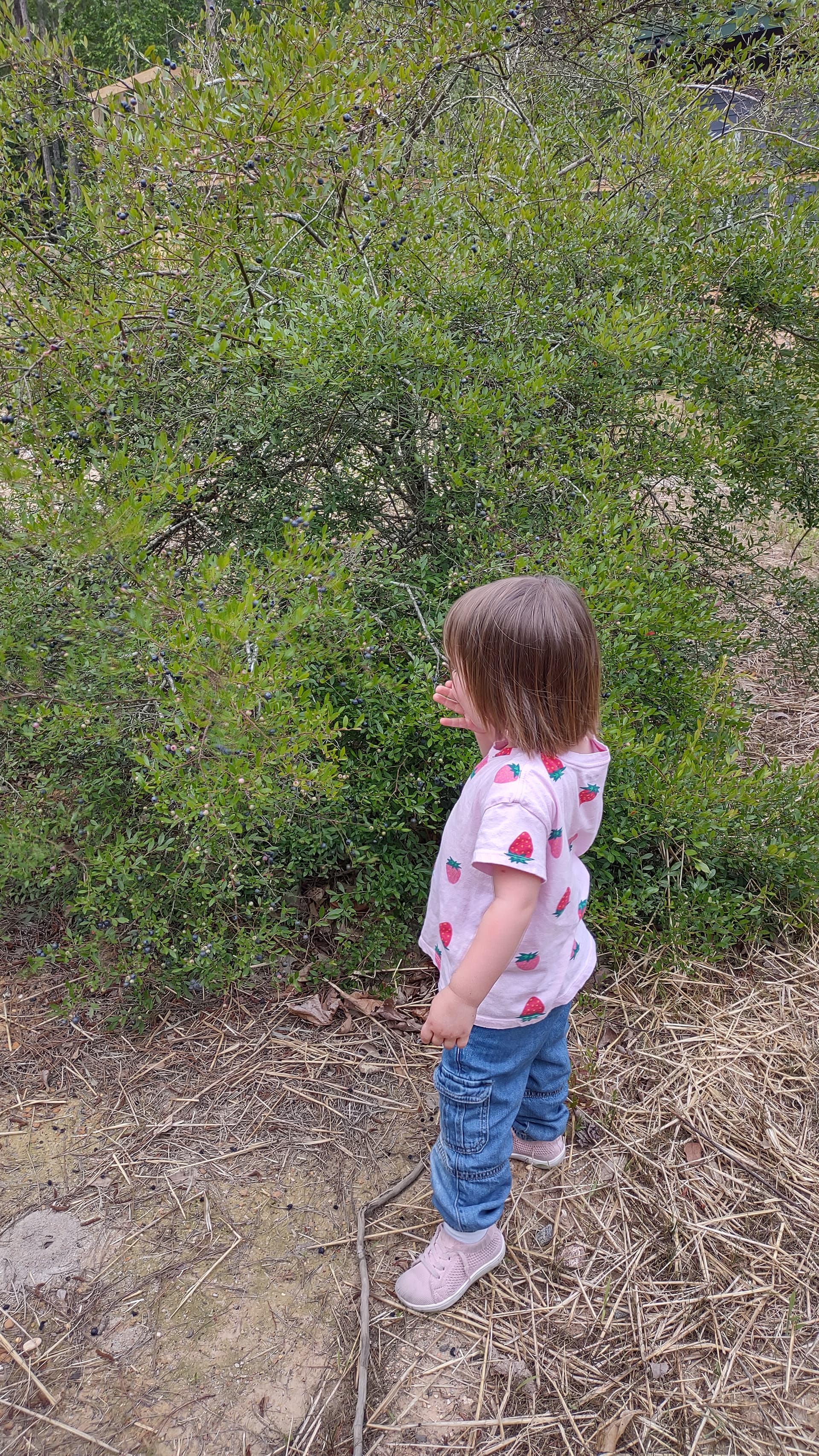
Some of the local wildlife seemed to be enjoying the berries.
5 Likes
The size variation between plants in my yard is extreme. I’m slowly removing small fruited strains and replacing them with better ones. I’m doing this at a rate of about two bushes a year.
5 Likes
If you haven’t already done so, look for suckers under that bush and for places where the branches have layered. Both happens sometimes. Cutting around the roots in winter often stimulates them to sucker.
4 Likes
A problem with the word Huckleberry is the whole other genera - Gaylussacia.
So I try to reserve use of Huckleberry for that one, anywhere those and Vaccinium species might exist. But common usage doesn’t agree with me on that; ‘blue’ & ‘huckle’ are used so interchangeably that I think people can easily get bad impressions from the wrong species, when looking at a perfectly tasty Vaccinium. And then Bilberry gets added to the mix too.
I’m surprised to read that Botany is a bit weak in Georgia, considering the history starting with Bartram and onwards to Dirr. Always figured UGA would be very strong in the field.
I’ve been thinking about Farkle/Sparkle berry (V. arboreum) a lot over the past year, though it has been 20 years since I was around them routinely working on Longleaf Pine sites in the south. Last summer I found a rare native Lonicera, L. villosa, up in Lake Superior country. What struck me about it was the attractive, striped, slightly shedding bark which made me think of Sparkleberry but have no idea if that is accurate. A bit more of a landscaping character that would suggest checking one of Dirr’s books for confirmation. Just wondering if V. arboreum has a pleasing winter “habit” or do I need to consider fixing my memory on some other souther shrub?
Of the Great Lakes Vacciniums, one of them commonly referred to as a Huckleberry, V. membranaceum, tends to tear the skin when picked, making for challenges in adapting to edible uses.
My own thought about common names with regards to blueberries vs huckleberriries is that it’s pretty pointless to try to buck them. The point of any name is communication, and when there is an established common name that is technically incorrect given the scientific name it’s better to use the term that people know. The best examples of this are butterflies and dragonflies which are absolutely not flies at all. It’s simply a fight scientists will never ever win. Just as they will never win when they try to convince people that birds are reptiles and all higher vertebrates are fish. I totally get and agree with the phylogenetic reasoning behind such terminology, but culturally that battle was forever lost before scientists began it and no amount of education will change that fact. Anything they have to say about it will always be culturally irrelevant though useful in scientific circles. But to communicate to the public it all has to be translated to the popularly accepted nomenclature and categories.
4 Likes
We went to Wyoming last fall for 35th anniversary trip. Jackson Hole, Grand Tetons, Yellowstone..
Every little shop you went in had a display of huckleberry jelly.
My wife bought a small jar and man was it delicious.
I assume they must have lots of huckleberry there.
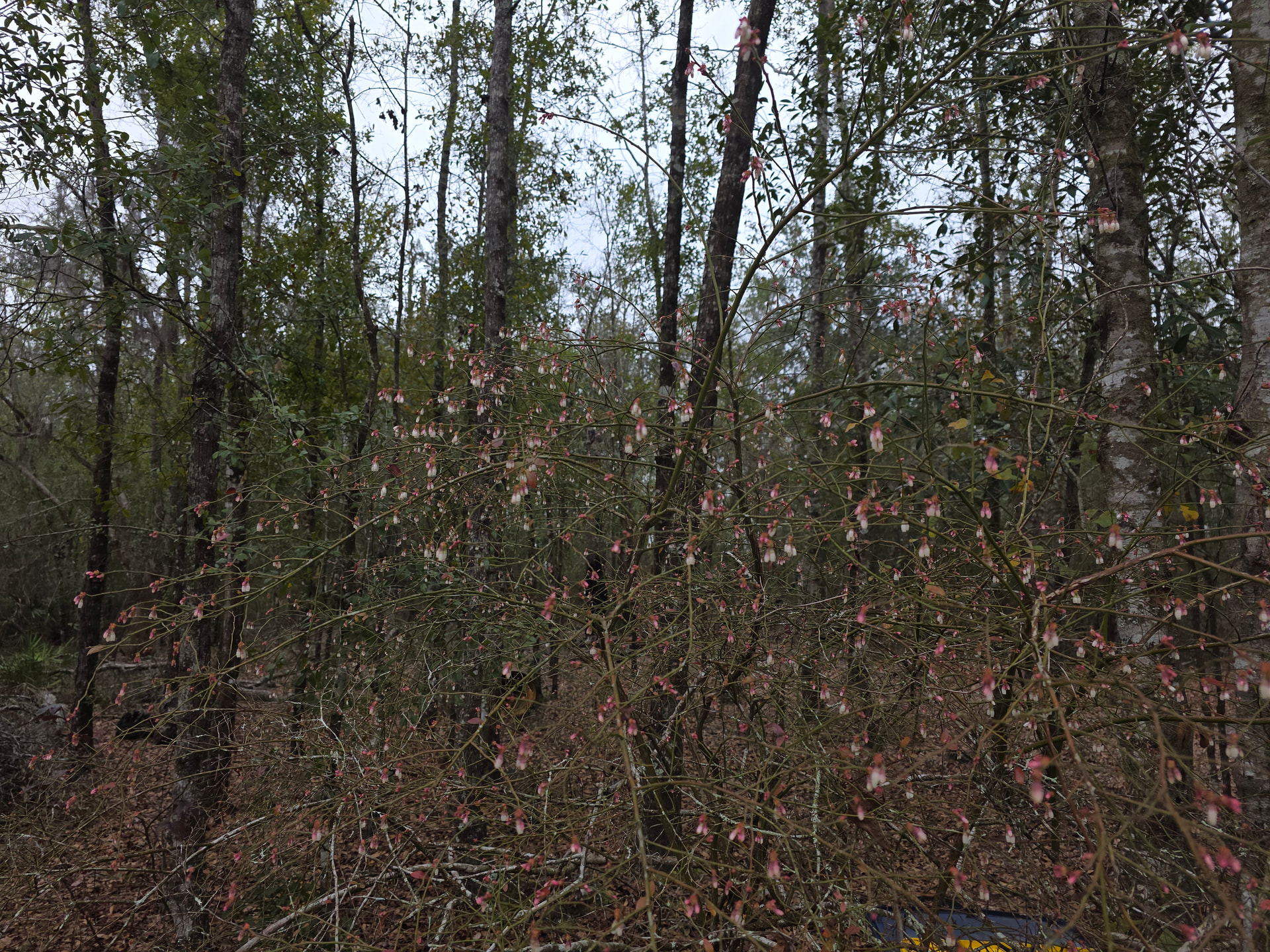
Never seen one here in southern TN… but I have a lot of Deerberry here.. aka Highbush huckleberry… they have beautiful blossoms early spring.. but the berries do not taste good.
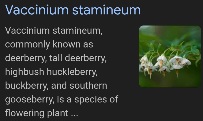
Birds and chipmonks love them.. to the extent you can’t pick a ripe berry unless you bag them… I did… but they tast nasty.
TNHunter
Would you sell any of your improved huckleberry cuttings or whatever propogative material is easiest?
1 Like
I’m willing to sell seedlings. Fruit quality will be unknown. None of my bushes are improved. They were taken straight from the wild to my yard. Some are much better than others though, and some of the lower quality ones have been removed and replaced.
5 Likes
I’ll be passing through Bulloch county this weekend. Could I send you a pm?