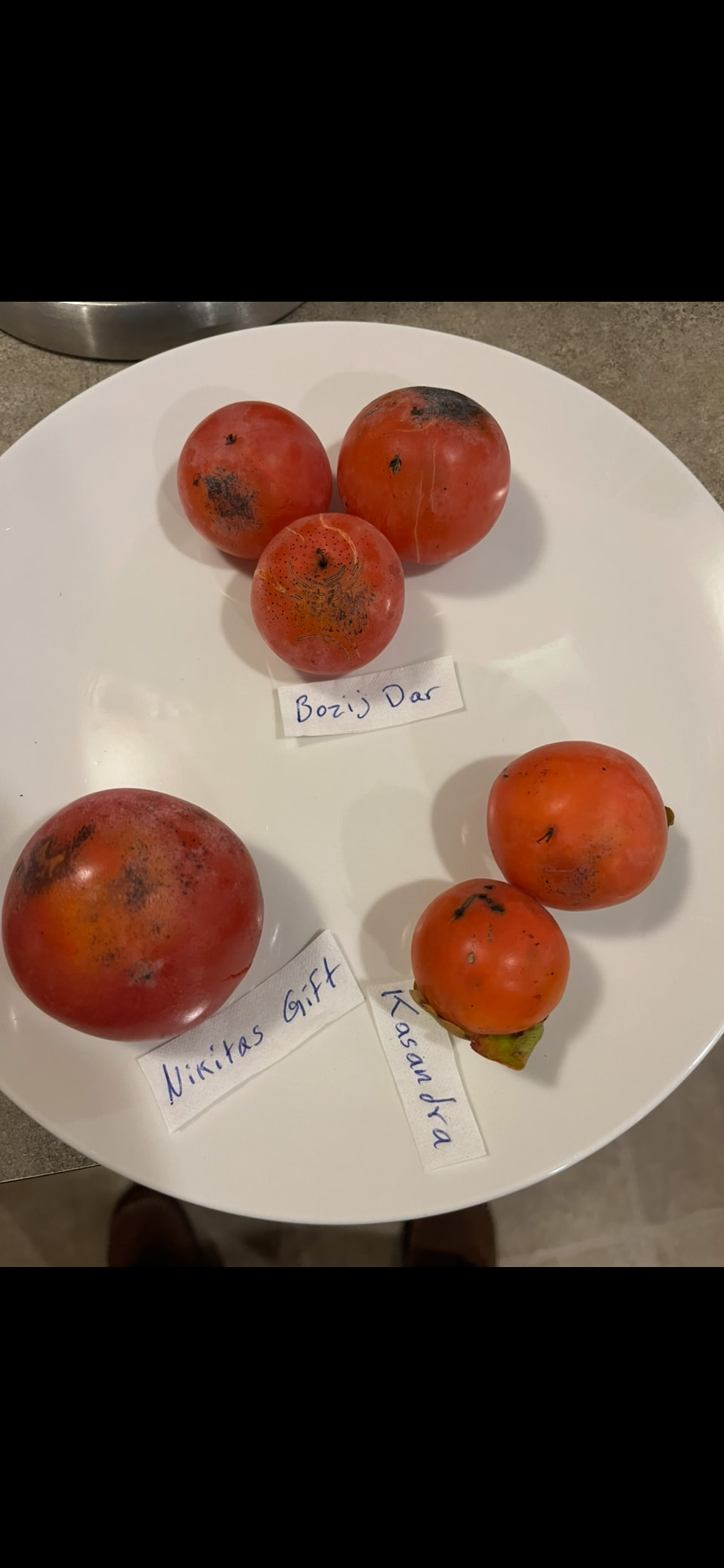
What’s written is wrong, but that’s not what my ChatGPT says. Version 5.2.
1 Like
Can you tell me a bit about Korwood?
The tree was loaded and I’m estimating 12’ tall.
The fruit size was comparable to Prok, and Kasandra, about two inches across.
Fruit had seeds, but minimum amount.
Ripened to a dark orange color.
My fruit ripened last of October, so I’m estimating the ripening period as being from our mid October first frost to mid November.
The taste was very good.
Our purpose for collecting and ripening the persimmons was to decide which scions to order. I ordered scions of Korwood.
1 Like
Does anyone have experience with UKR 15-9 or Adolf Lischuck?
Do they ripen early? Mid-season?
Of course taste is subjective, but can anyone compare their tastes to each other? Or to Kasandra or JT-02 (the only hybrids I’ve tasted).
Thanks.
1 Like
I’ve had the privilege of eating UKR 15-9 , late October 2024, as well as Adolph Lischuck in early November 2025, both from Cliff and Kumi England’s orchard.
I estimate, and I do mean “estimate” UKR 15-9 to ripen the earliest of late and Adolph Lischuck to ripen late. But, rest assured, they do ripen in our Kentucky season.
Now I’m one of these people that believe you have to be careful or you will end up with, in your hobby orchard, 10 hybrids that taste too much alike or 10 Americans that taste almost the same. So I’m always looking to introduce to my garden , persimmons that vary in taste.
UKR 15-9, to me, has a delightful fruity unusual taste. I think “strawberry” as I eat one, but my friend thinks “raspberry”. It has its own unique taste, which is as good, but different than Kasandra and JT-02. I have two fledging in my garden.
I just weighed a Fuyu from Costco, at 123 g. I didn’t weigh my Adolph Lischuk but the literature states that they go up to 120 g! Can you believe that? The size of a Fuyu but, to me, much better tasting. None are growing in my orchard , but Cliff promises scions are to arrive soon!
9 Likes
Thanks so much for the information Jobe. Not sure how your Kentucky season would match up with mine up here in Massachusetts as far as lateness goes.
Are there any early-ripening, or maybe mid, hybrid varieties that you have tried that you think taste as good as Kasandra, even if the flavor is different? (Just gathering ideas) Point taken on growing 10 trees that all have fruit that taste about the same.
3 Likes

I have a few seedlings going from various sources, including from fruit harvested at England’s Orchard Tour 2024 like this one.
I’m excited to see what kinds of improvements we might gain through growing these kinds of crosses out.
3 Likes
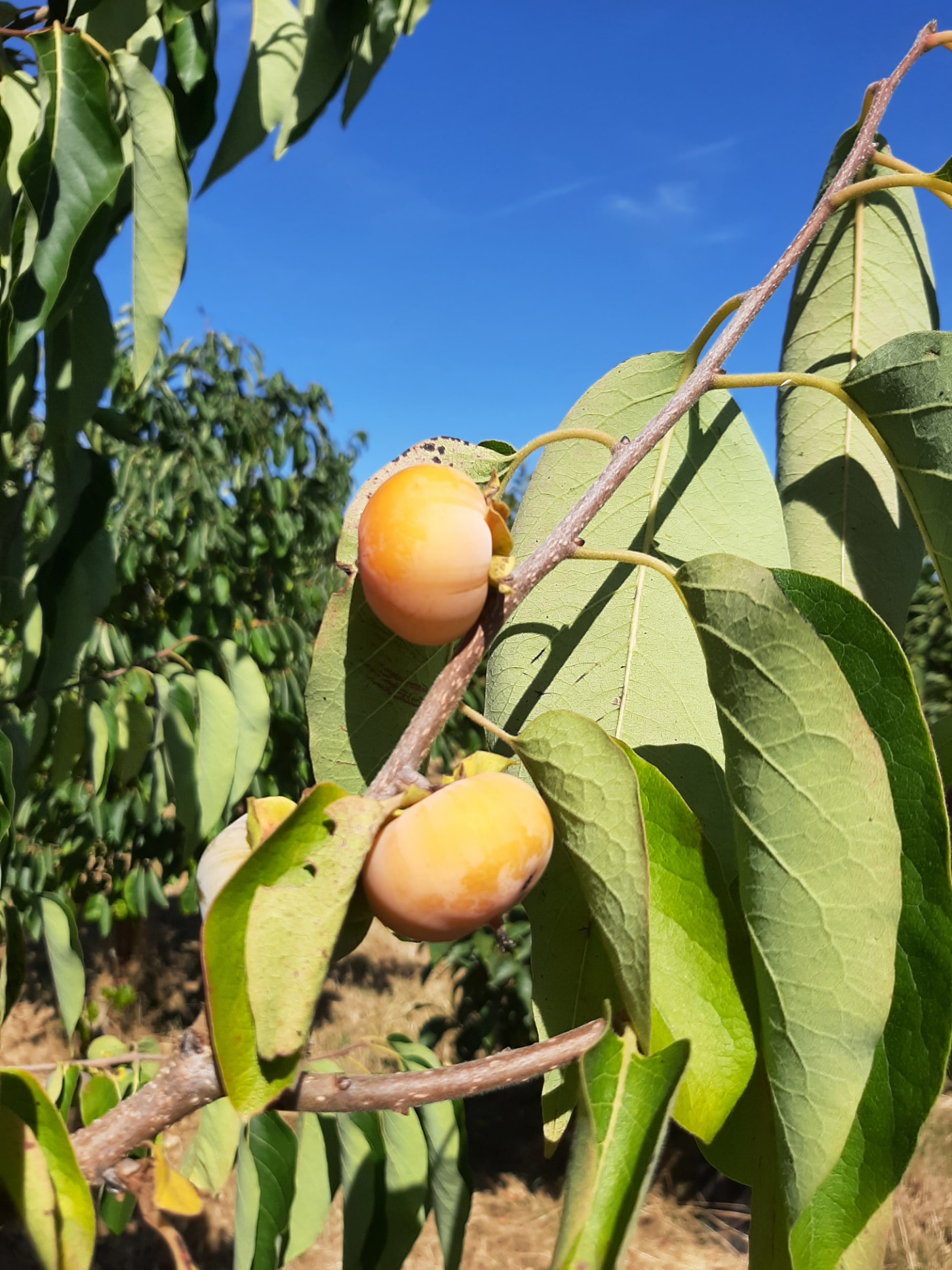
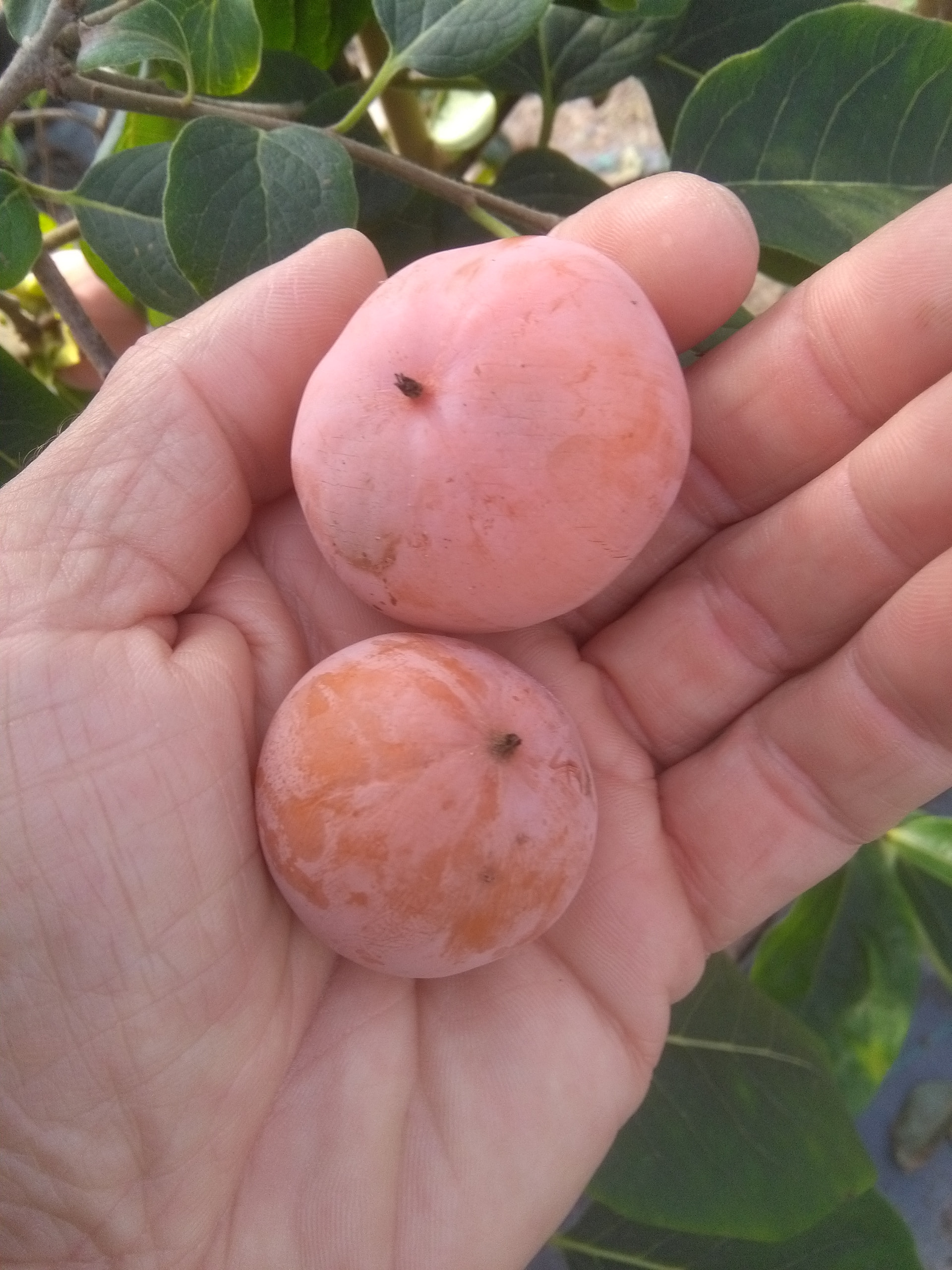
A forum friend sent me unsolicited scions of Kolhospnytsia (mother of Dar Sofiivky) and Stepova Krasunya. I’ve grafted both, just to see what pops up. SK is monoecious, so I may use it as a pollinator for varieties that may need it either for productivity (e.g., Nikita’s Gift, Chuchupaka) or flavor (e.g., Dar Sofiyivki).
This gift has prompted me to do more research, which leads to questions.
-
The monoecious variety Universal is reported by Ukrainian sources to be cold-hardy to ~-26 C, vigorous, and productive. Harbin says that it is very early and delicious. And it bears male flowers. Shouldn’t we be using it to produce the next generation of really early, tasty, hardy hybrids, e.g. Dar Sof x Universal?
-
The monoecious variety Bozhiy Dar is described by Ukrainian sources as “practically non-astringent” when still unripe; they also describe both the dioecious (but not parthenocarpic) Kolgospyntsia and its dioecious (and parthenocarpic) daughter Dar Sofiivky as having “slight astringency.” All three are reasonably cold hardy and tasty. Shouldn’t we be using them to produce non/low astringency, early, cold hardy hybrids, e.g. Dar Sof x Bozhiy Dar?
Probably somebody is already working on these ideas. Have I missed the news?
2 Likes
I’m also growing out a few dozen seedlings from England’s OP hybrids!
Question: what visible phenotypic indicators should I select for if I can only plant out five or ten? So far I isolated the most vigorous two- one with a mostly green stem, one with a reddish stem, and a healthy medium vigor plant with shorter node spacing. I’ve read elsewhere that people toss out the most vigorous seedlings. But it’s lost on me why you would do that.
The future would sure look better to me if I was seeing photos of beautiful fruit on trees surviving in a Z6. I have Steve’s Candy and Great wall growing against a somewhat south facing stone wall- both trees grow above it’s 7’ height. We got a low this season of -9F and the small wood of the Great Wall was killed but larger wood is vigorously sprouting new shoots. Wait, is it David’s Candy?.. I think so. It wasn’t killed back but I’m not seeing many flowers forming, so most of them may have been killed. However, both varieties have some shoots in the unprotected parts of the trees above the wall with David’s Candy having small 2-year shoots, so it is likely more cold-hardy than Great Wall.
-9 is the lowest temp we’ve had for quite a while, so it may be the new test winter (used to be about -20F). I’m glad Great Wall survived, last season it bore a nice crop of delicious non-astringent persimmons. David’s Candy did not even though it flowered profusely and had some delicious fruit the prior year. CHAT tells me it needs a hybrid pollinator so I bought one that has a ton of flower buds on it. Maybe there will be enough flowers on David’s Candy to test the results of the new sibling. I can’t remember the name, but CHAT recommended it. I’m impressed by its precocity. I will remove most every flower as soon as it stops being a pollen source. It’s pretty tiny but looks very healthy. I had it protected from cold over winter and it arrived last fall so it is untested in sub-zero conditions but is supposed to be pretty hardy.
1 Like
Z6A is -5 to -10 F average annual low, with excursions lower.
Many Ukrainian hybrids have shown great performance at -26 C to -30 C (-15 F to -22 F). These include Universal and Bozyi Dar (estimated tolerance -26 C / -14.8 F), Dar Sofiyivki and Chuchupaka (-27 C / -16.6 F) as well as Sosnovskaya (-30 C / -22 F). This record includes an episode at the research facility of -26.7 C in Jan 2006 where Sosnovskaya, Chuchupaka, and Universal took zero damage and Bozyi Dar took minor damage. Dar Sofiyivki was not available for testing at that time.
There are plenty of photos of ripe Ukrainian persimmons from these varieties.
3 Likes
Another idea. How about Luo Tian Tian Shi x Bozhyi Dar or one of the other monoecious hybrids. Couldn’t the result be a non-astringent hybrid?
1 Like
Thing is that winter kill is not just about lows, it is about previous temps and how hardened off trees are- cells with more water are killed at higher temps. Not saying you don’t already know this, but the reason I want to see pictures isn’t to admire the fruit but to provide proof that they perform well in my weather or weather more comparable to the continental U.S. than Eastern Europe.
4 Likes
Ok, but that’s not what you said. You said that you wanted to see pictures from Z6. Z6 is about nothing but the average winter low temperature.
Whence my clarification. Most members live in the U.S. with its fluctuating winter temps. The point of the pictures wasn’t to admire, but for proof they can thrive here.
Are there any zone 9b hybrids that y’all recommend?
1 Like
Most of us can’t grow Nikita’s Gift because it isn’t cold hardy enough for zone 5 or 6. It tastes real good if you can grow it in warmer zone.
2 Likes
ive heard kassandra is really well liked. do people like nikita’s gift more?