Luo Tian Tian Shi contains only one or two C-PCNA alleles.
so simply hybrid it with other PCA won;t let you go very fare.
founterly Luo Tian Tian Shi has male flower so self backcross may be helpful.
In addition, its chromosomes do not segregate evenly during meiosis,There are two distinct chromosome separation groups in Luo Tian Tian Shi.
So it cannot be treated as a simple “choose 3 from 6” case as in a normal hexaploid.
applying a simple combinatorial or probabilistic model is mathematically wrong.
other PCNA math is right as fare i can tell.
Furthermore, Luo Tian Tian Shi is not actually a single cultivar.
It is a group of persimmon populations native to Luotian County.
Among these populations, the number of C-PCNA alleles ranges from one to two.
Absolutely. That is really part of the point of my post. The greatest value of the forum for me is actual growing experiences of others. So when something begins to take off as a must have with no real experience of the taste of the fruit, size of the fruit, production, actual ripening times, etc. it seems time to just ask the question if the excitement is valid. If someone starts searching the forum, perhaps they’ll find these posts and understand they might be planting something that really isn’t a proven variety.
And just because we haven’t heard of any tasting reports, we’re at the end of the 2025 season and maybe someone harvested fruit this year and just hasn’t reported on it yet. If so, I hope to hear from them soon!
It makes sense that local growers might treat all non-astringents as a group. All these varieties would really have to share is the C-PCNA allele.
As the allele is reportedly dominant, is it fair to assume that some minimum proportion of offspring would be nonastringent? What’s been observed empirically?
p.s. I tried to find the answer myself. ChatGPT 5.2 says that in actual breeding studies, approximately 50% of offspring from Luo Tian Tian Shi are non-astringent. That’s what you’d expect if assortment were random, so any stickiness must be balanced.
Journey is a Hybrid 12.5 % Kaki F-4 cross of ( Rossey X Great wall ) X ( H-118 Early Jewel X OP) = no Male flowers has a taste of Vanilla, is excellent and begins to ripen before all the persimmons that we have planted, It has one flaw that I am not excited about, the production is so heavy that the limbs dangle with the weight of the fruit bending downward. First of the season to fruit then followed by J-59 and Prok.
I love the taste of vanilla in a persimmon…
Cliffs inclusion of that in his description… made me want to try it.
P-PCNA X PCA result in 29:33 C-PCNA:NOT-PCNA
on an other study C-PCNA X PCNA result in 22:12 C-PCNA:NOT-PCNA
their conclusion is that segregation is 1:1 (see table 1)
which is werid becouse Luo Tian Tian Shi chromosome did not segregation evenly.
well werid things happen all the time.
Viruses only continue while sap is providing them, think grafting or ingrafting, other than that there’s no source of viruses, I wish I knew the name of the nursery handbook that clearly says that. Viruses are a boogyman for problems that people don’t know how to fix, probably mineral or climate problems more than anything.
I’m starting to think these supposed new varieties are an AI hallucination… just to get us all tempted
Seriously, I would also be very interested in reports on taste of these new hybrids. There is very little out there. The only one I have is “JT-02” which I think may be in fact be some other variety since it doesn’t match the description. Whatever it is its very tasty. I am looking for a couple more that are resistant to KSDS to add for next year. The plan is to only grow KSDS resistant varieties, I have put in too much work on trees that died too soon from it.
I’m not sure which you’d classify as “new” hybrids. FWIW, I’ve been guided mainly by Harbin’s top 10 list, which has Nikita’s Gift, Dar Sofivievki, and Chuchupaka at the top. So I’m trying those three, though I suspect that Nikita’s Gift is both too late-ripening and too tender to be ideal here.
Harbin doesn’t mention JT-02 or Kasandra (or any of the other David Lavergne crosses), which may reflect a Eurocentric bias. It’s hard to believe that Kasandra, Cardinal, Honan Red, Kujinaja, and/or some other Kaki x Rosseyanka Male cross doesn’t deserve mention.
Thanks! I really don’t care how new it is, just so it’s good. I did try Nikitas Gift and its KSDS sensitive. I have an infected stock I’m grafting everything to, if it doesn’t take there I don’t want it I’ll probably try Kasandra and maybe a couple other ones like Chuchupaka or Zima Zhurma.
I also have a DV rootstock tree that appears to be infected. It killed Miss Kim after 3 years and failed to take grafts at all from Nikita’s Gift – my only complete graft failure on that tree. FYI, I did get good performance from grafts of JT-02 so I’d infer that JT-02 is not sensitive. IMO JT-02 is not as tasty as Kasandra but it is better than the PCNAs. Put a gun to my head and I’d rate it slightly better than Sheng and slightly inferior to Saijo.
Years ago, they found several male persimmon varieties near “Luo Tian”.
Yes, a strictly male persimmon.
and it produce 7 flower per inflorescence and not the normal 3.
i laugh at it thinking it was irrelevant.
The next question is naturally what we can do with it, and whether it is related to ‘Luo Tian Tian Shi’.
These questions are answered in the aforementioned paper, and the answer is yes.
Male-8 carries the same C-PCNA gene as ‘Luo Tian Tian Shi’,
and a hybrid between it and PCA persimmon produces some C-PCNA offspring.
preety intresting.
but since we can;t know the fruit quality of male parent.
and has no way to evaluated use it to breed a fruit still look silly to me.
Can’t we just test it? Better yet, test a large set of males with the C-PCNA allele (crossing with a variety of PCA females) to see what results. We might generate some great varieties. We might also identify males that produce superior fruit.
Three or four weeks after Cliff England’s field day, Larry Burton of Bear Wallow Farm and I toured his persimmon orchard, accompanied by Mr. England, himself, gathering baskets of unripe persimmons, paying by the pound. Our purpose was to help ourselves decide which scions to purchase for development in our hobby orchards. My notes are simple ,and only for myself but i see that there is so little info out there, that it might be helpful to “throw down”. I remember asking Cliff about a certain persimmon, him retorting “I don’t know. I’ve never eaten one!”
The persimmons were precisely identified and brought home to bench ripen. The following is my conclusion.
Mount Roman Kosh nice fruit but a tad of astringency in the peeling. In all fairness, could that be on me, maybe eating it too soon?
Zirochka UKR F Star. Didn’t ripen. Cliff said it was deserving of being tested further south i. e. longer growing season. I saved the seeds, however, thinking they could be the result of pollination by a different hybrid and be useful after grown out?
Uzbek Huge, excellent , burnt orange flesh, tender skin. A must have.
Adolph Luschick A giant. Possible best in taste. Reminded me of Nakita’s Gift. Cliff frets that the tree won’t hold up to the big fruit. It’s a hard knock life, Cliff!
Pamyity Chemaya Another giant. wonderful , delicious.
Pamyity Teheryicie Big. Larry and Cliff liked it as well as Chemaya, but I didn’t. I do concede that it is a nice fruit.
Whopper Dark flesh. Special. It must be included for the variation.
Nikita # 4 Red flesh. Very sweet. Excellent.
V Derevanko. It’s all the rage. Such as JT-02 and Sophia’s Gift was. I thought it a bit dry with a tic of retained astringency.
Cardinal . Sweet. Delicious.
Chuchupaka seedless must have
Pamyati Naji I’m a huge fan. chocolate. seeded, astringent until ripe. It’s large.
Monzano Lots seeds. Great taste. Kumi favorite.
Bozhy Dar 15-30 UKR I have two.
Sosnovskaya One of Cliffs favorites. It’s big enough. flawless Very very tasty. A commercial orchards dream. Stores for a lengthy time etc. etc. A Sophia’s Gift sort of persimmon.
and there is Davids Kandy, Norwood and Korwood etc. the list is endless and positive.
On my desk, I have a box of Fuyu from Costco. They are firm and crispy, sweet and very good.
Yeah, this is not a hill I want to die on. The point, I suppose, would be to take advantage of other traits carried by the alternative C-PCNA male(s). I don’t know enough about the varieties to have a guess what those traits might be. Some traits might pertain to the tree itself rather than the fruit, such as cold hardiness, disease resistance, vigor. We could judge those traits and select candidate males in advance. But of course the males produce no fruit so we couldn’t take such a directed approach re the qualities of the fruit. We’d just have to make a few thousand crosses, grow the seeds, fruit the trees, see what we get.
I guess the most important question is whether Luo Tian Tian Shi has traits that we’d consider undesirable. If so, then using LTTS as the male parent would imply incorporating those traits temporarily then breeding them out later. Maybe it would be more efficient to start with a C-PCNA male.
To reiterate, I’m no expert in plant breeding. This is all just naive speculation.
Your point is well taken.
Any C-PCNA crossed with one of the high quality Asian persimmons will probably produce some great and novel fruit trees if you plant enough
But (especially given some potentially mediocre reviews of LTTS) having one tree be the only source for the C-PCNA gene could absolutely keep them associated with these negative genes (cold hardiness may be particularly relevant, or KDS susceptibility perhaps), potentially for generations
Thanks for the review, so many good ones! I’m going to get a few random ones and see what sticks on my KSDS-infected rootstock. It’s a very vigorous stock and has half a dozen nice rootstock sprouts to graft to. If half don’t make it thats perfect, more than three varieties will be too many on one stock.
Thanks for your great report. It is very interesting to actually read real world experiences from people tasting a bunch around the same time and being able to compare.
I have several of these and more coming to graft this year, including Pamyati Cherniaeva (which I think/hope is the same as Pamyity Chemaya in your list) and my third try to get a successful graft of Gora Roman Kosh that is true to the variety. I think Cliff has several GRK trees and some variation among them, so I’d be curious of any other notes you had on the size of the ones you got, etc.
It seems the additional challenge, besides getting real world taste tests, is that they’re actually what they’re supposed to be. I’ve seen Adolph Luschick described as a very cold hardy hybrid with fruit averaging 120g (similar to Nakita), but it sounds like the ones you have from Cliff were much larger. Sounds like a great plan on your part to to collect all those and taste them. That way, even if what Cliff has doesn’t match the ortet, you know that whatever it is it is something you want in your orchard.
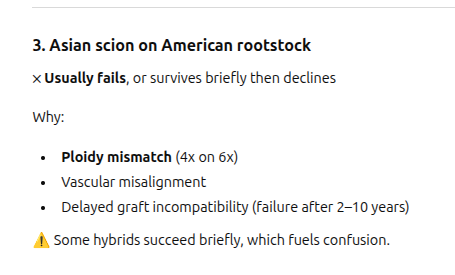
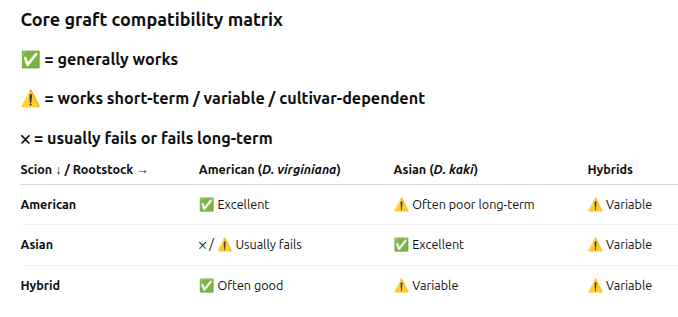
I thought Hybrids and Asians on American was fine/standard practice (to get cold-hardyness/vigor)?
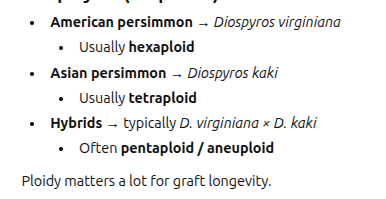
and some of the calculations above were based on hexaploid-y (6 genes “aaaaaa” from the Asian when it should have been just maybe 5 “aaaaa”? and the resulting hybrid should have had only 5 chromosome sets if what ChatGPT is correct [which im not sure if it is]?)

 I’ll probably try Kasandra and maybe a couple other ones like Chuchupaka or Zima Zhurma.