Illinois Everbearing Mulberry: When and How to Plant New Rooted Air-Layerings

Hi y’all,

I have learned so much from this forum over the years, and now after many unfruitful attempts to root my beloved Illinois Everbearing Mulberry from cuttings, I have finally hit big success this spring/summer from air-layering, and now need the advice of you fine folks so I don’t screw it up at this stage.

My goal is to augment and expand my orchards of this cultivar of mulberry on my mountain ranch, but the source tree is growing at my house in the suburbs. The destination of these new trees is Zone 5B/A, but where the source tree and the cuttings are currently located is Zone 7A.

My question is, when should I move the cuttings from the Zone 7A bed where they are developing their roots to the Zone 5B/A mountain ranch where they will be planted for good?

After having no success with rooting cuttings, both hardwood, softwood, and semi-softwood, using different rooting hormones and no hormones, and trying different media (sand, perlite, vermiculite, peat moss, promix, soil), I attached some air-layering pods to small branches on my tree on April 14 of this year, when the leaves were beginning to open, using rooting hormone. I maintained these branches by trimming off any developing fruit so that the branch could focus on leaves and grow the roots. All three of the layerings that had not broken off in a windstorm had some roots (not a bunch, but some) by late June, and I planted them in a partially-shaded place in my yard in promix (50-50 peat moss-perlite) before leaving town for a couple of weeks.

Given my past experience with rooting cuttings, I was not hopeful, but when I got back, I was delighted to see that all of the cuttings had grown new leaves and were thriving, as they are today. When I took the air layerings off of the tree in late June, I cut each to 6 nodes, trimmed all but two leaves off, cut those remaining leaves down to about 1/3 size, and wrapped the top and areas where I trimmed the leaves were (everywhere that I had cut) with film. New leaves are now pushing through the tape, and the cuttings are thriving.

When I took the first set of air layerings off of the tree, in late June, I attached the five pods onto new limbs that had grown completely this year and had no developing fruit, and with four still on the tree and doing well, just this morning I took one branch off that had broken in the pod during a thunderstorm last night, and it already has roots.

Both the first round and this next set of layerings are planted in an interesting area behind my house that was a rockscape when we bought the house 9 years ago, but which we have turned into, at various times, a flower garden, vegetable garden, and now a rooting patch. It is about 12 to 18 inches of very clay-heavy soil on top of what looks like a solid, flat brick surface, and for develpoing cuttings and air-layerings, I remove the soil from an area and replace it with my own blend of promix, which is peat moss with a very heavy admixture of perlite.

I have been tending to the cuttings in the rooting patch with a light dose of low-N, high-P fertilizer every two weeks to help the roots grow and encourage some leafy growth, and will likely stop the feeding of the June plantings in August, and the August plantings in September.

So that I don’t screw things up at this late stage, I am wondering when folks recommend I move the new cuttings (both the ones that went into the rooting patch in late June, the one that went in today (late July), and the ones that will go in some time between mid and late August to the mountains where they will be planted.

My options, as I see them, are (i) to move all of the new trees to the mountains this fall and hope they get established; (ii) move the ones that have been in the promix on their own and thriving since late June, and keep the ones that are coming off the tree later over the winter in my rooting bed to be moved in the spring; or (iii) let them all over-winter here in Zone 7A, and move them to the mountains in the spring.

Regardless of where they will be over the winter, I plan to mulch considerably to protect the new roots from the cold. If I move either all or a subset of the new trees in the spring, when do you recommend I do it? Should it be when it is still cold and everything is dormant, or should I wait until the chance of hard freezes in the mountains are gone? The latter would necessitate the leaves being quite advanced before moving, since deep freezes are common well into May in the mountains, at least six weeks later than they happen in 7A where the trees are now, and will potentially be until the spring.

Thanks again for your help, and I look forward to hearing what y’all think!
2 Likes

I would keep them in the zone 7 for the winter, but absolutely transplant them to the new location while dormant.

3 Likes

Thanks very much! This was my wife’s recommendation as well. Hopefully the trees still being dormant (mid-March or so) will keep them from being vulnerable to the much more extreme cold events that happen in the mountains.

The funny thing is, unlike up here in the DC suburbs of VA at roughly sea level, there are regularly nice and warm days at our mountain ranch, but it also routinely gets below -20F. The best thing about it, which also can make things tricky for our plantings, though, is that it NEVER gets hot. It has seriously only gotten to 80 degrees twice since we’ve owned the place, and often tops out at 74 for the whole summer.

Needless to say, the spruce and fir trees from the Himalayas, the mountainous interior of Japan, and the Qin Range in China do fantastically well there!

3 Likes

I’ve never tried this, but would agree with Treefrog.

Thanks! Just confirming here, they should be moved in the very early spring when they are dormant and things are still quite cold in both the root-development location (Zone 7A) and the planting destination (Zone 5B/A), right? Also, the planting medium should mirror what I’m using for development now, as in 50-50 peat moss-perlite, right?

When planting fruit trees at the mountain ranch, I generally plant them this way, with the medium surrounding the promix and root ball (stuff not yet in contact with the spread-out roots, but where they will reach in a bit) being a mix of the native soil (between 25% where it’s loamy and 10% where the hole is in heavy clay) from the hole, promix, forest floor cover (decayed leaves and topsoil, added for the mycorrhizal fungi from the mature forest on the land), and a decent amount of guinea pig manure compost.

The last component comes from the catch box under my family’s guinea pig cages, where we raise our pet guinea pigs (we plan to raise the larger meat-type guinea pigs when we are permanently on the ranch for homesteading, but it’s just pets for now), which consists of, in mass, about 2/3 guinea pig manure and dried residue of their urine, and 1/3 composted pine shavings. I do this so that when the roots of the new tree grow and venture beyond the promix in which they developed and are planted, they immediately encounter some nutrient-rich (but cold) material in the form of guiena pig manure.

As always, if anything that I am doing at any step sounds wrong to anyone, please do let me know! I’m compeltely self-taught in all this, and recognize that I have (and always will have) much to learn from knowledgeable folks like y’all!

Alba or hybrid mulberry trees are pretty tough, as @Lucky_P often puts it, they are basically big weeds. If you want to try to match the soil types it would be fine, but probably not necessary. Mulberry are fairly flexible on what soils they are in. As far as transplanting or planting a tree or bush, its ALWAYS best to do while its dormant.
There are benefits to transplanting it as soon as it goes dormant and benefits to waiting as long into the spring side of dormancy. Probably not a big deal either way.

One thing you haven’t mentioned is the amount of water the new trees will receive during the summer. Are you going to be present full time to attend to their watering during the summer in their new location? Is automatic watering via drip irrigation on timers going to be in place?

If not, I think your proportion of soil amendments you are planning is far too high. Most recommendations state to not use any soil amendments in the permanent planting hole, (or at most 50%). If the new trees will not be regularly attended for watering during the summer a higher clay concentration helps to sustain the trees if normal precipitation during the summer is inadequate.

As long as the new location you are moving the trees to isn’t a spot where its boggy/wet much of the year the porus amendments you are planning to add to your planting hole seem excessive to me. I try to never add more than 50% amendments max in any new planting hole as long as the native soil is semi decent for growing.

Just my opinion.

If it’s any help I’m supporting those who said transplant while dormant. My plants that arrive in zone 4b bare root dormant tend to look more robust at the end of summer than the ones that ship potted and leafed out.

I have difficulty with mail ordered bare root small grafts surviving fall and winter.

I would really recommend some Korean pines, or even Siberian pines, Korean and Siberian pine nuts are amazing!

Saw a recent thread in a mulberry Facebook group, where Buzz Ferver opined that own-root specimens of Illinois Everbearing were notorious for not anchoring well.

I have no experience in that arena, as until last year, I’d never been able to get IE cuttings to root, but I ended up with two rooted IE cuttings from last summer’s attempts, which are currently growing rampantly in 1-gallon pots.

I have an own-root specimen of ‘Stearns’ mulberry planted 35 ft off the west corner of the house; planted 5-6 years ago, as a 6-inch rooted cutting, it appears to be well-anchored, is 15+ ft tall, and has been fruiting well for at least 4 years now.

1 Like

Rooting IE is an unusual achievement so congrats!

I agree with others suggest you use a larger 5 gal pot that has at least 25% each mix of garden soil, compost, river sand, and clay to grow the roots a full season in the warmer zone.

Transplant them as a root ball with that mix next spring when ambient temps are above freezing. Water them in well and mulch with up to 6” wood chips at the future drip line, with only about 2” deep mulch within 6” of trunk

Good luck

Dennis

Kent. Wa


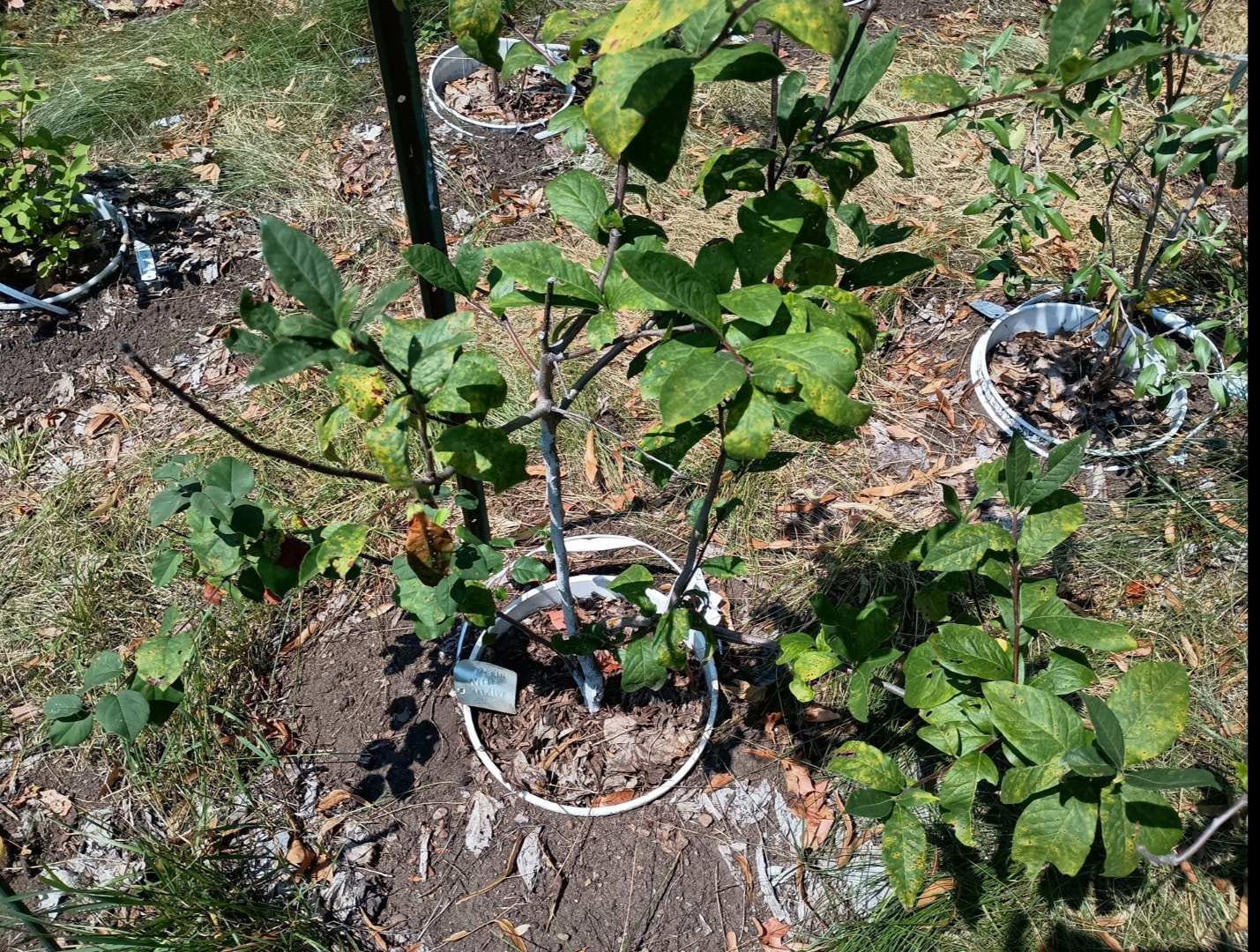
Don’t feel bad about growing things out in 5 gallon buckets (holes drilled in bottom) with a blend of 50/50 augmented soil. These are set in the ground to survive winter. The plastic bag that the augmented soil came in is used as a weed stop barrier. When it comes to digging the hole, I leave all the dirt in a ring around the bucket so that I can push the dirt back into the hole and re-level the surface when I’m done.

Yes I know the Medlar plant in the middle has a rootstock sucker of Provence Quince.

2 Likes

Seconding the dormant transplant advice. I’ve had a few losses moving things while they’re leafed out and it’s always the same story, the roots just can’t keep up with what the canopy wants. Early spring before things wake up is much less stressful for the tree.

glad to know your quince and medlar survive where youre at. would you tempt fate and leave them in containers, above ground, here in des moines? id like to not plant them in ground but if i have to i have to. found out that peaches wont make it in containers here this year.

1 Like

Maybe they still will, they seemed okay for me.

My uncle, a nurseryman, recommend that I put my pots against the foundation on the north side of the house and cover them and surround them with oak leaves for insulation and oak leaves have something in them that prevents mold.

It worked pretty well, I don’t know that I got pictures.

1 Like

i meant they died this year. i didnt insulate with anything but i had them surrounded by blueberry, blackberry and raspberry pots, though. black berries didnt make it either. i want to do less protections lol i put a peach on american plum to see if it will make it through the winter on that.

1 Like

To leave plants in pots above ground in winter, the general recommendation is that you need to be 2 growing zones warmer than the plant’s coldest growing zone.

In Des Moines, you don’t have 2 growing zones of separation above the coldest zones for neither Medlar nor Quince (both 4), so you would need to bury the containers into the ground.

2 Likes

This worked very well for me, you do have to insulate them in this case with oak leaves, also most of them were covered with snow, there were pots 3feet out from the wall and the only thing I remember dying was the unknown fig from South Carolina, but there wasn’t 100% survival.

Putting them in a shady, protected place is important, they can wake up too easily in the spring and die if they’re on the sunny side of a house.

So you don’t have to bury them, but I believe you do have to protect them somehow, this was very easy, I do have oak tree so getting oak leaves was easy too.

I wonder if Apricot can be grafted to American plum? Certainly it can be with an interstem, but directly, I’m not sure.

1 Like

Wow, my cup runneth over; I am so grateful to all of you for the advice!

When I said I hadn’t had luck rooting the IE mulberries from cuttings, it was true, but I did get pretty far with one. It was the self-anchoring issues discussed here that reminded me of the one cutting that actually made it and produced lots of leaves after sending out good roots in the river sand. It was one of my first cuttings, made in late winter/early spring, and while about 20 of the 100 or so I laid on the medium produced the beginnings of roots (the early successes were evenly-distributed between ones with rooting hormone and ones without), and five made it to the potting-up stage, just this one seemed to flourish. I kept it inside under grow lights until October, when I took it to the mountain ranch to plant. Just on the car trip up there some of its leaves were already turning a grayish white, and despite planting and anchoring and giving it lots of water, it died almost immediately. I noticed when planting that it had next to no roots at all, which was a baffling surprise.

It is sounding like the consensus opinion is that I should reconsider having and keeping these successful air layerings where they are; in the very sterile (half peat moss half perlite) pro mix that I have been making for years, and should instead consider using some combination of clay, sand, compost, and potting/garden as their substrate. Is that correct?

I have consistently been using this low-nutrient medium for a few reasons. With specificity to propagation and developing roots, I used it so that gnat larvae would not eat the roots of new cuttings; a serious problem with my rooting attempts done in soil, all of which were abject failures. I also was under the impression that having a low-nutrient medium and introducing the nutrients in a controlled manner with the use of light applications of high-phosphorus fertilizer dissolved in water (I use miracle gro flower food) facilitated root development, encouraged the roots to expand outward, and kept the leafy growth from outrunning the root system.

The general reason I use this mix is that I developed it for planting the rare and exotic spruce, fir, and pine varieties on my mountain ranch, and for those, one is supposed to give them a large hole with nothing but very-low-nutrient medium with good drainage, and not offer any fertilizer for at least one year (start in the second spring they are in the ground at the earliest). This has worked very well for me with the rare, alpine conifers that I introduced, and so I have used it for nearly every tree or shrub I plant.

I do think that having the air layerings (and cuttings if the top 6 nodes of the branches I have layered also take) spend both this growing season and another entire year in the shallow rooting bed (even if I put them in 5-gallon pots buried in the bed and insulated at the sides with lots of substrate) might be too long and cause them to be root-bound. This is based on my experience with planting bare-root IE mulberries, i.e., when they are planted and take, they REALLY take! The first one I ever got, which is my first experience with the cultivar and the source of my air-layerings, came as a very modest bare-root in February of 2017 (the month we moved into the house in the 7A suburbs) about 1/4” in diameter and 20” tall, and after simply planting it in the backyard soil and never fertilizing it, it was 8” thick and 17’ tall when the first frost hit in November of that year!

I already had to do some aggressive preventative care to work out and straighten girdling roots on the 5 bare-roots I got this spring and planted on the mountain ranch, and I would think that after spending this summer and then all of 2027 in 5-gallon pots in my shallow rooting patch, any examples of IE mulberries that took would have choked themselves out by August or September of that year.

As for the suggestion on Pinus koraiensis, I think the missus will very much want me to spring for a couple of those! She’s from Manchuria, and we met when I was an exchange student at her university (Peking University), so the first tree priority when we bought our ranch was planting the P. tabuliformis and P. hwangshanensis we fondly remembered from our undergraduate courtship on lots of promontories, ridges, and cliff edges. I swear, those things grow like they were bred for the high, southern Blue Ridge; on average, they grew 6” the first year we planted them (they went in the ground in March of ‘23), 18” the next, 3’ last year, and have already added 5’ this year!

Sub-alpine evergreens were my first and strongest interest in the field of botany (I grew up in sweltering, low-elevation central NC, so spruce and fir were a tantalizing and unattainable goal for me), and were also what got me into gardening and arboriculture. I have always loved mountains, and as my wife has felt the same ever since I took her to the mountains for the first time in her life, growing all kinds of plants in the challenging-but-rewarding environment of our mountain ranch is a dream-come-true, and I can’t thank you fine folks enough for all your help!

4 Likes

Thank you! Now I have another reason to hate gnats! :grinning_face_with_smiling_eyes:

The squirrels and turkeys would also vote “yes” for Korean Pine nuts, maybe deer too.

That was probably a grafted tree though right? Or do you know that it was a rooted cutting? In either case it’s nice to know it can grow almost in 1” diameter per year.

1 Like