I figured with the potential for further lines of hybrids through the existence of JT-02, it is worth discussing this particular variety and the breeding implications.
It is assumed that the selection currently called ‘Fruit Dump’ is actually Josephine.
Does anyone know if genetic testing has been performed for this selection?
Do ‘we’ have any testing available to correlate whether JT-02 appears to be the offspring of Josephine (aka ‘Fruit Dump’)?
Would current technology for genetic testing be effective/accurate in determining if a hybrid persimmon is in fact the offspring of a pure virginiana selection?
Do we have any sequencing or background genetics on file that would be appropriate for this kind of research?
Is the current sequencing project for the virginiana genome expected to improve the quality of information available for a research project like this?
Why is such genetic evidence needed? My understanding is that Jerry Lehman pollinated Josephine (female) using Taishu (male flower). There should be no question that the female parent is Josephine.
To my knowledge, no positively identified Josephine exists, it is speculation based on inferences that Fruit Dump is actually Josephine.
If Jerry had a known source for Josephine when making this cross, it is not one I’m aware of being commercially available in the nursery trade. I have heard there are some incorrectly labeled “Josephine” in circulation.
You are making an assumption that I am accusing Jerry of not having the right variety; My interest in testing JT-02 is actually to confirm that Fruit Dump is actually Josephine, hence the topic label chosen.
I speculate that Jerry secured Josephine from Sonneman’s orchard… Some time ago there was a post aboout genetic studies for persimmon made by Savanna Institute. If they sampled material from Hershey and Sonneman (maybe also Etter) orchards then we could cut off all speculations.
Not at all. To me, your main question as phrased was “whether JT-02 appears to be the offspring of Josephine”; and then you appeared to tack on the parenthetical (aka ‘Fruit Dump’)." So I wasn’t assuming your motive; I was just interpreting your question as stated.
If that’s your purpose, it’s not apparent from the topic label, which doesn’t mention Fruit Dump. Your first sentence indicates that your interest is further hybrids from JT-02. There’s no mention of Fruit Dump.
FWIW, Richard’s paper (below) indicates that Josephine was a wild variety discovered in the late 19th century in Bluffton, MO. It’s reported to have at least 4 synonyms, including Fruit Dump. I’m unaware of any information as to where Jerry Lehman acquired the variety that he identified as Josephine. But it could easily have been a private collection rather than a nursery.
It wouldn’t matter: (1) It is a polyploid, and thus testing by genetic markers is folly; (2) All horticultural use of genetic markers to date is equivalent to phrenology [J. Coyne, 2003]. To remedy this, amplicon sequencing must be applied to the PCR products.
No. It would require haplotype-phased long-read high-quality sequencing of both JT-02 and Josephine, then comparison of the haplotypes (2 each) from the sequencing. At present there is no viable laboratory method for sequencing polyploids. It could be a decade before hardware exists to enable it. If persimmon was diploid (it is not) the current sequencing and chromosome level assemby would be about $6,300 total, each specimen.
No. (1) The current assay methods (see above) are erroneous; (2) At present there is no hardware for polyploid sequencing assay; (3) The complete set of genes required to differentiate different species of persimmon (and most plants, in general) have not been identified. Specifically, the loci presently used in horticultural genetic markers have been determined by gross extrapolation and are not associated with genes that would define define species – in fact most are not associated with genes, period.
No.
That project is wishful thinking. At best they will produce a coarse genome map. However, they will claim much more exaggerated results.
@disc4tw
It is curiosity like yours that drives horticultural research.
There are four main types of biological assay. Morphology. Structural characteristics such as monocot vs. dicots, leaf shapes, and mature height. Physiology. Internal processes down to the cell level such as enzyme interactions with soil and chlorophyll chemistry. Genetic Markers. This assay is performed either manually or by robotic devices (size and shape of a washing machine) using a chemical process known as PCR. The necessary chemicals and optics are contained in the robot. In horticulture, the chemical byproducts of PCR (called amplicons) are examined for their length. In more robust sciences, the amplicons are sequenced to examine their contents. Genetic Sequencing. Robotic hardware (size and shape of a refrigerator) is used to determine the “base pairs” of a specimen. At present, there are two main types, short-read (e.g. Illumina) and long read (e.g. PacBio). They each serve different purposes. Unfortunately, the difference are sometimes ignored by investigators seeking lower cost assay. Both are limited to diploid assay.
This seems to be a misunderstanding of how these assays work, or maybe you haven’t kept up with more recent developments. The PCR machine I used ten years ago wasn’t much bigger than a computer “tower”. However, the important difference is that amplicons aren’t simply “examined for their length”. Rather, they are compared side by side to how far they travel between diodes - two very different samples can both be “long”, but having identical signatures across the whole spectrum is statistically impropable.
AFAIK the genetic testing Savannah Institute has done has lined up with the existing paper trails, which suggests the science is sufficient .
Both of these conjectures are false. Further, lining up with paper trails that originated in improper assay and statistical methods is a continuation of folly (and publisher’s profits) – not of scientific viability.
The “paper trails” I’m referring to are the breeding records left by those who made the original crosses of trees in their orchards - no assays or statistics involved. The fact that the genetic tests align with the known records of tree parentage seems to be pretty solid proof of concept.
@Richard could you provide us with the title of the article you cited. I can’t find anything by this author linked to “phrenology” or casting doubt on the use of genetic markers.
There is a long history of horticultural publications using breeding records for verification. All of them ignore the fact that horticultural assay methods to date imply astronomical size populations that statistically require sample population sizes many orders of magnitude greater than 10^10. However, the use of amplicon sequencing would permit analysis methods that imply realistic population sizes with tractable sample sizes.
Yes, they assayed polyploid specimens in machines designed for diploids, then claimed unverified software allowed them to determine all independent strands in the polyploids. For example, suppose 4 independent boats are observed leaving a harbor for unknown destinations. GPS tracking devices are put on two of them but the other two are never tracked or observed again. Further, it is not known which two boats have the GPS devices. From the resulting data, it is claimed that a software program can determine the voyages of all 4 boats in exacting detail.
You’re further misrepresenting the methods & science. I highly recommend actually reading that paper.
Is this your source? Because I don’t see how it’s in anyway relevant to applied genetics.
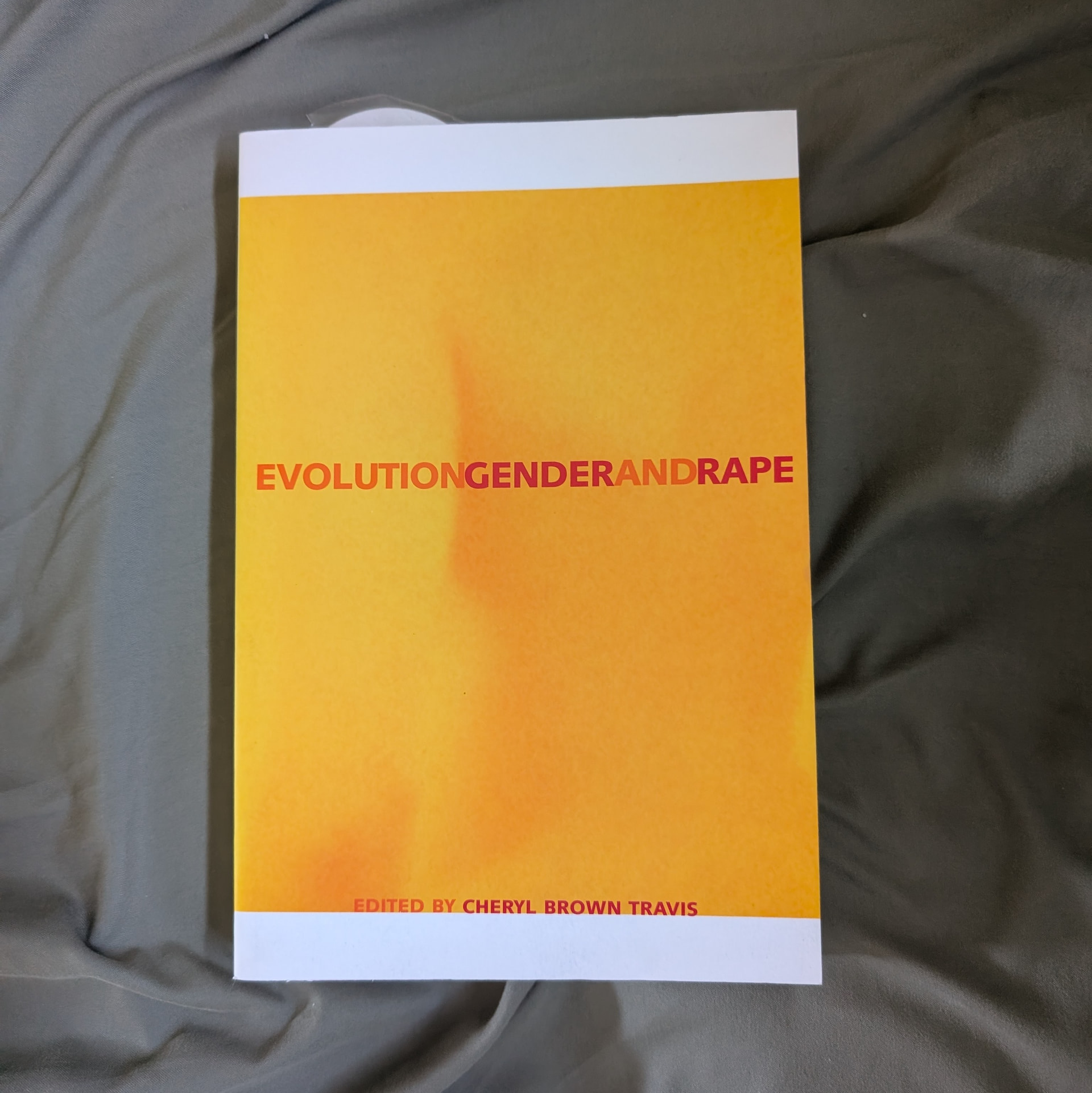
Of vice and men: A case study in evolutionary psychology
Jerry A Coyne
Evolution, gender, and rape, 172-189, 2003
“In science’s pecking order, evolutionary biology lurks somewhere near the bottom, far closer to phrenology than to physics. For evolutionary biology is a historical science, laden with history’s inevitable imponderables. We evolutionary biologists cannot generate a Cretaceous Park to observe exactly what killed the dinosaurs; and, unlike" harder” scientists, we usually cannot resolve issues with a simple experiment, such as adding tube A to tube B and noting the color of the mixture. The latest deadweight dragging us closer to phrenology is “evolutionary psychology," or the science formerly known as sociobiology, which studies the evolutionary origin of human behavior. There is nothing inherently wrong with this enterprise, and it has generated some intriguing theories, particularly concerning the evolution of language. The problem is that evo-lutionary psychology suffers from the scientific equivalent of megalomania. Many of its adherents are convinced that virtually every human action or feeling, including depression, homosexuality, religion, and conscious-ness, was put directly into our brains by natural selection. In this view, evo-lution becomes the key-the only key-that can unlock our humanity. Unfortunately, evolutionary psychologists routinely confuse theory with idle speculation. Unlike bones, behavior does not fossilize, and understanding its evolution often involves concocting stories that sound plausible but are hard to test. Depression, for example, is seen as a trait favored by natural selection to enable us to solve our problems by withdrawing, reflecting, and thereby enhancing our future reproduction. Plausible? Maybe. Scientifically testable? Absolutely not. If evolutionary biology is a soft science, then evolutionary psychology is its flabby underbelly…”
Here is a genetic “fingerprint” from a horticultural PCR study utilizing 15 genetic markers. The columns are markers, the rows are estimated lengths (in base pairs) of F and R primer products (amplicons). The content of the primer products are not sequenced. The comparative analysis of fingerprints is solely based on primer lengths.
At the time of Coyne’s book chapter, this was the status quo. A few years later, researchers of human genetics began employing amplicon sequencing, and a decade later much of zoology and bacteriology followed. Horticulturalists have not.
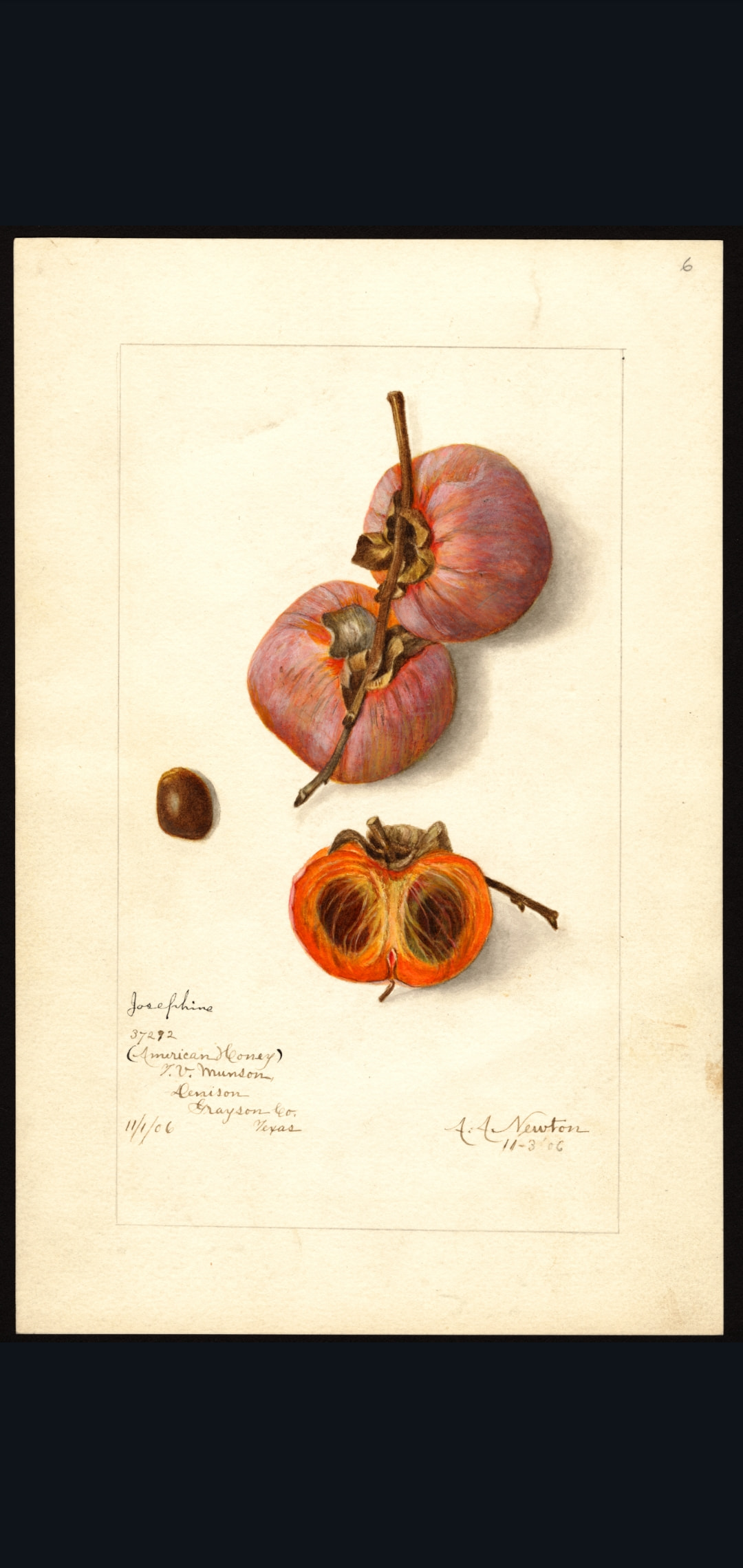
I’ve been searching for the Josephine for over 20 years now, so this is a topic of interest to me. Here is a data dump of my current understanding. ‘Josephine’ was discovered by Samuel Miller on a farm owned by Dennis Watson on the bank of the Missouri river.[1] It was also known as ‘American Honey’ and ‘Honey’[1,2] owing to its reported translucent, pale yellow color.[1,-5] Noted nurseryman T.V. Munson stated it was a “large, clear honey-colored fruit of the finest quality”.[6] The USDA yearbook of 1906 contains a color lithograph of presumed ‘Josephine’ fruit which they colored orange, but this was in 1906 and refrigeration and rapid transit were not yet available. If the lithograph was indeed based on real ‘Josephine’ fruit, it is presumed that it was old and of poor quality by the time of rendering - likely resulting in artistic license.
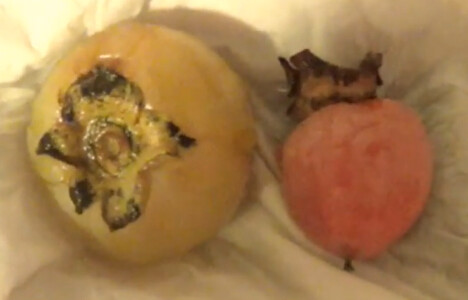
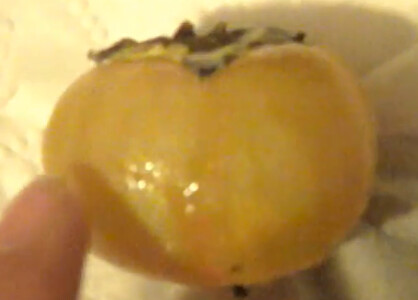
I believe the grafted persimmon from the Iowa Arboretum that is presented in the YouTube video entitled, “American Persimmon Review - Weird Fruit Explorer Ep. 179” may be the long lost ‘Josephine’. I’ve attached a couple of snapshots of it from the video. It matches both the published shape and coloring (which is very unique). In addition, I know a turn of the twentieth century persimmon enthusiast, H.O. Harrington,[7] grew many of the antique cultivars and was in direct contact with Samuel Miller at the time. It is possible that from there it ended up being grafted at the arboretum at a later date. I asked Jerry multiple times if he had come across this variety or had access to it. He always said no. I also have the spreadsheeet of the varieties/crosses Jerry had growing on his property at the time of his passing. ‘Josephine’ is not listed. From what I understand, the cross of JT-02 was created in Japan and imported. Whether the Japanese breeders possessed the actual ‘Josephine’ or one they thought was ‘Josephine’ is unknown to me.
I also know John Hershey used to sell ‘Josephine’ trees from his catalog,[8] so it is also possible that the tree Buzz thinks is ‘Josephine’ is true to name.
[1] Taylor, W.M. Promising New Fruits: Josephine Persimmons. Report of the Secretary of Agriculture. USDA. 1906. pp. 362-363.
[2] Buckman, B. A Talk about Persimmons: Valuable Facts about the Fruit. The Rural New-Yorker. Feb. 20, 1904. p. 136.
[3] Buckman, B. A Talk on Persimmons. The Rural New-Yorker. 1900. p. 783.
[4] Fletcher, W.F. The Native Persimmon. Farmer’s Bulletin. No. 685. USDA. 1915
[5] McDaniel, J.C. Diospyros Virginiana: Persimmons and their Propagation. 1964.
[6] The Munson Nuseries Catalog. T.V. Munson & Son. Dennison, TX. 1914-1915.
[7] Harrington, H.O. The Persimmon in Iowa. Trans. Iowa Horticultural Society. 34, 1899. pp. 251-256
[8] Nut Tree Nurseries. John W. Hershey. Downingtown, PA. 1952-1953.
Unfortunately I can’t find a picture of the Josephine fruit that I can guarantee is linked to the Fruit Dump tree. I asked Buzz if he has any. Looks like my homework thus fall is documenting Fruit Dump / Josephine fruits. But from my recollection they look pretty exactly like the USDA color slides. They are more yellowish than regular Dv but im not sure I would go so far as to say that they ARE yellow. They are mildly translucent too.
 .
.