Its hard to compare, especially since I think of “tropical” flavor as generally denoting something hard to put your finger on. In my mind it should involve some heady flavor combination that is at once sweet, sour, musky, and aromatic. If so, Id say both pawpaw and maypop are lacking in at least one element- sour in the case of pawpaw and musky in the case of maypop. Mayapple fruits have a nice pleasant balance of all those elements. To me its the most tropical tasting fruit thats not from the tropics, at least that Ive tasted.
7 Likes
Great description- wholeheartedly agree with how you worded that and your assessment of pawpaw and maypop.
Now I will have to up my mayapple efforts 
2 Likes
This is an interesting topic; it reminds me of finding mayapple plants near St. Louis in my youth. I wonder how they would do in the Pacific Northwest. Has anyone from that region tried to grow them?
1 Like
I’m in the PNW. I’ve been growing them in pots because I wanted them to be big enough to divide before putting in ground, but so far they’ve been doing well here the past few years.
6 Likes
Nice. Fruiting?
I had a huge area of mayapples at my old farm on a shaded gentle slope in old, old woods. But I never ate one as I somehow believed they were poisonous. Too bad…
2 Likes
Yes, I’ve gotten some fruit. My plants are pretty small still though. I’m adding a couple more clones to the collection this year. I’m debating whether to plant them all in the same area for a genetically diverse planting (keeping a back up clone of each in a pot) or if I should plant each one in a different part of the garden to compare them individually.
3 Likes
I just read on the Web that mayapples are not self-fertile. I assume that also means that clones won’t pollinate each other. Is that what others have experienced?
I have ordered 6 seeds that will be planted as soon as they arrive. How long should I expect to wait until the plants flower?
Thanks
There is variation within the species regarding pollination. Some clones are self-compatible and some aren’t. Nothing that is available from nurseries specifically addresses whether the clones they carry are self-compatible or not, so trial and error is required. I have already confirmed that the clone sold by Joy Creek Nursery is self-compatible, but they have retired and no longer sell plants to the public. I do have their clone, but it’ll be a while before I’ve got enough of it to share any.
3 Likes
Absolutely Fantastic Discussion going on here, Glad I found it cuz I didn’t even know there was this much excitement around mayapples.
I want to connect/revive the discussion with my notes I’ve shared here.
@hobilus I share your ethusiasium for Mayapples! Infact, I want to Domesticate them! They really are incredible Cold Hardy Tropical Tasteing Fruits (To me they taste like Pinapple x Passionfruit but with more sweetness) & Yes most of the Ornamental types should be edible when fully ripe just like Podophyllum peltatum (I want to try them all!). Look into my notes, I’ve listed all the species of Mayapples available with Fruit Photos.
Harvest the fruits Green to continue ripening at Home off the vine like you would Tomatoes. I harvested like 40 fruits from my local patch this way & got to enjoy them as they ripened.
@Ged Are you still growing Podophyllum hexandrum? You can harvest unripe fruits to ripen off the vine at home away from any animals who want to eat it.
Likewise, altho I’m more interested in the seeds which won’t hurt the plant anyway.
5 Likes
Thanks to this thread I’ve got about 20 seeds started and got some rhizomes in case the seeds don’t take. hopefully they survive here. with our deep snow, i think they will.
3 Likes
Thanks for the ongoing discussion, and the advice on edibility for P. hexandrum.
I don’t live where I left the hexandrum growing, but this weekend I should have a chance to check it and see if it’s still going. If so it should have multiplied and I might be able to get an offset. Here’s hoping.
3 Likes
@steveb4 Fantastic!
Your welcome!
I hope it’s still there! Being perennial, there’s a good chance it survived.
Seeds or offset, both are worth collecting.
1 Like
i just received the rhizomes. they are in moist peat waiting to be planted in May.
2 Likes
I have to agree. I’ve always gone by the idea that humans don’t have the proper perspective on nature. Plants have a singular objective - to propagate themselves. In collecting and propagating plants, if I can reasonably expect to be successful by being well informed, I consider my interaction furthers the plant’s continuation. A good example of this is the Franklinia, now extinct in the wild but surviving in gardens. It was only found in a very limited range, an indication that it was ecologically in a bottleneck. It’s hard to say why it was lost, but habitat disruption would be the best guess. It was certainly not over collecting for that place and time, but it easily could be today, since we are who we are and rarity is at a premium.
6 Likes
I recently came across a source in VT for P. hexandrum ( both the green and the red variegated forms). The one I grew years ago also came from a VT nursery, but not this one.
podophyllum-mayapple-hexandra-peltatum — Great Brook Nursery
2 Likes
thanks. I ordered a couple of each of the hexandrum.
2 Likes
Franklinia is actually one of several well known “glacial relict” species whose seeds floated down river during the last ice age & never managed to return north to suitable habitat once the climate warmed back up. Conservation groups have even tried “reintroducing” Franklinia into its “native range”, but all of them died. The species quite literally needed humans (or another, now extinct, disperser) to help them migrate.
Would love to know more about those P. hexandrums tho. Anybody tried the fruit yet??
2 Likes
That’s an interesting idea. What sort of evidence is there? I have tried growing Franklinia in zone 5 and it didn’t have a problem with that amount of cold. But I’m not sure we can explain why it was stranded in the south when many other varied species have readily returned north. It’s seeds must be quite unpopular or problematic since it didn’t even spread in the south. It also would need to have negotiated more than one watershed to get to where it was discovered.
As for the Podophyllum discussion, @hobilus has made a great case for the fruit as being delicious for the native species, and possibly others. I haven’t tried them, but I will if I get a chance.
1 Like
@Ged I don’t know a whole lot about Franklinia particularly, but here’s a graphic showing the obvious routes several trees took out of the Appalachians during the last glacial period, with stars representing where the species was “discovered”.
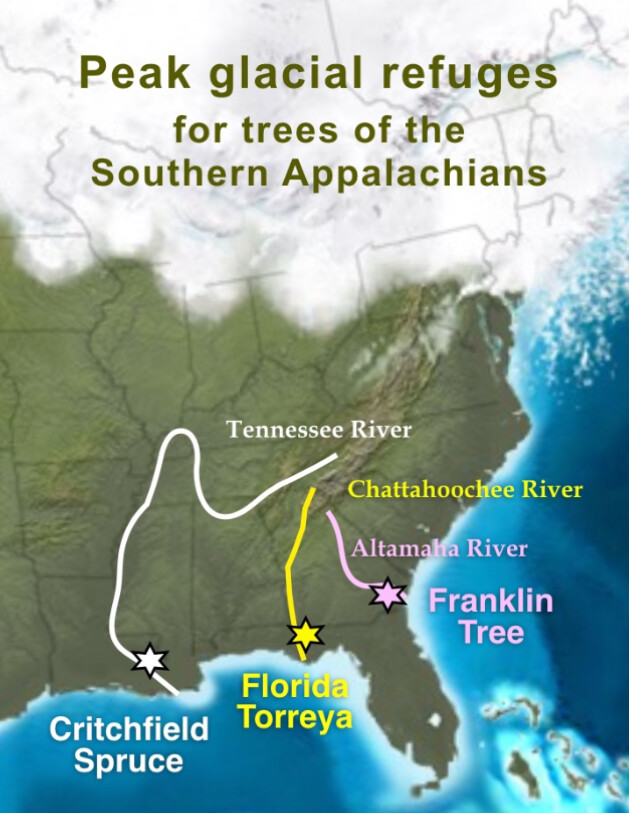
I do some volunteer work for an organization that propagates and dispersers the “Florida Torreya” northward. So here’s some info on that:
https://www.torreyaguardians.org/assisted_migration_paleoecology.html
As to Mayapples, I can also attest to the incredible flavor of our native P. peltatum. I definitely recommend trying one if you can beat the critters to it. Just wasn’t sure if the Asian counterparts are anywhere near as tasty.
2 Likes