It’s the Shipova of Medlars: a triploid hybrid. You’d think some plant collectors here would want to grow one. Thanks for letting me know people actually read the link I posted.
6 Likes
I’d certainly be interested in trying one, if I ever had the opportunity. “Surprisingly sweet” fruit sounds promising. But what was the flavor? That’s the question! Was it something unusual? If so, that would be really special, and I’d be chasing it like crazy!
If the flavor’s good but something I could get from a fertile hawthorn or fertile medlar or something else, I wouldn’t be inclined to chase it (because it’s infertile, and I prefer fertile plants that I can save seeds from to plant myself and share). It also doesn’t sound like it’s very productive. I’d be interested in tasting the fruits, but I don’t think I’d be chasing it to grow it.
Of course, if it was something I already had, I would highly value it and be eagerly offering cuttings and seeds to everybody who thought it was neat, so that its genes could continue. I think the mere fact that it exists is super cool.
2 Likes
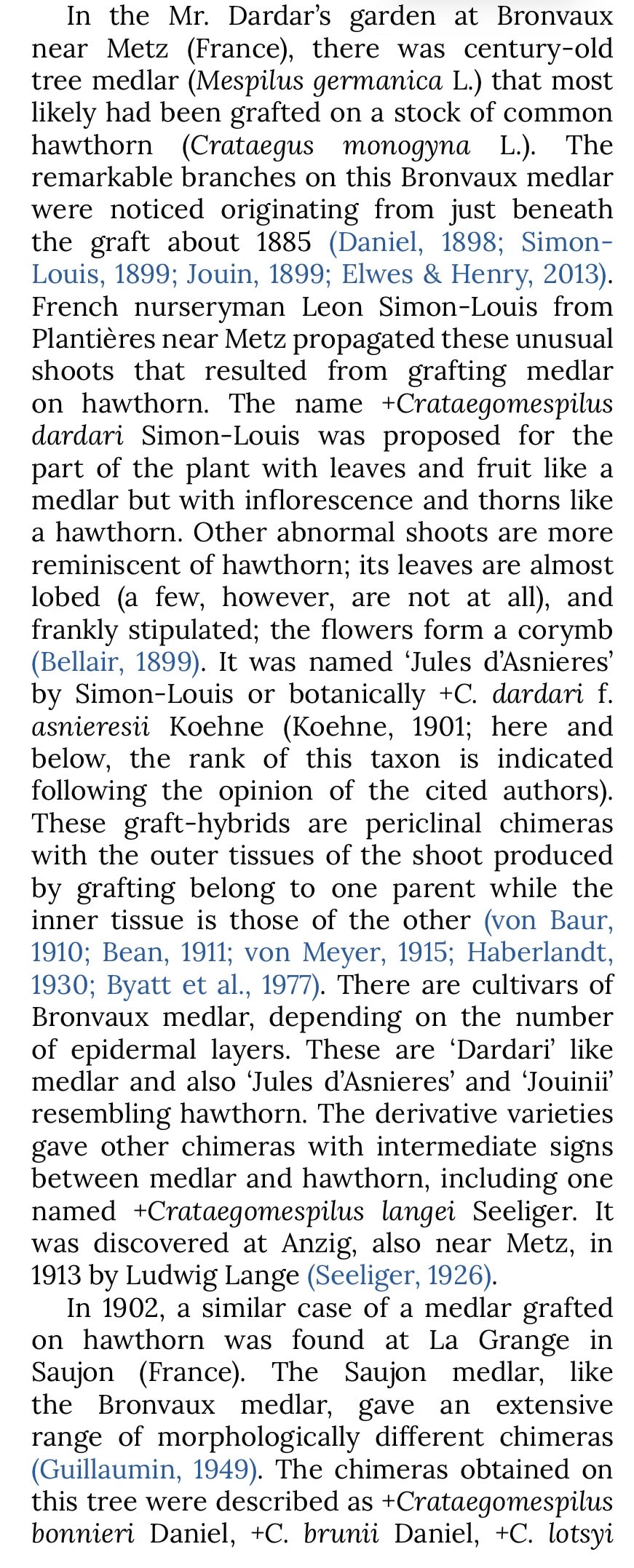
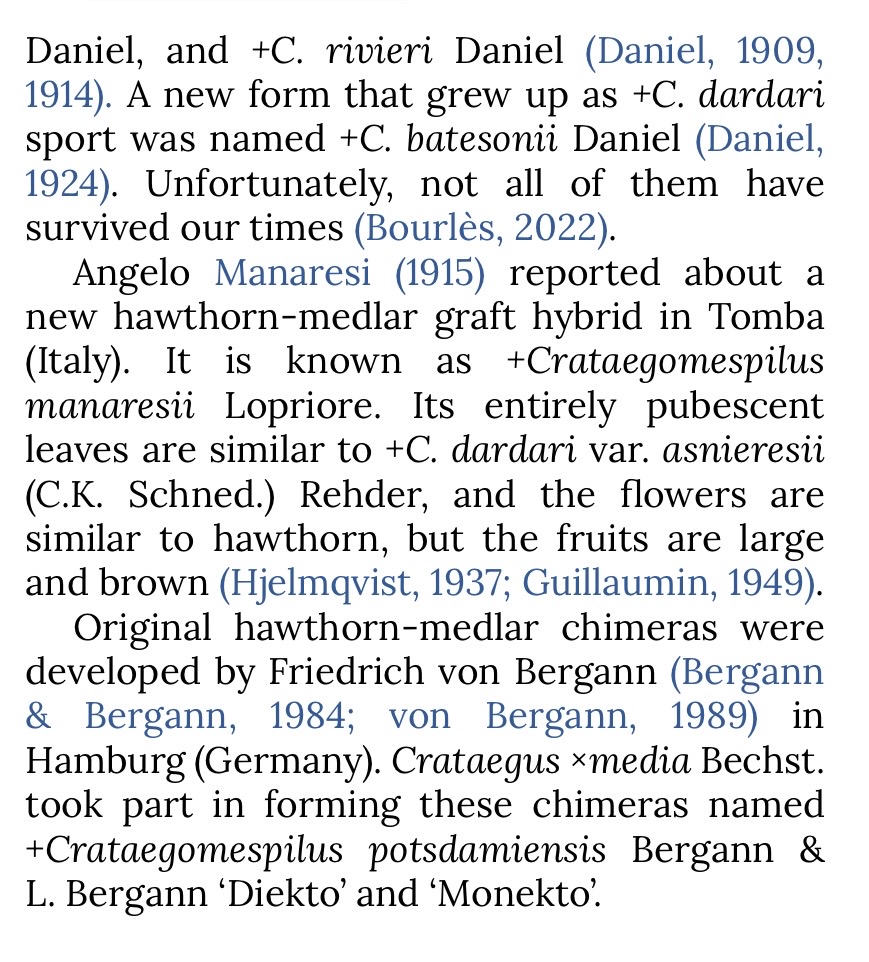
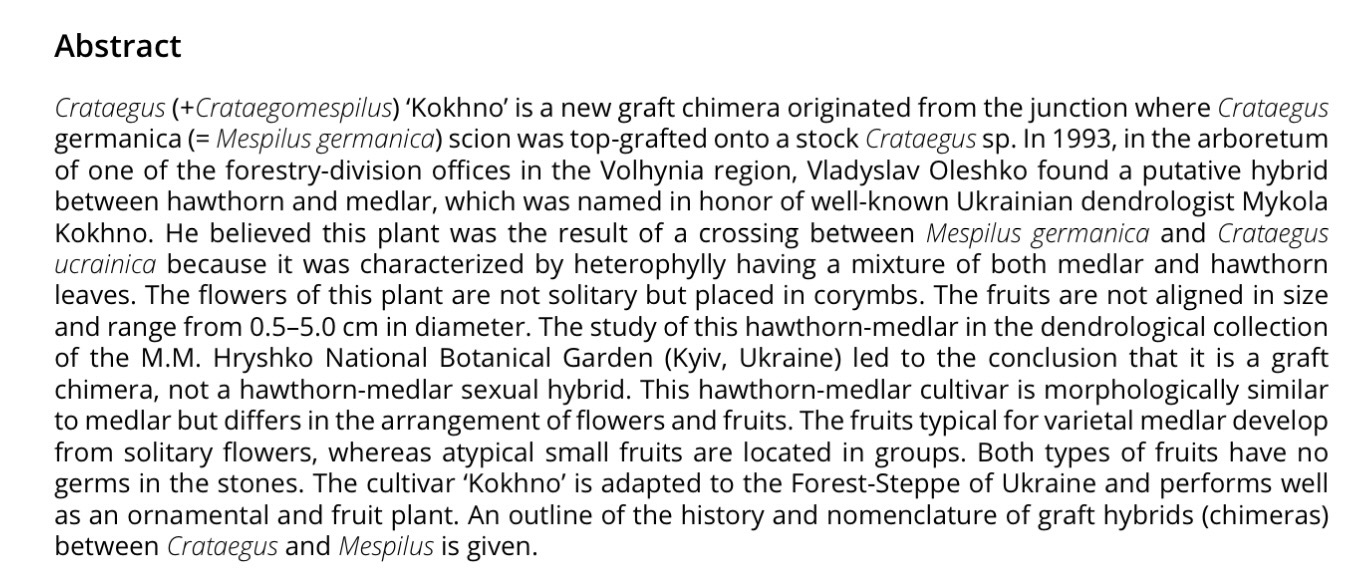
There are also multiple graft chimeras between hawthorn and medlar, along with sports derived from those chimeras. It would be interesting to obtain some of these, although I doubt I’ll be able to.
PDF: Graft Chimeras
2 Likes
so if chimera’s are not true genetic/DNA hybrids … where branches from any part can be grafted onto something else (like how persimmon hybrid Nikita’s Gift can be grafted on any american rootstock and always be Nikita’s Gift) …. Can you truly graft/propagate them?
Reading more about chimeras, it says they are ‘cell layer mixing’.
if thats the case, is it possible one branch can be a mix of 75% medlar cells and 25% hawthorne cells … and other branch on same chimera plant is 10% medlar cells and 90% hawthorne cells?.
Is that possible?
or thats not true, and when a chimera happens at the graft union, its some mix that shows up evenly on the plant above the graft union? (and hence you can remove any branch for grafting).
Also lets say i grafted one of these chimera branches onto quince rootstock … would it stop having hawthorn cells going up the rootstock since now quince has supplanted it and revert back to becoming a 100% medlar?
3 Likes
Possibly to answer my own question (well the AI if its accurate [sorry for posting AI, but guessing not many people know the answer so might be useful])…
What happens if you take a branch and graft it?
Case A: You take a fully chimeric shoot
If the bud you graft still contains both species’ cell layers, then:
-
 The chimera can survive
 -
 But it is unstable
 -
 Many grafts lose one layer during healing
Outcomes you’ll see:
-
Some grafts stay chimeric
-
Many revert to pure medlar or pure hawthorn
-
Sectorial chimeras often collapse into one genotype
This is why historical ×Crataegomespilus plants are:
-
Rare
-
Poorly propagated
-
Often preserved only in collections
Case B: You unknowingly take a reverted branch
Very common.
If the branch already reverted internally:
-
It will propagate as pure medlar or pure hawthorn
-
The chimera is gone permanently from that cutting
This happens because one layer outgrows the other.
- Will the graft “snap back” to medlar?
Often, yes — but not always.
What actually happens:
-
During graft healing, one cell layer dominates
-
The more vigorous species usually wins
-
In medlar/hawthorn chimeras, medlar often overtakes hawthorn layers
So many propagated scions:
-
Grow out looking 100% medlar
-
Produce medlar-like fruit
-
No longer show hawthorn traits
This is called chimera breakdown.
Thanks, I have a shoot sticking out of a graft union, but I don’t want any % Provence Quince.
I did see the USDA and other references ShiverMinneapolisZ4b mentioned above were saying all 3 were the same or similar.
Raintree says theirs is 2.5”. Is it worth having Macrocarpa for its larger size? or Nottinham/Marron are smaller (1.25”?) but even better flavor?
Anyone have scionwood of either variety ( @JohnS ) ? Send me a pm.
I think FruitwoodNursery is soldout.
There’s a very mature ‘Macrocarpa’ at the arboretum in Seattle. It makes wonderful fruit, and while I would believe 2.5” size could be possible, the average size is not that big from my observation.
Even though the name ‘Macrocarpa’ leads one to believe it should have bigger fruit, you have to account for the fact that the name was applied to it long ago, and by today’s size standards it would be considered a mid-size medlar.
4 Likes
I missed this when you originally posted it. Sorry to somewhat derail the thread but AI’s answer is really terrible. Both Case A and Case B are misleading at best.
Case A
It is true that many chimeras are unstable. However, this does not mean that all graft chimeras inevitably break down.
Periclinal chimeras—the most stable type—can be propagated clonally for very long periods. Some have been maintained for centuries in botanical gardens and arboreta. The graft chimera +Crataegomespilus has persisted in cultivation since the 17th century. Likewise, ‘Prague Citsuma’ (a citrus graft chimera) has been propagated successfully without extraordinary difficulty.
So while instability is a real biological phenomenon, exact clonal lines of stable periclinal chimeras can be maintained indefinitely through vegetative propagation
This wording is misleading.
First, it suggests that a plant might suddenly lack an epidermis or a major tissue system, which is not what happens. What actually occurs is a change in which histogenic layer contributes to the meristem.
Second, the framing is unnecessarily negative. If one histogenic layer is replaced during healing, it is equally valid to describe that event as one layer expanding into another. The biological event is the same; the interpretation differs.
More importantly, the AI’s reasoning appears to rely on an outdated two-layer model of plant organization (inner vs. outer tissues). Modern plant developmental biology recognizes three primary histogenic layers in the shoot apical meristem.
Older research on graft chimeras—including early work on +Crataegomespilus—was conducted when two-layer terminology was common. If one assumes only two layers exist, as the AI does, then any change in one layer appears to represent the complete loss of one parent. Under the modern three-layer model, that conclusion is incorrect. A chimera can persist even if one layer changes, depending on which layers remain genetically distinct. Because the AI based its answer on outdated research, it cannot recognize that a sport may be created rather than a complete loss of the chimera occurring. The nurserymen who created the sports described above in this manner probably thought it was the coolest thing in the world and told anyone who would listen—I know I would.
Many revert to pure medlar or pure hawthorn
Reversion to one parent is something that happens in chimeras in general and not something specific to grafting them. My neighbor doesn’t pick all the green shoots off his variegated English Holly (a periclinal chimera) and the green is taking over.
- Sectorial chimeras often collapse into one genotype
This point is largely irrelevant here. +Crataegomespilus is a periclinal chimera, not a sectorial one.
Periclinal chimeras are the most stable type because one genotype completely surrounds another in a consistent histogenic layer. Sectorial chimeras, by contrast, are inherently less stable because genotypes are arranged in longitudinal sectors.
Bringing up sectorial instability in this context conflates two biologically distinct situations.
This is why historical ×Crataegomespilus plants are: Rare, Poorly propagated, Often preserved only in collections
Rarity is better explained by lack of demand, not inherent biological instability.
During the late 19th and early 20th centuries, graft chimeras attracted significant scientific interest. Charles Darwin, among others, discussed them extensively. As interest declined, so did commercial propagation.
By contrast, citrus graft chimeras such as ‘Prague Citsuma’ remain available because there is active horticultural demand. If there were comparable demand for +Crataegomespilus, it would likely be more widely cultivated today.
Case B
If the branch already reverted internally: It will propagate as pure medlar or pure hawthorn. The chimera is gone permanently from that cutting
This conclusion is too absolute.
If the L3 layer (internal tissues) of a shoot changes genotype, the result is not necessarily complete loss of the chimera. A new chimeral configuration (a sport) may arise instead.
The phrase “reverted internally” again reflects a two-layer conceptual model. Under the modern three-layer framework, loss or replacement of one layer does not automatically eliminate all chimeral structure. The outcome depends on which layers are retained and how they reorganize.
The more vigorous species usually wins
Vigor may influence outcomes, but layer behavior is often more important than species identity.
For example, when a periclinal chimera is propagated by rooting cuttings:
- Adventitious roots commonly arise from internal tissues (L2 or L3).
- The regenerated shoot often originates from those same internal layers.
- As a result, the original L1 layer (epidermis) is frequently lost.
- L2 may also be lost depending on regeneration patterns.
In this scenario, dominance occurs because of developmental origin of the new meristem, not because one species is inherently more vigorous. The L3 layer becomes prevalent because roots and regenerated shoots typically arise from internal tissues—not because its genotype “wins” competitively.
1 Like
Just ate some medlar I left on the tree. Have to say I think ripening on the tree is way better than on the counter. Really surprised they were still good here in February.
6 Likes
Has anyone ever tried grafting a medlar stick to an Asian pear tree? I kinda want to try them but really dont have room for another tree… or do i…..
I grafted to callery pears last spring pretty successfully. I think an Asian pear would be compatible.
3 Likes
does any one have a few medlar scions they could spare? id like to try grafting them to my hybrid mountain ash. i tried growing a medlar but it didnt make it. i have lots of things to swap with.
1 Like
I collected mine in December and put them in the freezer. Thawing them now, they are fine!
3 Likes
Just to confirm because somewhere this story started getting passed around:
For Medlar grown on nursery-quality dwarfing rootstocks like Provence Quince and OHxF 87, do we plant them with the graft union above ground? Is the thing about planting the graft union below ground only for those grafted to Hawthorne or whatever wild rootstock someone could forage, as a “nursing rootstock” to get the slow-rooting tree started? Some say self-rooted Medlar would grow to 20’ tall and wide, much larger than a dwarf.
This is my understanding as well. Not being overly familiar with medlars, I can’t confirm it, but this is what I have come to understand.
Just guessing I’d say that’s for hawthorn. My medlar are on some form of quince and the trees are getting quite large. Will get chopped back next winter as it’s to hard to get the fruit now.
medlar took the winter unprotected in a too small pot without any issue. will be going on the East side of the house in a morning sun area soon as the ground can get worked
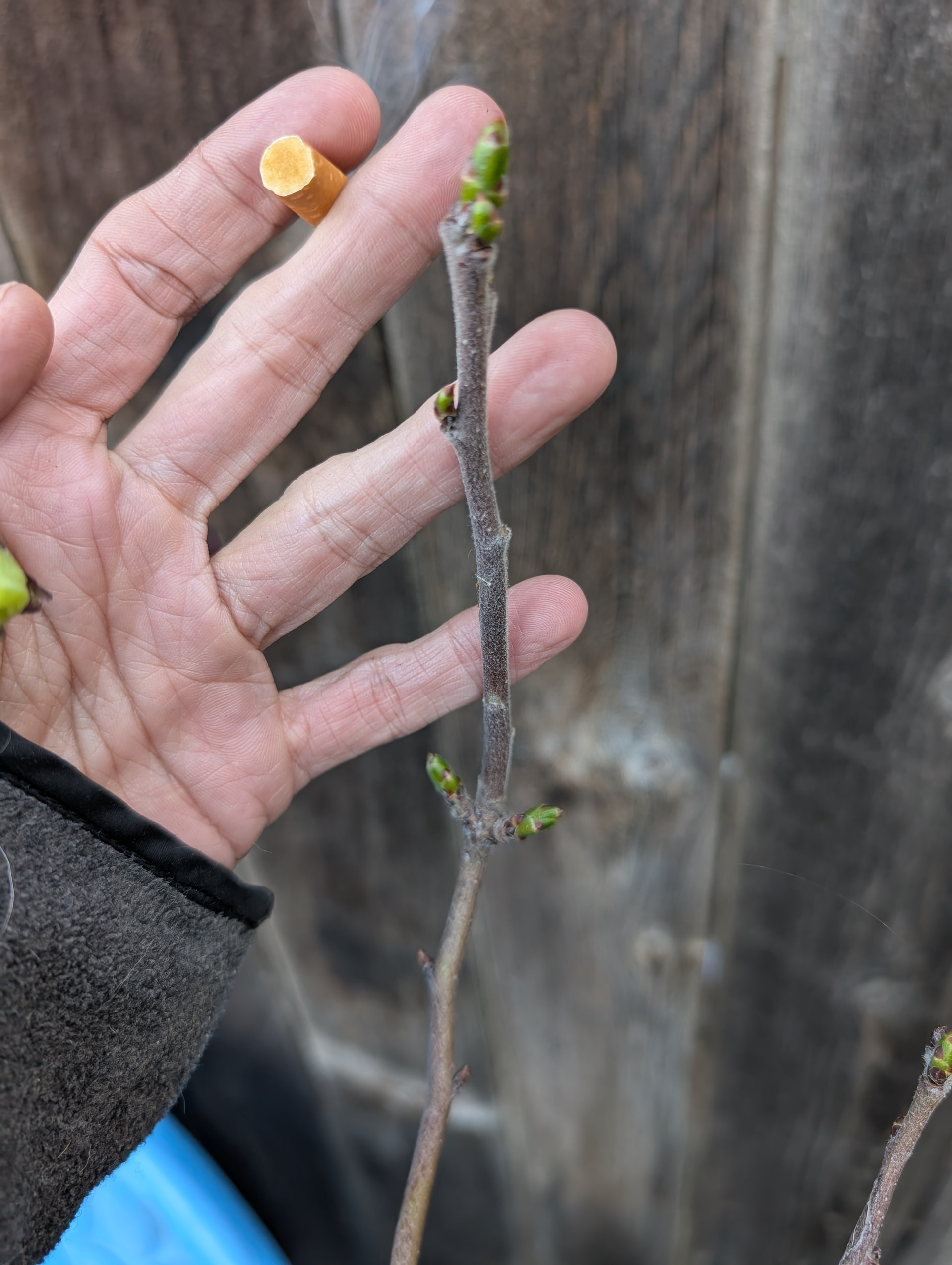
had that and a quince get abused and make it, a good sign. i had some medlar from a client over winter and they were delicious, hope these are as good
4 Likes
What is the variety?
i had to go out back and look. marron is on the label.
2 Likes