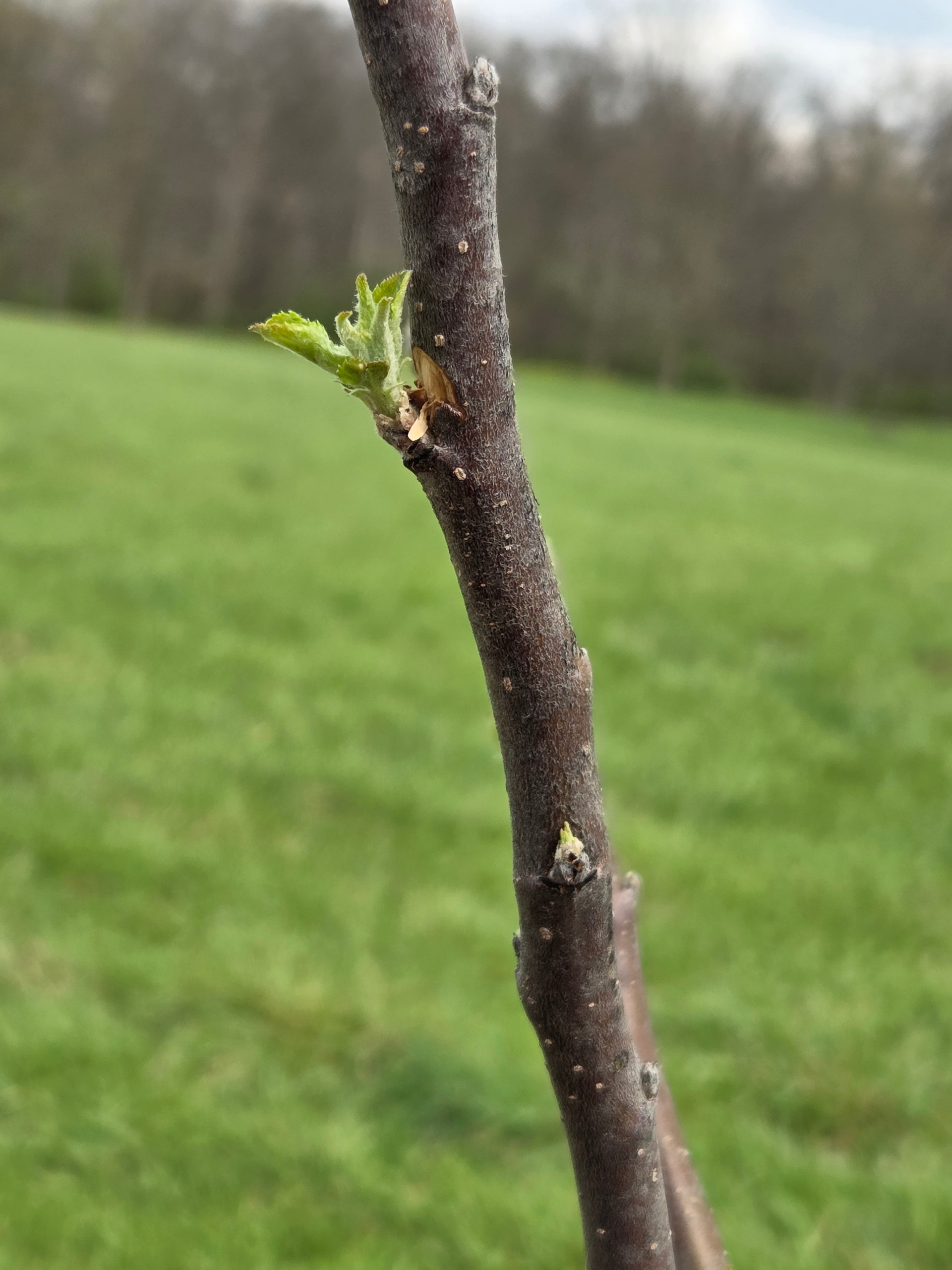
Notching buds worked, kind of

What do you guys think I should do with this pear tree? It’s a Yulu I planted last year. Grew straight up about 6-7 feet. I notched the buds where I wanted scaffolds to develop. They all started growing, but most of the resulting shoots haven’t grown very much. The top buds all pushed and are growing well. How do I encourage growth on the lower shoots? Should I top the tree?


Please ignore the dead plum I have yet to remove.

2 Likes

Don’t top your pear! Use clothespins to set a good horizontal angle for all young branches and they may set flowers next year. Your pear tree structure looks similar to my Harrow Crisp Pears will not Spring Flower - #24 by ukie

1 Like

I would not top that pear either. But I would consider removing some (many, most?) of the branches that are not to be part of the tree’s permanent structure. Then energy will be put into the remaining branches that are to become your scaffold.

I personally discourage removing non-permanent framework branches pre-maturely. Letting non-permanent branches grow along the trunk while young will help make the trunk thicker and stronger. Only allowing it to put energy into permanent branches when still young will result in a weaker trunk and a tendency to be top heavy.

If a non-permanent branch starts growing too vigorously, it can be bent down or headed back to slow its pace and keep it from growing too large prior to its eventual removal.

10 Likes

Yeah the top always wins with pears, they’re very apically dominant. I’d top it above where you want the highest scaffold, that should redirect the energy into those lower shoots. Some people bend the lower branches down to horizontal too which helps push them into fruiting mode eventually, but getting them growing first is the priority.

2 Likes

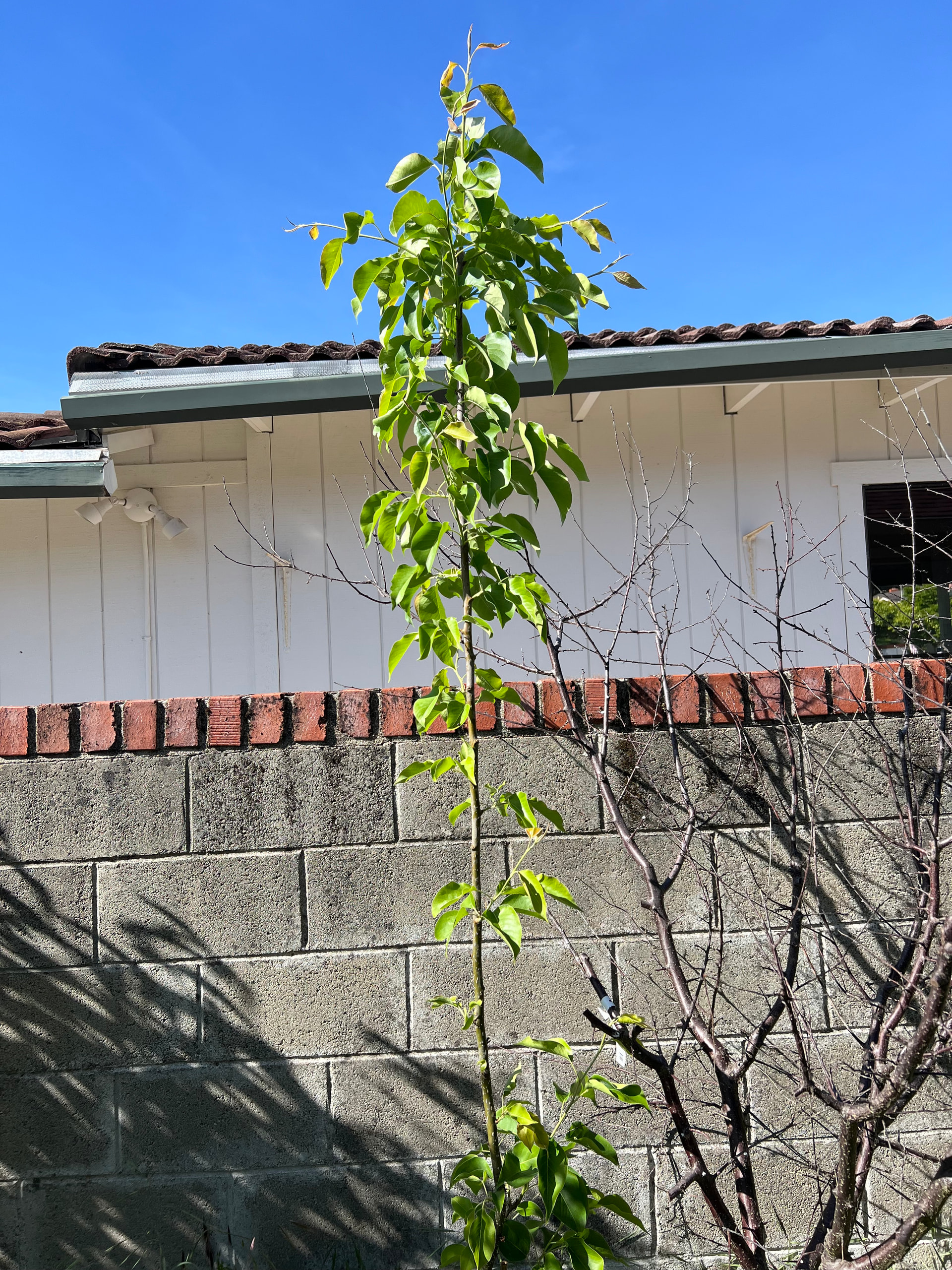
tall spindle pear!

The pear is demonstrating exceptional deer resistance.

5 Likes

I did not know that. Thanks for the explanation and the benefit of your experience.

3 Likes

There is another theory. Obtain adequate size by pruning very little until a tree begins to flower (with late maturing pears you might not wait that long) or reaches adequate size to hold meaningful crop. Just cut oversized (diameter wise) branches and touching and broken ones.

My favorite commercial fruit production advisor suggests this method for most varieties and species of common tree fruit. Commercial growers need to get trees to size and productivity as soon as possible and this appears to accelerate things for probably everything but peaches and nects. If you select scaffolds early you aren’t going to be harvesting and putting to use as much light. You aren’t just developing the top of the tree- you are also getting your roots established. A vigorous root system pushes top growth more than anything.

6 Likes

Are you saying that you wouldn’t head the tree or remove any of the branches until the tree has reached the desired height and/or begins to flower? So is the idea to utilize all of the branches and leaves to accumulate energy to continue to push growth?

1 Like

Thanks for the suggestions, everyone. Seems like there’s more support for not topping, so I’ll go with that for now and see how things develop. Is there any benefit to pinching back the laterals at the very top so they don’t shade out the future scaffolds?

I am no expert on notching, but I’ll pass along the experiences I’ve had so far. My experience has been that for notching to have a high percentage chance of being successful you need to do it early in the year. In my climate that means early January for fruit trees that come out of hibernation in Feb. Trees like apples and pears that don’t break dormancy until March/April you can wait longer. However, it has been my experience that you’re way better off doing it too soon rather than later.

Notching very early in the year can allow the cambium layer to grow back before the trees main growth spurt later in the spring. If this starts to happen, it’s best to use a hacksaw blade and refresh the notching cuts if the bark looks to be regrowing in the notched area.

Early notching has proved far more successful for me. Notching after the tree has already begun to leaf out almost seems a waste of time and effort IMO, as late notching rarely seems to work, at least in my climate.

Mind you, I’m sure my climate is very different than most other growers experience. Our winters are generally very mild and many of my fruit trees are already coming out of dormancy in January. At least that is the case for Japanese plums, or plumcots/pluots and other plum interspecifics. Basically we saw very few days below freezing this winter, so most trees got off to a very early start coming out of dormancy. From my experiences notching you really need to get on it a ways before the tree shows any signs of coming out of dormancy.

I’m not claiming to be an expert on notching by any means, but those would be my tips for those planning to notch their fruit trees.

Just my opinion, and YMMV.

5 Likes

Yes, but it it was excessively lanky, I might support it with a long length of metal conduit.

Notch a few branches and rub a very light amount of this into the open wound and buds. You wont regret it. I have used this plant growth regulator and it works.

1 Like

I have used pastes similar to that. I would say in my experience they improved the success rate marginally, but certainly not dramatically. I also found that even using these types of compounds, the success rate was very low if done after the tree was out of dormancy.

Certainly not a waste of time using stuff like this, but don’t expect miraculous results.

Again, just my own personal results (in no way conclusive).

2 Likes

I notched back in early March as the buds were swelling. Every bud I notched pushed, so that part worked at least. It’s just that now, the shoots at the very top where I did not notch are growing much faster. It does look like the notches have mostly healed over, so I’ll try refreshing them.

2 Likes

I notched two limbs on my 2 year old pear tree and rubbed in the keiki paste… and every bud on that tree popped. I had to remove buds. I was impressed. They say it can promote branching on older wood and ive heard of people having success with up to 5 year old fruit tree wood. Maybe the age of the tree and timing had an impact as well to how it responded to the PGR.

1 Like

If you want a branch to grow to become a scaffold don’t bend it right away. If you do bend it, only bend it a tiny little bit. Bending the branches will slow that branch’s growth way, way down. It’s worse on pear than on other things. I appreciate the idea of spreading early, but it seems to backfire on these large vigorous pear trees.

I’ll add an agree and disagree with everything else! I think it depends on what your goals are for which strategy you pursue.

I do think it’s a waste of time to notch at this point. It sounds like it did work, so if next year you want to do it again, then you know when and how to do it.

Pears like to grow straight up. Asian pears especially like to grow straight up. I have no clue about Yulu in particular, but I suspect you will be wasting your time if you try to create an Asian pear that looks like a peach tree or a spreading apple. Since it’s Asian pear, I’d guess BET or OHxF87 or OHxF97? you’re going to get a lot of tall vigorous growth with that.

The other thing that’s worse on pear is that once you get a branch and you want it to be more horizontal you have to be very, very careful when bending it. I’d use notches, even if I didn’t expect to have to. Bend a little at a time, over time, if you can. Don’t try to bend to 60 or 45 all at once. After bending 20ish apple branches with notches I thought I was getting good. Then, I promptly broke 3 pears in a row (I thought I’d had bad luck for #1 and #2). I learned that for whatever reason, they break more. All of them split on the top side of the branch, near the collar.

To slow the top branches down, you can bend them. I don’t see much risk of shading from the top with those little branches, but if it does become an issue you can always remove them.

If you’re trying to stop it growing so tall, you can cut off the top foot or so of leader back to whichever is the wimpiest looking side branch. You could try what apple growers do - they take the leader and fold it over then when it starts putting up shoots from the U part that are vigorous, they unbend it, let it grow, then repeat.

If you want the tree to fruit as quickly as possible, it is probably best to do what Alan says and not cut anything. Once you get a couple bigger branches you can bend them more horizontal and that will encourage fruiting. Once it fruits it will have less energy to grow grow grow.

@kinghat I love the “tall spindle” pear idea! lol. I wonder if it would work! I’m totally going to try it!

5 Likes

I notched a bunch of trees about 3 weeks ago. I have been limiting my heading cuts on my scaffolds.

I thought I may have a lot of blind wood on those scaffolds, plus some really long central leaders on tall spindle trees.

I’m having a very good response to my nothing.

The pictures show the notch buds pushing out while others still laying dormant. Pretty consistent through the orchard.

6 Likes