Richard B. Frost
Frost Concepts, Vista, CA, USA
Keywords: Ficus, dioecy, gall flowers
In the biologic past prior to Ficus carica, Ficus were monoecious – meaning that separate male and female receptacles appeared on the same individual[1]. Male flowers only occurred in male receptacles. Female flowers with ova capable of fertilization only appeared in female receptacles. The receptacles were likely open – which is generally common with compound flowers.
At some point a category of wasps (Agaonidae) began specializing in Ficus [2]. In symbiotic response, the Ficus developed gall flowers with modified ova to host the wasps. These have no reproductive function[3] and historically have been mislabeled as female flowers.
The Ficus compound flower receptacles then continued to evolve. One very noticeable feature is the closure of the sepals and the formation of the eye (ostiole). Another adaptation is the transition from monoecy toward dioecy[1].
Ficus carica is part way through this transition. As a result we presently observe many sexual variations. These include female individuals with no male flowers, and Caprifig individuals with male flowers, true female flowers (typically fall crop), and gall flowers. These are true Caprifigs. A Ficus carica individual with male flowers and no true female flowers in any crop is a male fig.
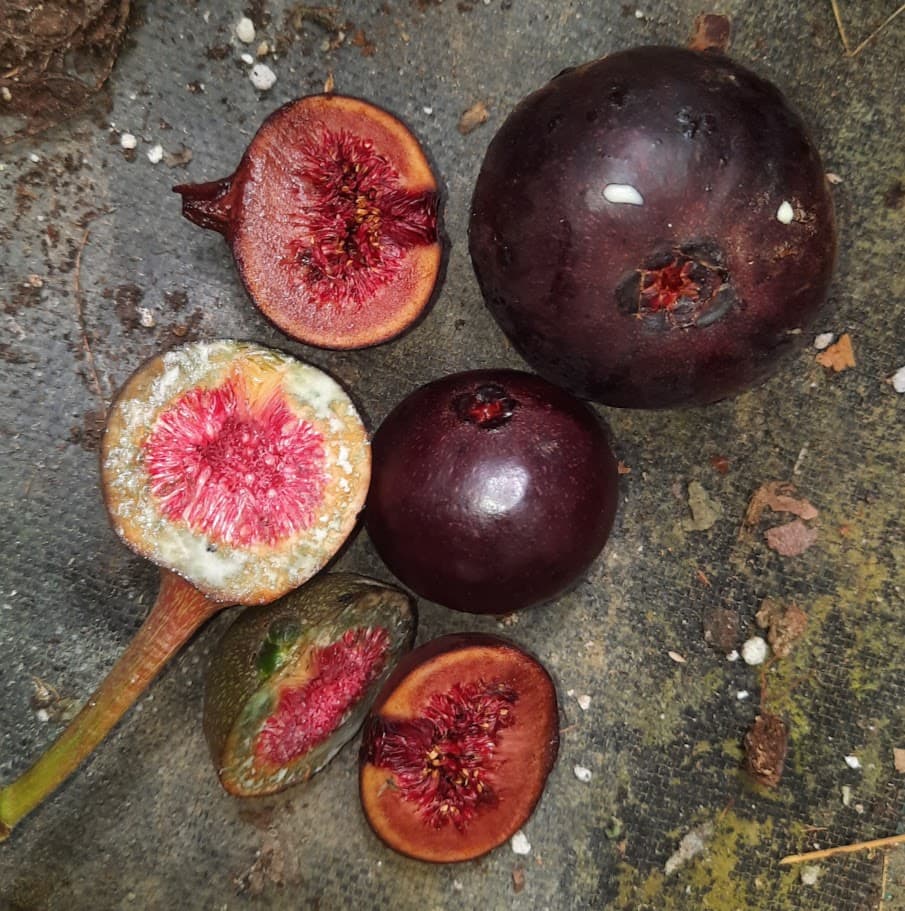
Beyond Ficus carica there are Ficus species which are believed to have completed the transition from monoecy to dioecy – meaning all individuals are either male or female but gall flowers still occur in both. Ficus erecta is one of them[4].
Compton SG, Ball AD, Collinson ME, Hayes P, Rasnitsyn AP, Ross AJ. 2010. Ancient fig wasps indicate at least 34 Myr of stasis in their mutualism with fig trees. Biology letters 6:838-42 doi.org/10.1098/rsbl.2010.0389
Flaishman MA. 2022. Fig morphology and development. In Advances in fig research and sustainable production: 47-58: CABI GB.
Wachi N, Kusumi J, Tzeng H-Y, Su Z-H. 2016. Genome-wide sequence data suggest the possibility of pollinator sharing by host shift in dioecious figs (Moraceae, Ficus). Molecular Ecology 25:5732-46 doi.org/10.1111/mec.13876
Is this always true? Could a fig exist which produces neither male nor female flowers?
One question I’ve been asking myself is why there is a trend toward dioecy. As an example, persimmon as a diploid would have been dioecious but with chromosome duplication to tetraploid and hexaploid species seems to have moved back in the direction of monoecy. Evidence is from common persimmons such as Taishu that produce male, female, and complete flowers.
I suggest the reason is because sexual reproduction has a huge survival advantage when two different plants contribute to offspring yet the genetic mechanisms for sexual differentiation are plastic enough to enable a single plant to provide both reproductive structures. Pecan provides an example where a single plant produces both male and female flowers but one or the other is reproductively available first. Heterodichogamy tends to enforce crossing between two different plants even though a single plant produces both male and female flowers. I’ve speculated on GF that pecan produces 3 kinds of buds - male, female, and vegetative and that each bud type has its own chilling hour requirement. The result is receptive female flowers offset either before or after male flowers mature.
One of the interesting effects of heterodichogamy is that wild stands of pecan tend to have equal numbers of protogynous and protandrous individuals. Under normal Mendelian inheritance, protogynous is dominant therefore we would expect 3/4 of individuals to be protogynous. But! Since pollen from protogynous trees tends to mostly fertilize protandrous flowers and vice versa, the result is 50/50 inheritance.
in this case, when there’s a continuum of fig stages of ripeness on the same exact plant, it’s a given that most (notable exceptions) of the pollination will be the result of the plant having sex with itself.
with dioecy, on the other hand, since some plants are female, and others are “functionally” male, it’s impossible for a plant to have sex with itself. this guarantees cross-pollination. i mean, it guarantees that pollination, if it does occur, will be from cross-pollination.
with cross-pollination you get more variation among the offspring, and variation is the source of adaptation to new pollinators, new conditions, new pests and pathogens, and so on.
like cinnamon prunes, but with a softer consistency. i’m really curious how different they would taste if pollinated. quite a few carica growers outside of wasp territory manually pollinate their figs because doing so noticeably improves their taste (in general). is this also the case for all ficus species? in theory, it might be possible to pollinate habrophylla by injecting it with carica pollen. all ficus figs are edible, and worthy of their own category.
 . Thank you!