Yes: Camelia is not a good indicator of mild cold-season weather as many varieties bloom mid-autumn to mid-winter, before the majority start blooming in late winter.
The temperature data definitely shows warming, particularly the last 30 years. I recently looked at the previous 100 years of climate data from my location in the Willamette Valley, and it is definitely trending towards becoming zone 9. Over the previous 30 years this areas around Salem is definitely a zone 9, though as far as I know the USDA hasn’t changed it.
The average extreme low since 1996 is 21.6 F. It has only reached single digits one time since 1996, and that was 9 F. It has only gone below 15 F three times since 1996. Single digits were a phenomenon that happened on average every third year until the 1990’s. And dropping below 20 happened more years than not.
Also the average accumulation of snow and the frequency of ice storms has diminished radically since the mid 20th century.
Who knows if this will continue, but the data surely suggests as much.
I have not checked any database with regards to temperature trends in my location. I don’t need to see evidence in black and white to prove what I have experienced in my location where I grew up.
I live on a lake. When I was a kid the lake froze over regularly with ice thick enough to skate on. The water now rarely has ice at all. My neighbour who is in his mid/late seventies whose family has owned their property longer than mine, can recall seeing pictures of cars on the lake from the 1920’s.
In the last five years since I’ve I’ve moved back to my childhood home there has been several extended heat waves where temperatures exceeded 100 deg F. When I was a kid I can never recall exceeding 100 deg on an extended basis. Temperatures exceeding 90 deg was fairly rare back then, and breaking 90 would have been considered a heat wave back then.
Regarding the Camelia in bloom, it is the first winter I’ve had it and I did not know that it could flower during the winter when I purchased it. I find this extended showing of flowers during our shortest days of the year a particularly nice treat. I will be sure to purchase more of these bushes as the show is simply stunning at this time of year.
1 Like
Yeah the past few years, we’ve hit 100+° in Colorado Springs and in Seatac, WA as well.
I bought 2 stand alone ac units just in case the regular house ac isn’t enough.
My friend showed me photos of her hydrangeas and other plants just being fried by the sun last year.
I looked it up after i saw it on the news and they weren’t lying… hotels and motels were going for 800$+ a night during those heatwaves.
Don’t ever remember seeing that as a regular summertime appearance for western Washington until the last few years as well.
I’m just gonna invite all my friends and family over for a cookout when it hits those numbers again this upcoming summer. Can’t wait to get my new home situated and be able to just hang out and eat with everyone again.
2 Likes
Since you sent me this message I’ve been nose deep in study about all things citrus. My collection is doing quite well here. If you’d like to have any clones from this collection let me know.
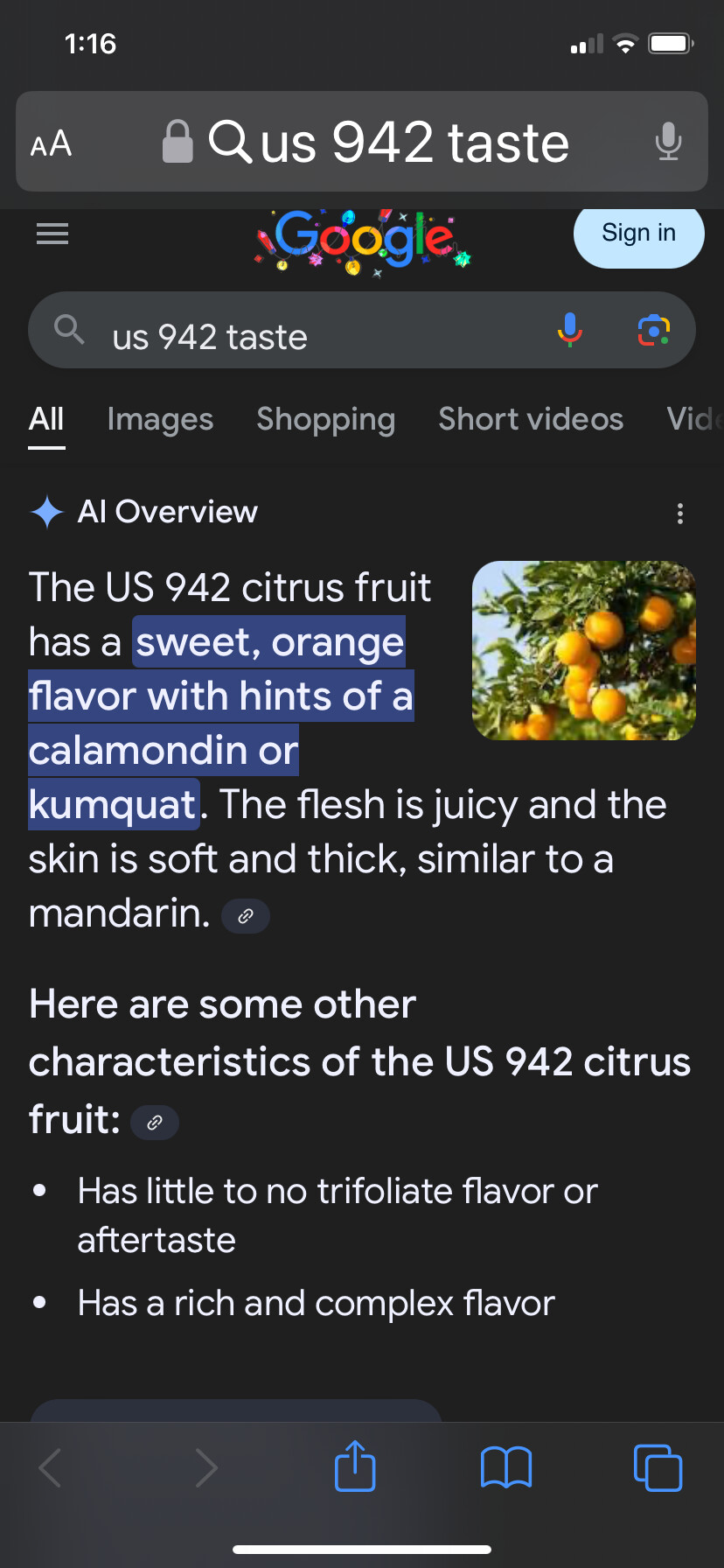
I’m really excited about the US 942. It’s a cross of a flying dragon and a sunki mandarin. The fruit have virtually no off taste and is hardy to 0 F.
How is your Morton doing?
1 Like
My two ‘Morton’ have been doing great. I started watering them more this year and they responded really well. I hadn’t realized just how much water they needed to put on significant growth. Now, if I could only get them to decide to start flowering to see if they’ll ripen here. My three 'Dunstan’s are doing well too, but much less attractive since they get severe damage every winter. They seem to be pretty hardy overall, but for some reason put on most of their growth at the end of the season which leaves them with a lot of tender branches which get damaged by cold before they have a chance to harden off. I might need to start watering them more early in the season like I did for ‘Morton’ so that they can put on significant growth that actually hardens off in time.
I am itching to spend a gift card I got for Christmas and was eyeballing the Plum Parfait. Has anyone grown this plumcot on the west side of Washington? Did it set fruit for you? Any comments on how it taste? Thank you for your input and time.
Are the Morton and Dunstan seedlings, grafts or rooted cutting from a mature tree?
This year I’m adding a clem-yuzu and silverhill mandarin to the partially protected area. The only varieties I allow to go fully unprotected are the yuzu and trifoliata hybrids.
Here is the US 942 description for people interested. It looks like a flying dragon, but with bright orange, golf ball sized fruit that tastes similar to a calamondin. Should do very well in zones 7 and up. Particularly in the warmer microclimates that will allow it to ripen quicker. Madison has some 3 gallon available, but the 1 gallon are sold out now.
The two ‘Morton’ are grafts I purchased from Stan McKenzie. The three ‘Dunstan’ are seed grown. I planted three of the ‘Dunstan’ knowing that statistically I would be likely to get the real deal even if a small percentage of the seedlings ended up being the result of zygotic seed (which would make them not true to type). So far I’ve observed no variation among the three ‘Dunstan,’ but I can’t rule it out until I see fruit.
I’m surprised Stan’s grafts have yet to flower for you. Does the location receive sufficient sunlight? Too much shade can definitely prevent citrus from blooming.
I also notice a lot of late growth on dunstan. For whatever reason this one hasn’t radically defoliated yet. Though about 1/4 of the season’s newest growth always shrivels and turns black once we get a hard frost.
Have you ever trialed other trifoliata hybrids at your location? Perusing the nurseries in Georgia and Alabama has revealed a few others worth exploring that have fruit superior to citrange or citrumelo, but are just as hardy if not hardier. Besides the 942, there’s also the 842, and something called Sundragon which combines pomelo and flying dragon for a low acid orange.
Full sun. I would not describe either ‘Dunstan’ or ‘Morton’ to be deciduous so wouldn’t expect them to defoliate aside from leaves which get damaged. My two 'Morton trees looked lush and leafy all winter long last year despite being a rough winter. I’m re-trialing ‘Thomasville’ since my original tree died from mechanical damage (something girdled it). I suspect it’ll do well here.
Perhaps something similar is going on with a grafted yuzu I have. In its second year after grafting to flying dragon it made several fruit that hung on until October when I picked them ripe.
Since then, however, it has gone three full years without producing so much as a single blossom. . Yet all the while its growth rate has been fantastic. After this most recent growing season its tallest branches are just a few inches shy of the roof’s soffit.
The lack of fruit puzzles me, especially since some other trees, including sudachi and Meyer, produce good amounts of fruit on smaller, younger trees. I’m really hoping this is the year the yuzu once again joins the party.
Ah, yes, Thomasville. Definitely on my life of must haves. I also noticed a couple others on Stan’s property that he doesn’t offer for sale on the website. I need to ask him if he’ll harvest some of those. One looks like a Buddha’s hand, but is much smaller and has lots of juice inside.
Do you guys think in the next few years that the PNW might get upgraded to zone 9?
Would be great to be able to put my citrus in ground and not have to do the plant shuffle every winter 
The Pacific Northwest already has many areas of zone 9. Parts of Seattle and Portland and along the coast have been zone 9 for decades. I know that southern Vancouver Island and the southern 1/3 of the Oregon coast are zone 9b. Areas in and around Brookings, Oregon are probably 10a. If you drive around Curry County and check out plant life along the immediate coast it looks identical to central California. There are even coastal redwoods within Oregon, a species that requires zone 9 to thrive. In the last 30 years certain inland areas have also become warmer. In the central Willamette Valley there are now zone 9 areas. I was recently checking weather stations in the Willamette Valley, between Corvallis and Salem, and discovered that they qualify as a zone 9, though as far as I know the USDA has not chi anger the designation from 8b. Since the mid 90’s, spots located in the hills, above the valley floor, really don’t drop below 25 very often.
4 Likes
You definitely can grow certain citrus in the ground here, but you need to site them very carefully and have a means of protecting them in the event of a freak cold snap.
What I did was build a raised bed at the base of a (30 foot long/12 foot high) south facing garage wall.
I planted Meyer, sudachi, mandarin, kumquat and calamondin at 5 foot intervals. Then I attached a wooden awning to the wall at a height of 10 feet. The awning has polycarbonate roof to allow light and limit rainfall.
I leave the trees fully exposed to the elements unless the temps drop below 25. If they do drop that low I drape plastic sheeting from a thin metal pole that runs the length of the awning. The plastic is like a shower curtain that I can slide open or closed with ease.
In an average year I only need to close the plastic 8 times.
The entire thing only cost me a few hundred dollars to build. Of course I did the carpentry myself which is why it was relatively inexpensive.
I’m also building one on the southeast facing wall, but with the awning at 20 feet high to allow clearance for loquat and avocado.
I figure it’s a small price to pay to allow the trees to get massive in the ground and produce epic amounts of fruit. The trees should pay for the investment in fruit within 5 years.
The other option is growing things like yuzu, thomasville, Prague citsuma or US 942, The fruit from these is considered really pretty decent and the trees are fully hardy in zone 8. I also have a dunstan amongst those growing out in my yard and they are big and happy. Even survived last January’s deep freeze with no die back.
4 Likes
Much of the lowlands will probably get to zone 9.
The city of Portland is a fairly recent zone 9, the 30-year annual low average is now 20.7 (1994-2023). Low to date 2024 is 15, will not drag down the average to below 20.
There have been pockets of zone 9 per the USDA maps just SE of Portland for some years now.
The cold snap of early 2024 (in the teens for 30 hours at the house here) would have greatly bothered zone 9 plants.
1 Like
While I am in zone 9a, I won’t grow any plant rated above 8B. Prefer 8a or below.
Odds of temperature dropping below 10F - 1-5%. Once every 20 years.
Odds of dropping below 15F - 10%. Once every 10 years.
Odds of dropping below 20F - 20%. Once every 5 years.
I don’t wish to replace trees every 5 years. 10 years might be ok in rare circumstances.
4 Likes
Does anyone grow citrus outside?
I’ve been reading on the cold hardiness of Silverhill Satsuma but it never states the surrounding environment during cold hardy trials.
I have a terrible tasting calamondin I have been trying to kill for 4 winters. It just won’t freeze to death despite 16f last year. I just dropped it in a corner of the yard. No love. Won’t die.
2 Likes
Is your calamondin terrible-tasting compared to other sources of calamondin?
Otherwise, that fruit is not typically used for fresh eating, but for juicing or using as an ingredient in various desserts. Commercial drinks are only 6, 8, or 10% juice.