My statement wasn’t specific to pawpaws. Rootstocks have been found to influence phytochemical production across multiple fruits. However, the KSU study alluded to elsewhere, which shows wide variation of acetogenin production across different trees of the same cultivar, appears to support the assumption that rootstocks can also influence annonacin concentration in pawpaws.
The KSU study was a stunt. There were no controls and many unproven assumptions. No viable conclusions can be made.
More generally, keep in mind that chemical concentrations in fruits can vary significantly on the same tree.
The KSU study was a study and not an experiment. A “control” would be irrelevant in a direct comparison of cultivars.
Keep in mind that rootstock influence on phytochemical production has already been proven for fruits with greater economic significance (i.e., funding & research).
1 Like
@DijonG
There were more than cultivars in that stunt. None of them had controls, and all of them had unfounded assumptions. In my experiences it wouldn’t pass as a lab report. Maybe it’s ok elsewhere.
However, not all is woe at KSU. In this PawPaw article, I point out their contributions to average cultivar fruit weights and degree days.
“2,600 fruits/day for 28 straight days to reach toxic levels.”


thas a really good talk to watch. theres more harm in being allergic to the fruit than its annonacin content.
2 Likes
@kinghat
Of course it would take 2600 fruits to reach the morbidity level. That is not of concern. The issue is the random death of nerve cells in the brain (the brain’s blood barrier does not block annonacins). The important comparison is to the life-time dosages allotted to annonacin serums. K. Pomper is well aware of this, having read my article 3 years ago.
3 Likes
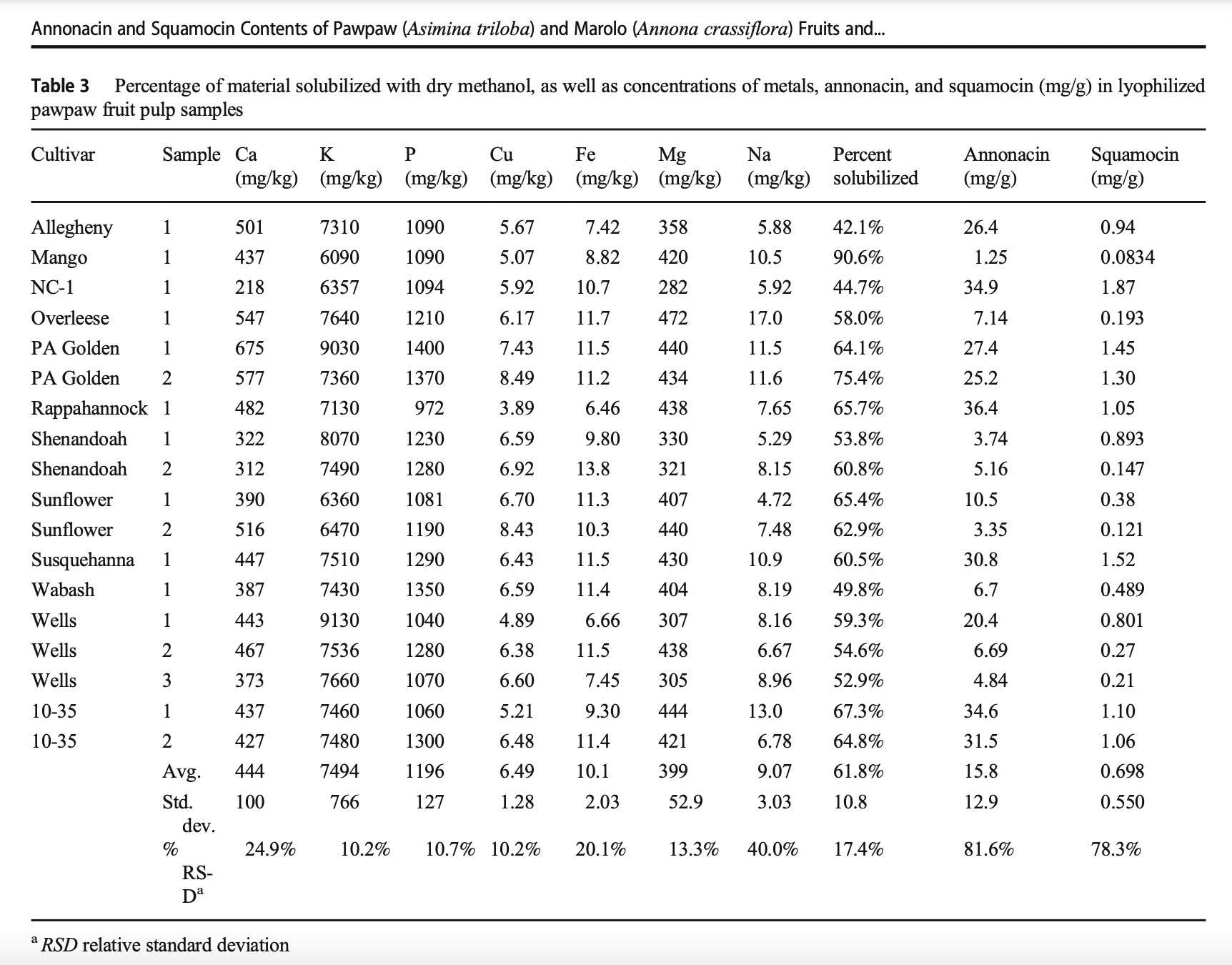
That’s the table I was looking for. It’s those Wells samples that always piqued my interest. 20 vs 6 & 4 mg/g annonacin is enough variation to make me not put much faith in a single sample of a specific cultivar.
I’m not personally worried about eating the fruit in season at reasonable amounts, but if I was, I would want more of a sample size (and in different settings) on each cultivar before settling on a few to plant.
1 Like
Were those all from the same tree? Ive heard wells is not the same wells in the trade that once existed so i wonder if theres multiple wells out there
Wells stock was already mixed. Some nurseries in Europe describe it as a big fruited cultivar so maybe this event take place somewhen after the first evaluation at KSU.
I used to have that study on hand, but not anymore. If someone else does maybe they can comment on the methodology and whether or not the samples came from the same tree or the same orchard. I would assume that if they came from the same site that the scion would be the same.
Just confirmed, all the pawpaw samples came from the same site:
“…all trees were grown in close proximity in the same orchard. The metal analyses were done in an attempt to understand and document the minimal impact of environment, leaving us with results that are based primarily on genetics.”
…
“ Pawpaw (Asimina triloba ) fruits (one from each cultivar, weighing about 0.5 kg each) were harvested from a research orchard in southwest Missouri (lat. 37.085845, long. − 93.867079) at the University of Missouri Southwest Research Center in Mt. Vernon, MO. The orchard was established in 2003 on an excellent alluvial soil using both pre-grafted trees and seedling trees that were later grafted to improve fruit-producing cultivars.”
1 Like
It’s been about 6 months. Curious if there is any news on this since then
1 Like