I’ve ordered from EL before, not pawpaws, but white bush cherries instead. I remember feeling ok about what I got.
Anyway, which varieties did you order?
I’ve ordered from EL before, not pawpaws, but white bush cherries instead. I remember feeling ok about what I got.
Anyway, which varieties did you order?
ksu chappell and atwood, I got nyomis delicious from somewhere else but i cant honestly remember where lol
I too have high hopes for my 100s of frozen, and now thawed out, pawpaw seedlings. I will update this thread when (if?) they ever start growing in spring. We have another low-20s freeze coming tonight, so I will use a furniture hand-truck move them all to a warmer spot for the night. Not sure where I’ll find space since my garage is still filled with 100s of citrus and tropical fruit plants! Sure wish I wasn’t OCD…
As a general reminder to some of the comments in this thread, it is illegal to import plant materials into the U.S. I have mentioned this before, but we are always gaining new members to the forum.
There is a way to import plant materials legally. It is done through APHIS. As I recall, one member has done this. It is a lengthy process, but doable.
Other nations also prohibit importing plant materials. Laws vary by nation.
These laws exist to protect agricultural production of food. There are many (if not most) plant insects and diseases which have entered the U.S. via foreign plant materials. Once the disease or insect is established, it generally takes millions of dollars, and more intensive use of chemicals as countermeasures. This expense and loss of production generally lasts decades, or in some cases centuries.
I know some avid hobby fruit growers are persuaded they are too smart to ship pest infected material across the globe, but it’s likely Huanglongbing (HLB) entered the U.S. via infected plant materials. HLB has reduced citrus production in Florida by 75%. It’s essentially killed the citrus industry in Florida. So importing plant materials illegally is not always a victimless crime.
Others have pointed out, that we do import lots of fruit from other countries, which is true. The justification is, what’s the difference between industry importing fruit vs. me illegally trading plant materials? The difference is those fruit are subject to inspection, and rejection.
This goes for both U.S imports and exports. For example, in the U.S., if even a single cherry fruit fly larva is found in a load of cherries for export, the entire load is rejected. If more larva are discovered, the entire growers crop can be rejected for the whole season.
How this applies to pawpaws, I can’t exactly say. Pawpaws are not a widespread commercial crop. Any commercial ventures are in their infancy. So, while there are many pawpaw diseases which have been identified, there are probably more which have not.
Mycocentrospora asiminae, Rhopaloconidium asiminae, and Phyllosticta asminae.
Mycocentrospora asiminae, rhodpaloconidium asiminae, and phyllostaicta asminae are some diseases of pawpaw which are only documented in the U.S. You may ask yourself, can you identify any of the aforementioned diseases on pawpaw? Furthermore, sometimes diseases don’t show symptoms. So there is no guarantee the plant materials are disease free.
It’s your own personal decision whether you want to break the law via shipping/receiving illegal plant materials. But just know that it’s not just your plants at risk. You may be risking the livelihood of people in an entire industry, and/or ushering in more intensive pesticide use, and/or loss of production in producing the crop.
While I agree with your post, I don’t think these diseases affect pawpaw. If you google it, it says yes, but if you look into it, it says yes because papaya is called pawpaw in a bunch of countries. While its possible that they do and its just not recorded, there is no reports on any of the tropical annonas either, and I feel like those are more likely to be documented as papayas and annonas are commonly in the same area and papayas and pawpaws are not.
That being said, as someone from a state with multiple major agriculture crops that are heavily influenced by foreign pests (including those papaya viruses that kill are melons and squash), I think your post is well said.
did i miss where we were discussing illegally importing plant material at any point. genuinely confused lol
No one mentioned illegally importing plant material. Just wanted to point out that importing plant materials without APHIS is illegal. APHIS tests to make sure imported plant materials aren’t vectors for new diseases/insects into the U.S.
The elephant in the room is that lots (read most) fruit hobbyists who import, do import illegally.
oh you just… said it was in response to people in this thread. i mean yeah i think we agree that illegally importing is bad because of disease issues
Yeah I think asimina triloba may be one of the fruits here least likely to be imported from overseas. The only serious discussion was about exporting. Unless I missed something. 
Which ones have made it from across the pond? Yuri and Prima?
You are absolutely correct. I misread papaya, instead of pawpaw, lol. I will edit my post above accordingly. Thanks for catching that!
From Peterson’s page major diseases affecting pawpaw are:
Mycocentrospora asiminae, Rhopaloconidium asiminae, and Phyllosticta asminae.
According to Grok, those diseases are currently only documented in the U.S.
That’s fair enough. The reason I brought this up is that another admin mentioned it in a staff topic in reference to this thread. After looking over the thread, I did see that exporting was discussed, but I didn’t read all 230 posts of this thread. As admins, most (if not all) try to discourage scion exchanges from overseas, for obvious reasons.
My comment was really more of a general comment, since there are so many new members. In the past there have been scion exchanges from overseas. I have had requests from me (because of my somewhat abundant peach collection) for scionwood in exchange for foreign cultivars. I have always refused.
Many times there have been requests for scion exchange of members of this forum via personal messages. I know this because many times members have reported these requests to staff.
Re: Exporting plant materials from the U.S.
I don’t know what China’s rules are on importing plant materials, but I have to think there are some restrictions? Maybe not? It’s something all parties should think about, imo, for the good of humankind.
Well yeah it probably requires a phytosantiary cert but i dont think it wss implied there wouldbt be one. It was a good write up tho..maybe post in general as its own thread?
If anyone is interested in importing seeds legally, it is quite straightforward. I can’t speak to other countries’s policies, but a small lot of seeds permit is free in the US and works for many fruits including pawpaw.
Are there any pawpaw breeding projects outside of the us worth investigating? Is anyone crazy enough to cross it with its tropical cousins? If anyone makes a cold hardy cross between a paw paw and a sweetsop, I’m buying more land 
There was a presenter from a university in Poland (I believe) at the 2025 International Pawpaw Conference at KSU. Also, on their website there are several nurseries outside the US with licenses to propagate their TM cultivars:
Acetogenin content from KSU research: Shari Crabtree kindly emailed me this info today. Note: at the KSU Conference Dr Pomper emphasized that Ac. bioavailability is low in humans, under 10%.
“In research we have conducted looking at acetogenin content, so far we have found levels to be high in: NC-1, Overleese, Mitchell, Middletown, Shenandoah, and Susquehanna; and low in: KSU-Benson, KSU-Chappell, Sunflower, Wabash, Potomac, Tallahatchie, Zimmerman, and Wells. KSU-Atwood was middle of the road. Sunflower is by far the lowest. We have not yet tested KSU-Dunnigan and KSU-Pomper’s Choice.”
I never would’ve guessed Shenandoah would be high given how mild it is. I guess intensity doesn’t correlate to acetogenin content.
there seems to be no correlation of taste to acetogenin. People have theorized that the bitter aftertaste is related too, but it doesnt seem to be since sunflower is a major offender there (in my experience)
checked out the link……about 50 miles north of me….described itself (farm) as an agritourism destination…..$38 plus $13 parking for a one day event with no specified event schedule………..I’ll pass
Yeah im waiting for a schedule to be released to decide if im going lol
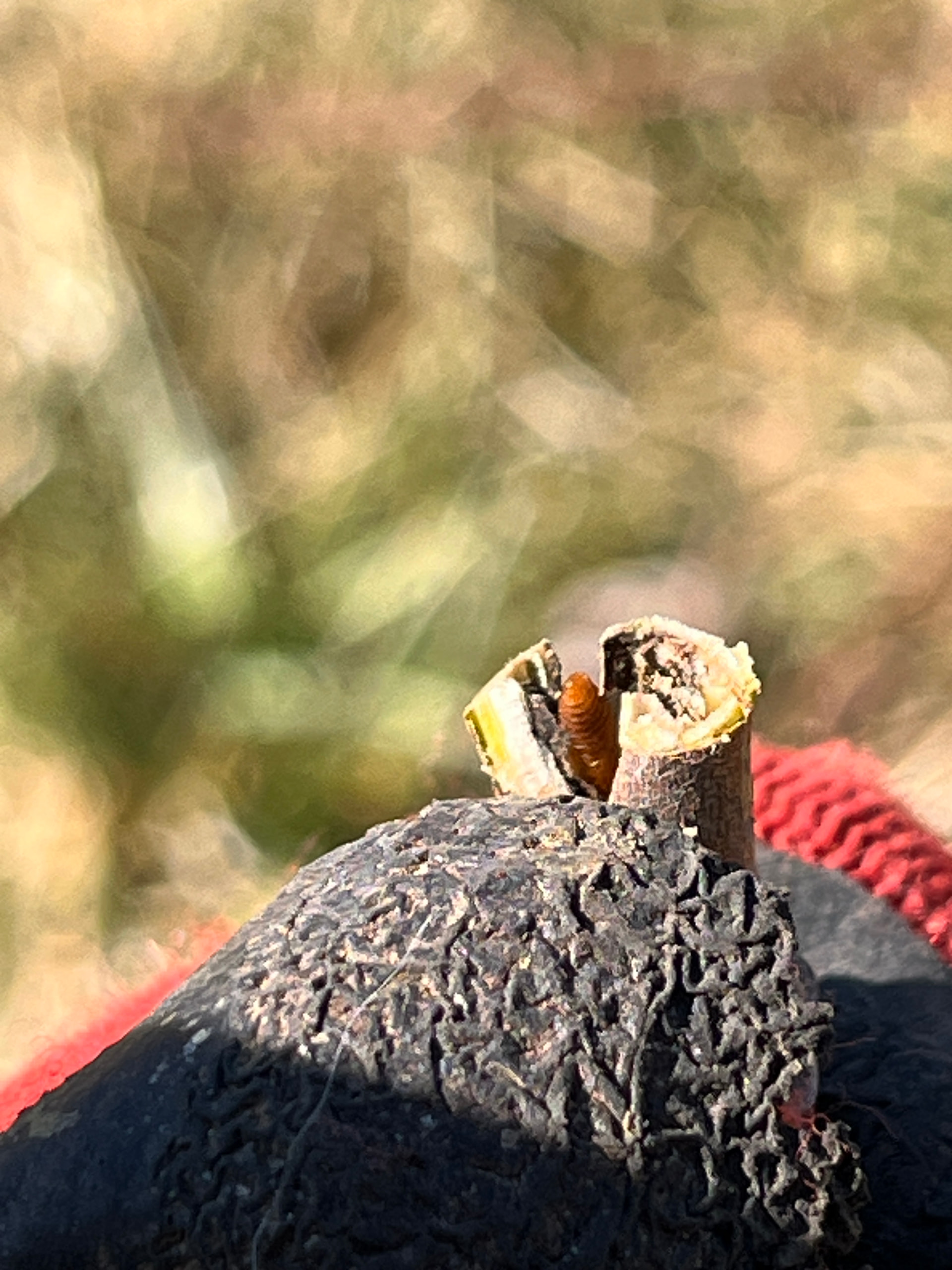
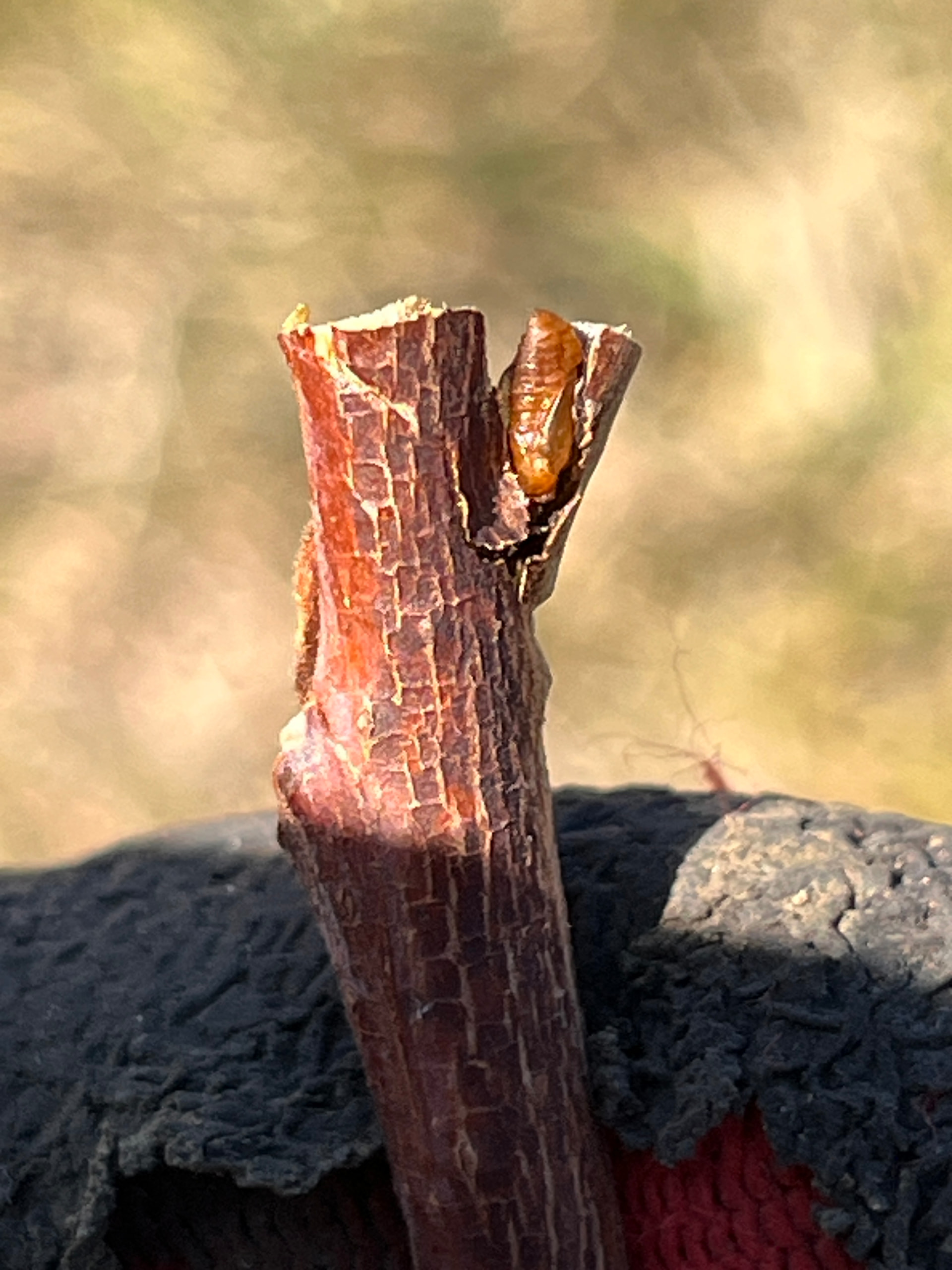
Was pruning in the pawpaw orchard today and noticed the signs of pawpaw peduncle borer (Talponia plummeriana)
While it’s called the peduncle borer that is only where the borer begins it’s career of damaging your pawpaw trees. After the young larvae hatch on the flowers, it proceeds to bore into the flower, destroying it. It then will borer into the young twigs where it pupates and then later emerges as a moth. The moth then lays eggs other places, including the fruit, which the larvae can bore into and complete their life cycle.
The pupa (empty case from last year).scions that have frass instead of healthy white pith are still useable, but B Grade IMO.
The indiscreet, crescent shaped bark scars are egg deposits made by a moth last season.