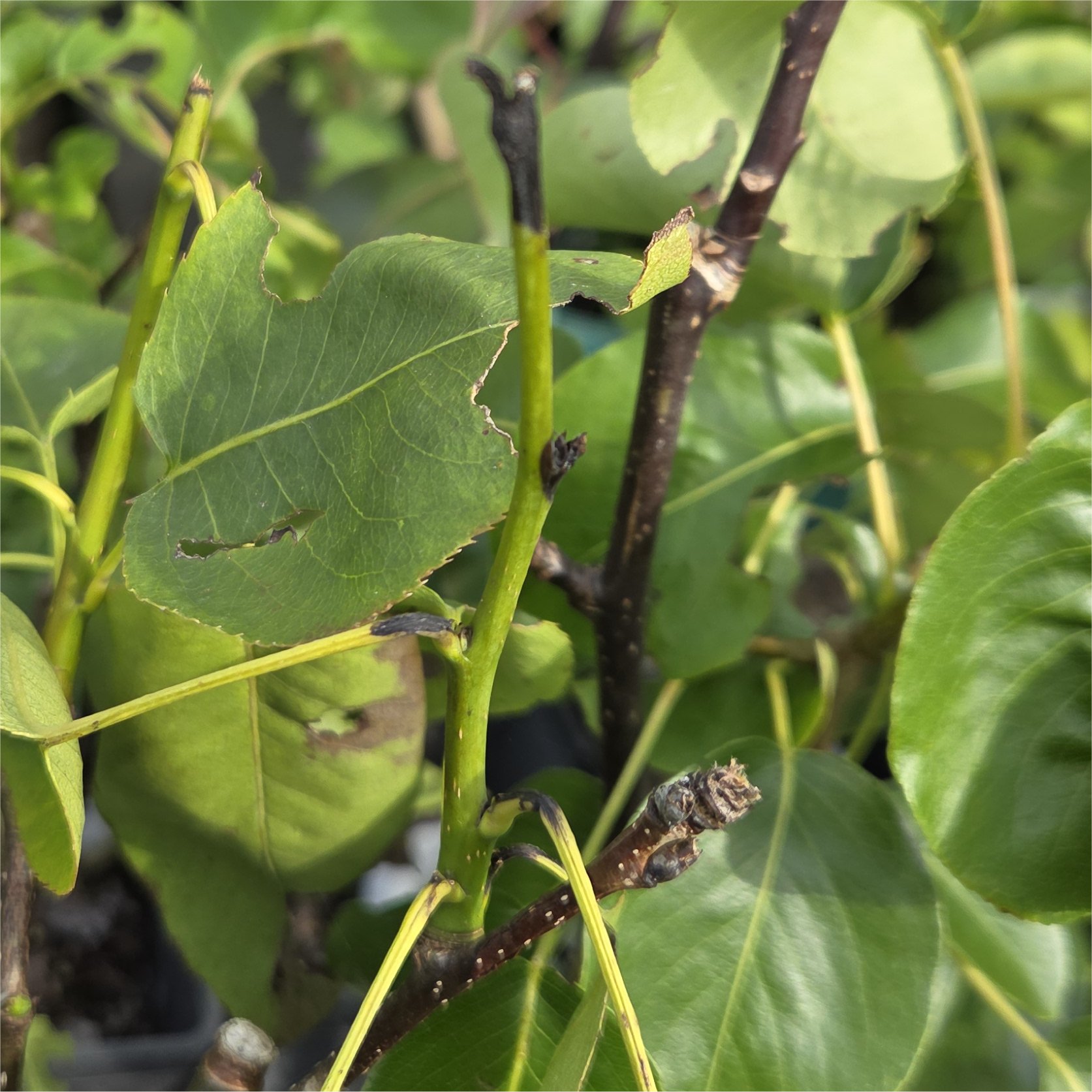
Pear tree problem - any ideas please.
Its a newly grafted scion, and I do not want to lose it.
With the issue being on basically every part of the scion I wouldn’t be hopeful for its survival. If there is a way to get it to survive, I would expect it to be more expensive than just getting a new scion. I’m not familiar with diagnosing plants issues but I fear that might be fire blight.
I guess you could try putting it in hot water or otherwise heat it to (45°-50°) for several hours to try to kill pathogens. Can’t promise that won’t kill it instead though. Based on https://www.researchgate.net/profile/Pascal-Lecomte/publication/229990944_Heat_treatment_of_plant_propagation_material_for_the_control_of_fire_blight/links/5cb867e6299bf120976daad4/Heat-treatment-of-plant-propagation-material-for-the-control-of-fire-blight.pdf
I have read that article a few years ago, and never thought about it.
I now have 6 affected.
Not too sure how to treat the whole potted plant. I suppose boil up a big pan of water, let it cool down to say 50 deg C, and then immerse the whole potted plant for 1 hour. Just letting the water and plant cool naturally, hoping it stays near 50 deg C for 1-3 hours.
Are you sure it’s not insect damage? It looks like something chewed on that leaf and the end looks chewed on but it’s also blurry…
I’m not even seeing which part is the scion and which part is the rootstock. Hard to tell if is fire blight.
I should have thought a bit deeper about immersing them in hot water.
As it’s a bit like steaming/boiling vegetables. The existing green leaves all went limp like steamed spinach. I think I have killed them.
So the heat treatment should only be done to dormant scions.
Needless to say, before doing this, the ‘dead’ areas all travelled further down the scion into the rootstock. But some branches were still green and leafy at the tips.
All the graft joints were still solid, so it’s not anything to do with a bad graft.
Still a bit none the wiser, but I have done the most logical thing. In that they have been destroyed by burning, rootstock, soil, scion, and pot, everything, and not just putting them on the compost pile.
Yeah it’s a risky thing because the plants don’t like the heat involved either so it’s a balance between getting them hot enough long enough to kill pathogens and not getting them hot enough long enough to kill them.
Have you look up fire blight in pears? You may want to read up on it. It is very common disease of pears and apples. Some varieties are more susceptible than others.
When infected, some trees/branches/grafts show classic signs of fire blight, others do not show signs as obvious. Removing infected grafts/branches when they first show signs of fire blight is often done. I’ve never heard of a hot water treatment. Once, the pathogens travel down the rest of the tree, it’s too late.
If your scionwood/graft or the tree was actually affected and killed by fire blight, I would not throw them in a compost pile. I’d throw them out with trash.
I probably should have mentioned that if you wanted to save the tree itself cutting off the infected parts at well bellow where the symptoms are showing would be the best option. I think I might have been too literal with your asking to save the scion