Pecan

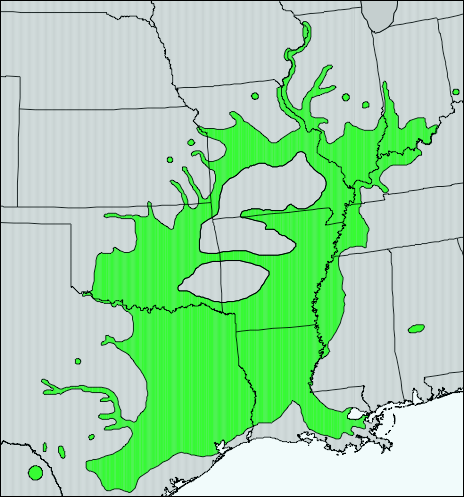
There is some pretty good info on the RBT website now… including the map below showing the natural range of pecan trees.
image

The text below is from his site…


Pecan trees in their original range were best adapted to deep alluvial soils. They were most common in the river bottoms of the Mississippi and its tributaries.

Pecans will grow and produce outside those native soils. Deep soils are best, but adequate moisture is more important to fill out the nuts. Pecan roots run deep and are very powerful. They will seek out moisture if it is available.

Pecan trees can withstand periodic flooding and do very well along stream banks and in bottom areas. Pecan trees are an excellent species for helping to stabilize stream banks all the while providing a crop of pecans. Periodic flooding is one thing but, pecan trees do poorly in constantly saturated soils. They are not a swamp tree.

Pecan trees are often planted in upland areas as well. These pecans survive well and often thrive, living to be very large trees. Nut production will not be optimal but certainly acceptable, especially for home use and local consumption. Home and farm plantings can be successful without irrigation so long as it is understood that dry years will yield a reduced crop.

In my case I am in southern Middle TN (not in that natural range at all) and even worse, I am on a ridge top… not in a hollow bottom with creek or river bottom deep loam soil.

That is why for my location he recommended a Pecan variety that was NOT a heavy producer.
He said the varieties that were heavy producers… if you tried to grow them in less than ideal location… they would very likely produce many (empty, or not quite filled out) nuts.

A tree that is a low producer, would be much more likely to fill out the nuts it does produce.

He recommended a combo of Amling, Kanza for me.

Question for those of you that have grown these to producing nuts. How Long (how many years) before you get first fruit ? even that first small crop ?

I might still decide to grow some…

1 Like

What’s the new link to cooling & heating degree days, very-much, please? Thanks

1 Like

Dave’s Garden has a frost free day lookup (https://davesgarden.com/guides/freeze-frost-dates/#b). But, it did not include my zip code. I ended up going to the NC state extension website and was able to calculate it.

Amling bore first nuts for me in 6 years from setting out a grafted tree. Kanza is similar.

3 Likes

My bad… ugh. 950 is great. 1000 is ideal for pecans. I was thinking 2,000 for some reason.

I lost all my notes during a computer crash- sorry, my bad…

You’ll be perfect to grow Kanza’s and all that.

Dax

1 Like

Oops, based on your original recommendation, I already ordered a Hark and Kanza. I assumed those varieties would be a given :slight_smile:. Maybe David will let me swap those for these varieties.
You probably are safe in Hark and Kanza from the little I can help.

Don’t worry, Dax jumped the gun. Hark and Kanza are perfect for your climate. That is actually better heat levels than necessary.

1 Like

Do you think an Adam 5 and Lakota would be another good option for my area? I am looking at purchasing those in the fall when Rock Bridge Trees has the Adam 5 back in stock. Your earlier description of Adam 5 was very convincing. The 4 trees I would start out with would be an Adam 5, Hark, Kanza, and Lakota. If these survive, I think it would be fun to cross some of these trees in the future and grow out a few hundred of the seeds. A 15-25 year project that could be interesting. But it might be more interesting to look at a more northern variety to cross with the Hark and Kanza.

One interesting tidbit that hasn’t been mentioned lately - and F_p first brought it to my attention - is that genetic analyses done by Dr. Grauke, et.al., at the USDA pecan breeding project show that ‘Major’ possesses some genetic markers common to both bitternut hickory and shagbark hickory, suggesting that one of its recent ancestors may have been a bitternutXshagbark hybrid (similar to the Weschke ‘shagbark’).

2 Likes

I would say Adams #5 has very good potential, however, it runs about 81 nuts per pound which is on the small side. My experience is that it produces a good crop of pecans yearly when given a bit of spring fertilizer. As with all small pecans, birds will carry away and eat all they can get.

Lakota is a different story. It is definitely adapted to climates at least as far north as yours, however, it has a very strong tendency to overbear inherited from Mahan. The only reason I would suggest not growing Lakota is because of the overbearing tendency. As stated above, it makes very vigorous rootstocks.

The recent DNA analysis of Major’s offspring showed a large introgression from bitternut on chromosome 8. There were also markers from C. Myristiciformis and C. Aquatica the best I recall. Interesting fact, in crosses where selection is performed, the bitternut chromosome segment tends to be preserved indicating that it conveys one or more very important traits for nut production. This is very suggestive that important traits are out there in other hickory species if we are willing to do the breeding work.

Entirely aside from pecan discussion, I found a black walnut seedling growing on the side of the road about 30 years ago. It was growing in a bank of heavy red clay and thriving with yearly production and up to 6 nuts per cluster. I collected seed and used it as a rootstock in my walnut grove. It made the best walnut rootstock I’ve trialed yet. The parent tree was ripped out when the road was widened about 15 years ago. I have a graft still growing and producing and at one time John Brittain had it grafted and sold a few trees. Relevance is that in a quest for clay tolerant root stocks, sometimes the best source is a tree growing on the side of the road in a clay bank.

4 Likes

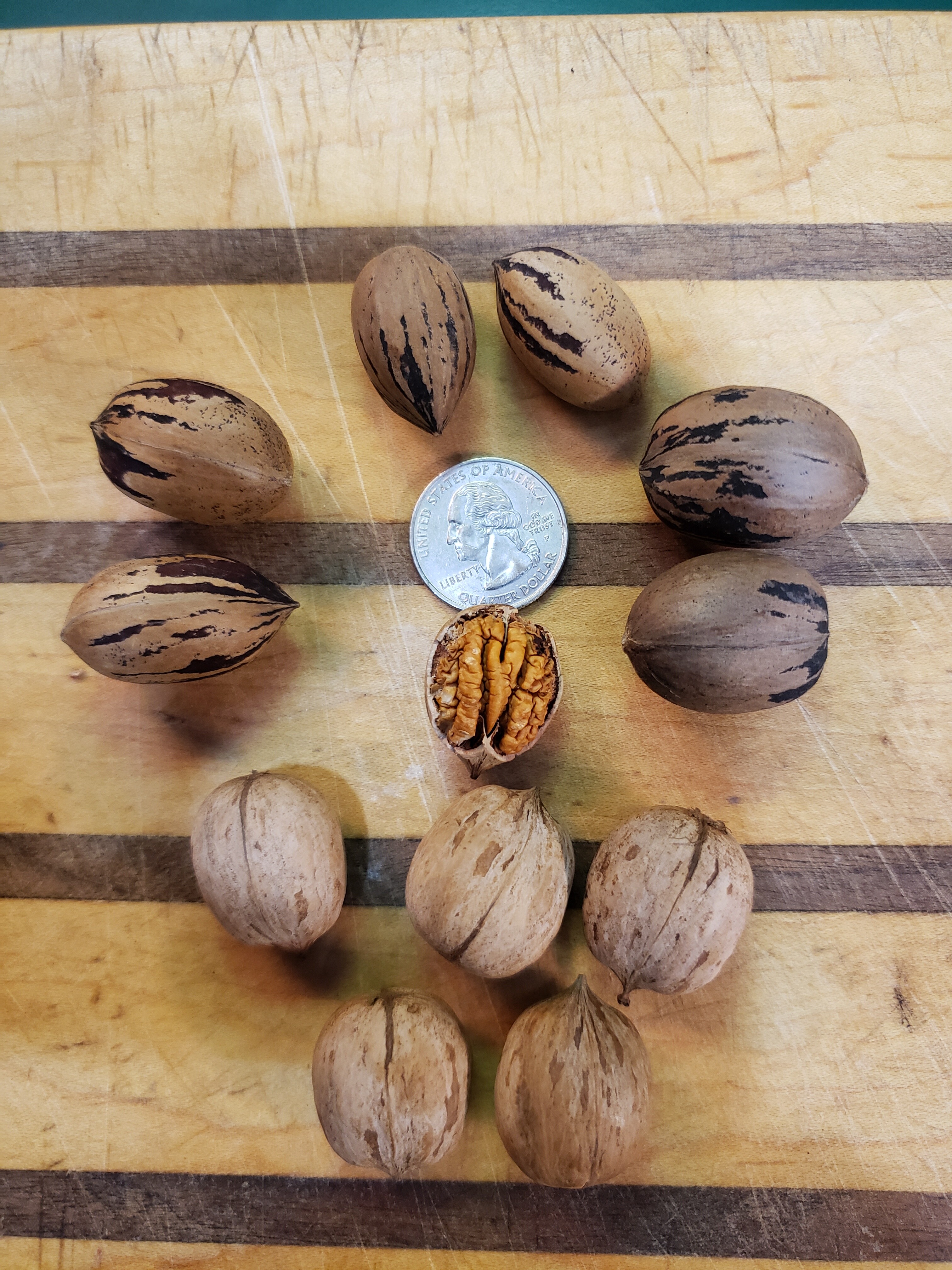
I encountered a ‘new to me’ bitcan, this fall, on a family friend’s farm in the south end of the county here. Nut looks very much like a typical bitternut, but has those unmistakable pecan spots/stripes. Thin shell and astringent kernel, but I presume probably pollenized by one of the dozen or more big old seedling pecans about its same age (75 yrs or more) planted all around it on farmstead. Sent a couple gallons of seednuts to a young colleague in the Northeast who’s growing seedlings for reforestation/afforestation projects and selecting bitternuts and the like for cold-pressed oil production. Some of those 3/4 pecan-1/4 bitternut seedlings might, at some point, be worth something. In photo below, bitcans at the bottom, sampling of pecans from the other trees there in the farmyard at top.

2 Likes

Thanks for your help. I’ll trial an Oswego instead of a Lakota.

For apples, I’ve using crabapple rootstock. They are everywhere on the farm, thrive in my environment, and have these 2" thorns that deer avoid. They are superior to any apple rootstock that I’ve tried. Sometimes, the best rootstock is close at hand. I have so many black walnut trees around me I’ve never considered growing black walnut cultivars. How do the black walnut cultivars compare in flavor to their wild brethren?

There is no comparison re black walnut meaning the wild walnuts lose every time. If you want to give a grafted walnut a try, get Thomas, Farrington, and Neel #1.

@Fusion_power … 6 years… thanks. Hopefully I will be around that long or longer.

You mentioned yard trees earlier… do they actually work OK in an area that gets mowed weekly ?

I have some red hickory in the edge of my yard and they drop nuts in the lawn… but no problems for mowing… the nuts are fairly small.

How are pecan trees to mow around when nuts are dropping. Do they mostly get mowed over or become projectiles ?

I keep the lawn mowed close and using a grass species that stays small. If you let the grass get tall, pecans get down in it so deep you will never find them. Other than that, pecans mature when grass has mostly quit growing for the summer. Pick up the pecans, mow the grass, wait for more pecans to drop.

Just planting a pecan tree is not going to get it to mature nuts in 6 years. It also has to have routine care including fertilizer and regular weeding. Bill Goff published results of putting mulch around pecan trees and showed the mulch significantly increased growth. I have had very good results putting chicken manure around pecan trees as fertilizer, just be aware that too much can cause nutrient imbalances.

4 Likes

Is there a nursey that you would recommend that would have these varieties?

I’ve seen Thomas walnut trees that were clearly infested with viruses resulting in useless trees. I was fortunate to locate a 50+ year old Thomas tree as a source of scionwood for my grafts about 20 years ago. Thomas is very distinctive in nut shape and kernel cracking traits. If the tree is virus free, it produces a very heavy annual crop.

That said, I don’t know anywhere that currently sells all three walnuts named. John Brittain (Nolinnursery) carried them and sold a ton of trees over the years. Your best option might be to get some seedlings established and graft your own trees.

I got some new information coming in from under the microscope of a friend of mine in California.

(Rice, Wesley G 2005, 'Pecans - Volume II A Grower’s Perspective’)

‘Fisher’ pecan - Carya illinoinensis
Origin: New Memphis, IL.
Range: Northern Pecan Range
Pollen Shed Type II (protogynous) *based upon pollen size and timing, (Mayginnes, D. 2022)
Nuts per pound: 79, % kernel: 46
Scab 2
Shuck split: 3-days before ‘Colby’
Good flavor and cracking qualities

(Rice, Wesley G 2005, 'Pecans - Volume II A Grower’s Perspective)

‘Deerstand’ pecan - Carya illinoinensis
Range: Far-northern Pecan range
Origin: Burlington, IA.
Pollen shed Type II (protogynous) based upon pollen size and timing, (Mayginnes, D. 2022)
Nuts per pound: 101, % kernel: 52
Shuck split: 8 days before ‘Colby’
Nut quality: 2, tree quality 2
Good cracking qualities

2 Likes

I visited Shiloh nursery in Ray City GA yesterday and brought home 15 Kalos trees. These trees are HUGE, as in 1.5 to 2 inches diameter at the graft. They have @400 trees of Avalon left in the 6 to 7 ft range for $17 each. They might give a discount for a large purchase.

I also visited the Auburn planting and collected scionwood of these varieties:

Apalachee
Elliott
Kanza
McMillan
Moreland
Syrup Mill
Tobacco Barn

I also have about a dozen varieties growing that I will collect scionwood from in the next few days.

Adams #5
Amling
Creek
Lakota
Syrup Mill
Gafford
and a few others

2 Likes