I planted another Kalos tree today and will try to get the rest in the ground by the end of next week. These trees are HUGE. I’m digging holes 2 feet diameter by 18 to 24 inches deep to plant them. They average 8 feet tall after planting. They were taller but were top pruned in the nursery. One of them is almost 3 inches diameter at 4 feet above the ground.
Time to begin a southern nursery for those reading… WoW!
I’ve visited two different nurseries to get the 7 varieties I planted this winter. 15 Kanza, 15, Avalon, 15 Lakota, 10, McMillan, 5 Zinner, 10 Oconee, And 15 Cape Fear. The latter two as pollinators. We’re in the SE pecan belt, but I can’t imagine the land being planted for the thousands of cultivars I saw dug and about to be dug.
2 Likes
Would it help to know that over a million pecan trees will be planted this year? There are about 20 large scale pecan nurseries in the U.S. with each producing between 30,000 and 150,000 trees each year.
Buck Paulk still had about 400 nice 6 to 7 foot Avalon trees the last time I checked.
2 Likes
I made two whip and tongue grafts of Florence pecan on a couple of seedling trees today. Weather forecast calls for temps in the 70’s for the next week which is about as good as it gets for grafts to heal at this time of year. I also set 9 pear grafts with scionwood sent by Lucky Pittman most of which are inlay bark grafts though a few are cleft and 1 whip and tongue.
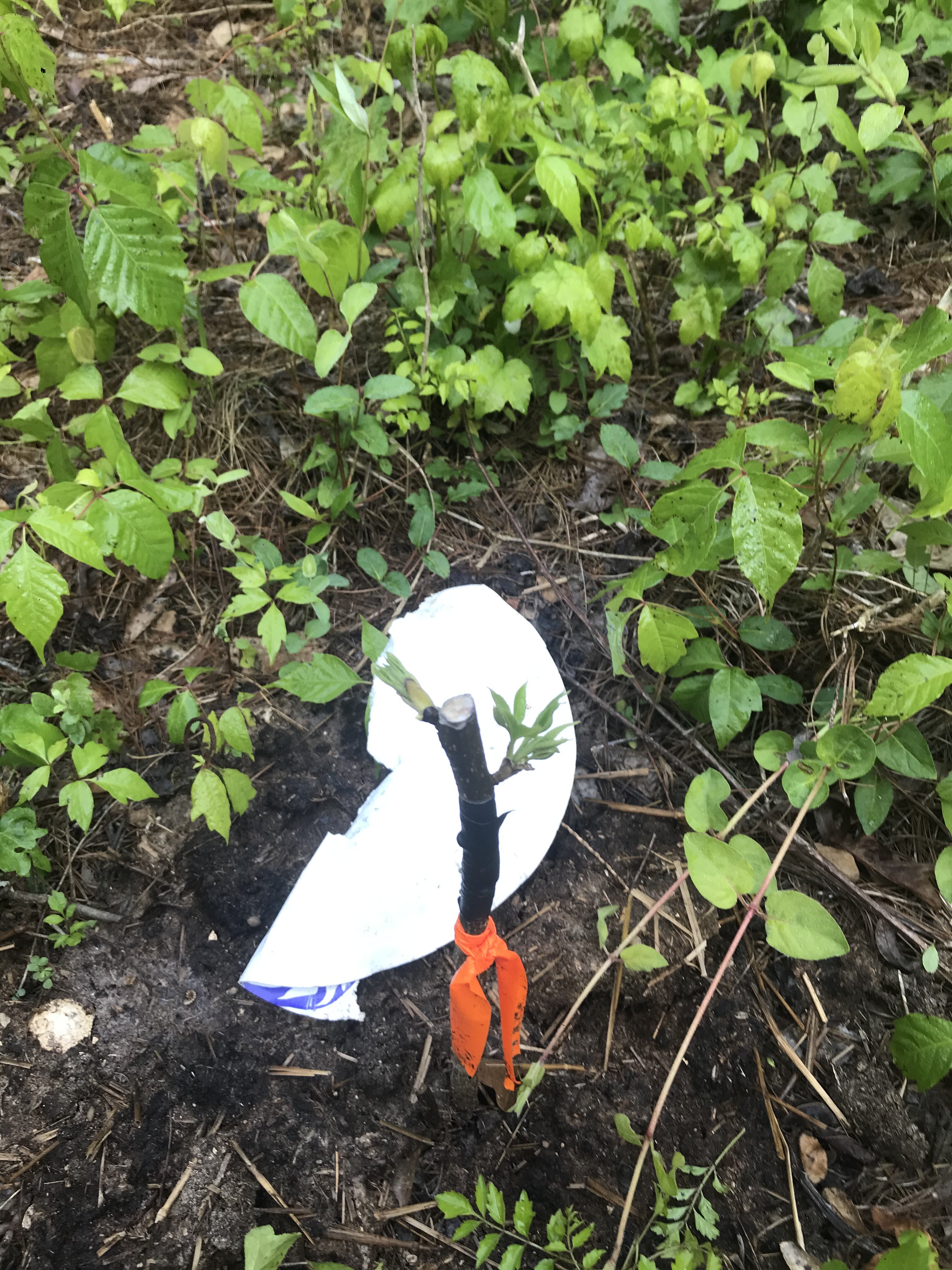
My “technique” for making whip and tongue grafts has improved over the years. These were almost perfect size matches between scion and stock and the tongue was cut at the right place for good alignment. I used black electrical tape which will help callus form given daily temperatures. If we were a month further along, I would use gray electrical tape to reflect some of the heat.
1 Like
Anyone recommend a book that has good pictures of older cultivars. Especially the bark and the leaves. I have the SE Grower’s handbook but it has one small snapshot of a few. I’m looking at the Thompson, Sparks, or Rice and it seems those three are the best. Jut hate to pick the wrong one and be disappointed. They aren’t cheap.
I have all three including both issues from Wes Rice. IMO, Sparks will come closer to what you are looking for. FYI, I got all of mine for about $100 but I had to look for them. I got Sparks book from Wes Rice. He was at the point it was not being used so he passed it on to me for $35.
Here is a pic of a whip & tongue graft of Florence pecan onto a seedling rootstock. This is an example of my very best grafting skill using very high quality scionwood. The cuts were smooth and straight. The tongues were cut to precisely align. The scion exactly matches the rootstock diameter. It was made about a month ago. Growth is just starting and I can feel the callus tissue forming beneath the electrical tape.
Here is a pic of the pecans the parent tree produces (54 per pound with 54% kernel).
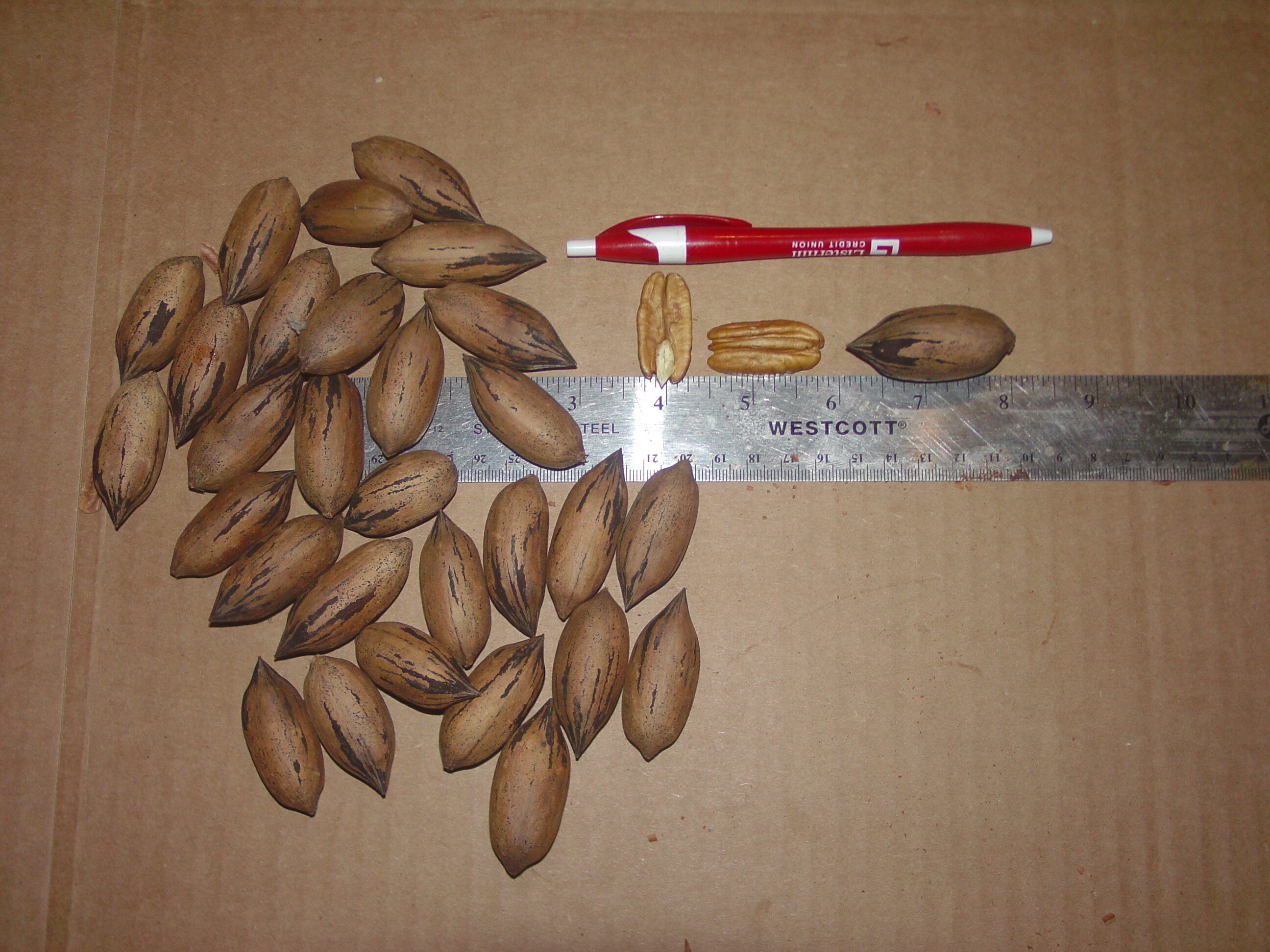
Florence is a scab free pecan seedling tree growing on a side road east of Florence at the edge of Killen Alabama. It is an annual heavy producer which makes it very interesting as a yard tree.
5 Likes
Resembles a Caddo. Maybe some Schley or Brooks parentage?
It is most likely a Stuart seedling as the only trees growing near there are Stuart. That long tip looks an awful lot like Van Deman. Florence is a very interesting tree to me because it produces annually with no scab and very little insect damage. I’ve seen up to 1% of nuts damaged by stinkbugs. Other than that, very few pests or diseases affect the tree.
’OC-7’ one of the O’Connell Island off of Burlington, Iowa selections made by Gary Fernald and Bill Totten. It’s a Protandrous (Type 1) cultivar.
Carya illinoinensis ‘OC-7’

1 Like
The pictured graft of Florence shown above failed. This is a common problem with pecan where the scion develops a necrotic layer that prevents callus from joining the scion with the rootstock. Callus production from the rootstock was abundant. The scion leafed out and grew nearly 3 inches before failing. Fortunately, I made 2 grafts one of which was on a tree 3 feet away. That graft was fully accepted and now has a foot of new growth on the scion. I’m looking forward to getting pecans from this variety. The parent tree is impressive in terms of yearly production of good quality pecans.
I fertilized the young trees planted this year with hopes of pushing them to establish root systems and put on as much new top growth as possible. I have an abundance of chicken manure and purchased some 13-13-13 commercial fertilizer. I have been using 15-15-15 miracle grow liquid fertilizer on a few trees. The effect of fertilizing is very obvious with leaves darker green and lush growth.
I purchased 15 bare root Kalos trees in the spring. They were very large grafted trees averaging 8 feet tall and from 1 inch to 3 inches diameter. This is much larger than I normally purchase, however, it was what was available so I bought them. So far, 3 of the trees have failed to leaf out. A few of them leafed out but are growing very slowly. Time will tell if they make it.
1 Like
I’m growing with a pecan mix in 30 inch treepots and RootTrapper bags 15" x 8". I have controls in place to learn the fastest seedling that can be grown. I’m doing shellbark seed, pecan seed (‘Major’), and American persimmon. The controls are to use flats to grow an extensive root-system, first, and then shift/transplant to the tall Treepot or the RootTrapper. The others are direct sown.
The mix is specifically tailored to pecan, however, it’s a good all around mix I’ve discovered. In two-years I’ll have a good idea of what works best and how large I am able to grow a seedling; then those can be observed against another year of growth in each of the respected (container(s).
I’ve just sown the persimmon and shellbark 6/12/2022 and persimmon. The pecans I sowed 3-weeks ago in flats so they are late to start too. I just haven’t had time to play around with seeds when grafting and getting my nursery in order were, priority…
5-6" side walled flats is what I’m using. They create about a 5-7" pecan or persimmon if sown earlier and then are transplanted while they are actively growing still. Seeds grown in tall walled flats produce a mass of roots vs. a long taproot and are automatically air-pruned due to the construction of Trays/Flats. They’re heavy-duty, also.
Local company around here has pecan fertilizer by the 50# bag. 5-10-15 with zinc and magnesium. The local pecan farmers really like it.
Some of my grafts are really going gangbusters with 2-5 feet of growth. I’ve had really good luck with the three flap graft and about 50% on the inlay graft.
My bare root trees I planted in February are about 90% living so far. Some were over 10’ when purchased. Y’all keep up the good info coming.
1 Like
I was reading the April issue of PecanSouth magazine last night. Three new pecans were released by USDA with scionwood available to propagators in January. The varieties have been named Pueblo (Osage X Creek), Seneca (NC-2B X NC-4), and Zuni (Pawnee X Waco). All three are protandrous. Seneca is northern adapted so perhaps worth obtaining for zone 5 growers. Reading the blurbs, all three will be somewhat susceptible to scab. I hate to say it, but evaluating pecans in Texas gives a very poor environment for selecting for scab resistance.
I purchased 20 Kalos trees back in January and donated 5 of them along with 5 Avalon to Auburn. I also planted a dozen Kalos trees on my land and gave a few to people who wanted them. Of the trees I set out, it looks like 5 did not leaf out. We had an abnormally wet summer so it was not from lack of water. It is what it is and I can easily replace the trees that died. I’m waiting to see how they perform for scab resistance. I don’t expect much as the parentage is from scab susceptible varieties.
I updated the pecan spreadsheet with the new USDA varieties. I need to add a few more varieties before publishing an update.
3 Likes
This may be a dumb question. Are there any quick cropping varieties? Something that could have a nice production in under 10 years?
Varieties listed as “precocious” tend to produce a crop within 3 to 7 years. I found out through growing trees that this takes excellent soil, good rootstock, and the right varieties. Without good care such as fertilizing, watering, and weeding, it still won’t happen. Lakota is a very precocious variety to name one.
Older varieties such as Stuart are known for taking 10 or more years to produce the first nut. That said, when a 70 year old Stuart tree is in good health and well cared for, nothing comes close to the pounds of nuts it can produce.
1 Like
In one of Scotts threads he mentioned his took 7 years. I agree they have massive production, that’s why I want to put a few in. Just have that minor problem of how many years I have left. But there was always the chance that quicker cropping varieties had been developed.
I have had nuts on 2 or 3 trees the 3rd year from planting. Gafford and Lakota often produce precocious flowers. Significant production rarely starts before the 7th year. I’ve seen a few 7 year old trees (meaning 7 years since transplanting) that produced 10 to 20 pounds of nuts.
I got nuts on a Sumner pecan the 3rd year from planting. It’s not even recommended for my area. It is in its 12th year now. Doing fine.
I’ve got a couple of others that are going on about 10 years that have not produced their first pecans. May be that both trees were never grafted.