Good squirrel cover…
That might be the cause on this one, because I am right between Fresno and Sacramento. And after cracking all, I noticed some actually filled so I assume some had priority on little water intake depending on branch location or height.
1 Like
Is there any less graft compatibility between pecan and hickory than there is between pecan and pecan?
1 Like
Anecdotally, there appears to be, for some hickory selections.
Several people I know have had a hard time getting ‘Lake Icaria’ shagbark to grow on pecan rootstock (it’s not an issue only for me).
The late Larry Daulton swore that ‘Cody Cox’ would not work on pecan - but Fred Blankenship says he has not had that experience with it.
I have a 25-y.o. graft of ‘Wurth’ shagbark on pecan that has struggled to grow well, and the pecan understock has persisted in pushing multiple vigorous shoots below the graft, each year, that I’ve pruned off repeatedly. This may be - like Clark has described for some of his callery rootstocks - an incompatibility peculiar to that one particular pecan seedling rootstock.
1 Like
Any experience with pecan grafted onto hickory?
Pecan tends to grow fast where hickory grows slow. As a rootstock, hickory is almost always overgrown by a pecan scion.
This year I got 32 pecans totalling 182 grams from one of my Kanza trees. So over 6x as much as last year! We did have a much wetter year this year, versus last. At the same time, we had had almost no rain from mid-August until I harvested October 19th, iirc. Average weight after drying this year was 5.7 grams, with a range of 3.52 to 7.41 grams. That average is quite a bit less than last year, but given the much larger number of nuts it’s not surprising I suppose. The ones I’ve cracked so far has been well filled, light colored, and tasty, so living up to expectations in that regard I think.
I accidentally deleted my photo of the whole lot, after I had cracked and eaten the smaller ones, so only have the 19 largest to take a picture of:

On the other hand, the tree that gave 1 pecan last year gave 0 this year. So I’m not sure what’s up with that one, which is also a Kanza. I suppose I’ll hit it with more fertilizer next spring. Still waiting on my Hark to bear, which I think is only 2 years younger than the Kanzas, but nowhere near as large.
When one wants to save pecans for seed, should one keep them moist in a bag, like I’ve read you’re supposed to do with chestnuts? Or are they less sensitive about that than chestnuts are?
1 Like
Pecans need to be stored cool and moist to germinate rapidly next spring. Peat moss or cedar shavings (sold as hamster bedding in most box stores) work well for the purpose. Moisten just enough to be damp but not dripping, put in a ziploc bag, add pecans, put in a crisper drawer in your refrigerator. Pull them out in March or early April and plant them. Squirrels and ground squirrels will dig through barbed wire to get to stratified pecans so be sure they are protected!
Will native hickory (shag, red) pollinate pecan trees?
I am planning to experiment grafting pecan to a couple of the many hickory trees around the perimeter of my orchard. The plan is to get a couple different northern pecan cultivars, but it would be nice if I didn’t need to worry about the grafts all taking, surviving, and being near enough to each other.
The 32-chromosome hickories - shagbark, shellbark, bitternut can pollenize pecans, as evidenced by the existence of hybrids in the form of hicans, bitcans, etc., but IDK if they will perform that duty sufficiently to ensure good crops on pecans.
In general, while pecan and hickories are graft compatible, the typical configuration is to graft hickories onto pecan rootstock, as pecan is generally mor vigorous and ‘grows’ farther into the growing season. Pecan-on-hickory often fails to reach its productive potential.
1 Like
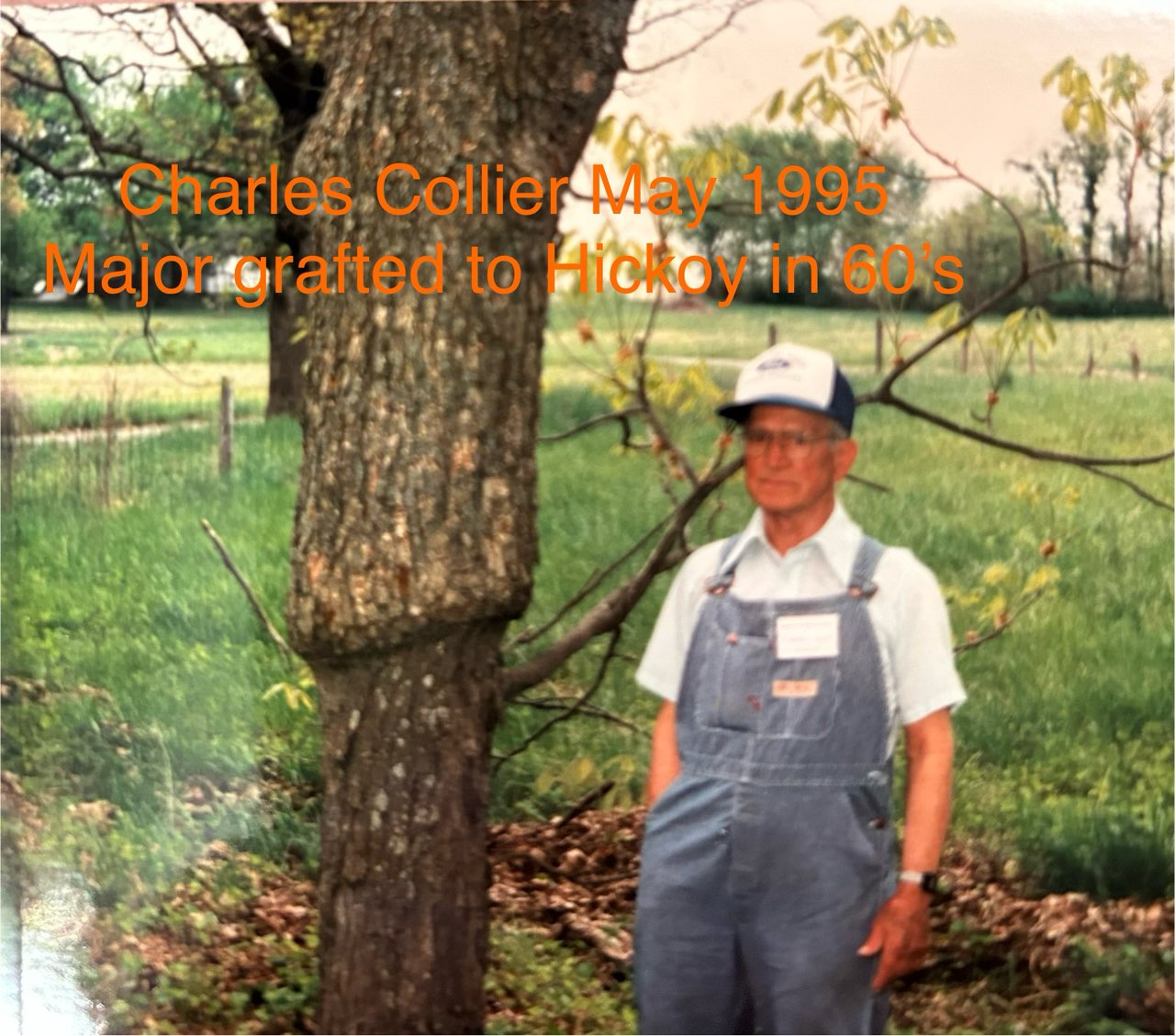
Visited a friend’s pecan orchard over in far western KY this past summer. Her father started planting/grafting pecans in the early 1960s. Photo is of her father, in 1995, with a ‘Major’ pecan that he grafted onto a pignut hickory (C.glabra) growing in the hog lot, almost on the edge of a small pond, sometime in the 1960s. The tree is still alive and bearing - and still has a low branch of pignut, below the graft union.
I don’t know how productive this tree is, compared to others in the planting on pecan understock, but this one, at least, is in a low spot with access to plenty of moisture.
6 Likes
Hickory is not a good pollination partner for pecan because hickory tends to produce pollen either too early or too late for most pecan trees. Hickory also tends to produce relatively low amounts of pollen as compared with pecan trees.
1 Like
Thank you both for the answers. I will try and find two or three pecan cultivars then. Sounds like grafting onto hickory is not ideal, but I’m going to try it anyway. This is just a fun experiment for me, utilizing established trees that would otherwise get removed. Maybe in 30 years someone will take my photo standing next to a goofy looking tree! 
I have a couple 2" diameter trees that may be good candidates. There are also some larger trees with side branches, including one about 30" diameter. Unfortunately, many of larger trees grew in competition for sunlight and are 60 to 70’ tall and without low branches, so not easy to graft to.
I assume the same weevils that I find in my hickory nuts will like the pecans just as much?
The 2" diameter trees will be your best bet. Nothing wrong with giving it a try, knowing ahead of time that results may not be optimal.
I’m currently working my way through some of the smaller northern pecan seedlings I planted in a riparian bufferstrip 25 years ago, cutting them off 8-10 ft above ground, where trunk diameter is ~4 inches, and grafting them over to improved hickory selections… and a few pecans.
Yes, the same weevils that attack the local hickories will definitely enjoy pecan nuts.
I was somewhat surprised to see that 60 yr-old graft of ‘Major’ pecan on pignut understock… I’d been operating under the assumption that graft compatibility might be an issue between 32-chromosome Carya species and those with 64 chromosomes (like pignut, mockernut, red hickory) - but was mistaken.
With regard to which pecan varieties you should try… if there are any MI NGA members in your area, they may be able to recommend those that have performed well - and might also supply you with scionwood. I used to know a couple of old timer MI nutgrowers in Flint & Eaton Rapids, but they’ve gone on to their reward.
2 Likes
I’ll try grafting some pecan on both shagbark as well as red, assuming I can find suitable rootstocks of each! I’d like to try grafting some Hican as well, if I can find enough places to graft too.
Good idea on MI NFGA. I think it’s MI Nut & Fruit Growers Association now, if that’s the org you’re talking about? They have a facebook group where I could inquire.
Grafting…
- Are you just using typical inlay bark grafts on your 4" diameter cut trunks?
- Ever tried a side inlay graft on large diameter trees?
- Do pecan like being grafted in warm temps like walnut, chestnut? Or should I have at as soon as they break bud?
If you have weevils, they love hicans more than they do pecans or hickories. Hicans are notoriously ‘shy’ bearers, for the most part, and mine produce > 95% ‘blanks’ and/or weevil-infested nuts. I don’t recommend them to anyone who is limited in space. I have a dozen hican varieties, and still graft ‘new’ ones, but only one copy, until I finally find one that is not a waste of space… but I have 110 acres of open ground to plant on.
Topworking the bigger pecans, yes I’m doing a Texas/American bark inlay graft. Kinda like this: https://www.youtube.com/watch?v=IlB-UCVJ3ng
They do like warm temps. After battling for 25 years, I’ve finally admitted that a large percentage of my failed graft attempts were probably due to trying to do them too early in the season, with not enough heat to effectively callus in.
1 Like
Another issue is using scions which are already breaking dormancy.
I have had problems with keeping pecan scions stable and dormant until I graft.
1 Like
Darn, a shame to hear about your experience with the hicans, I was kind of excited about them. Maybe I’ll settle for an improved shag or something. I don’t mind the weevils too much as it’s minimal work to let them sit in a bucket for a few weeks after harvest, then toss the ones with holes. But if 95% percent are bad, then you aren’t left with much for your efforts!
I wonder if the higher weevil infestation rates is partially a result of more blank nuts? If female weevils can detect blank nuts and won’t lay eggs there, they would be concentrated onto any nearby filled nuts.
Thank you for the guidance and tips!
weevils overwinter better in hicans than in pecans.
Lucky, do you have T-92?
I think it will be productive moving in a direction of grafting hicans and hickory hybrids onto vigorous rootstock seedlings of themself. This should sidestep genetic incompatibility issues, and i wonder if there could be something like a nutrient incompatibility too, leading to, for instance, higher weevil susceptibility in the hicans. Grafting to progeny may also sidestep that issue if it’s real.
I think seed growing is where it’s at though. Just need another tree generation or two until the hickory genepool and their hybrids are at a point similar to chestnuts, where they can be planted out on broad acreage and culled 10-33%.
Some cultivars like Grainger shagbark and Fayette shellbark have already demonstrated the ability to make seedlings (OP with quality cultivar pollen) as good or better than the parent at least 25% of the time. Those are great odds. Just need to experiment with more parents trees and then start an offspring orchard and let those cross.
Badgersett to date has established a planting most like what i describe, however, from what i hear it all began from a grab bag of seed from Weschcke’s farm, so aside from being very northern selections it was also a limited genepool. With more experiments and more genepools the possibilities are a nut yet to be cracked.
1 Like