I do have T-92. Produced its first nuts last year; all blanks… just like Vernon & Jim Wilson (which are the same), Bixby, Burton, and James.
I was reading a description for mcallister hican yesterday. According to the description, this particular cultivar requires shellbark pollen to fill nuts. Is it possible that many hicans have fussy pollination nuances? Do you know if other hican growers also see similarly high percentages of blanks?
Though this variety has been around for a long time, we have just recently discovered it needs Shellbark Hickory pollen to set a full crop of nuts and for those nuts to fill properly
Yes, hicans tend to throw a large percentage of blanks up to 100%. I have a James hican which is about 30 years old that produces only a few filled nuts yearly. I’ve also seen a Mcallister with a crop of huge nuts but only a small partial kernel was in a few of them.
I’ve often wondered if I am not meeting the pollination requirements. Genetics suggests there is a problem during meiosis where by random chance a few nuts get a viable set of chromosomes where most do not.
1 Like
My McAllister has not yet produced nuts.
Numerous Type I and Type II pecans, hicans, and grafted shell barks in fairly close proximity to most of the hicans, plus the native shagbarks in the nearby woods and native shellbarks down along the creek, a half-mile away. I feel like I’ve got the pollination issue covered.
The late Henry Converse (Dean of the KY Nutgrowers Assn) suggested ‘Flack’ pecan as a potential pollenizer for ‘McAllister’ hican. Ive never sought out Flack budwood, so idk if it might improve nutset/filling of hicans or not.
1 Like
Fayette Etter’s McAllister tree, which still stands, fills it’s nuts reasonably every year. They arent filled to the point of bursting (althoigh some nuts are), but they are filled enough to rival any big pecan. The family living there sells the nuts. There are lots of shellbarks at Etter’s.
A friend of mine found another McAllister in downtown Frederick MD planted between two seedling (non-cultivar) shellbark trees. Those nuts fill every year too.
So it could be shellbark pollen that does it, but Lucky’s experience, and those of other orchards with McAllister and shellbark and poorly filled nuts says otherwise.
My thinking is that its about timing more than anything, and seeing as how shellbark can be one of the earliest to release pollen, McAllister has an opportunity to catch it then and thus have a longer time to ripen. But if McAllister can’t catch the right pollen in time, maybe the nuts fertilize but cant achieve any size by the time the season is over. On the other hand, it is hard to believe just a week or two of difference re: pollen times would make that big a difference.
The other factor could be water. McAllister seems to need a lot of it. I remember Parker Coble talking about how his McAllister filled in 2018 i think when we had a really wet year, when normally it wouldn’t.
Etter’s McAllister is planted in bottomland. No idea about the Frederick tree.
Maybe its a combo of early pollen + water, who knows.
1 Like
Any recommendations for some 6A? SE Michigan near the Lake Eric. I know I’m really pushing the limits for pecans but I like a good challenge. I have 8 acres of old flat farmland that sits next to a large pond. My apples, pears, and peaches are thriving and all on drip irrigation. I’d like to add a couple pecans just for variety. I was looking at Lucas and Campbell NC 4. Both are on Grimos as available. However this site has them both listed as type 1.
Campbell NC4, Deerstand, Earlton, Lucas, Seneca, Snaps, and Warren 346 will work in your area. Earlton and Lucas are type 2. I suggest pairing them with Warren 346 and Campbell NC4.
2 Likes
What is the best way to combat zonate leaf spot, pecan scab, and powdery mildew in pecan trees? Thanks.
Best is to plant resistant varieties to start with. If you already have them planted and need damage control, spraying with fungicides is the only effective alternative. Look up “pecan spray schedule” for some recommended chemicals.
1 Like
Jerry Lehman had a very productive McAllister he claimed was likely pollinated by the Pounds pecan ortet growing beside it. Here’s his writeup from the Hoosier Kernel: McAllister Hickan - Jerry Lehman - March 2014 INFGA Hoosier Kernel.pdf - Google Drive
2 Likes
The Wright hican growing on Hershey’s old farm in Downingtown PA is highly productive, and does not seem to have pollination issues. That said, it sits in a grove of mature (Green River, and Indiana or Busseron, among others) pecan trees, with Hickory all around as well, and while it has a delicious flavor, it does not crack out easily or cleanly. It does get weevils, which to me always seemed more prevalent in drier years, but in a productive year with enough rain there were plenty of uninhabited nuts.
1 Like
I wonder if the seedling shellbarks bookending the McAllister tree could be its offspring?
Seems to me that pecan fungicides are generally available only in commercial-size packages. Then there is also the problem of getting the spray up in the top part of the tree. Of course the tree has to leaf out first. The Captan and Myclo fungicides that i have used previously for plums, apples and grapes are not labeled for pecans. However I do have liquid copper fungicide that if I can figure out how to use in a hose end sprayer may work. Don’t know the effectiveness. Hazardous stuff though.
Perhaps someone from this forum has some experience with James Early (Type I) pecan? Or maybe you know someone I could ask directly?
I know it’s a small nut (4.3 gram), but it’s very early (140 days) so it looks interesting for areas with shorter growing seasons. According to the patent it should have high and regular yields (= no biennial bearing) of high quality nuts. I wonder if that’s all accurate.
Unfortunately I could not find any info about it’s precocity and resistance to scab.
I have very little info on James Early. IIRC, it was found by George James back around 1970. It is a small very early maturing pecan. Warren 346 should ripen nuts about the same timeframe or just a few days earlier. My current list of ultra-northern varieties includes: Campbell NC4, Deerstand, Earlton, Iowa, Lucas, OC-6, Seneca, Snaps, and Warren 346. James Early would fit in this group.
There are several problems with small very early maturing pecans. Size makes them slow and usually difficult to crack. Birds really prefer small pecans so bluejays and crows may make off with the crop. Trees may be very slow growing in far northern climates.
The earliest varieties would only ripen in the middle of October for my area, but the problem is that we often get the first frost at around the same time or a week after that.
Without information on your location, I can’t provide much guidance. I can say that based on stated first frost date, the most likely to mature nuts in your area would probably be Warren 346 and Lucas. OC-6 might be another option but it is very hard to find. I just got scionwood this spring.
You might read the Seneca release document below. Seneca is about 170 days to maturity where Warren 346 is closer to 150 days.
Hi i wanted to show you my trees cause they leaf out a week or 2 and the leaf looks pretty yellow. I wanted to ask you what you think about it? I checked pictures of zinc deficiency but i doenst look like that so i don’t know what to search for.
Thank you for your advices.
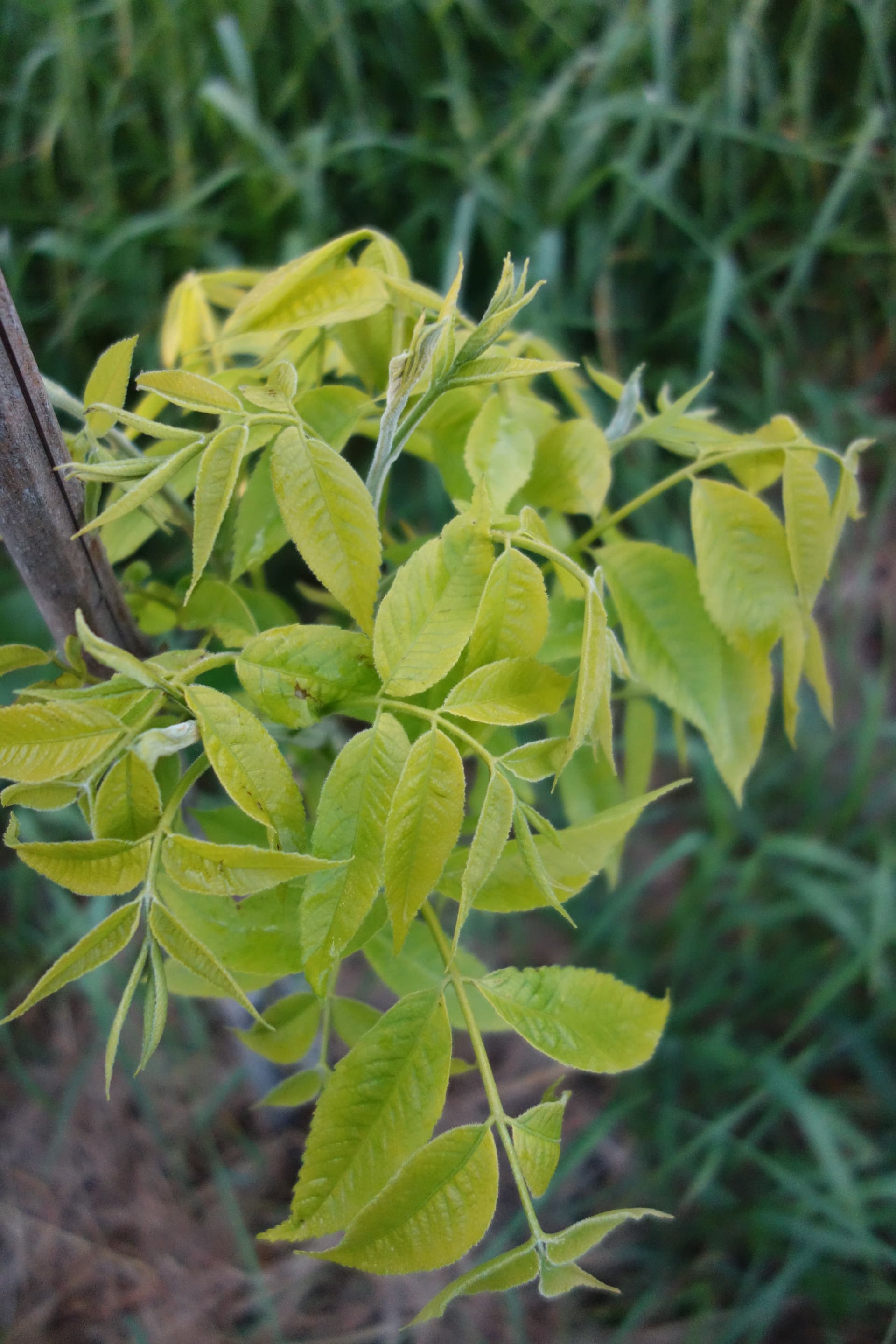
That is typical of nitrogen deficiency but may also be associated with micronutrient problems. Get a NPK supplement that includes micronutrients. It should have something in the range of N-16, P-12, K-24 for macronutrients. Be careful not to apply too much!
1 Like
Ok thank you Darrel!!!