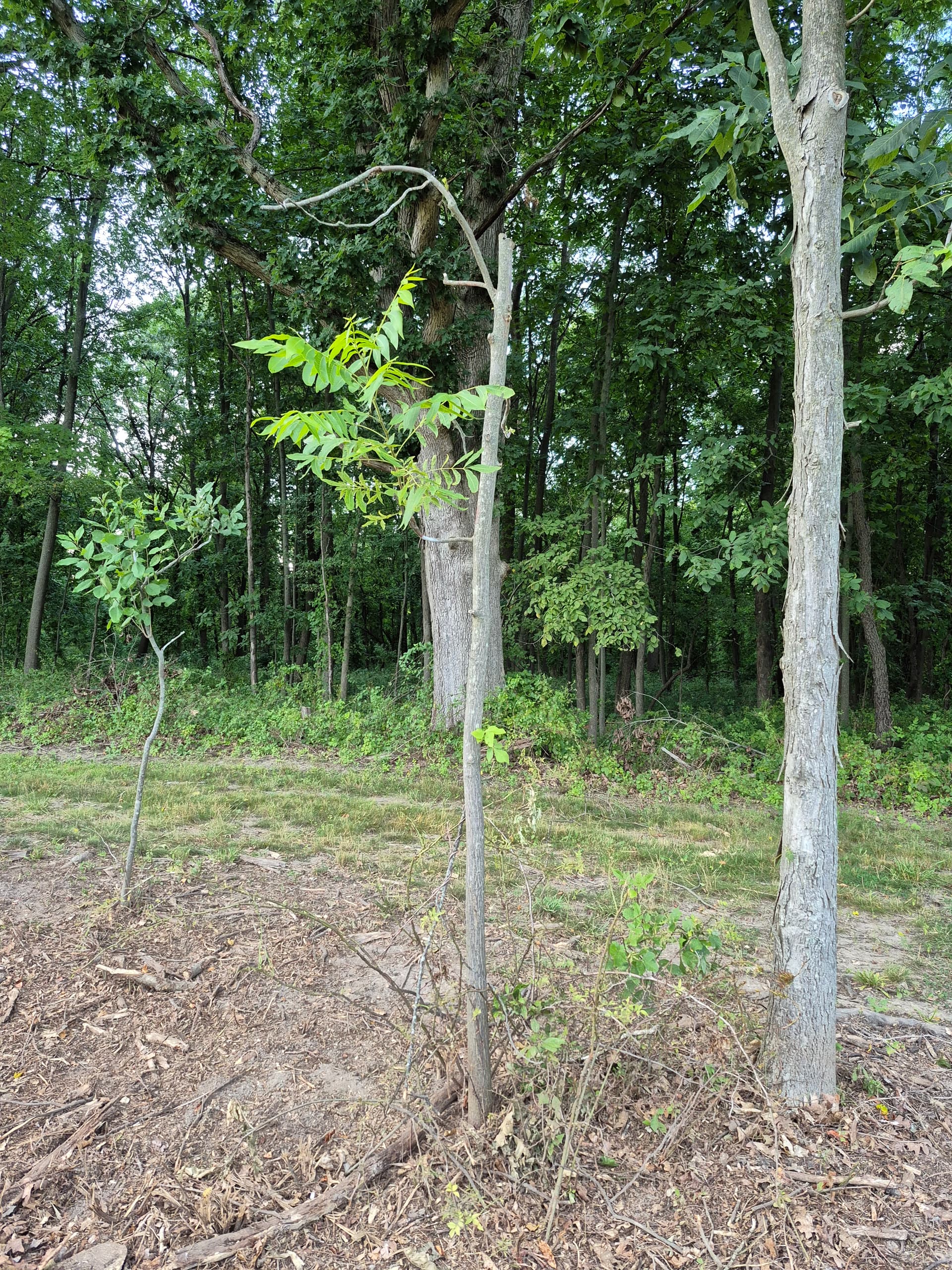
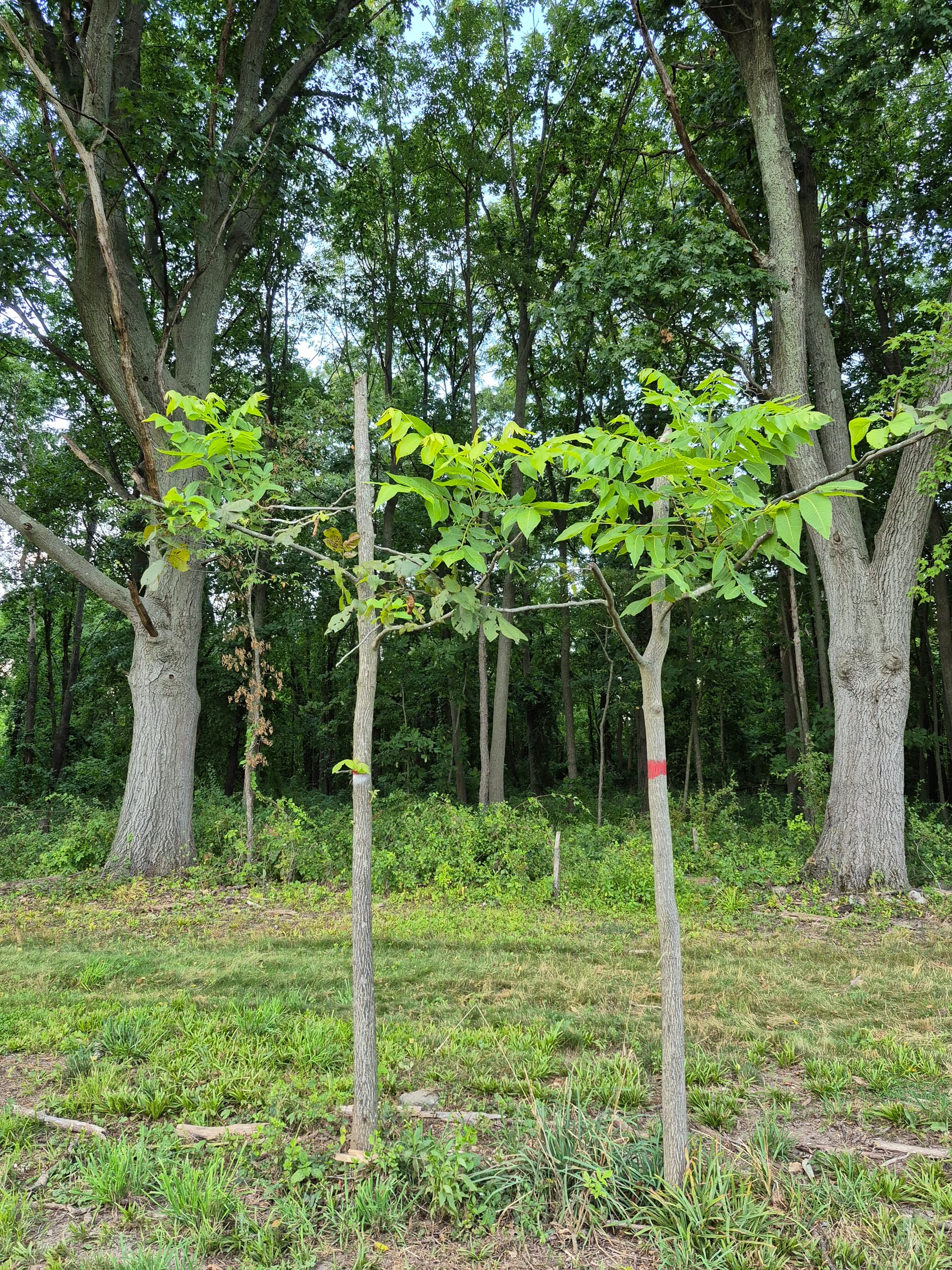
Even 60 feet won’t work after 45 to 50 years. When they get that big, the most that can grow and produce is about 7 trees per acre. I have some old documents where studies showed the number of square feet of trunk cross-section for optimum production. When the trees get big enough to exceed the optimum range in terms of tree size, production drops dramatically.
The major problem with 60 feet between trees is that they take so many years to start producing that they are uneconomic. Most modern plantings of pecan are based on 35 or 36 trees per acre where either hedging or tree removal will be used to maintain production as the grove ages. So why did I suggest 45 feet between trees? It is a good middle of the range spacing that will keep the trees producing for 25 to 30 years. Then a few trees can be removed to maintain production. Homeowners won’t have equipment to hedge the trees so it makes sense to plan for tree removal when establishing a planting.
I saw extreme amounts of hedging in SE AZ, is this a way to keep old groves productive? Take advantage of old deep roots?
They were also putting in new rows between trees so maybe they hedged to make room?
They were replacing the trees while keeping older trees productive. Hedging can be used to make room for new trees to get established. The older trees continue to produce for up to 8 years after which they are removed. If done with care, the result is a pecan grove that slows down but never stops producing.
For the typical backyard pecan planting of more or less 4 trees where the initial spacing is 45 feet there is the likelihood that when the time of thinning occurs the owner would be faced with cutting down 1 or maybe 2 of his favorite producing pecan trees. Well that is the exact situation that I’m in. Not so bad as at my age I won’t be around anyway when that happens. Besides I just consider them mostly as just shade trees.
In such a scenario wouldn’t the 60 feet be better? Maybe that is the difference between 2-4 trees in the backyard as opposed to a pecan grove consisting of multiple acres. I guess its easier to shoot the squirrels out of the trees with the spacing greater.
Even after 30 years, they only need to be thinned beyond 45 feet if you’re targeting maximum production in an orchard setting. If you’re just looking to eat some pecans from your backyard it’ll be fine. I’ve seen many, many wild pecans growing closer than that and they don’t mind at all.
The industry has been promoting thin shelled pecans as in the Sumner cultivar. I’m beginning to think that the reverse is better. Isn’t thicker shelled pecans more resistant to rot and stinkbug damage? Maybe even scab. Who knows?
The only significant benefit of pecans with thicker shells is that they are less likely to crack either in harvest or as they dry. As an example. Cherryle is well known for cracking as they fall from the tree. Once cracked, ants and birds are far more likely to eat the kernels.
The industry is moving more toward medium shell thickness at about 1.5 mm. This is the sweet spot where the shell is thin enough to crack by hand but not subject to cracking during harvest or cracking during drying.
I made some pecan grafts onto hickory this year (despite knowing hickory isn’t ideal, this is just an experiment). Anyway, did a few grafts each of Campbell NC4, Warren 346, and Fisher.
Fisher was the only type 2 pollenator, so of course none of those grafts took. I did get two each of NC4 and 346 though.
So, I need to order more scionwood for next year. Considering Fisher again, along with Lucas. Any other recommendations for early ripening type 2 options (Michigan)?
We have some extremely thin shelled wild pecans and they are heavily damaged by birds. Crows especially have learned they can peck through the shell. I believe they also intentionally drop the nuts on concrete or asphalt to crack the shells.
Wes Rice’s has some interesting things to say about bluejays and thick shelled pecans. He watched a jay peck a hole in a Mohawk pecan then pick it up by the hole and carry it off to eat. Agree that very thin shelled pecans are readily predated by birds, but birds are not selective. They will also eat thick shelled pecans if that is what is available.
Hi, i can’t find informations about pecan scab on those 2 cultivars: Deerstand and Busseron. Can someone help me please?
And also i can’t find what type is adam5?
Thank you very much!
Perhaps the best advice that I could give you would be to simply call up someone that sells these trees and ask them directly… Rock Bridge Trees in TN sells both the Deerstand and Adam5 cultivars. They don’t list the types but I’m sure they can answer your questions. Busseron is a really old cultivar so that would be difficult.
Watered my pecans for the first time this year. Its been dry here for the last 3-4 weeks as the rains has missed me. Noticed that the soybeans nearby are suffering.
@Fusion_power
About how many trees are you thinking that you will end up with and are you intending on doing any spraying?