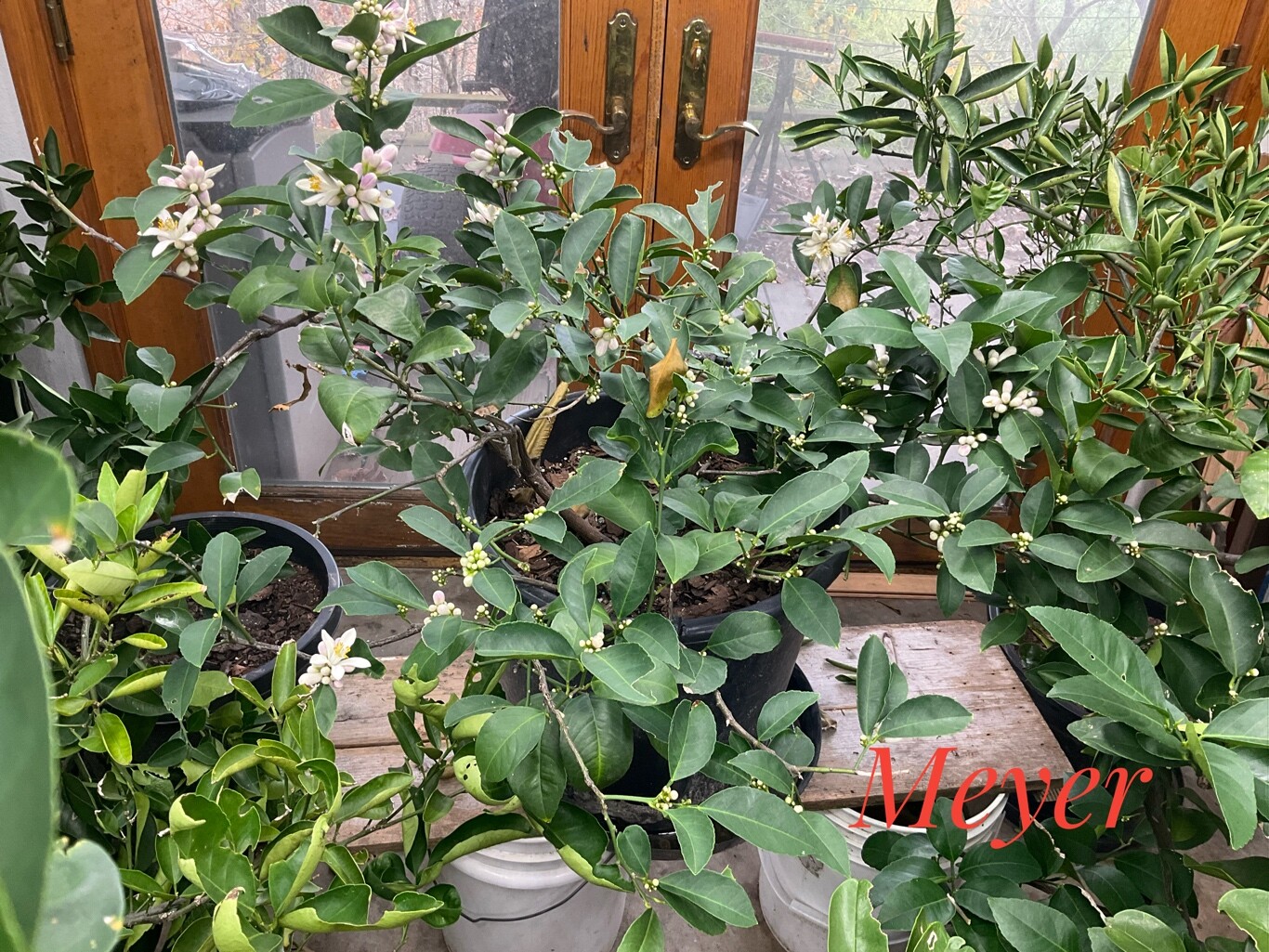
That’s true meyer usually does not come true from seed - however most sources clearly state meyer lemon to be self-compatible. As an aside, you mentioned meyer being possibly a lemon x mandarin hybrid, which is interesting and relevant here, as a specific Self-compatibility gene (abbreviated “SC”, as opposed to the self-Incompatibility gene, “SI”) was found to likely originate in mandarins and is why most or at least many mandarin varieties and hybrids are in fact self-fertile.
So, really, some “families” or lineages of citrus, whatever you want to call them, (Swingle vs Tanaka taxonomical system, whether most citrus are truly hybrids and not species, etc.) there are some that are more predisposed to having the SI gene vs the SC gene, but this really does not seem to be a definitive and hard rule - again, the genes here controlling self-incompatibility are apparently mostly recessive and in some instances can even be naturally “switched off” like in the example I gave you with the self-incompatible pomelo variety that had a bud sport that WAS self compatible.
source: “Here, we demonstrate that SI citrus species employ the
S-RNase-based GSI and harbour a S-RNase linked to several SLFs
at each S locus. Notably, we identify a mutant S-RNase, Sm-RNase, that is responsible for SC in citrus; this SI–SC transition occurred first in mandarin and then spread to its hybrids. As citrus is evolutionarily distant from other families that use S-RNase SI, our data provide new insights into the evolution of this widespread SI system.”
“Data from crosses show that SI in citrus is controlled by a single co-dominant S locus with multiple S alleles17,18”
" We present evidence that SI-SC transitions due to the Sm -RNase, initially arose in mandarin, spreading to its hybrids and became fixed."
Edit: I think maybe you might be speaking of parthenocarpy, which is a related mechanism but not the subject of my post. It is very important subject in the production of good quality citrus fruit that are “seedless”. Parthenocarpy is apparently also controlled by sets of genes that can be expressed or suppressed even in grapefruits or pomelos that are usually mostly monoembryonic and self-incompatible. Source
" Considering that about 20.0% of precocious-flowering nucellar seedlings of grapefruit did not set parthenocarpic fruits, it is suggested that the parthenocarpy in these hybrid seedlings of grapefruit are controlled by three dominant complementary genes, P1 , P2 and P3 ."