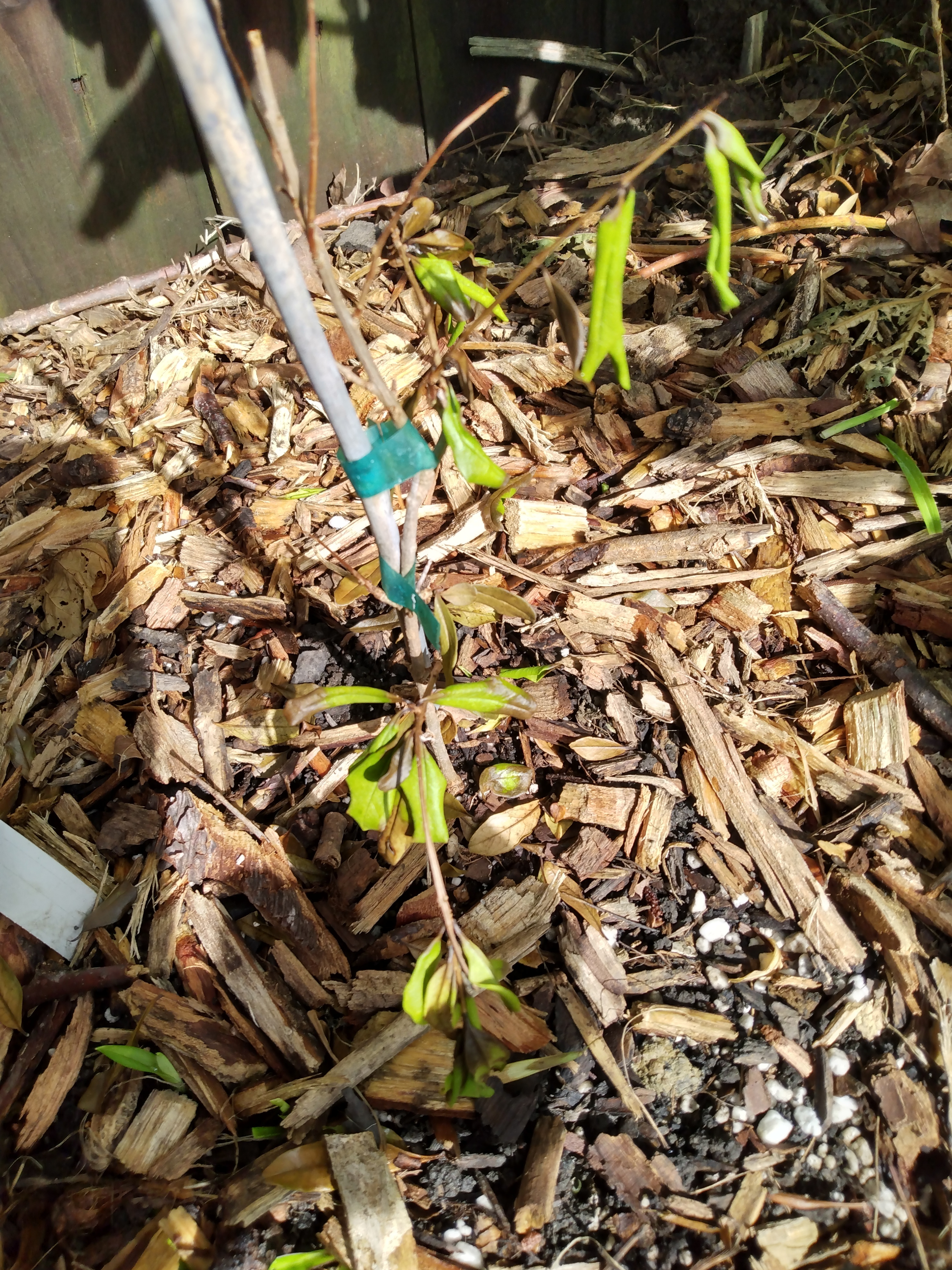
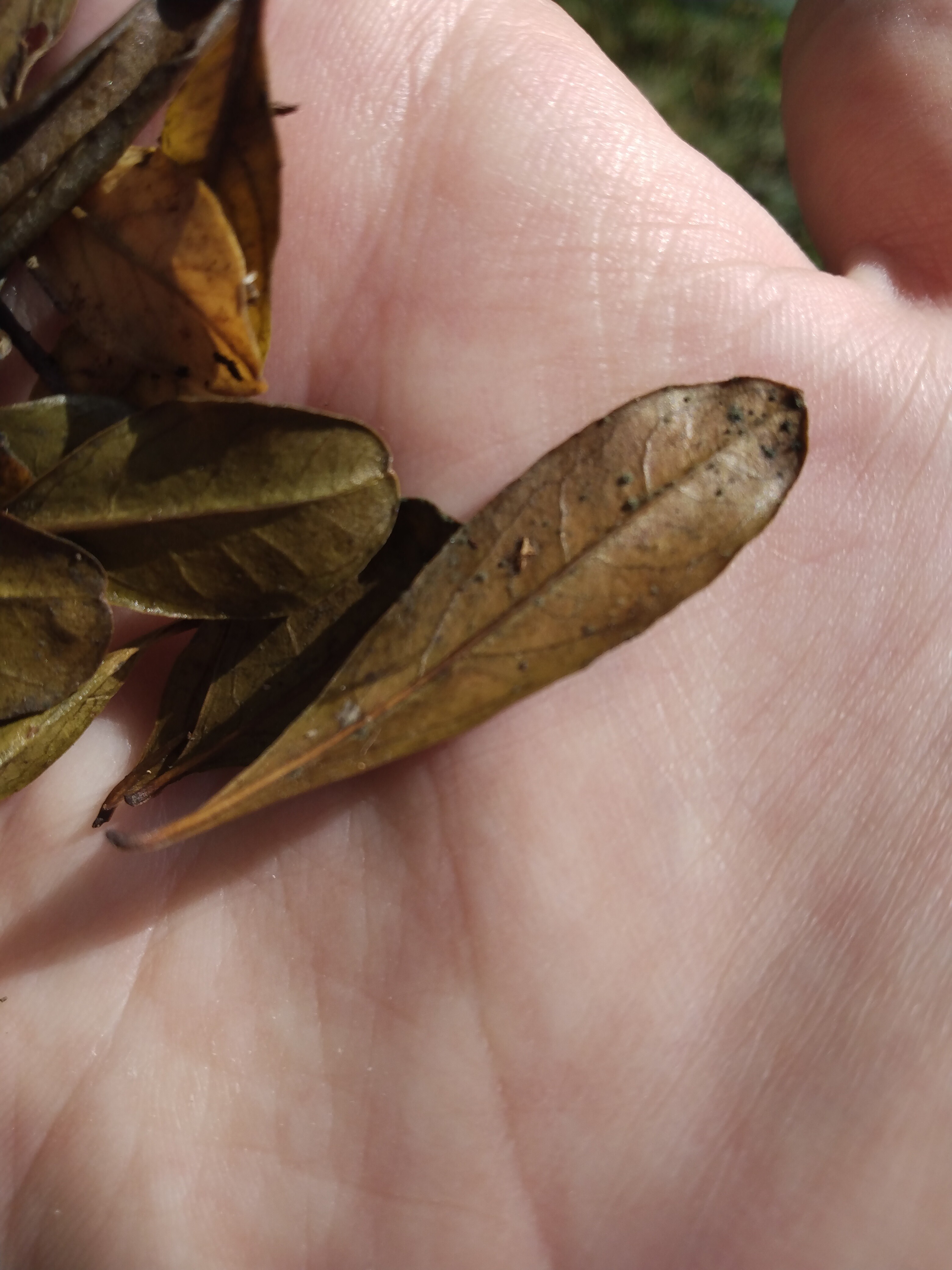
I have a young in ground makedonia red/macedonia pomegranate from edible landscaping that I planted mid spring and has been looking great and actively growing up until a few days ago. It is planted in a fairly sunny location and I am attentive to watering but not over watering. It now has many completely brown leaves, others browning from the stem or leaf tip ends, and everything is wilted. Not sure what the issue is here.
I’ve removed many of the brown leaves and noticed green and/or blackish mold on the underside of some of these leaves but none on any of the leaves with any green left. The brown leaves are still flexible and not dehydrated.
This pic is after the removal of the brown leaves.
Thanks @Richard,
That was my hunch but haven’t seen anything under the remaining green leaves but will check again, continue monitoring, and add more pictures when I get home.
Another vote for overwatered. Along with root issues, if that mulch is getting wet regularly since the plant is so low it will significantly raise the humidity around the leaves which will lead to leaf rots. Normally poms can take some humidity but being newly planted it is much more vulnerable.
You guys are so right. Too much water - not a good thing for pomegranates. I put in drip irrigation and some of my trees got too much water and I ended up losing some canes. Yellowed leaves. Some defoliation - but not much. Cracking fruit. Just do not look healthy!
I’m going to put a ‘switch valve’ in my line - so that I can turn off the feed to the pomegranates.
However - overall - I think the more consistent watering has benefitted most of the poms. I just have to figure out a happy medium.
Considering removing all mulch, too. I am quite sure that it is harboring the fungus. And it’s too hard to remove all the fallen debris from each tree. Will have to figure out another way to deal with the weeds.
What kind of soil is it in? For pomegranates I use a very well draining soil, like the type used for citrus or for cactus, that helps to prevent over watering. This is especially important for plants that are not developed well yet. How often you water is hard to explain, that depends on the soil, on how thirsty the plant is (the more well developed the plant is the more water they need), how well developed the roots are (the better developed the roots are the less water the plants need), how hot it gets, how directly they are hit by the sun, how many hours of sun, and how windy. Also July and August are the hottest months, so that can make things more confusing, and stress out the plants more. You could be both over watering and under watering in a very short time if you are not careful especially a poorly developed plant with poorly developed roots.
Pics of pomegranates growing in very rocky arid soil - show plants doing very well. Maybe we should add gravel to the dirt we plant them in? I like the idea of that cactus mix. I think I’ll try a couple of my growing cuttings, this fall - with that added to the holes. I really don’t have too much to lose at this point. So many of mine are pretty plants . . . but the fruit keeps succumbing to that black fungal problem.
It’s odd, though. Because there are people who swear by dressing them with compost - and that seems the opposite approach of keeping the soil un-moist.?
Lets use the Islands of Malta and Gozo as an example. The soil there gets very dry, desert like dry, and while a lot of plants there loose their leaves from the dryness, or the dryness kills them. The pomegranate bushes there keep their leaves and their flowers. Some years it stays that dry well in to October, and the fruit still develops without watering. That is because most of the pomegranate bushes there are either seedlings, or cuttings that were grafted on to seedlings. The huge difference between seedling pomegranate bushes, and pomegranate bushes rooted from cuttings is that the seedlings have tap roots that grow directly down, and rooted cuttings even though they do grow down some, nowhere near as much as the tap roots do. Maltese farmers used to grow pomegranates bushes for their tap roots, which brought up nitrogen from deep in the ground which helped to fertilize their crops, while the pomegranate bushes required no care, not even watering. Of course the tap roots would need to get deep enough first for them to survive a real Maltese desert like conditions.
The problem with grafting pomegranate is if there is die back, you could loose the grafted on part. Even though the roots of a rooted cutting do go down some, not enough to deal with the worst desert like conditions. A pomegranate seedling could be planted in pure sand and gravel, and when the tap roots got deep enough they would get the water and nutrients that they need from well below the sand and gravel.
“dressing them with compost” would be good for pomegranate bushes in lets say Los Angeles that don’t have tap roots.
Well I think that solves it. Though I let it dry out between waterings with a few days of 90s in-between I think I likely over watered. I amended my clay soil with garden soil and perlite with the perlite about 50% of the mix but the pom arrived in a more moisture retentive mix and so maybe that kept the root ball moist. I also watered as soon as it went downhill so I didn’t do it any favors. Sad because this variety is not available anywhere now and Bass from trees of joy said it will survive with some dieback and fruit in zone 6
Very interesting! I had no idea! That explains a lot. When we have to move or pull out a pomegranate - the root system is extensive. I’m finding roots for a few years afterwards.
Several of my trees I grew from cuttings. Others I ordered - and am quite sure they were propagated in nurseries from cuttings. Can’t imagine they grow them from seed.
I never noticed any sort of tap root! So your explanation makes sense.
Any chance digging this little guy up and potting it in very well draining soil could save it or cause regrowth from roots or should I just throw in the towel?
I would do this if I were you, and put it in the shade. Within 3 or 4 weeks it should look better.
Oh and if you put one or two watering globes (aqua globes) in the pot/container that would make sure that the soil does not totally dry out. As long as you make sure the globe(s) does not run out of water.
I would not dig it up. Any disturbance could kill it. In general any plant in active growth in the ground is very hard to move. I killed a bunch of things before I figured that out.