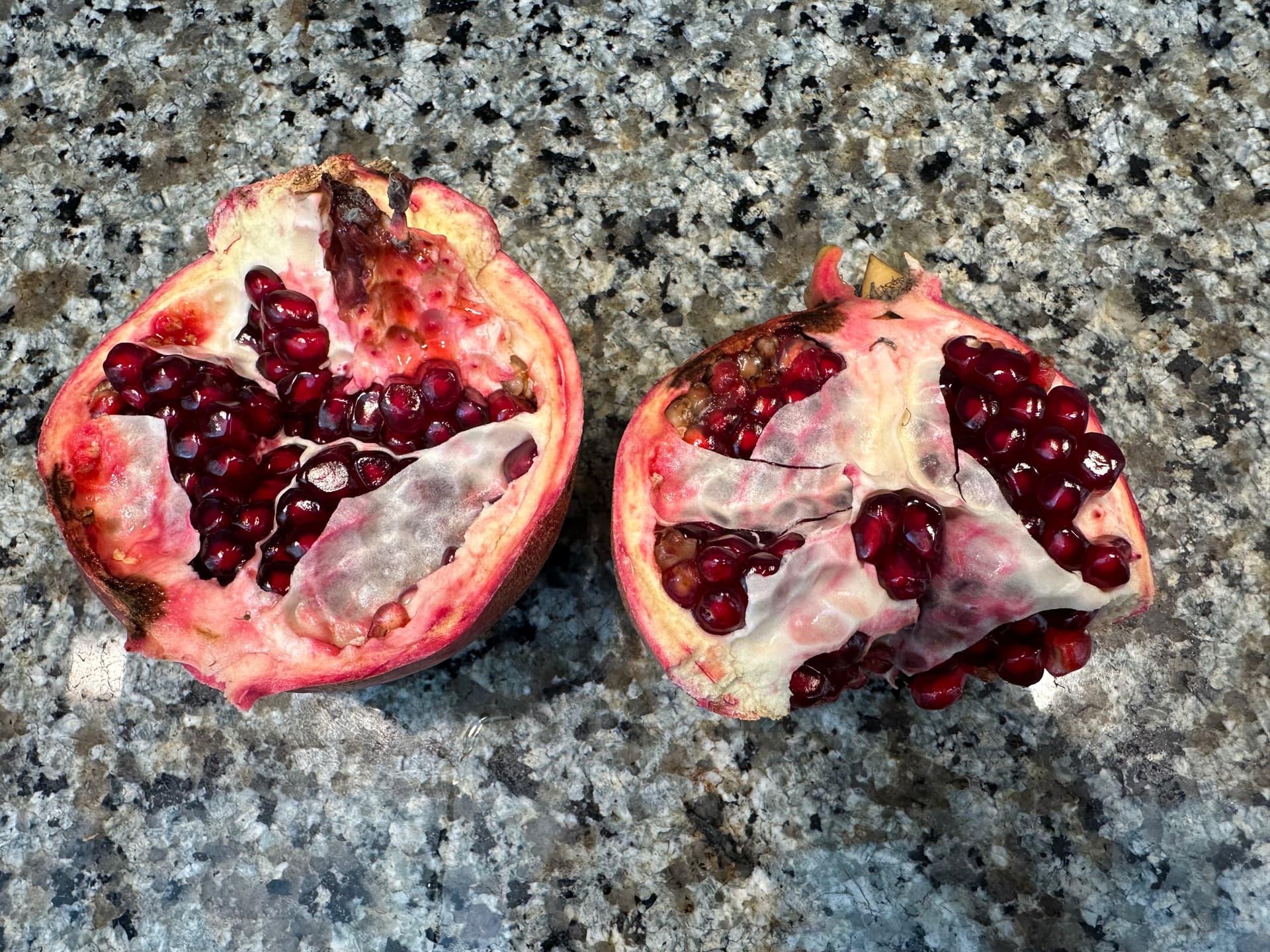
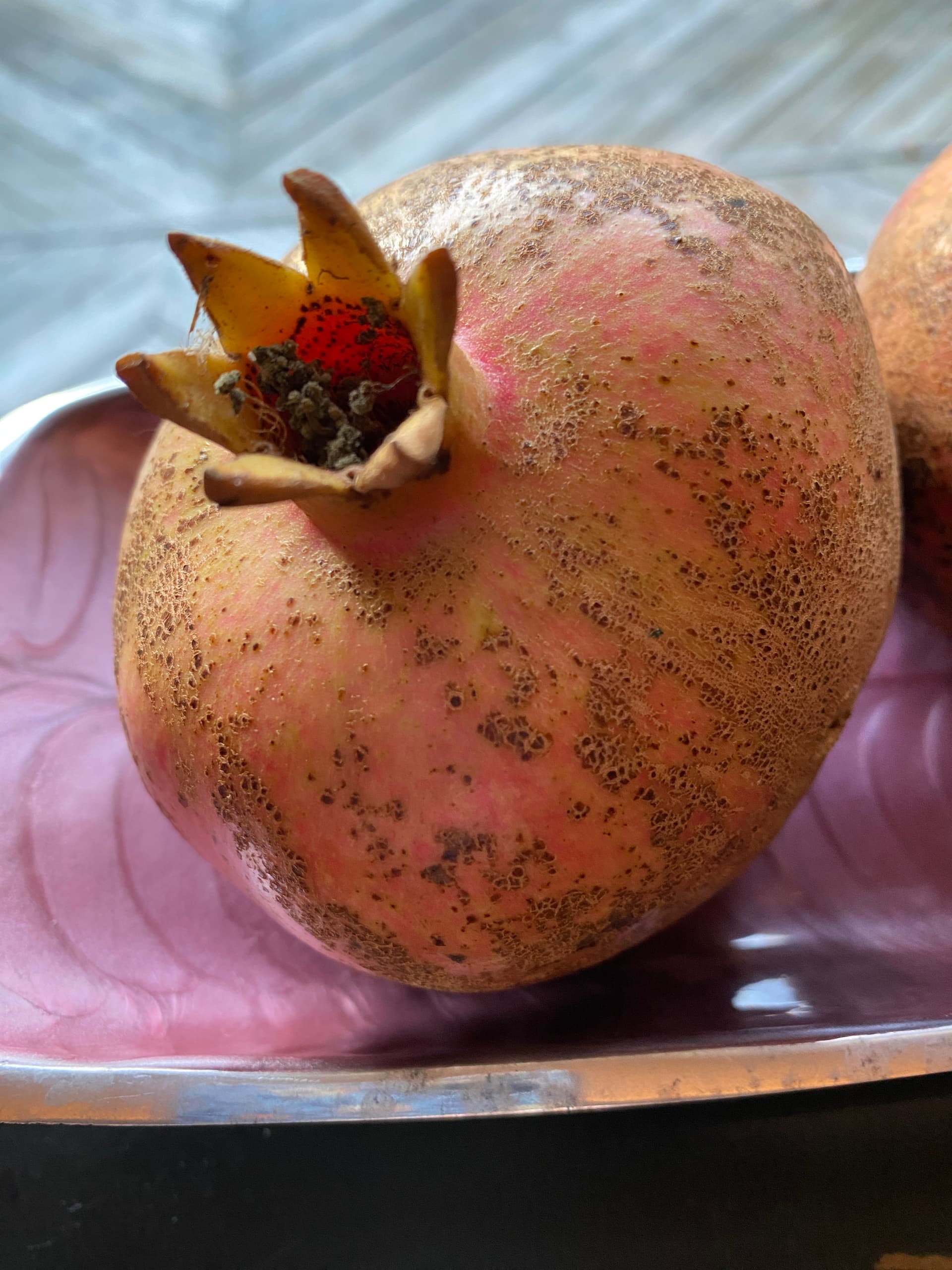
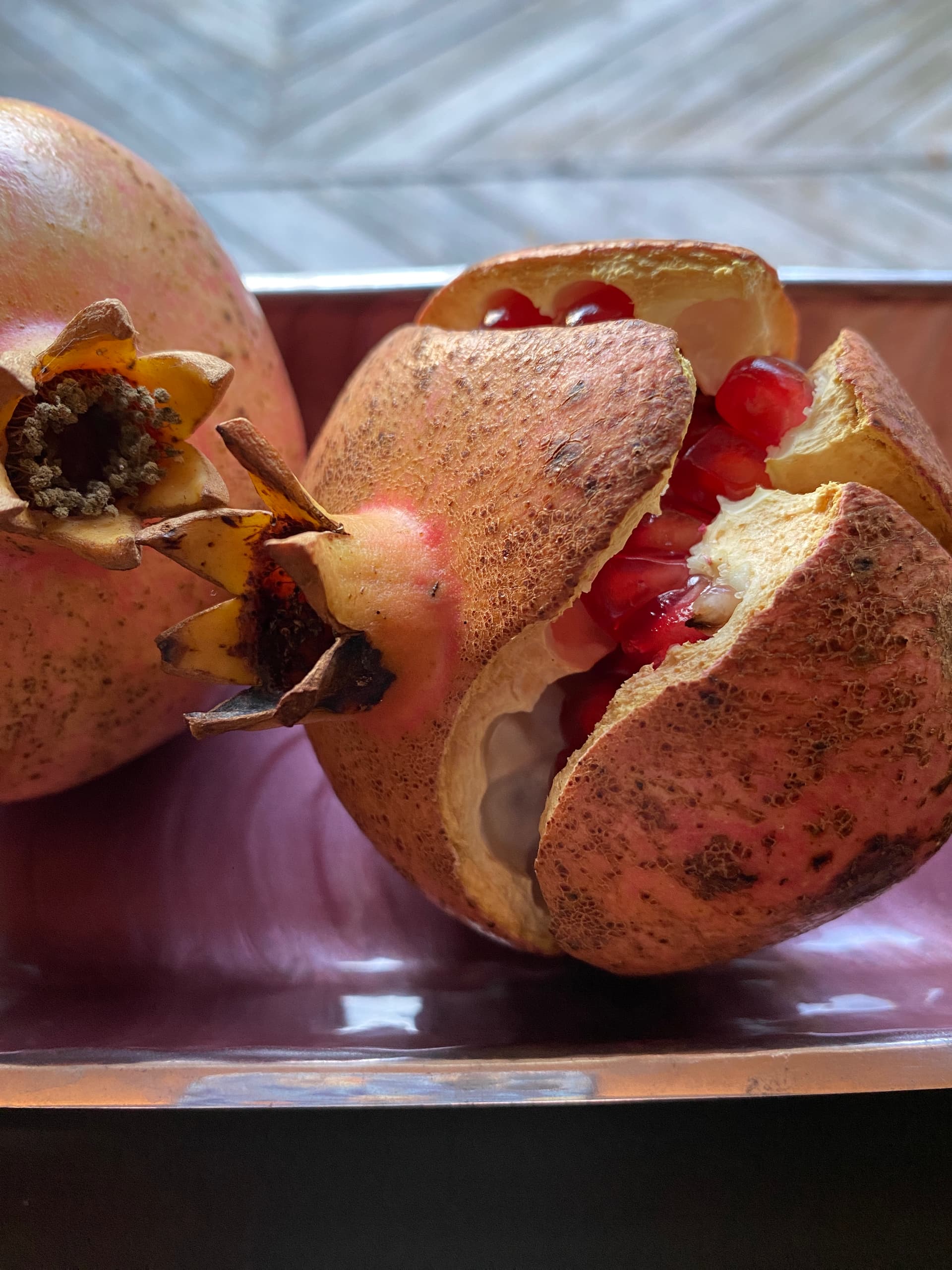
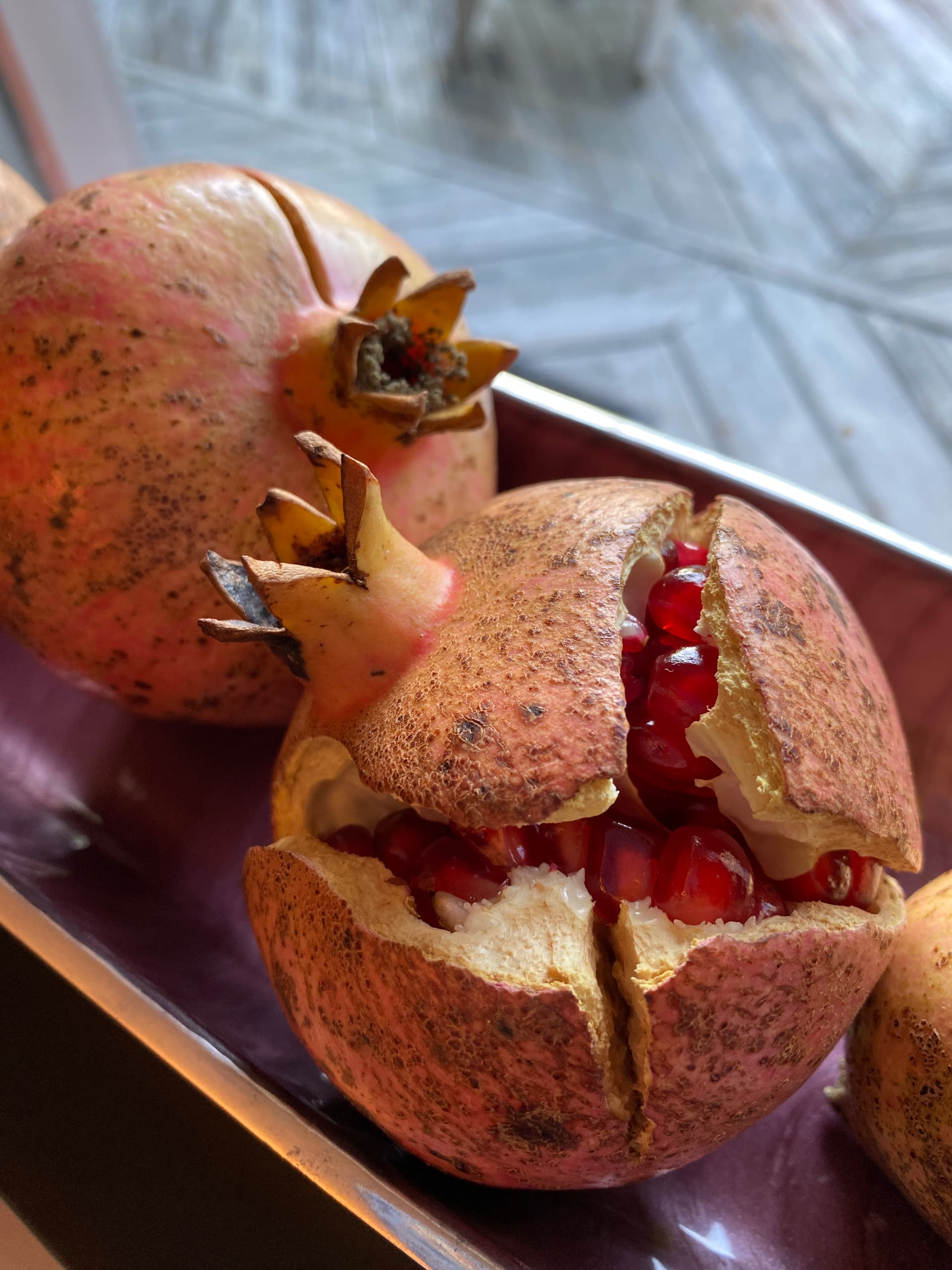
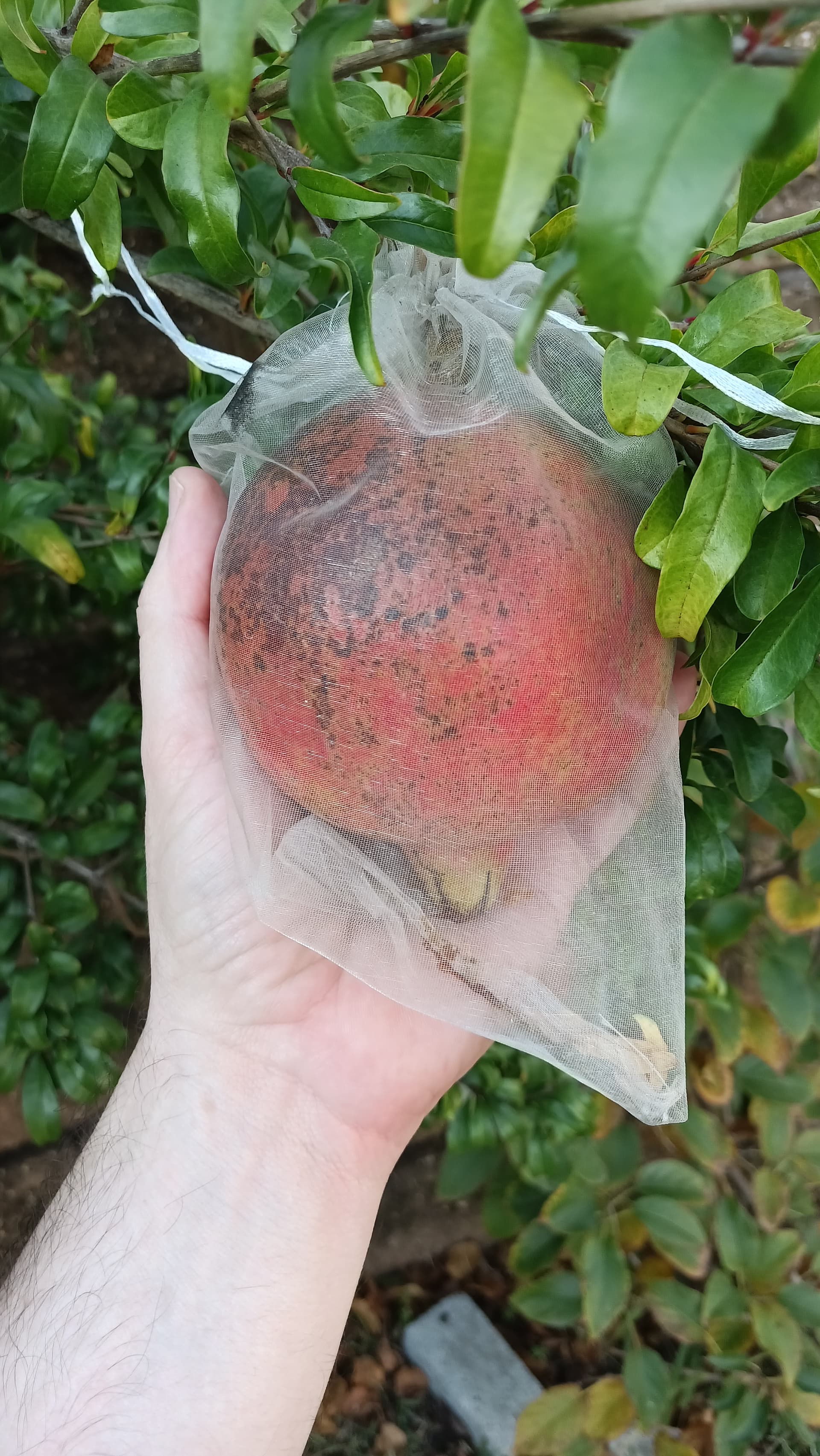
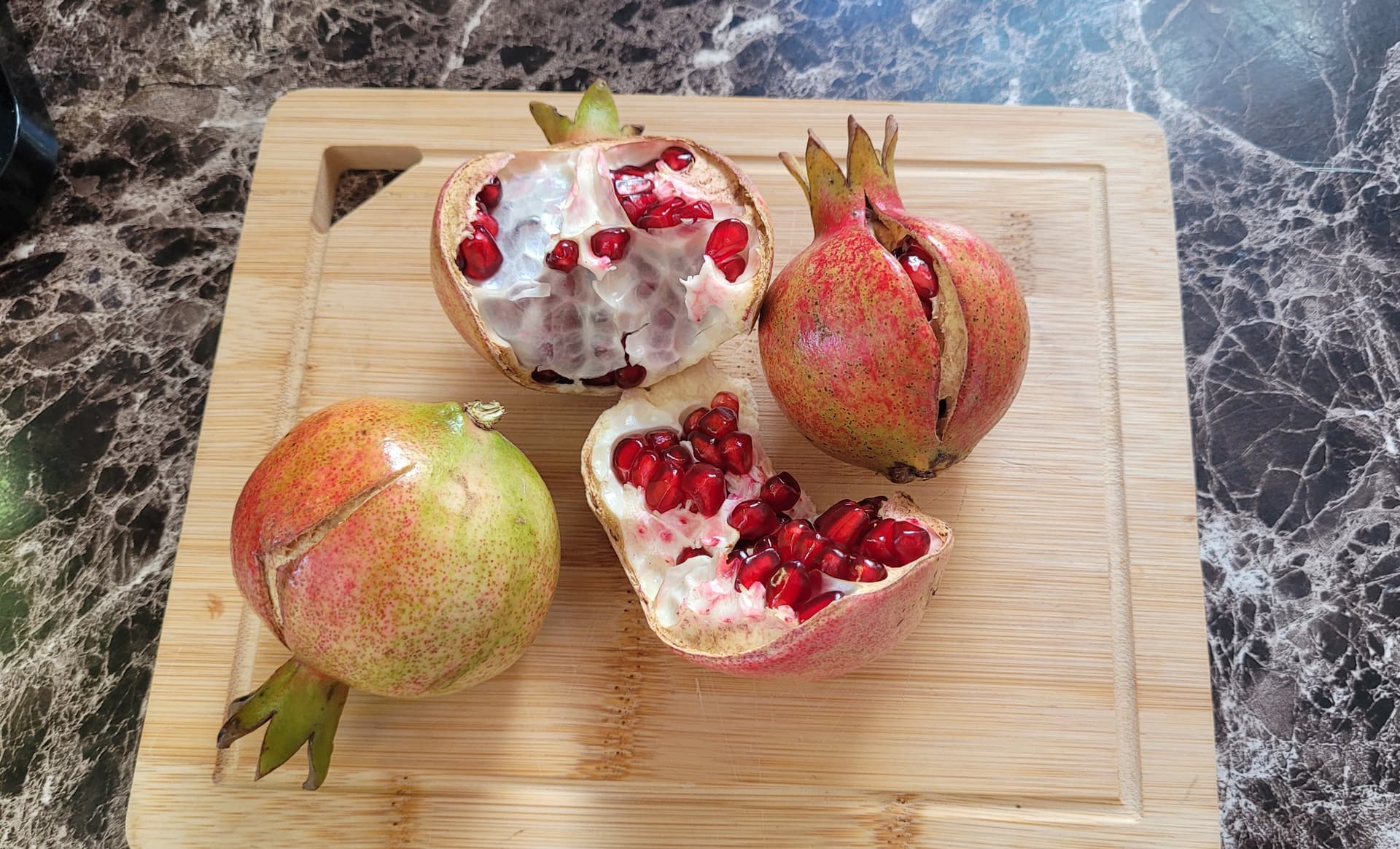
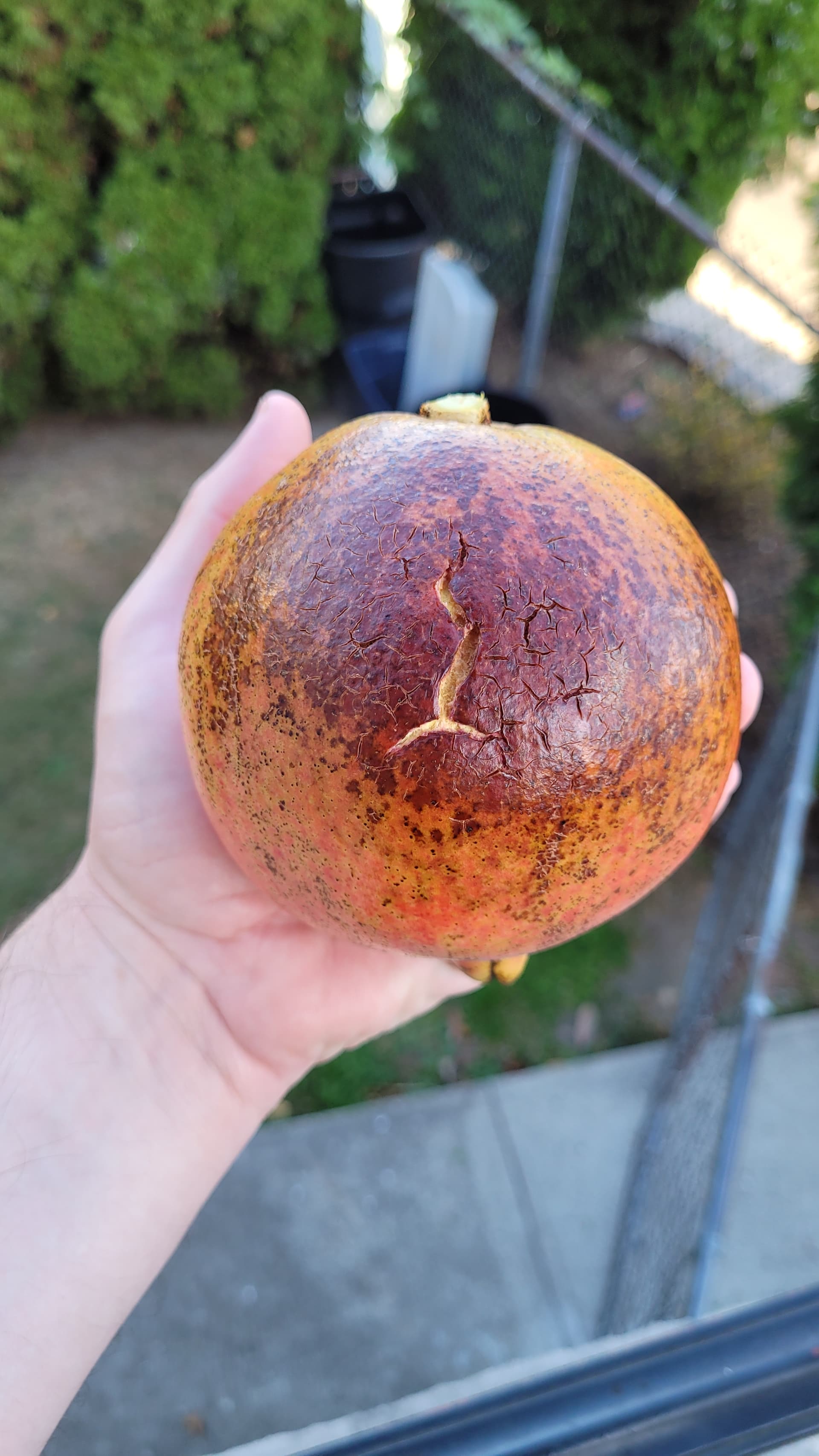
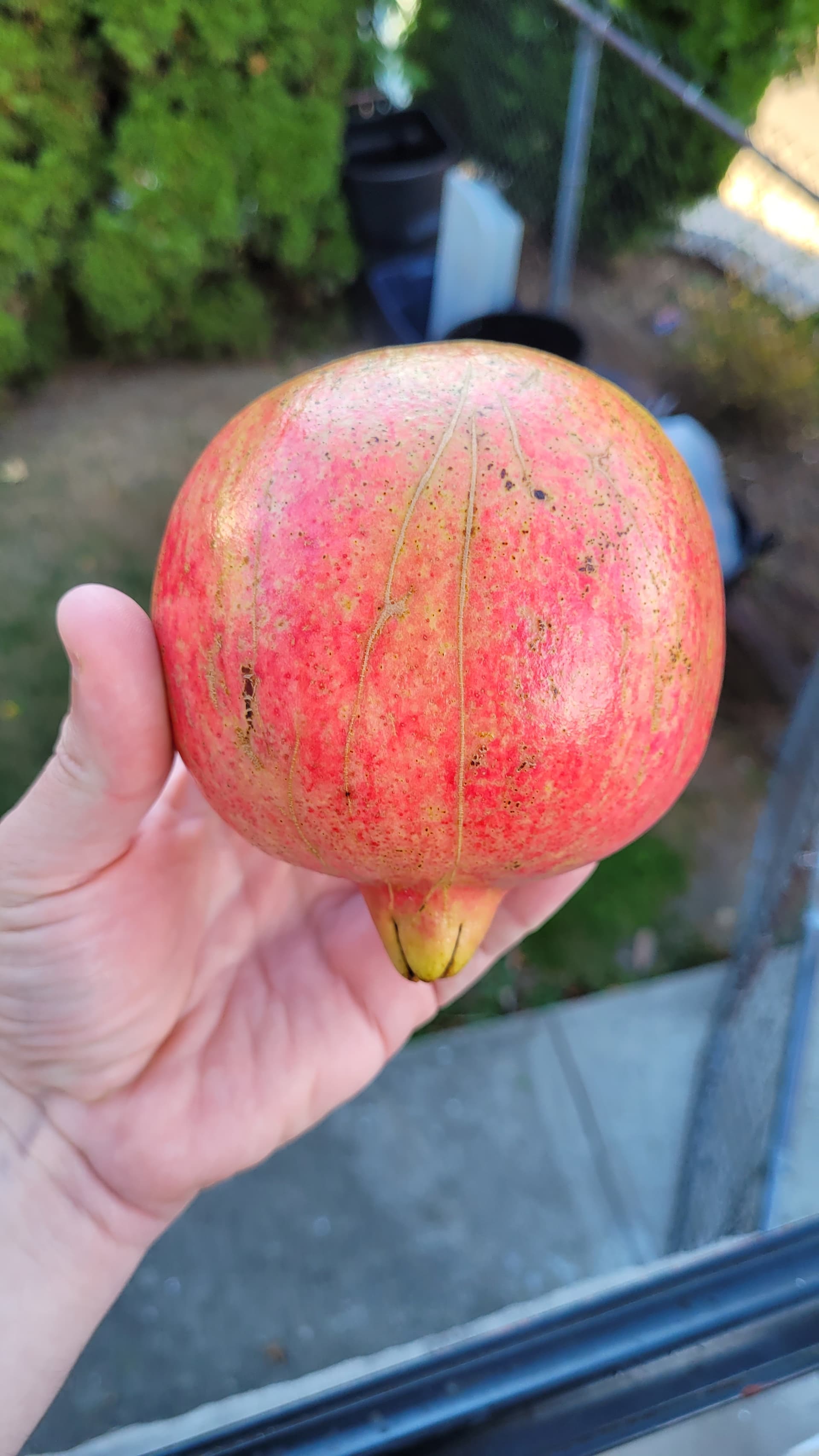
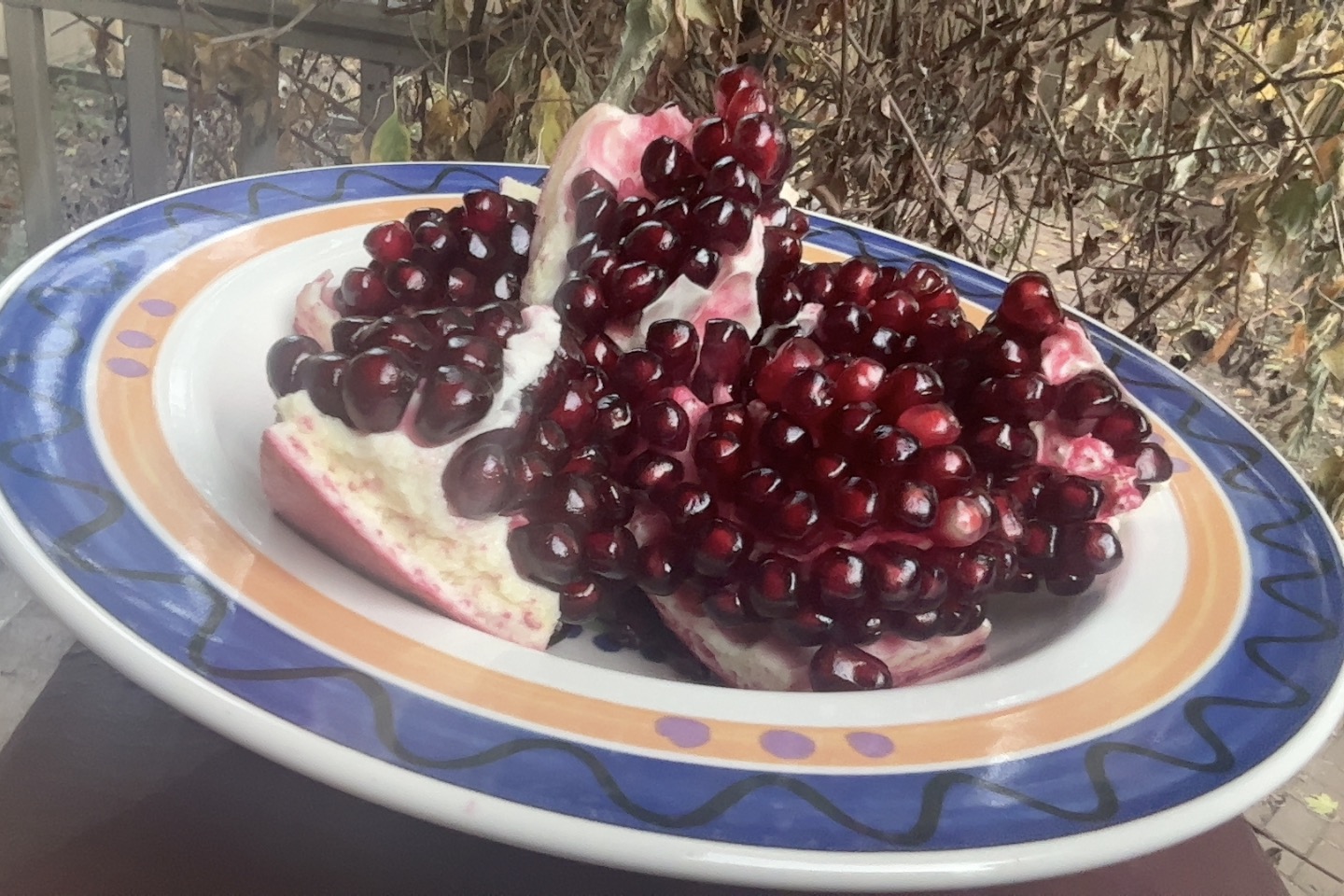
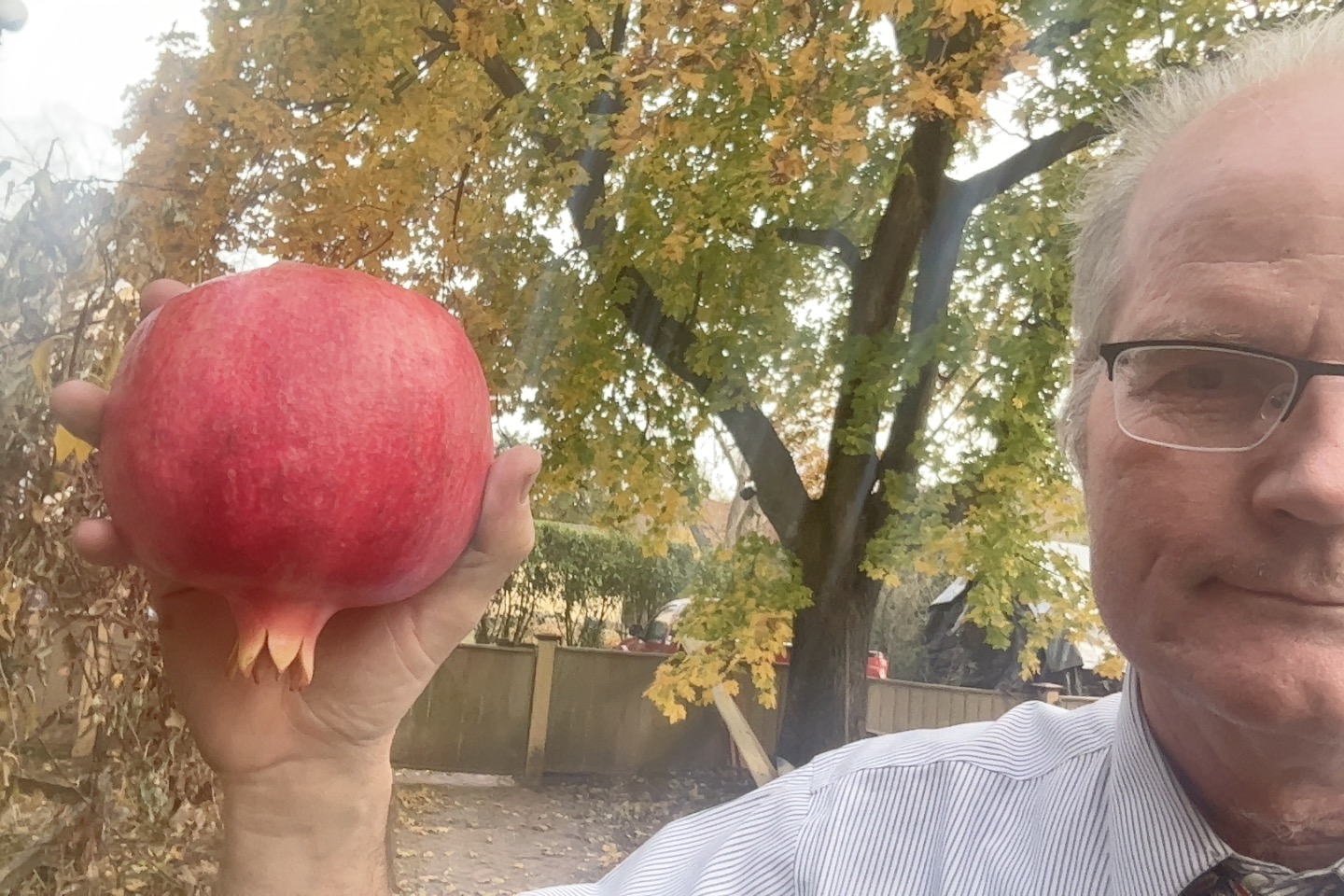
I’d pick one and see how they are doing on the inside. Pick the one with the most apparent ‘chubby ridges’ - where they start to swell on the sides and cease being truly round. They start to ‘square off’ - but with round edges, if that makes sense. Like the second shot of a single fruit that you posted above.
Depending on which variety you have - many poms are pretty tart. I started picking mine early this year - because I found that even though they had dark sunken or ‘tough as nails’ areas on the outside of the fruit - there was quite a bit of salvageable arils and it was worth it to save those . . . even if the taste might be a little sweeter if I’d waited till end of October - or beginning of November.
I like a tart but not sour taste. And so do my grandkids. We have fun ‘picking’ them apart, together. And the sour does not seem to turn them off. They get excited when I show up with a basket of home-grown pomegranates.
I am going to ‘thin the mess’ out of my trees soon. They got so thick this past season and they are hard to manage . . . plus the air can’t circulate very well, I’m sure. I had a lot of fruit this year - but not a lot of GOOD fruit. This was true for the peaches and nectarines - the apples - AND the pomegranates.
Let me know what you think when you finally do taste one! - karen
I call that pomegranate shape when ripe ‘Jellyfish’ shape, because some varieties of pomegranate have fruit that look a lot like ‘Jellyfish’ when ripe, and now that I think about it they sort of do look blocky as well, blocky jellyfish.
That Salavatski looks pretty darn good, Scott. I don’t think I got a single Salavatski this year that wasn’t totally rotted.
I picked some Phoenicias today. The tree started out with quite a lot of fruit, but ended up with about 15 survivors. They are just barely touched by the fungus. Some not at all. No disease inside. They were starting to crack - so I grabbed them.
Mine don’t appear to be ‘true to type’ - as the arils are definitely not multi colored. The exterior looks a lot like the ‘official’ description. But, who knows what they really are.
All I know is that their original tag said ‘Phoenicia’ !
@jxz7245
Hi Janet. I have a little orchard of 18 pomegranate trees which are spaced about 6-7’ apart.
And then, I have my original pomegranates - Wonderful and Granada - as part of my landscaping, up near the house. They are only about 5’ apart. They have gotten MASSIVE . . . so I gave them a crewcut this week. And thinned them out a LOT.
I’m hoping the added airflow might help keep down the disease next year. ???
I got 2-5g trees in winter put one in the ground and one in a very large container. Anyways they grew pretty good this year and I got pollen from each on a brush and ran it back and forth. So the flowers I pollinated made nice pomegranate. I only did a few since they’re basically first year poms but very happy to try some out.
Thanks, I have about 14 I want to plant in a protected trial garden but at the smallest spacing possible, did yours fill in the 6’ spacing or could be closer? I’m expecting some dieback.
I have 3 in a triangle very close together, it’s about 5ft x 3ft triangle and they are filling in. I personally think spacing just equates to how much pruning you aren’t afraid to do and/or how you want things to look. They grow thick and shrubby so I wanted them thick with a few other grafts on them and likely more to come in the future. They were tiny plants when I planted them but are sizing up nicely.
I have found that pomegranate trees are rather slow growers. Also - some have a more upward growth habit - and others tend to be fuller and stockier. But they all put out a lot of spindly new growth - and most varieties will get very dense, and tangled, blocking light and airflow. I’ve tried to keep up with thinning and controlling height. And I get rid of most growth that is growing inward, toward the center of the tree.
To answer your question - is 6’ the closest that they should be planted?
Think about it - if each of those plants just grows 3’ horizontally, from their trunk - or trunks - they will be encroaching on each other. Quickly. So - if you can control their width as they grow - you might be ok. If you have more space - I’d allow them to have it.
I actually described my trees’ closeness in a misleading way. My bad! I was thinking of how much clear area there is between the ends of their horizontal growth.
So . . . basically - I allowed for the trees’ widths . . . and then tried to keep about 6’ of clear ground in between - for mowing and air and all of that.
Im not picking my Afganski yet, tried a small fruit and still very tart so defintely in November. But the fruit that set in June is starting to look blocky. I figured out that the spots are sunburn.
Some of these smaller poms cracked this morning. Most likely a watering problem, the arils expanded too rapidly for the shells to handle.
These are the rooted cuttings in the driest part of the property (the ones in front of the shed in my video). I don’t have any sort of supplemental irrigation system set up. Tart with a hint of sweet, can still use them for juicing or drizzle some agave or honey on top.
All of mine started cracking a couple of weeks ago. We had a lot of rain - and then no rain for several weeks. My Wonderful poms never turned red - and the arils are bland, but on the sweet side. This is very strange. I don’t think they had enough time to ripen this year, for some reason. They should be getting red by now. And . . . like yours . . . they are all cracking.
Getting more cracking now on the sunburned area. This is my 2nd largest Afganski pom from a July bloom. I was hoping to compare the flavor to the June set fruits but had to pick it early before it cracks more. I know it will be tart because its still a little green but it is more pink than the smaller ones from the other day. Perhaps next season I will cover the fruit with white organza bags to reflect some sun off of them? Kaolin clay might also be an option, if I can find it locally.
My one Texas Pink I was waiting on harvesting but saw a small hole in it and opened it to find it mostly ruined. However I ate a few arils and they were good, a shame it was ruined. Better this year than last, but lost all but one fruit due to drought (I think)