I water until I harvest, but I stop fertilizing by August.
3 Likes
No because that can make the pomegranates abort, and they also can split if they suddenly start to get more water, the best thing in our area ‘where I live’ is to try and water enough to prevent aborting of fruit and flowers, and enough so that when the precipitation increases a lot, they wont split. Which is very hard to do, especially when they are in the ground, it’s hard to tell how wet or dry the ground really is. Water often seeps up from the ground, when the soil seems dry.
It rains too much here to stop water from entering the roots, especially when they are in the ground. Maybe there could be a water slowing down though.
3 Likes
Looks excellent, the arils look juicy! can you remind me if Salavatski seeds are hard, medium, or soft?
1 Like
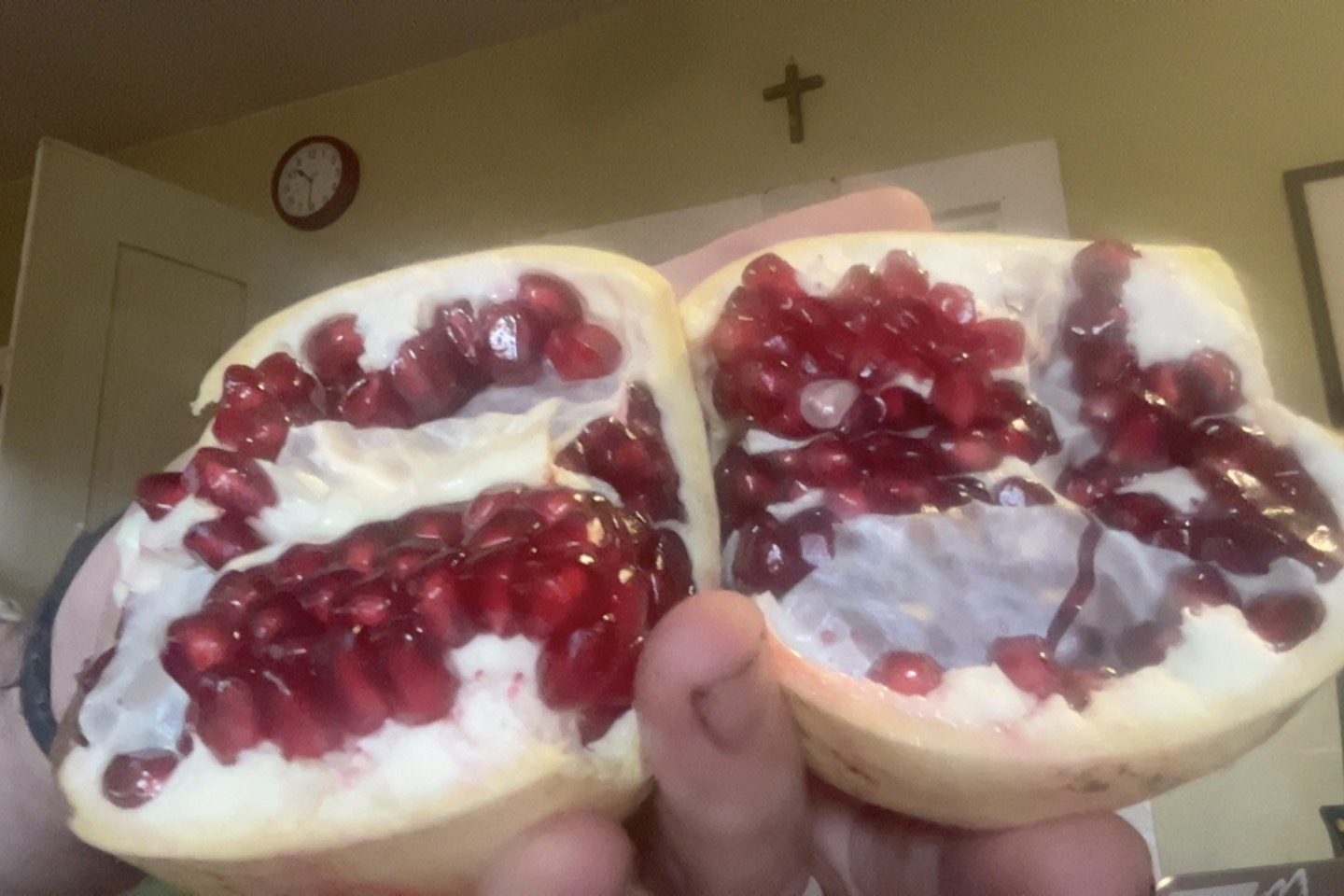
Did a taste test comparison, nothing scientific just comparing the ripeness / flavor between the poms I had to pick early due to some damage.

5 Likes
Seed hardness of pomegranates in general, they appear to vary in hardness based upon climate. That’s true here in the USA and in Europe.
Seeds of ‘Salavatski’ can range from medium hard to very hard. Mine so far has only had very hard seeds, my powerful citrus press which is cast iron has difficultly crushing the seeds, while juicing the fruit.
1 Like
I’ll be trying a masticating juicer once I pick all the poms. I know it’s more work to get the arils out to juice them vs a press. My seeds don’t taste bitter when I chew them so crushing them into the juice will be ok. Will report once I try it
The Omega masticating juicers like this one, they definitely work great for juicing the pomegranates, Yet for me, it’s too much work, and I need to juice citrus anyway. https://www.youtube.com/watch?v=NzbVlJr78TA
1 Like
Does Russian 26 go by another name? Is it the same as Salavatski? Or is it a unique variety?
Russian26 is aka Afganski
1 Like
Here are pics of Azadi, a sweet, soft seeded variety completely immune to fungal damage as seen in your video and is sweet early before frost for those growing outside in pots. This one was grown in my passive solar greenhouse in Central New Jersey.

5 Likes
My Salavatski fruit gets significantly hard towards the end of ripening, but definitely soft enough to chew. I like to blend the harder, more tart variety arils like Salavatski with soft. sweet varieties like Azadi, which is a real winner (immune to fungal rot) and ripens early and bears prolifically.
1 Like
Afganski seeds are similar, not like a rock but more like chewing on a toothpick lol.The Azadi fruit looks great, the yellow-pink rind really stands out. If it’s really a zone 7 pom as some nurseries claim I wouldn’t mind growing unprotected, except for maybe infront of a structure as my other poms are. Are the arils astringent at all, I am seeing that they contain “just a little astringency”? We need to start making our own crosses and planting out the seeds! Is anyone on this forum interested in backyard breeding new varieties? Once my Sirenevyi blooms I’ll probably cross it with Afganski.
1 Like
Azadi reminds me of eating table grapes, non astringent, but some residual tartness, very large fruit with very large strawberry colored arils, and soft seeds. It’s best trait is fungal resistance. I do not believe it has good cold hardiness and if you keep it outside year round I would give it some protection. I imagine a south facing espalier held against a wall of water barrels, all wrapped in a breathable tarp, with decon at the base to deter mice who love to chew pomegranate bark in the winter. Liquid water gives off huge heat as it freezes and could keep the space inside above 20 degrees F when outside temps hit the occasional 6 F.
2 Likes
Regarding new varieties, it’s a great idea, but I am mainly focussed on new techniques with established varieties. I imagine small passive greenhouse frames for dwarf, fungal resistant varieties that mature early would solve a lot of our problems in the mid Atlantic.
2 Likes
While I don’t think I have the fungus, that Azadi fruit looks very good. Have you found it cold hardy enough to take the occasional 15°F unprotected? If it can, I’m adding another pom to the list.
1 Like
The coldest my passive solar New Jersey greenhouse gets is 20 F. Azadi has done fine at this temp with no die back. The greenhouse does not get below 20 because of large amounts of liquid water.
2 Likes
Thank you for sharing this! I have been reading through every pomegranate thread trying to figure out how I might get fruit here in Maryland! I have 3 salavatski that are only a year old and ordered a nikitski ranni and red silk (and crimson sky before I read here that it’s nikitski ranni!) for the spring. I seem to be too late to get an Azadi from One Green Word, but will when back in stock. My concern now: my in m-ground pomegranate spot is at my deck (full sun and good air) and all my container plants are on my deck. I am building 2x12 strawberry bed on the deck in a few weeks— am I dooming my container pomegranates or vice versa for the strawberries? I’m on a small 1/6th acre urban lot, so possibly anywhere on it the two will share fungus?
3 Likes
The espalier and pot set up is fascinating. Can you provide more details of how you did that? What size was it when you started training? Do you think the frame could go in the pot to make it movable to a garage in winter?
If you manage to cross those, please share!
Hi Eme,
I grow most of my poms from cuttings or rooted plugs. I use a 5 gallon wicking pot for rapid growth. In two years a rooted plug will grow to 6 foot tall in a subsurface irrigated wicking planter. Next I transfer the plant to a 10 gallon pot and start to train the plant to a trellis. I make my trellis from two vertical rot resistant pieces of wood like black locust or red cedar or pressure treated wood. I then attach 4-5 horizontal bamboo pieces (5 foot wide) wo train the branches to. The 10 gallon pot is small enough to be moved. When they go outside I put them on a drip irrigation for the summer and fall growing season and then bring them back in to the greenhouse for the winter.
Bryan Davison (Pingry Science)
2 Likes