Im spoiled by the western trailing blackberries. Unique flavor and such. I did buy Ponca though. I like to have one from the Arkansas program! I prefer the Oregon program’s Newberry too What a fantastic blackberry.
1 Like
They have a new primocane bearer, called PrimeArk Horizon. It is thorny, though, like PA-45.
From their flyer. No word on when it will be available.
‘Prime-Ark® Horizon’
Prime-Ark® Horizon is a new primocane-fruitng variety to expand grower options for this unique blackberry type. It has very high yield potential, particularly on floricanes. Berries are large and firm, with postharvest potential similar to Prime-Ark® 45. In Arkansas, the floricane crop first harvest date is June 12, about 6 days after Prime-Ark® 45 and near that of Ouachita. Primocane first harvest date is August 4, just before Prime-Ark® 45 but 6 days after Prime-Ark® Traveler. The primocane-fruiting period extends into mid-October, 8 days longer than Prime-Ark® 45 and 19 days longer than Prime-Ark® Traveler. Prime-Ark® Horizon is intended to be a complement to Prime-Ark® 45 in areas where primocane-fruiting blackberries are adapted, with strong floricane crop potential also.
Type: Primocane-fruiting, thorny, erect canes.
Ripening: Floricane first harvest later than Prime-Ark® 45 and Prime-Ark® Traveler and near that of Ouachita. Floricane harvest period averages 40 days. Primocane first harvest averages August 4, just before Prime-Ark® 45 and later than Prime-Ark® Traveler.
Primocane fruiting extends potentially until mid-October providing for a fruiting period of over 60 days.
Berry: 7.8 overall average but can be larger than 10 g for floricanes and average 7.3 g for
primocanes. The floricane and primocane average weights are much closer than other primocane-fruiting varieties, suggesting more berry weight stability in summer heat during primocane flowering and fruiting.
Yield: Very high yield potential on floricanes, and crop control with pruning is advised to
balance crop. Floricane yields have exceeded 30,000 lb/acre, but can be less depending on the degree of primocane fruiting the prior year. Primocane yields range from 3000-9000 lb/ acre depending on year and environment.
Flavor: Flavor has been rated good with light aromatics. Berries can be tart, particularly
when very high floricane yields are experienced. Soluble solids overall average is
10%, with titratable acidity of 0.92%.
Postharvest: Storage for 7 days has been comparable to Prime-Ark® 45 in reddening/reversion. Prime-Ark® Horizon berries retain excellent firmness in storage and the firmness, leakage and decay have been among the best measured in the Arkansas program.
Plants: Prime-Ark® Horizon plants have shown good health, except when excessive
floricane yields were experienced that resulted in reduced floricane leaf size as well
as upward leaf curling. No orange rust nor anthracnose was observed on Prime-Ark® Horizon. Winter hardiness has been comparable to Ouachita, and has shown very limited winter injury to a low of 1F. Chilling requirement is unknown, but is
anticipated to be approximately 300 hours.
Seems like a good one for commercial operations. A flavor rating of good. Is well, not good. We have many rated excellent.
1 Like
All you blackberry growers: are birds, squirrels, deer, hornets a big problem for you?
Do you net the crop or just grow extra for Mother Nature?
I might tear out a couple dud heirloom apples and plant some Osage.
Any chance I can grow say 3 in a 12 ft diam circle or would that turn into a jungle? Am not set up for a linear row.
Birds can be, I net all my fruits. But for me with blackberries the biggest problem is the SWD fruit fly. I pulled most of my blackberries only leaving those that fruit before they get here. So many would birth in my blackberries and attack other fruit. Now that they are gone, I only have a few each year. The attacks on blueberries stopped once I got rid of the fruit fly magnets known as blackberries. Man they made my orchard so infested, even attacking stone fruit.
No matter how planted will turn into a jungle. I said I removed most of mine. Well 4 years later I still have them pop up all over every year.
4 Likes
Birds are a problem once they fruit, I don’t net my runs as they get too of hand. So, I hope there are enough for us and the birds.
Deer don’t seem to eat the berries as much, but can chomp on the canes and leaves, especially in the winters.
SWD hasn’t been a problem for us yet on any of our berries. I don’t know if they’ll find us eventually, or maybe we got lucky with them.
A 3x12 foot section might work if you can keep the canes down to a manageable number. We have space to do straight runs, but I’ve been sloppy about keeping them in check. You should keep runs no wider than 24" at the most, and some of mine have spread out too much.
Blackberries grow here like weeds, we even have wild ones. Raspberries have been a struggle to get established. None of the domesticated blackberries I’ve planted have died, but a lot of the rasps have.
1 Like
As mentioned, birds and SWD are the biggest problems for me. Our blackberries also get crown gall pretty bad. But so far it hasn’t dimmed production yet. We also get a bit of orange rust, which we remove and kill those plants.
At one time when I was growing blackberries in my backyard, I tried the approach of plant enough for birds and me. It didn’t work here. Seemed like the more I planted, the more robins and other birds called in reinforcements, so that they ate all of the crop anyway. And there was a lot more bird pecking on tree fruits. Netting was the only way to stop the birds in the backyard blackberries.
Btw, if you decide to net, it’s well worth the money to buy good quality nets, not the cheap monofilament nets. American Nettings has pretty good quality bird nets. They have 15 X 100 foot rolls for about 90 bucks, which should cover a large home planting easily. They offer lots of different sizes of nets. Their nets last a long time and are much easier to put on and take off compared to the black monofilament netting. They are cheaper in the long run, compared to monofilament netting.
We have to spray for SWD. But sprays completely control the pest.
4 Likes
I second the American Nettings. The green netting is just awesome. I don’t like to spray because I grow many different blackberries and raspberries. Because of that something is always in bloom and I don’t want to kill bees. I have used powdered DE in a powder pump. Works, but is messy and dangerous because of the dust. With raspberries often the fruit can be harvested before the eggs hatch. But with blackberries it’s difficult. I also wanted to say that removing the blackberries that ripen mid to late season seemed to help and greatly lesson the number of flies. But It might not be the removal of the blackberries, but possible predator’s learning to like the new food. Such as sparrows and humming birds. Ponca is fairly early (early enough to avoid SWD) and another reason I want to try besides the fact the breeders could not hold back their excitement announcing early last year it was the highest brix berry they bred so far. Probably even hurting Caddo sales which was still new. I was going to buy Caddo last year but passed after reading about Ponca. I bought Columbia Giant instead. I need a good, big berry for processing only. Interesting I saw a comparison with Marion and Columbia Giant. Marion wins for fresh eating but when both were made into syrups Columbia Giant won hands down. Exactly what I need! I have 5 Ponca plants coming this year.
1 Like
Did you get yours from Nourse?
Haven’t you had some of the older UArk varieties, like Natchez or Navajo?
I got rid of them because of SWD. I didn’t like Natchez that much. Huge berry and very productive.
I would use it for processing. I may add it back one day if I find Columbia Giant not to be hardy enough. Natchez certainly was fine here.
I liked Navajo a lot but removed it because of SWD . It keeps coming back and last year, after 3 or 4 years gone. I decided to let it grow back, it could be Triple Crown? Which is fine as both tasted about the same.
Besides Ponca I’m adding Logan, and Dewberry this year.
I wanted an old school eastern blackberry too. A few years ago I added Darrow, but I think it was mislabeled? I removed it. . So I’m adding it again this year. I also bought another Columbia Giant as my dog may have killed the one I have. I won’t know until the blackberries start growing.
Yes mine is from Nourse. I don’t need them all either if anybody wants to trade. I can spare one of them. I’m putting 2 in my garden and 2 in my daughter’s garden.
1 Like
I’ve read that Navajo is the best tasting of the older thornless varieties, but also has the smallest berry?
Is that a blackberry, or is it short for Loganberry?
Was Natchez and Navajo hardy enough there? I’m finding that Ouachita and Osage are at their hardiness limit here. They’re rated to zone 6, and we’re 6b, but they don’t seem to do well here. I don’t think I got any Ouachita berries last year.
1 Like
Loganberries and Boysenberries have red raspberry in their parentage and when ripe, do not turn fully black. So rather than calling them blackberries, they are commonly referred to as Logans or Boysens, and obviously, they are berries.
1 Like
Yes berry is smaller, but it is still a decent size. Not that small.
Loganberry
Yes no problems at all.
True. I don’t really distinguish as many of the new blackberries have raspberry too. Tayberry is another.
Newberry, the Columbia series Columbia Star, Giant etc all have raspberry in them. You can taste it in Newberry, which to me is the best of the USDA/Oregon breeding program.
The Oregon program produces nice PDF’s on the berries. I love this linage
Newberry
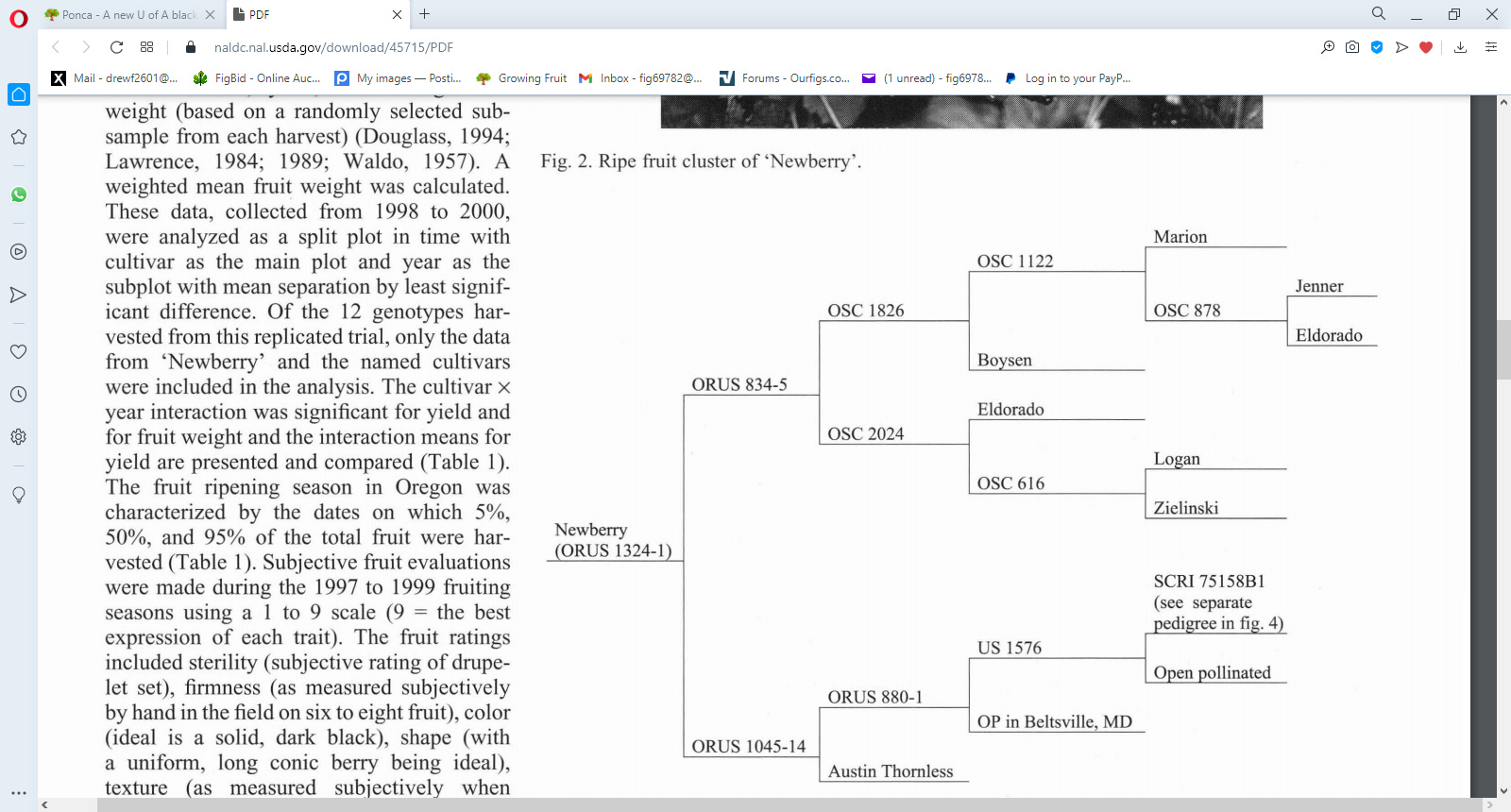
Everett on here has a very nice sized flavorful wild blackberry in his yard hes supposed to share some cuttings with me this spring. hes in z5 just south of me. should be plenty hardy for you too. give him a yell. hopefully it works out here also. i have nelsons from fedco. good tasting berries but on the smallerl size and not very prolific. maybe once i fertilize them for the 1st. time they will produce more and bigger fruit.
2 Likes
I agree with Drew about Navaho. It tastes pretty good and is only slightly smaller. I also agree it’s comparable in flavor to Triple Crown, although Triple Crown might win by a nose in the flavor category, imo.
I’ve not grown Natchez. I used to grow Arapaho and Ouachita. I got rid of them because too many of the berries were bitter. Ouachita was better than Arapaho, but I still wasn’t satisfied with the quality. When I read Natchez had similar brix to Arapaho, I didn’t try it, because my Arapahos weren’t very sweet.
All the talk on Ponca made me decide to order some for this spring. I again agree with Drew, the descriptions from John Clark seem like it is something a bit innovative in the flavor category. He says Ponca is the sweetest blackberry they’ve released.
This video of Ponca has already been posted somewhere on the forum, I think. But I didn’t see it in this thread.

5 Likes
Ponca blackberry available here: https://peacefulheritage.com/shop/blackberry/ponca-thornless-blackberry-new-2-plant-bundle/
We planted 1/4 acre of Ponca this fall. We are somewhat cautious since the new variety produces a small secondary crop and requires a different management technique when toping the canes. I suspect it’s going to be an excellent addition or terrible.
Placed the new Ponca side by side with Caddo, Ouachita and Von in a new field. Von ripens at the same time as Navaho. Since its a NCSU variety it has been tested a lot in my area. Brix, yield and flavor has been described as about the same as the Arkansas berries. It has better resistance to orange rust than Navaho.
Still have about an acre of Natchez, Ouchata and Navaho in the old field. I like the Navaho fruit a lot but the plants are consumed with orange rust and will be removed. These plants are 12 or more years old and we have noticed some decline in vigor and plant survival over time.
2 Likes
Wineberry was a nightmare for me.
1 It was a very shy bearing plant
2 It was not shy about self-rooting and sending up suckers
- It was horribly thorny (and I am not one to usually shy away from plants with thorns).
Scott
1 Like
That’s very interesting Rick. And thank you for the report!
I haven’t seen orange rust in the Navaho, but those are planted to the south of the Triple Crown, where we’ve had to deal with the orange rust. Most of the prevailing Spring/Summer winds here come from the southwest, which could explain why our Navahos haven’t been infected yet. Doesn’t sound like something to look forward to on the Navahos.
I watched the vid how Ponca develops a later crop. I’m not sure how that would make management of that crop more difficult for us. I’d guess the secondary crop might ripen during the Navaho (slightly earlier) than the Triple Crown season.
Any thoughts on that? Also have you heard how Ponca handles orange rust pressure?