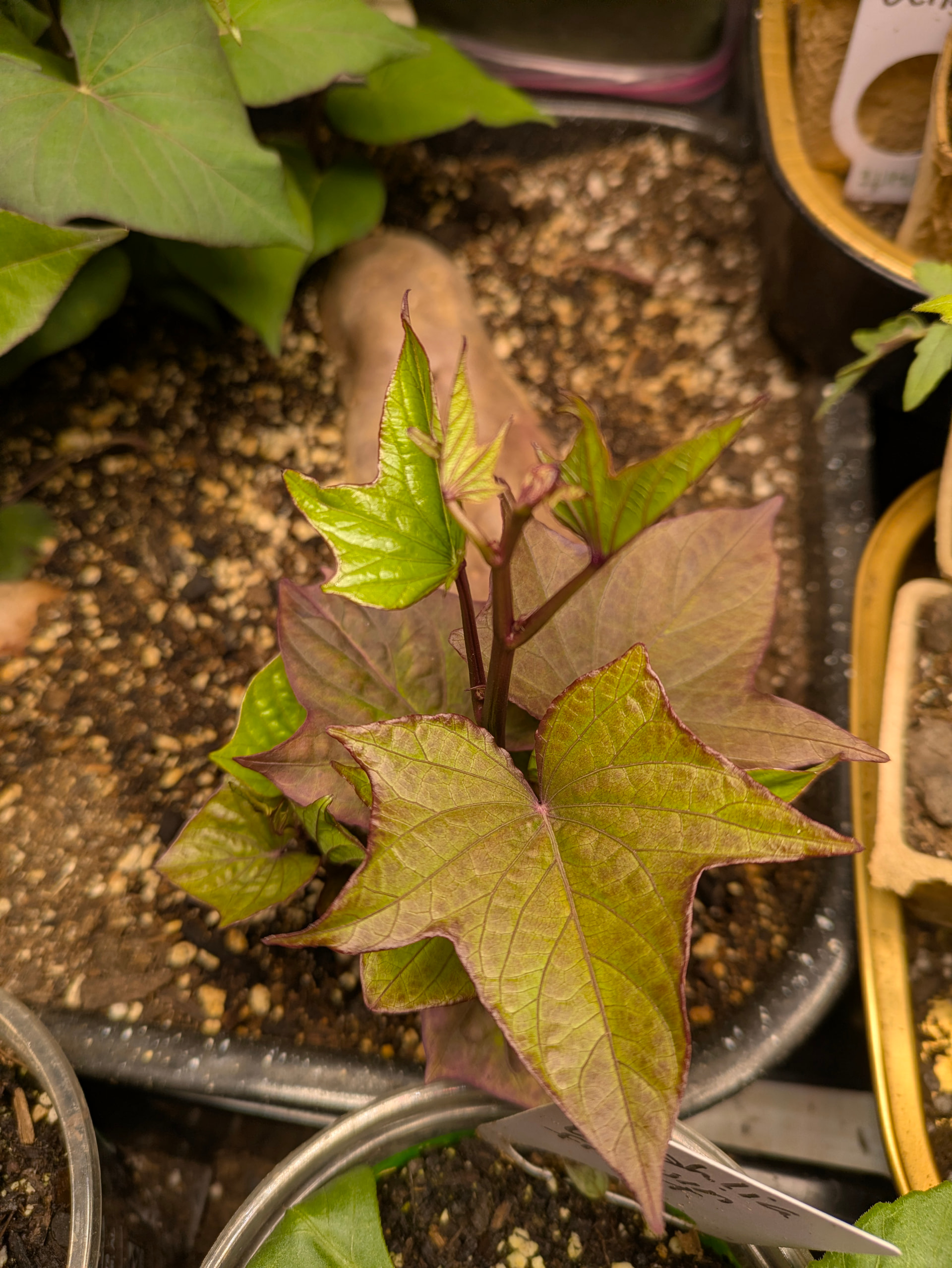
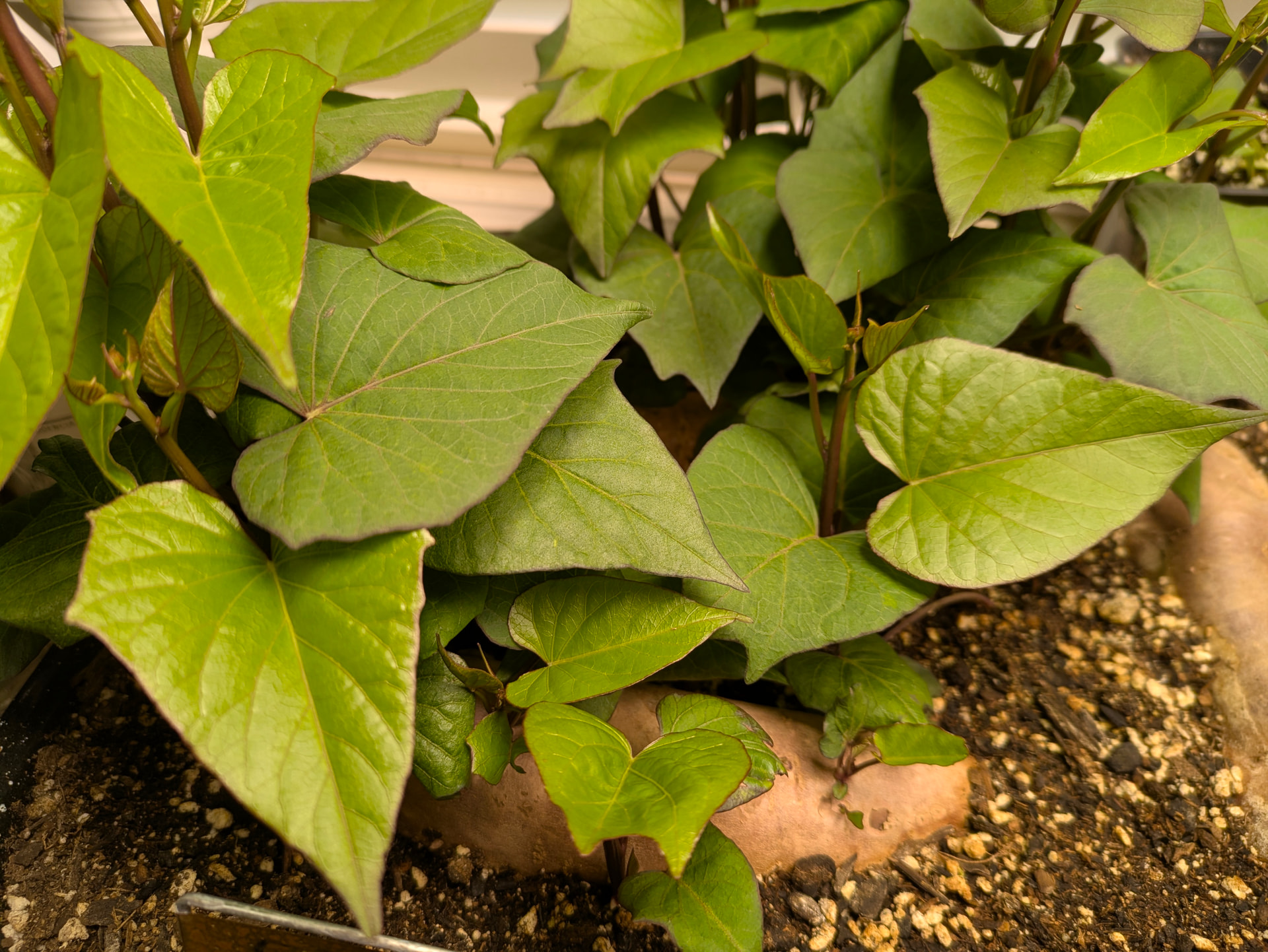
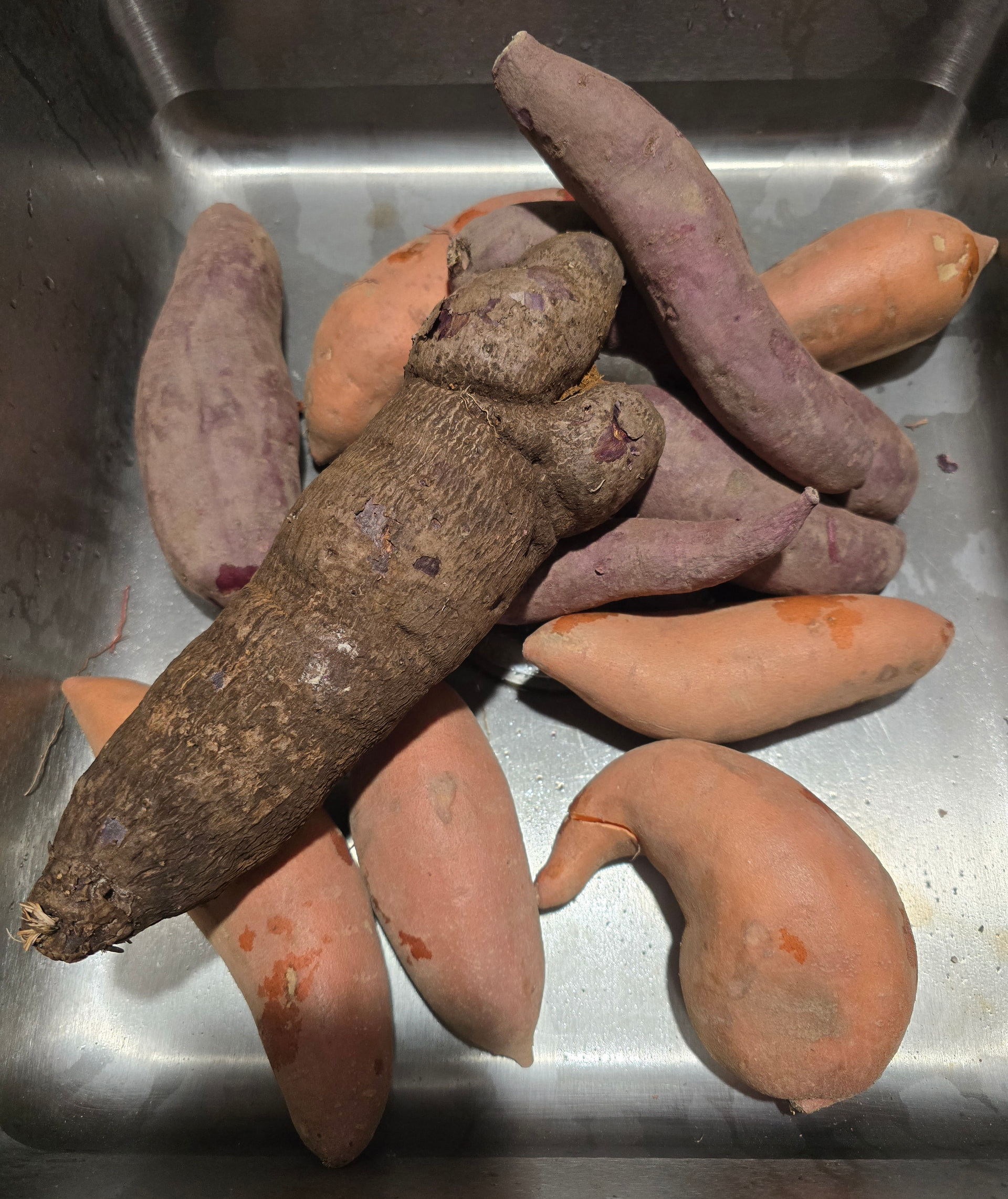
After reading up on the benefits of purple sweet potatoes, I decided to start growing my own slips. I sourced two kinds - the first Stokes sweet potatoes from Sprouts, and the second, a purple “yam” from a farmer’s market in the Santa Barbara, California area. When I asked him if these were purple sweet potatoes, he corrected me and told me that they were “yams” and when I asked the variety, his reply was, “I’m not sure, but it’s an Asian variety.” From my reading, my understanding is that yams have a rougher skin, but this is smooth.
I did not take photos when I cut them. The Stokes has a white “ring” inside, whereas this does not. It was also a darker purple than the Stokes.
Now that I have the slips going, note the difference - the Stokes variety has heart-shaped green leaves. The “yam” has ivy-shaped leaves with some rustish coloration to it.
I suspect this isn’t an actual “yam” since it doesn’t have the rougher skin, but what is it? Any ideas?
I thought the same, but I think he was just a worker hired to man the stand, but wasn’t the farmer who grew the products. I did ask him if he knew which country. He replied, “I think Japan” but I didn’t put much weight into that since he clearly didn’t know.
Purple yam (ube, Dioscorea alata) has a leaf like a black pepper and is more heart shaped. It also has a little bit different stem and growing habit typically. This definitely looks more like purple sweet potato, although he may have just be clarifying that it was sweet potato and not a purple potato that is sweet. Usually the word yam and sweet potato are used interchangably for most people.
The ube I have has kind of a mixed color, not full on purple when raw. It is completely purple when cooked.
I do understand there are variations of purple coloring within ube.
It tastes a lot like a russet to me. Once cooked, it maintains a nice freshed baked potato texture when reheated. I do like that. I eat it with egg whites and tobasco sauce. I don’t eat a lot of sweet foods. Sweet potatoes are much sweeter, so I don’t really understand why these are so often used for desert foods. Texture? Purple novelty? I really don’t know. I eat the skin, the skin has texture of a really good baked russet potato where the skin is kind of tough. Not for everyone.
I had eaten about three without anything on it before being able to detect any vanilla notes, no nutty notes.
Interesting that it’s like a russet, but it’s often used in desserts.
I’d say that the Stokes has a texture more like a russett, at least the ones I had from the bag I purchased. The mystery sweet potato was much creamier, but I also suspect that it was more recently picked.
I find that neither of these was as sweet as a “typical” sweet potato that one would purchase from a grocery store.
I harvested the first slip from the mystery purple “yam” today. They continue to look quite different than the Stokes leaves. Until I know for certain what the “yam” is, I will refrain from eating the leaves.
It is Ipomea batatas, the sweet potato. Yams are an African crop that grows huge tubers. Asian sweet potatoes are not yams. However, when African people were brought to North America one of foods that appealed to them were sweet potatoes because they were familiar with yams. The term yam was used and, particularly in Louisiana, sweet potatoes are preferable called yams. So when sweet potatoes are called yams it is botanically incorrect but is a colloquial preference.