Questions re the PVNA trait in PCNA varieties

Within this forum, there have been separate reports of PVNA behavior in a PCNA variety (Fuyu) and in a DV x PCNA hybrid (JT-02). These reports are implicitly linked in that Fuyu is the mother (50%) of Taishu and Taishu is the father (50%) of JT-02. So may a tendency to PVNA behavior was passed from Fuyu to Taishu to JT-02. If this hypothetical link is real, then Taishu must carry some PVNA alleles.

Why do I care? Presence of the PVNA trait has two observed benefits. First, the PVNA trait results in early non-astringency. Early non-astringency is redundant for Fuyu, which never develops much tannin, but could be very helpful in JT-02, which does. Second, the PVNA trait reportedly results in desirable changes in flavor. These flavor changes could be beneficial both to (a) pure PCNAs, such as Fuyu or Taishu; and to (b) hybrids with PCNA ancestry, such JT-02. Thus, I’m interested in pursuing the possible beneficial impacts of pollination on these varieties.

So, I have some questions, intended to help determine whether this is a quixotic quest. Basically, I’m asking for additional reports on the observed behavior of these varieties to supplement what has been reported thus far. Thank you in advance if you have the experience required to answer any of these questions:

  1. Is PVNA behavior (i.e., change in color and flavor) reliably observed in Fuyu when seeded?

  2. Does any observed PVNA behavior in Fuyu when seeded seem to depend on the pollinator? Specifically, does PVNA behavior depend on pollination by a PVNA pollen donor (e.g., Chocolate)?

  3. Is PVNA behavior ever observed in Taishu when seeded?

  4. If so, same question. Does it seem to require a PVNA pollinator?

  5. Is PVNA behavior reliably observed in JT-02 when seeded.

  6. If so, same question. Does it seem to require a PVNA pollinator?

  7. Has anyone ever observed PVNA behavior in any other pure PCNA? If so, does it have Fuyu ancestry?

FWIW, I intend to try to pollinate JT-02 next year; I have it growing both as a graft on an established DV tree and on a small stand-alone tree. For PVNA pollination, I have Giboshi in-ground nearby and both Chocolate and Coffee Cake in pots. I’ll try for a persimmon orgy.

To my knowledge, most of my other Kakis (IKKJ, Cardinal, Saiyo, Miss Kim) do not produce male flowers. Taishu, however, does produce male flowers. So if my Taishu survives and flowers, I’ll try to remove any male flowers then try to get it pollinated by the PVNAs as well. Maybe I can help answer my own questions.
4 Likes

Seeds in Fuyu have no obvious effect on flavor in my experience. Maybe a side-by-side tasting could show some more subtle differences that I haven’t picked up on. But degree of ripeness has such a large impact on flavor in Fuyu, I think it’d be hard to say for sure even then. They’re edible when still slightly green tinged but are hard and mostly flavorless at that stage. As they become softer the flesh gets darker orange/red and they gain more flavor and sweetness. At their ripest they become a jelly consistency like a fully ripe astringent type.

4 Likes

Joe,

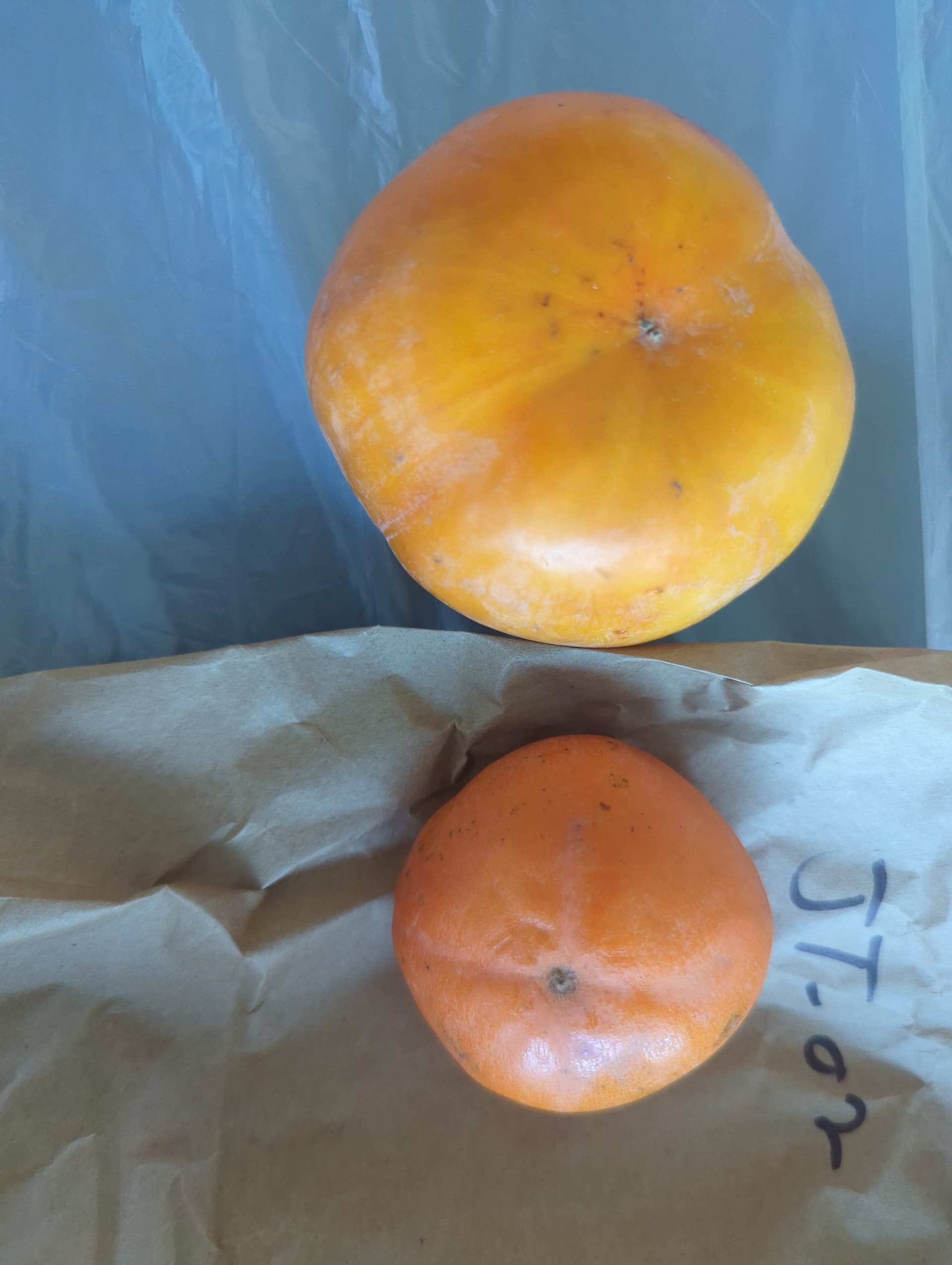
We need to cross JT-02 with Taishu male flower to see if We can get a bigger fruit also. Here is the comparison in size of JT-02 to a Fuyu. JT-02 is very undersized.

Tony

5 Likes

Without formal training and only a 101 biology course with little information on genetics or information pertaining to plants, t’s taken a lot of recurring reinforcement in my mind to wrap around the concept of PCNA vs PVNA vs PVA vs PCA. They certainly didn’t touch on it it wetlands and aquatic plants either.

All that said, the above topic thrust a (novel to me) thought/question into my head, possibly based on a lack of education. Is PVNA tendency, from a genetics perspective, independent of the mechanisms of PCNA astringency loss.

That is to say, do ALL PCNA fruits exhibit PVNA tendencies when seeded? Based on my understanding, all PVNA chromosomes must be present for a fruit to be PCNA, correct???

Basically, I’m trying to understand from the perspective of ā€œAll American flags are flags, but not all all flags are American flagsā€, and if that applies here.

It may be a helpful concept to suss out to develop an important baseline understanding for this conversation.

1 Like

In southern CA with male D. kaki, yes.

4 Likes

You must mean relative to the already quixotic quest of growing persimmons. Youre in good company either way, so I say give those windmills hell!

love the one/s youre with

I dont have a heck of a lot to add, though I (as ever) applaud any efforts toward improvement and/or furthering our understanding of such things. Ive read and heard these terms PVNA, PCA, PCNA used with different degrees of certainty. It seems to me they are descriptive and dont necessarily have direct genetic corollaries. There could easily be a number of genetic factors at play, Id think.

1 Like

No. Maybe that was a typo. The 6 chromosomes that carry the gene for astringency (or not) must carry the non-astringency version for a fruit to be PCNA. The PVNA genes have nothing to do with it.

<< It may be a helpful concept to suss out to develop an important baseline understanding for this conversation. >>

I’m no expert, but here’s my layman’s attempt to explain the broad outline of what I think we know. . . .

In Japanese Kakis, there are two paths to non-astringency. Following one path, the basic PCA Kaki becomes a non-astringent PCNA Kaki because it never produces much tannins. There is a genetic deficit in tannin production. Following the other path, the basic PCA Kaki becomes a non-astringent PVNA Kaki because its mature seeds produce substances that bind/degrade the tannins. Thus, there is a genetic mutation that leads to early neutralization of the tannins before full ripening.

Different genes control the two paths. I think it’s safe to assume that these two genetic variants arose as mutations in wild persimmons that were preserved because humans found non-astringent fruits more appealing. [There is a third path in Chinese persimmons, but that’s not relevant here.]

An important issue for breeding is how each gene interacts with other similar genes, e.g., is it dominant, recessive, cumulative. Someone with more expertise can refine my terminology. What we can reasonably infer from past research and breeding results is:

(1) The PCNA allele (i.e., the non-astringency allele) is ā€œrecessiveā€ so the trait appears only when the persimmon is homozygous for a non-astringency allele. In simple terms, there must be 6 copies of the NA allele. The PCNA trait prevents the persimmon from producing (or storing?) the tannins that create astringency. We might think of the PCNA allele as the absence of the machinery that produces tannins.

(2) The PVNA allele is cumulative (I forget the proper term) so the trait appears to an increasing degree when the persimmon has more PVNA alleles. If there are a few (e.g., 2-3) such alleles, the persimmon is weakly PVNA – what is usually classified as PVA. If there is a preponderance of PVNA alleles (maybe 4-6 but that’s guessing), then the persimmon becomes non-astringent early.

For a PCNA variety such as Fuyu or Taishu, the expression of PVNA behavior is interesting only because the flavor may be enhanced.

For a PCA hybrid with possible PVNA tendencies, such as JT-02, the expression of PVNA behavior is interesting both because the flavor may be enhanced and because astringency might be reduced somewhat early.

Enough for now . . .

2 Likes

Thanks. Do you see any impact of the male variety? I realize that this may be difficult to discern in open pollination where different male flowers compete. Behind the question is my wild speculation that the PVNA trait may be enhanced if the pollen comes from a PVNA source.

Do you have any similar experience (pro or con) with Taishu or JT-02? I suppose you would have said so, but I just have to be thorough. :slight_smile:

1 Like

The seeded fruit have a more pronounced, appealing flavor.

2 Likes

Here’s some background information with a few references, some already discussed on this site.

Diospyros kaki Datasheet excerpt.pdf (72.3 KB)

2 Likes

thats been noted at various times by others about persimmons across the board.

2 Likes

With due respect, I’d argue the cPCNA route is definitely a worthy topic to consider in the conversation.

Reason being, based on the explanation you gave above with PVNA being a ā€˜cumulative’ trait (typically enhancing flavor or our perception of), by including a dominant gene for PCNA tendencies, you introduce a whole other route to an enhanced flavor for PCNA fruit other than introducing virginiana genetics.

Obviously when I say enhanced, it’s for a preference in taste to the complexities of virginiana type flavor, over what I consider a single dimension I’ve observed in store bought Fuyu type fruit. Some may disagree with that preference, and that is OK. It’s just not what I think this thread is geared towards.

If one were to breed a PVNA with all 6 alleles with a CPCNA I’d argue you might end up with some very interesting selections. The kicker would be introducing kaki/virginiana hybrids for (hopefully) more cold hardiness. Persimmon breeding options are almost overwhelming. Every time I learn more, I feel like a dog chasing a horde of squirrels around an oak tree in late fall.

2 Likes

And to further complicate the equation, I’m not sure how much research (if any) there has been to determine if any virginiana have PVNA genes, whether expressed or just present.

I’m looking at you, Morris Burton & offspring.

1 Like

True. I was specific about D. kaki because others have not been positive about fertilization from D. hybrids.

1 Like

An excerpt from the excerpt above:

The mechanism in PCNA cultivars of Chinese origin has not been clearly elucidated. However, the tannin cells in the fruit at maturity are small, as are those in PCNA of Japanese origin (Ikegami et al., 2004, 2006).

2 Likes

My question wasn’t clear. What I intended to ask is: Does the effect pollination depend on the source of the pollen? Specifically, does pollen from PVNA males cause more PVNA behavior than pollen from non-PVNA males?

1 Like

I totally agree that we should explore introducing the cPCNA mutation into other Kaki varieties, hybrid varieties, and Virginiana varieties. But that’s a very long-term project. I’m just trying to figure out whether (1) I can improve the taste of my Taishu by pollinating it; and (2) I can reduce astringency in my JT-02 by pollinating it. And whether the pollinator itself should be PVNA.

p.s. When I described PVNA as a ā€œcumulativeā€ trait, I was referring to astringency not flavor. The reduction of astringency by a persimmon’s seeds seems to depend on a high number (e.g., 5-6) PVNA alleles. When a PVNA is crossed with a non-PVNA, the offspring’s ability to reduce astringency is diluted.

1 Like

I’ve seen claims that seeded Virginiana fruit taste better, but I’ve never seen claims that seeded fruit becomes non-astringent sooner. That’s what PVNA is all about – NA. Does Morris Burton (or any other DV name) get non-astringent quicker if seeded?

1 Like

I’ve not read any clear answers in the literature.

Also as I’ve pointed out elsewhere, the discussions of genes (or potential genes) on this site are misinformed, and the discussions of persimmon genes in the literature to date are invalid. The bottom line is that researchers put too much faith in detection of SNPs by PCR. This will not be resolved until the science community is able to resolve SNPs in diploid and polyploid sequences. A sequencing device for the latter does not exist. Note that PCR does not involve sequencing.

3 Likes

It will be a multi-year experiment with different pollen sources and duplicate trials. The results will be valid for your climate and not necessarily others.

1 Like