And my opinion is that we should not think of the two mechanisms as mutually exclusive.
This paper seems to refute these assumptions:
Flesh darkening inevitably takes place some time after the natural loss of astringnecy. The pigmentation becomes more intense for other 4 to 5 weeks when fruits reach full maturity.
d. TSUKAMOTO16) 17) reported that maximum activities of an unspecified oxidizing enzyme and peroxidase coincided with the darkening in the peel. He also found that enzyme activities in the flesh were higher in pollination-variant fruit, especially in the brown seeded portion, than in pollination-constant nonastringent fruit.
These quotes support the hypothesis that an enzyme like PPO is involved in browning AND that
This also reflects what Zendog observed in the other persimmon thread:
If we cannot extrapolate the knowledge we have to different cultivars of the same species, how can we hope to understand how specific traits will behave in hybrids with and cultivars of a different species?
The only things wrong in my book, and it’s not your fault at all, are the low numbers of progeny (we cannot hope to have statistically relevant numbers of each phenotype from these population sizes) and, as you pointed out, lack of quantification. PCA/PVA/PVNA are being treated as discrete categories when that is almost certainly not the case.
Is this the paper you are referencing when talking about seeds and ethanol production?
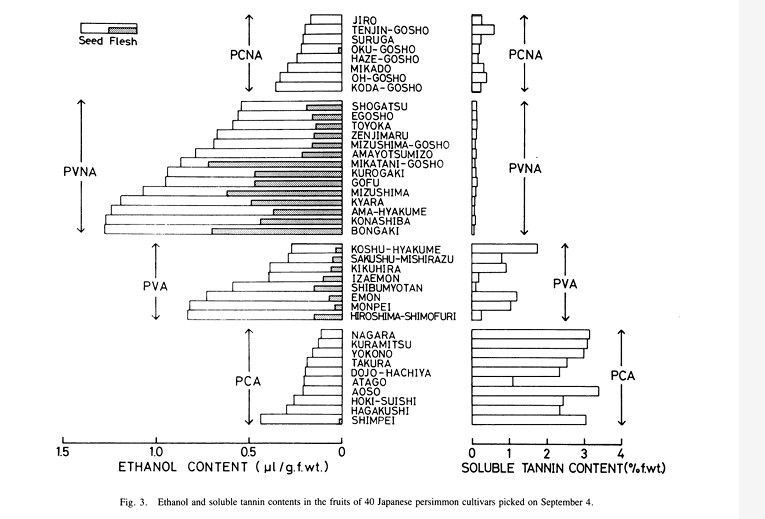
From this figure it would seem that flesh ethanol content is what’s important for distinguishing PC from PV cultivars. Seed ethanol content, while generally lower in PC than PV cultivars, has a good amount of overlap between categories. Some PVA cultivars with the same seed ethanol content as PVNA cultivars have very different flesh ethanol levels. Ethanol is highly soluble across cell walls. We can safely assume that any production in the seed quickly results in accumulation in the flesh. But different rates of ethanol metabolism in the flesh would help explain the distinctions between PCA/PVA/PVNA fruit.
There’s another mention of browning in Fuyu as well:
The high ethanol level in ‘Fuyu’ fruit (Fig. 1) is considered an exception compared to low levels of other PCNA cultivars (Fig. 3). This high level of ethanol is probably responsible for relatively abundant brown tannin spots in the flesh of ‘Fuyu’ fruit.