the foothills near sandiego also have the most southern (by hundreds of miles) population of evergreen huckleberry and they are drought tolerant but not heat tolerant. Trailing blackberry looks like the most heat/drought tolerant native rubus around san diego
5 Likes
Hi, Sounds like a great plan. I wish I had available the genetic resources you have in the US.
In Australia, I am very limited in what I can get, but I do what I can.
2 Likes
Love it! I like the primocane selection idea, too. It seems like Snowbank isn’t very productive and fruit size is small. If your F1 are diploid, will you try to increase ploidy chemically or with a cross?
1 Like
Do you mean limited in terms of the varieties you can purchase?
Anyone heard of ORUS 4344-3? I’m interested in using this in my program, but I won’t be able to until it’s released, probably in a couple of years. It combines a lot of interesting genetics and seems to have great heat tolerance and insane productivity.
Here’s one of the reports: https://oregon-berries.com/wp-content/uploads/2022/03/2021-2022-ORBC-Research-Progress-Reports.pdf
Report is long, so I’d suggest searching ORUS 4344-3.
1 Like
I’ve wondered for a while who will carry the torch at OSU now that both Bernadine and Chad Finn are no longer with us. That report is from 2021 and things may have changed.
2 Likes
I reached out to the current director for the USDA-ARS program in Oregon and confirmed ORUS 4344-3 is still on track for release in a couple of years (assuming nothing unexpected pops up).
4 Likes
Sounds like having some eastern blackberry in the petigree is helping with heat tolerance. Once they patent it we should have a better idea of the parentage. Definitely an interesting one.
2 Likes
Well I think snowbank can be extremely productive and not very, just because it seems like it has a very poor time self pollinating.
If it winds up being diploid I’ll probably just cross it with other diploids, mostly raspberries. I don’t feel like chemicaly inducing polyploidy, unless I get enough things that I want to increase the ploidy of, enough to justify buying some colchicine. I don’t have any hexaploid rubus to use in crosses.
1 Like
Sorry, my chain must have gotten messed up. Trying to reply to your initial comment starting this post.
I’m on the opposite end, haha. Here in WV we have hot humid summers and cold winters - I live up on a ridge that can get down to -15 to -18. While I can use a high tunnel, I’m interested in breeding new varieties of hybrids and blackberries that do well in our cold. I’m still fresh to the science of it all, but I’m just starting down the rabbit hole.
Blackberry varieties like Nelson (from Maine) are very cold hardy, but man are the thorns wicked. Old hybrids like phenomenal, olympic berry, etc. are better suited for more temperate regions. To be honest, I’d love to mess with some fun colors, too. I have access to 3 varieties of gold/yellow mutation blackcap raspberries, and I’d love to make a cross with a golden raspberry to make a “yellow” purple. May take a while to get something worthwhile, but I’m hoping I’ll learn a lot along the way.
I hope to follow along this chain! Seems to be a good group of folks.
4 Likes
Talk about cold! It looks like you still grow a bunch of varieties. Do you use a greenhouse/tunnel for those?
Makes sense on trying to obtain more cold hardy hybrids. That seems like an achievable goal since raspberries are so cold hardy! Are you going to take a hexaploid or octoploid approach for your first cross?
1 Like
Hi, Yes. Australian quarantine makes it very hard to import new cultivars. We have none of the Arkansas cvs. Only Chester thornless, Waldo, and very old cv’s like Boysen, Logan, Youngberry etc.
I have, I think, Karaka Black but I am not 100% it is true to type. I bought it about 10 years ago and it was a fake.
3 Likes
I had a lot of new additions this year! Most of my rarer hybrids listed were obtained this spring or summer.
Ranuiberry was from a nursery up in New York (even colder than where I live). As far as I know, the variety can be harder to find around here - it is a hybrid from New Zealand (speaking of, that may be a good option for @favman ? Not sure how easy that would be). Their plants in the field have winter cane dieback and then regrow the next year, so no fruit. The ones in their high tunnels do fruit. I am wanting to get a sturdy high tunnel (that can bear snow load) within the next year or so, but my current plan is applying insulating frost blankets with straw over the canes when it gets below 0°F - just to safely get the plants through this winter. Tayberry should be fine here - except maybe for the wind dessication. I know a guy who grows Tayberry in zone 5 north of Pittsburgh, and he seems to get fruit every year. We’ll see, haha.
I completely understand your issue with heat, as I’m originally from out west. Where I am, we’re in the 70s for the next week. Very rarely do we ever go above 92 unless there’s a bad heat wave. Unfortunately, we have a lot of humidity, so I do checks on my plants and apply preventative fungicide before long rain spells.
Interesting to see how different folks deal with their issues! Another reason why I love the idea of breeding for region favoring traits. It will be trial and error over here 
4 Likes
Makes sense - looking forward to hearing how that all goes. And agreed! You grow a ton of varieties  Which are your favorites from each of the categories you have listed in your profile? How are you keeping track of everything?
1 Like
I also have a Rubus cockburnianus just out of curiosity, it’s still young but it’s actually handling the heat here in North Florida summer surprisingly well. D.L. Jennings in his Raspberries and Blackberries book in 1988 also wrote it has potential to increase number of fruits on each lateral.

3 Likes
I was able to pick up some trifluralin, it’s a dinitroaniline like oryzalin and studies with polyploidy have the dosage similar to oryzalin for chromosome doubling. I haven’t had a chance to try it out yet, but it’s an option.
3 Likes
Good to know! Mine seems to be doing ok but hasn’t impressed me much. I was worried it might be struggling with the heat but if yours isn’t mine definitely isn’t. Probably just getting established, it did have a few really dry periods while still in a pot which I think got to it.
I’m thinking in hindsight it was a really good idea to get it. The natural hybrid between it and Rubus idaeus is sterile, but now more than one paper I’ve found place it pretty close to Mysore raspberry. It should be easy to breed the winter tolerance from it to Mysore, which will make overwintering Mysore much less work than I currently have to put into it. But another benefit I’m hoping for is just having something else with fertile pollen I can use on Mysore and Mysore hybrids. I’ve been trying to backcross my Rubus niveus x idaeus hybrids back to niveus but the darn thing barely produces pollen. Backcrossing with idaeus pollen is easy but won’t fix the sterility issue.
Most likely, over the next year or two, I’ll end up with (R. niveus x R. idaeus) x R. cockburnianus and (R. niveus x R. idaeus) x R. niveus plants. And in theory those will have fertile pollen again which I can then apply to my original F1 hybrids, R. idaeus, and maternal idaeus hybrids with R. niveus and R. cockburnianus to try and map out what maternal parents and backcrosses are dead ends and which ones can make good breeding lines.
3 Likes
I love this idea! Cool source.
Hopefully this circumvents the sterility issue!
3 Likes
There’s a similar article that summarizes a number of useful traits from wild Asian species.
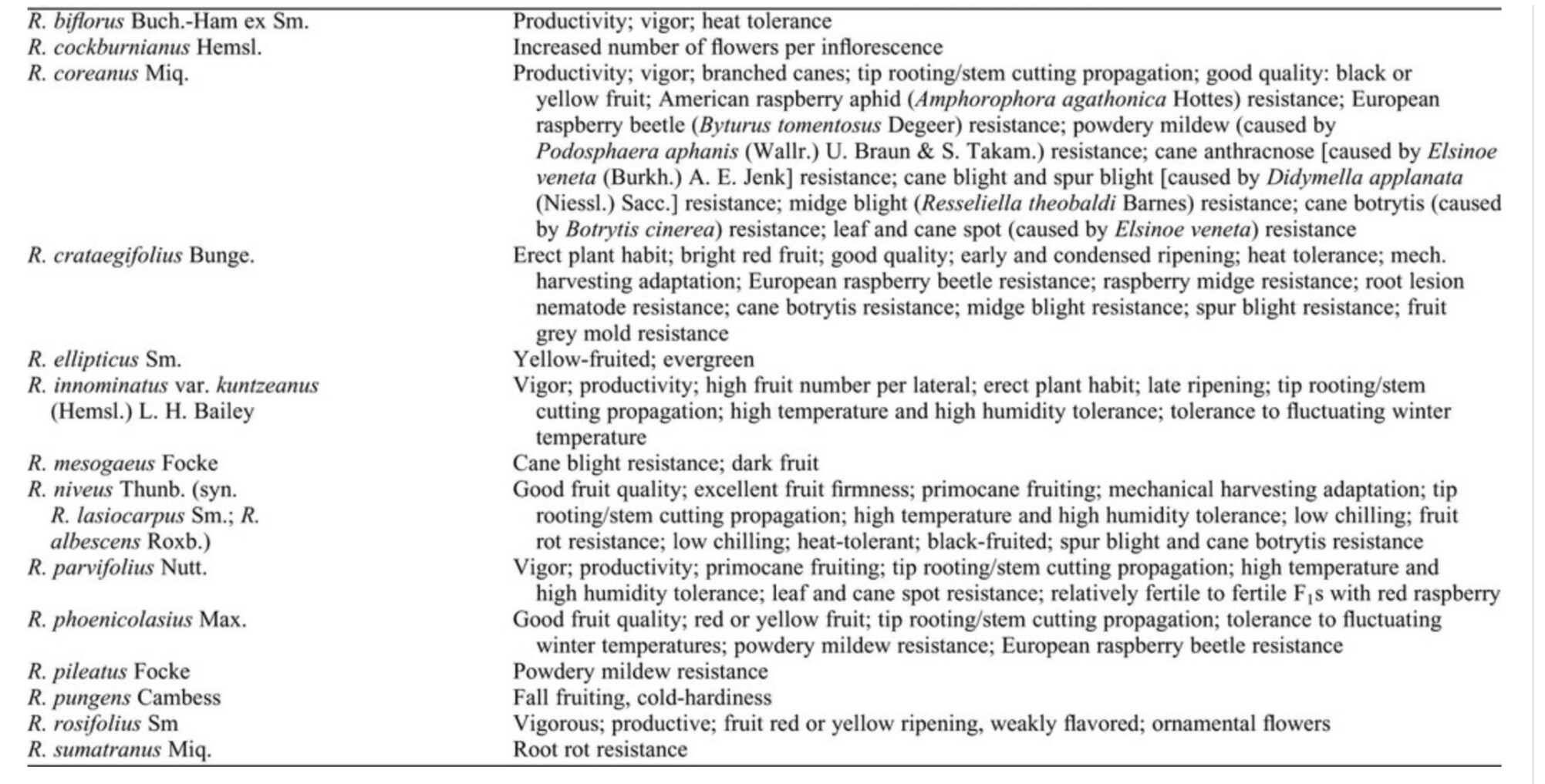
I’m not sure all of these are realistic crosses, but it’s interesting information regardless. Rubus ellipticus is really, really distant from Rubus idaeus for example. But some of these definitely do hybridize with idaeus.
3 Likes
https://www.mdpi.com/2073-4425/14/6/1152
Check out this paper, it’s kind of interesting, it has R. niveus, R. cockburnianus, R. phoenicolasius, and R. parvifolius (which our Dorman Red is mostly) all together in group 20, the black raspberries R. occidentalis and R. leucodermis are in group 16, and R. idaeus is in group 15, and R. ellipticus is in group 8, so it gives me hope that maybe those group 20 crosses may have better luck. Me personally, I’m really hoping to be able to cross R. niveus and R. phoenicolasius next year but right now they’re just primocanes (but vigorous), that’s the cross I’m most excited about.
3 Likes