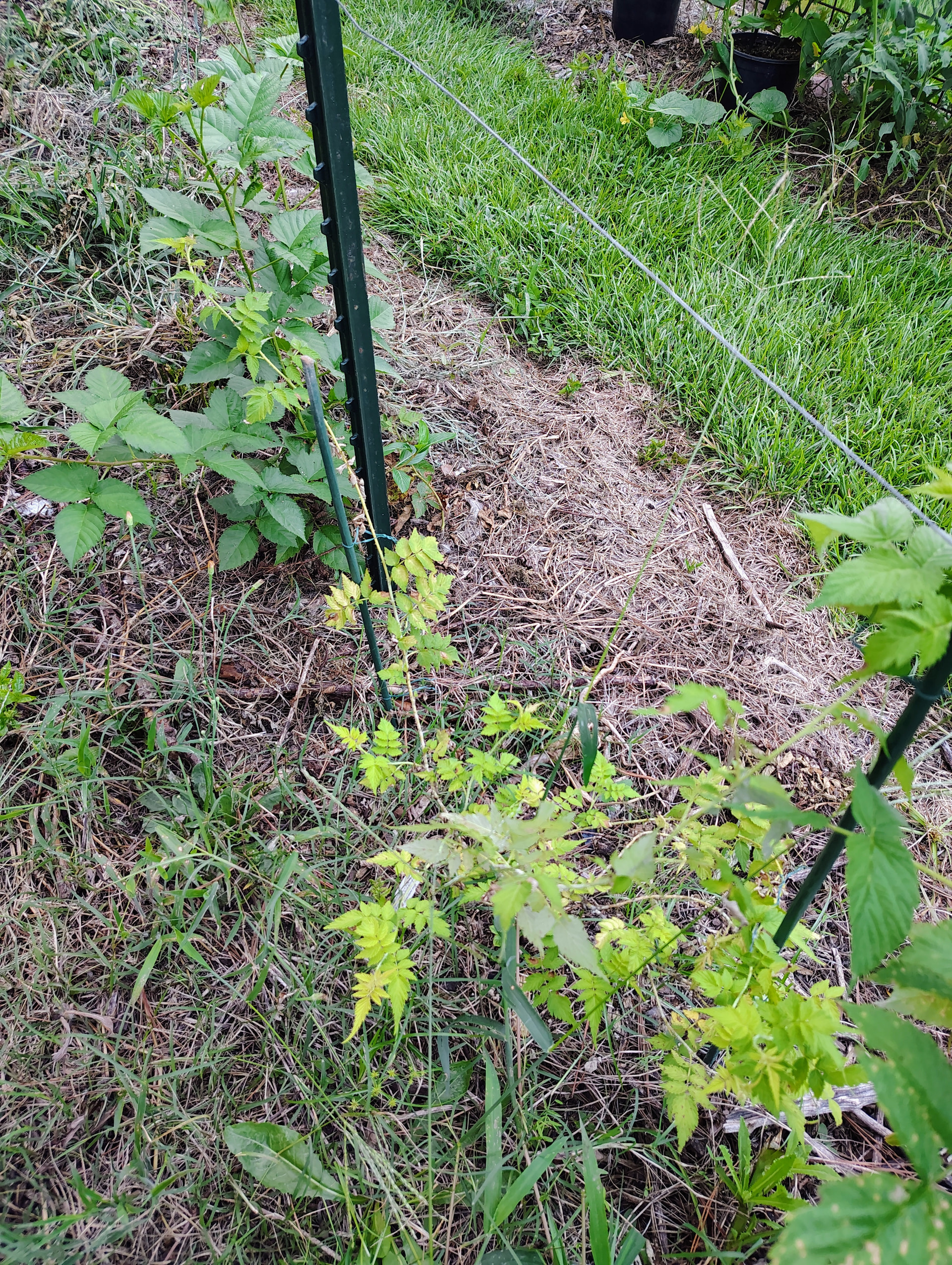
Two plants from the dozen or so got red necked cane borer damage. That’s a much lower rate than Tayberry which really suffers from them here and overall seems better than my normal raspberries so I’m hopeful they have some resistance.
Leaf spot is completely absent except for on one plant, which is great because my raspberries and even most of my blackberries get leaf spot pretty bad.
I’ve not seen and spur blight but it’s too early to tell with that one. However, Mysore itself is basically immune so my guess is these hybrids will handle it well.
Japanese beetles and grasshoppers like the hybrids, in giving because they’re quite lush and always have soft new growth. The deer however basically completely avoid them which is awesome.
So far looking good, just need to get fertility restored and start working on fruit characteristics.
Hi, I hope you can get a backcross to Mysore and get good fertility. My hybrids are just coming out of Winter and should bloom in the next few weeks. If any of them are male fertile, I will do a post.
So far I know that none of mine are male self fertile, of the ones that have bloomed anyway. But I haven’t quite ruled out them being male fertile when cross pollinated. My Mysore plants look to be self incompatible, so it’s possible that what little fertility I might have with that pollen isn’t being indicated because it’s failing anyway due to self incompatibility.
I really wish Mysore produced more pollen on bigger flowers, would make these backcrosses so much easier.
I do have Rubus cockburnianus as a backup. I don’t know yet if it has flowers that are easier to work with but at least it should be winter hardy and so will have more reliable floricane blooms. Need to get it weeded and mulched though, it’s not looking very happy.
Didn’t help that the only variety I can find available on the US is a charteusse one.
I think you have to try everything you can. To the best of my knowledge no one has successfully hybridized Mysore and Red or Black raspberry and had a self fertile plant.
Yep. I’m kinda scared of what the growth will look like next year on the floricanes.
Bababerry is a pretty tall growing raspberry, so that’s definitely part of it as well. I am morbidly curious what a Mysore x Dormanred is going to be like, Dormanred is pricing to be an enthusiastic grower as well now that it’s more established.
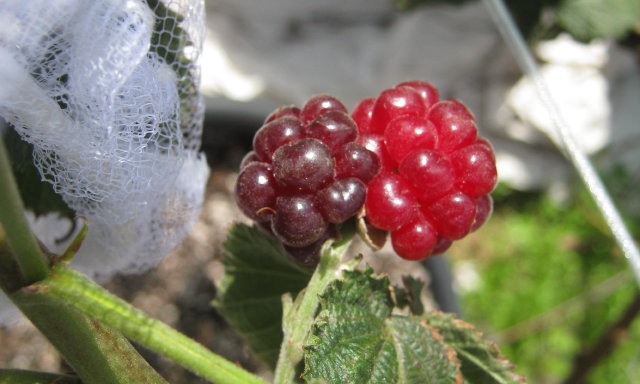
The fruit from my 6x Blackberry/Raspberry Hybrid crossed with Raspberry, is nearly ripe. I only ended up with 2 fruit from about 6 crosses. This may be due to cold weather or lack of enough raspberry pollen.
“It has been repeatedly stated in public prints that I entertained the idea when I planted those seeds of a cross between the raspberry and blackberry. I am sorry to disturb one of the supposed truths of history, but candor compels me to say that such is not the case. I did not even deem such a cross possible, and did not know what I had done until May, 1883, when the plant first fruited.”
-J. H. Logan, Oregon Horticultural Society, undated but possibly early 1920s
So given that Logan not only unintentionally crossed R.ursinus ‘Aughinbaugh’ x R. ideaus ‘Red Antwerp’ and very much lucked out with unreduced pollen grains which allowed the cross to even be fertile in the first place, how did Burbank pull off Phenomenal (Aughinbaugh x Cuthbert)? Sheer brute force of just growing 1000s of plants until he also lucked out? The serendipity factor of Logan seems off the charts but given that Burbank was able to replicate it with Phenomenal makes me more curious. I wonder how much things like Rubus Breeding - #338 by BerryAllen were involved…
I think Burbank did grow out hundreds, if not thousands of seedlings from crosses he did. You only need one unreduced pollen grain to form a fertile hybrid. Sudden heat, sudden cold, radiation, can all interupt meosis. I prefer to use colchicine, so I know I have a much better chance of getting fertile hybrids. I only needed to grow out 6 seedlings to get a fertile hybrid, not 600!.
Oh man, I only just learned that there’s another species of black raspberry in Mexico, Rubus eriocarpus. At first glance I thought it was a dewberry species given the fruit, but it’s grouped with the black raspberries and the stems and foliage definitely match even if the fruit looks quite different. Flowers also match.
It grows in far southern Mexico through Coasta Rica in wet highland forests. I see a few observations of it in Oaxaca and Chiapas.
I probably don’t need to be going off on any surreptitious romps in the isolated mountains of Oaxaca and Sinaloa.
It’s the first I’ve heard of it, haven’t found much information. That climate though it something else, basically a mash up of high altitude southern California and the gulf coast of Alabama. From what I can tell, the summers there are in the 80s mostly and very rainy, while winters are cool with occasional light frosts and quite dry, at least for the Mexican population. Presumably, this species has decent winter dormancy, tolerance of warm (though maybe not hot) temperatures, and surely pretty good fungal resistance judging by all the bromeliads, ferns, and clubmosses that grow in the same habitats. The ones in Costa Rica are higher and even wetter, though there it kinda looks like it prefers exposed ridgelines and peaks.
Something that can handle that climate would be very interesting to work with.
Between this one, the Rubus pringlei populations in Sinaloa, Rubus glaucifolius, and the Rubus leucodermins and strigosus populations in southern California and Arizona, there’s plenty of genetics to play around with if one could theoretically get collections. For my part, I’m working on getting a tip rooting from a population of Rubus occidentalis growing in the lower NC piedmont, which is pretty much the furthest southeast the species reaches.
The big advantage of these is that they’re all very closely related to red raspberry and so are not nearly as difficult to breed with. In contrast, Rubus niveus is great in its preference for humid subtropical climates, but it’s so distant from Rubus ideaus that it’s quite challenging to make successful crosses.
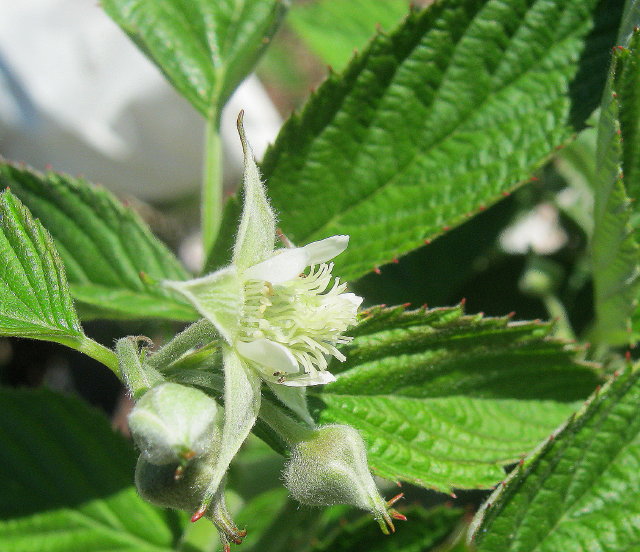
The seeds from a male sterile primocane Mysore hybrid x Purple are germinating. I am chromosome doubling half of them, to try and get self fertile plants but this may not be required, now that one plant has anthers. I will keep a close eye out for other flowers with anthers.
I looked at some anthers under a microscope and saw mostly aborted grains. I did see one, what could be fertile grain but this is disapointing. I will wait and see if any fruit set. There are no other raspberries flowering yet, so if fruit sets, it must be from self polination.Still, it is a start in the right direction.
Oh wow, I didn’t realize it was that straightforward to do. Hopefully open pollination (once there are other flowers) will do the trick. It sounds like this is the earliest flowering Rubus plant you have? Is that because of the Mysore background?
Hi, Yes it is pretty straight forward. Mysore hybrids flower very early in Spring, pure R.idaeus flower later but they are about 2 weeks away, so there should be plenty of overlap.
The problem is that if I do not get a fully self fertile hybrid, then I will have to cross pollinate for ever and that does not make for a good cultivar. Maybe chromosome doubling will work, nobody has tried that.
On the other hand, is that really the end of the world though? It’d just mean in order to grow it and set fruit you’d need at least one other compatible variety. Consider a situation like rabbiteye blueberries which almost all require cross-pollination and nobody minds much.
It will usually mean a lot of poorly pollinated, crumbly fruit, which is not ideal. I do not know of any raspberry cultivar that is male sterile and needs a pollinator to set fruit.