This would be fun to test on the home breeding scale as well. See how it compares with grafting the seedlings onto dwarfing rootstock. Would I be correct to assume that Michurin probably didn’t have dwarf rootstocks as an option at the time he was doing his breeding work?
1 Like
I have been working on dragon fruit breeding for a while.
Most cactus exhibit strong two stage growth. And they may stay in juvenile stage forever
As for dragon fruit . I found that the transaction is determined by both size of plant and amount of sunlight recive.
Juvenile has thin needle like spine and creeping hanging habit.
Mature has cone like typical soine of dragonfruit.and more erected habit.
If the stem is more then 20cm long then it is possible for transaction.
Then full sun will trigger the mature.
The next sprout will be in mature stage.
This is my hybrids we can see that the lower half is really large but it didn’t receive enough sunlight and are still in juvenile stage.
After i move it out of greenhouse and giving it full tropical sunlight it transition to mature stage in December.
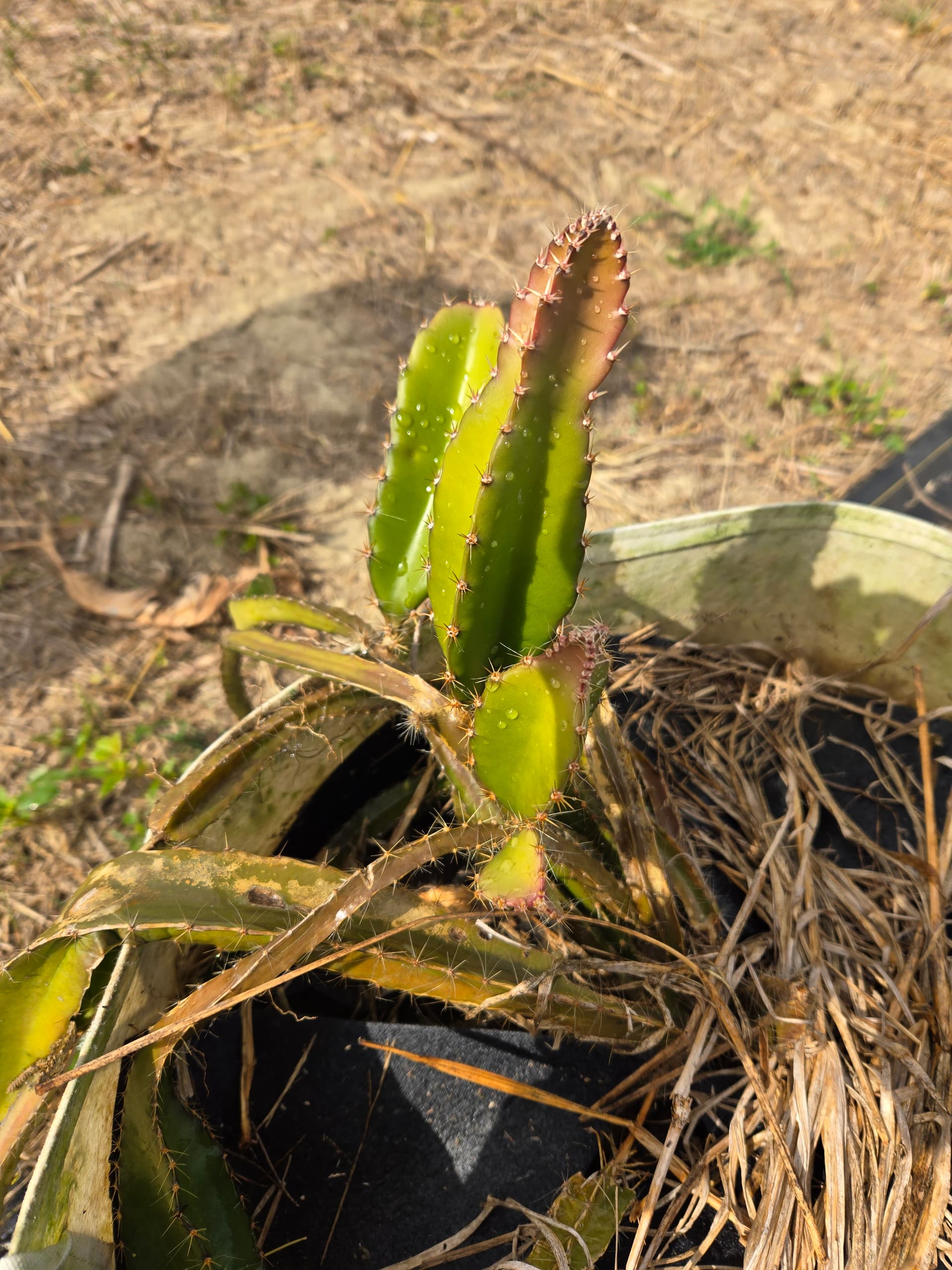
And yes grafting speed up mature. Grafted seedling can mature in several month.and flower in next suitable time.
4 Likes
Side trivia, grafting of seedlings onto large mature trees is commonly used in pecan to speed flowering of seedlings. Pecan typically takes up to 20 years to bear the first nuts with an average range from @7 years to @20 years. What is interesting about this is that pecan grafts are set 30 feet or more up in the top of mature trees. I wonder if there is a connection between the height of the graft and the tendency to shift from juvenile to reproductive growth phase?
4 Likes
Clonal dwarf rootstocks have been in use since at least the Middle Ages, and probably much earlier. Michurin conducted extensive breeding work with dwarf rootstocks, and his dwarf apple rootstocks formed the basis of the Budagovsky (Bud) series.
Michurin did not use dwarf rootstocks in his other breeding work, however. He speculated that the use of clonal dwarfing rootstocks was the reason intentional crosses between two high-quality apple varieties generally produced offspring vastly inferior to the parents.
To test his hypothesis, he cut scions from seedlings at the earliest possible stage and grafted them onto clonal dwarfing rootstocks, while allowing the original seedlings to continue growing on their own roots. He claimed that when these trees began to produce fruit, the apples from each tree differed: the seedlings grafted onto dwarf rootstocks were always inferior to the same seedlings growing on their own roots.
This experiment formed the basis of his idea that seedlings—especially hybrids—possess immense “plasticity” (the ability to change) at the earliest stages of development and can be directed by environmental influences. Michurin reasoned that if seedlings could be negatively influenced by dwarfing rootstocks, they could also be positively influenced. He called this positive influence the “mentor method.”
For many years, these ideas were regarded as complete quackery in the West. More recently, however, research into epigenetics and graft-induced transformation (primarily in the Solanaceae) has shed new light on Michurin’s ideas.
4 Likes
Since you mention Solanaceae, there is documentation on a white fruited tomato grafted to a red fruited rootstock which produced pink fruit. Something was translocated from the rootstock to the fruit of the scion. This is not the part that was odd. Seed were saved from the pink fruit (remember that the genetics would be 100% for white tomatoes!) and grown. The seedlings produced pink tomatoes!!!
4 Likes
That is fascinating! This is a new concept to me, I haven’t’ come across mentor grafting in any of my reading so far. You have given me something new to investigate.
I think I’m most interested in the idea that fruiting can be sped up without using dwarf trees. That’s an exciting prospect worth testing out.
2 Likes
Maybe it’s based on technical factors like shade or possiblity of grafting more seedlings ?
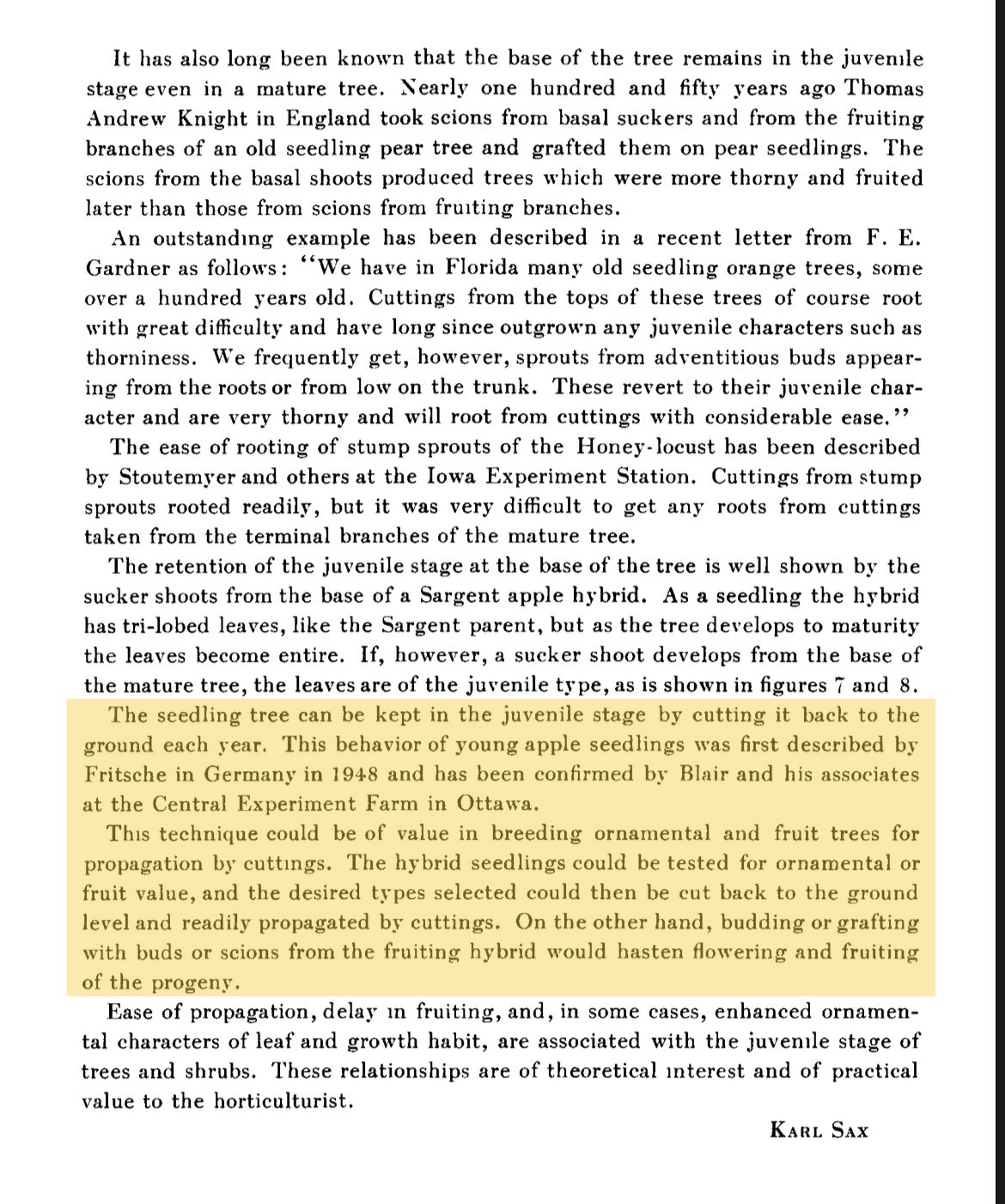
This suggests that you’re right about the height of the graft and the tendency to shift from juvenile to reproductive growth phase. The highlighted part is really interesting as well. I could see it being useful in a number of different situations since it works with hard to root species.
Some apple trees are way more precocious than others.
I bought a Novamac on B9 a few years back. It arrived as a 4.5 ft whip… but in shipping the top 1.5 ft had been broken.
I pruned that broken part off and planted it in a half whiskie barrel planter. It bloomed right off… first season. I pulled those blossoms off before fruit set.
It grew well that season and bloomed and fruited the next season.
It is the only apple tree I have ever had on B9 rootstock… but it sure was eager to bloom and fruit… and has been ever since.
I had a Gold Rush here on M7… that was nearly as eager to bloom and fruit… but FB took it out in year 4.
TNHunter
2 Likes